






Quick Answer
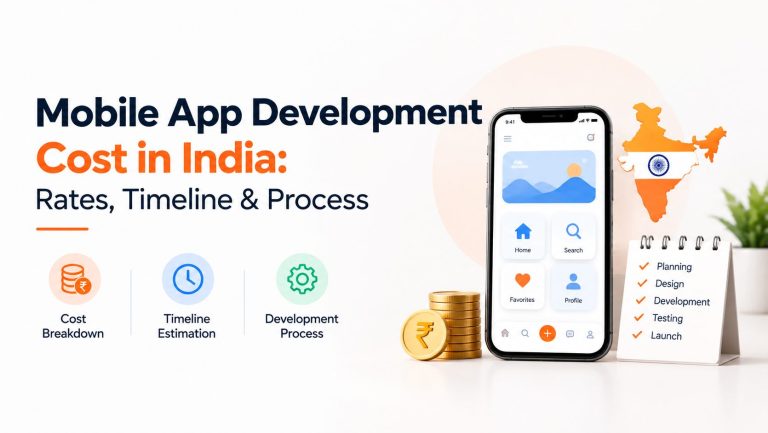
Mobile app development cost in India in 2026 depends mainly on app complexity, feature count, platform choice, technology stack, team composition and third-party integrations. As an illustrative planning range, a basic app typically falls between roughly ₹5 lakh and ₹12 lakh, an MVP between ₹8 lakh and ₹20 lakh, a mid-complexity app between ₹15 lakh and ₹40 lakh, and an enterprise or AI-heavy application ₹50 lakh and above. These are directional estimates, not quotations, and actual pricing depends on the scope defined during discovery.
Introduction
A business can send the same app idea to three development companies and receive three very different quotes. The gap rarely comes from one team padding the price. It usually comes from differences in scope definition, technology choice, team structure, the number of integrations, and whether QA and post-launch support are priced in from the start.
This guide breaks app development cost in India into its actual components so a founder or product owner can read a quote and understand what is driving the number, rather than comparing totals in isolation. It covers cost by app type, by feature, by platform, by team structure, and by development stage, and it ends with a calculation framework you can reuse for your own project.
Mobile App Development Cost in India in 2026
The table below gives an answer-first view of typical planning ranges by project category. Treat these as starting points for a conversation with a development team, not as fixed pricing.
| App Category | Illustrative Cost Range (INR) | Typical Timeline |
| Basic app (single-purpose, limited screens) | ₹5 lakh – ₹12 lakh | 6 – 10 weeks |
| MVP (core flow, one platform first) | ₹8 lakh – ₹20 lakh | 8 – 14 weeks |
| Mid-complexity app (accounts, payments, APIs) | ₹15 lakh – ₹40 lakh | 3 – 6 months |
| Complex app (real-time features, multiple integrations) | ₹35 lakh – ₹80 lakh | 5 – 9 months |
| Enterprise application (custom backend, compliance, scale) | ₹70 lakh and above | 8 months and above |
The final figure in any of these bands moves with the number of features, the platforms targeted, the technology stack, the size and seniority of the team, backend and API complexity, security requirements, third-party integrations, testing depth, and ongoing maintenance. Two apps in the same category can land at opposite ends of the range once these variables are added.
Mobile App Development Cost Breakdown
Every app development budget is made up of the same underlying components. The share each one takes depends on the project, but this is a reasonable planning model for where the budget typically goes.
| Development Component | Approx. Share of Budget | What It Includes |
| Discovery & Planning | 5 – 10% | Requirements gathering, scope definition, technical research |
| UI/UX Design | 10 – 15% | Wireframes, prototypes, visual design, design system |
| Development | 45 – 55% | Frontend, backend, API development, database |
| Testing & QA | 10 – 15% | Functional, security and device testing |
| Deployment | 3 – 5% | App Store and Play Store submission, release setup |
| Maintenance (post-launch, ongoing) | Billed separately | Updates, bug fixes, monitoring, OS compatibility |
These percentages are a planning model, not a fixed formula. Projects with heavier backend work, such as marketplaces or fintech apps, shift more budget into development and testing. Projects built primarily for brand or content purposes shift more budget into design.
App Development Cost by App Type
Different app categories carry structurally different cost drivers, independent of how polished the design is. The comparison below focuses on what actually adds engineering effort in each category.
| App Type | Complexity | Major Cost Drivers |
| Calculator / productivity app | Low | Simple logic, minimal backend, limited screens |
| Content or media app | Low – Medium | CMS integration, offline access, push notifications |
| Marketplace app | High | Two-sided accounts, search, payments, ratings, admin panel |
| E-commerce app | Medium – High | Catalog, cart, payment gateway, inventory sync, order tracking |
| Social media app | High | Real-time feeds, media handling, notifications, moderation |
| Healthcare app | High | Compliance, data security, appointment/EHR integrations |
| Fintech app | High | Security audits, KYC, payment rails, regulatory requirements |
| On-demand app (delivery, ride-hailing style) | High | Real-time tracking, dispatch logic, maps, notifications |
| SaaS application | Medium – High | Multi-tenant architecture, subscription billing, admin tools |
| Enterprise application | High | Custom backend, legacy system integration, access control |
| AI-powered application | High | Model integration, data pipelines, inference infrastructure |
| Blockchain application | High | Smart contracts, wallet integration, security audits |
MVP Development Cost in India
An MVP is the smallest version of a product that lets you test the core assumption with real users. It is not a stripped-down version of the full app; it is a different, narrower product built to validate demand before committing to the full build.
What an MVP should include
- The single core user flow the product depends on
- Basic authentication and user accounts
- Minimum viable data storage and one platform, usually the one your target users prefer
- Simple, functional UI rather than a fully polished design system
What to leave out of an MVP
- Secondary features that do not test the core hypothesis
- Advanced personalization, recommendation engines or analytics dashboards
- Support for every platform and device size from day one
- Heavy admin tooling beyond what the team needs to operate the pilot
A typical MVP in India runs roughly ₹8 lakh to ₹20 lakh and takes 8 to 14 weeks with a small, focused team. MVP scope has the single biggest impact on final cost: every feature added before validation increases both the budget and the time to learn whether the product works. The financial logic of an MVP is to spend the minimum needed to get a real answer, then reinvest based on what users actually do.
iOS vs Android App Development Cost
Neither platform is universally cheaper. The real cost difference comes from device fragmentation, testing scope and store requirements, not from the platform itself.
| Factor | iOS | Android |
| Device fragmentation | Low (limited device range) | Higher (many manufacturers, screen sizes) |
| Testing scope | Narrower device matrix | Broader device and OS-version matrix |
| Store review process | Stricter guidelines, manual review | Faster review, more automated checks |
| Design conventions | Human Interface Guidelines | Material Design |
| Typical relative effort (single platform, same scope) | Baseline | Similar to slightly higher due to device testing |
Building for both platforms separately roughly adds a second development track, though shared backend, APIs and design assets reduce the combined cost compared to building two fully independent apps. Businesses targeting one platform first typically choose it based on where their actual user base is, not on which platform is theoretically cheaper.
Native vs Cross-Platform Development Cost
This is a genuine trade-off decision, not a case where one option is always right.
| Approach | Strengths | Trade-offs |
| Native (Swift for iOS, Kotlin for Android) | Best performance, full access to platform features, smoothest long-term maintenance per platform | Two separate codebases, higher initial cost for multi-platform apps |
| Flutter | Single codebase, strong performance, growing talent pool | Some platform-specific features need custom native modules |
| React Native | Single codebase, large ecosystem, fast iteration | Complex native integrations can require additional native code |
Cross-platform frameworks generally lower initial development cost when the app targets both iOS and Android from the start and does not depend heavily on device-specific hardware features. Native development tends to be the better long-term choice for apps with performance-critical features, deep OS integration, or a single dominant platform in the target market. The right choice depends on the product, the team’s existing skills, and the maintenance model, not a blanket rule.
App Development Cost by Features
Feature complexity is the most direct lever on total cost. The table below groups common features by relative implementation effort.
| Feature | Complexity | Relative Cost Impact |
| Login and registration | Low | Low |
| Social login | Low | Low |
| Push notifications | Low | Low |
| Search | Medium | Medium |
| Payment gateway | Medium | Medium |
| In-app chat | Medium – High | Medium – High |
| Maps and GPS | Medium – High | Medium – High |
| Admin dashboard | Medium | Medium |
| Video streaming | High | High |
| AI or ML features | High | High |
| Blockchain integration | High | High |
| Real-time tracking | High | High |
The actual cost of any feature depends on how it is implemented. A basic search bar and an AI-powered semantic search both fall under “search,” but the engineering effort behind them is not comparable. Feature names on a spec sheet are a starting point for estimation, not the estimate itself.
Developer Hourly Rates in India
Client billing rates in India vary by experience level, technology, engagement model and whether you are hiring an individual freelancer, a dedicated team, or a full-service agency. Billing rates should not be confused with developer salaries, since a billing rate also covers project management, infrastructure, QA support and business overhead.
| Experience Level | Illustrative Hourly Rate (USD) | Typical Fit |
| Junior developer (0 – 2 years) | $15 – $25 | Well-defined tasks under senior supervision |
| Mid-level developer (2 – 5 years) | $25 – $40 | Core feature development, most day-to-day work |
| Senior developer (5+ years) | $40 – $60 | Architecture decisions, complex integrations, code review |
| Specialist (AI/ML, blockchain, security) | $45 – $75 | Domain-specific engineering with limited talent supply |
These are illustrative planning bands, not published rate cards, and they move with project location, technology demand, and the specific engagement model. A dedicated development team model generally sits below equivalent onshore rates while still including project management and QA, which is the main reason offshore development changes total project economics rather than the headline hourly number alone.
App Development Cost by Team Structure
| Team Structure | Relative Cost | Best Fit |
| Freelancer | Lowest | Small, well-defined projects with limited ongoing support needs |
| Small development team | Low – Medium | MVPs and early-stage products with a narrow scope |
| Dedicated development team | Medium | Products needing sustained development and predictable capacity |
| Software development company | Medium – High | Full-cycle projects needing design, QA, PM and long-term support |
| In-house team | Highest (fixed overhead) | Long-term products where the app is the core business asset |
Cost is only one axis of this decision. Freelancers offer flexibility but carry higher continuity risk. In-house teams offer control but come with fixed overhead regardless of workload. Dedicated teams and development companies sit in between, trading some cost efficiency for structured project management, QA processes and easier scaling. The right structure depends on how long the product needs active development and how much internal technical oversight the business already has.
App Development Timeline in India
A typical project moves through discovery, requirements, UI/UX, architecture, development, API integration, QA, security testing, deployment and post-launch maintenance. The table below maps typical duration by project complexity.
| Complexity | Typical Timeline | Team Size (typical) |
| Basic app | 6 – 10 weeks | 2 – 3 people |
| MVP | 8 – 14 weeks | 3 – 4 people |
| Mid-complexity app | 3 – 6 months | 4 – 6 people |
| Complex app | 5 – 9 months | 6 – 10 people |
| Enterprise application | 8+ months | 10+ people |
What commonly causes delays
- Scope changes introduced mid-development
- Delays or limitations in third-party APIs
- App Store or Play Store review cycles
- Unclear or shifting requirements at the start
- Backend complexity discovered after development begins
- Late-stage design revisions
What Factors Affect App Development Cost?
- App complexity and number of core workflows
- Number of platforms targeted
- Total feature count
- UI/UX complexity and custom design work
- Backend architecture and scalability requirements
- Number and complexity of API integrations
- Third-party service integrations (payments, maps, analytics)
- Security and compliance requirements
- Number of user roles and permission levels
- Admin dashboard complexity
- Real-time functionality (chat, tracking, live updates)
- AI or ML components
- Blockchain components
- Cloud infrastructure choices
- Testing depth (functional, security, device coverage)
- Ongoing maintenance scope
- Team location and engagement model
- Development model (fixed price, time and material, dedicated team
- Project timeline and any rush requirements
- Regulatory requirements specific to the industry
Blockchain App Development Cost
Blockchain projects generally require more specialized engineering effort than a typical mobile app, which is the main reason they sit at the higher end of cost bands. The added effort usually comes from a combination of the following.
- Smart contract development and testing
- Wallet integration and key management
- Token functionality where applicable
- Blockchain infrastructure setup and node access
- Independent security audits, which are often a separate line item
- Web3 integrations with external protocols
- Additional testing for irreversible on-chain transactions
Security audits in particular are not optional for production blockchain applications, since on-chain errors are often unrecoverable. Budgeting for an audit as a distinct component, rather than folding it into general QA, gives a more realistic picture of total project cost.
Custom Software Development Cost vs Mobile App Development Cost
A mobile app is frequently only the visible layer of a larger system. The mobile frontend, backend services, a web admin panel, APIs, cloud infrastructure, third-party systems, analytics and security together make up the full product ecosystem, and each of these carries its own cost.
Comparing two quotes without first defining the full ecosystem is one of the most common budgeting mistakes. A quote scoped only to the mobile frontend will look cheaper than a quote that includes backend, admin tooling and infrastructure, even if both teams are pricing the visible app fairly. Before comparing vendor quotes, it helps to write down every system component the product actually needs, not just the app a user will see.
Hidden Costs of App Development
These are the costs that most commonly get left out of an initial budget and surface after launch.
- Cloud hosting and server costs
- API usage fees for third-party services
- Payment gateway transaction fees
- App Store and Play Store developer fees
- Independent security audits
- Third-party SaaS subscriptions the app depends on
- Monitoring and error-tracking tools
- Analytics platforms
- Ongoing maintenance and bug fixing
- OS and platform update compatibility work
- Device testing across new hardware
- Compliance costs specific to the industry
- Customer support infrastructure
Budgeting for these from the start, even at a rough estimate, avoids the common pattern of a project that looks affordable at launch but becomes expensive within the first year of operation.
How to Reduce App Development Cost Without Sacrificing Quality
- Start with an MVP focused on one core workflow
- Prioritize features by business impact before development begins
- Reuse existing backend components where they genuinely fit
- Choose technology based on product requirements, not trends
- Write a clear product specification before requesting quotes
- Avoid unnecessary custom features when a proven pattern exists
- Build reusable UI components across screens
- Plan third-party integrations early, not mid-development
- Use automated testing where it reduces manual QA time
- Choose an engagement model that matches project duration
- Work with a team that has direct experience in your app category
None of these should come at the expense of QA, security, or sound architecture. Cutting those to hit a lower number usually costs more later, in the form of rework, security incidents, or a product that cannot scale past its first version.
How to Calculate App Development Cost
A transparent way to estimate cost is to build it from its components rather than ask for a single number.
Cost Formula
App Development Cost = (Development Hours × Hourly Rate) + Design + QA + Infrastructure + Third-Party Services + Maintenance
What each component covers
- Development hours: estimated engineering time across frontend, backend and API work
- Hourly rate: blended rate based on team seniority and engagement model
- Design: UI/UX design and prototyping
- QA: functional, security and device testing
- Infrastructure: cloud hosting, DevOps setup, environments
- Third-party services: payment gateways, maps, analytics, messaging
- Maintenance: ongoing updates, monitoring and bug fixing after launch
Illustrative example 1: MVP
A single-platform MVP with core account features and one payment integration, estimated at 500 to 700 development hours at a blended rate of $30 per hour, lands in a rough range of $15,000 to $21,000 before design, QA and infrastructure are added. This is a hypothetical illustration to show how the formula works, not a quotation for any specific project.
Illustrative example 2: Mid-complexity marketplace app
A two-sided marketplace app with search, payments, ratings and an admin panel, estimated at 1,800 to 2,500 development hours at a blended rate of $35 per hour, lands in a rough range of $63,000 to $87,500 before design, QA and infrastructure. Again, this is illustrative math to demonstrate the framework, and actual figures depend entirely on the finalized scope.
App Development Cost Calculator: A Conceptual Framework
A simple, reusable way to size a project before requesting quotes is to work through the following inputs in order.
- Select the app type: basic app, MVP, mid-complexity app, complex app or enterprise application
- Select platforms: Android, iOS, both, or cross-platform
- List features and classify each as basic, intermediate or advanced
- Estimate backend complexity: simple CRUD, moderate business logic, or complex distributed systems
- Estimate UI/UX requirements: template-based, custom design, or a full design system
- Estimate testing and security requirements based on data sensitivity
- Estimate ongoing maintenance scope for the first year
Working through these seven inputs before contacting a development team produces a far more accurate conversation than starting with “how much would an app like this cost,” because it gives the team a defined scope to price against instead of a broad category.
How to Choose an App Development Company in India
- Relevant portfolio in your app category, not just general mobile experience
- Technical expertise across the specific stack your project needs
- Case studies with enough detail to verify real involvement
- A documented development process, not just a sales pitch
- Clear, responsive communication during the evaluation stage itself
- Defined security practices, especially for apps handling sensitive data
- A structured QA process, not testing treated as an afterthought
- Named project management, with a clear point of contact
- Transparent pricing, with cost components broken down
- Defined post-launch support and maintenance terms
- A clear NDA and confidentiality agreement before scope is shared
- Awareness of compliance requirements relevant to your industry
- Realistic team availability for your timeline
- A contract structure that matches your engagement model
Why Businesses Hire Indian App Developers
India has a large, technically trained developer talent pool across mobile, backend and emerging technologies, along with mature outsourcing infrastructure built over two decades of serving global clients. Time zone overlap with both US and European business hours makes daily collaboration workable for most engagement models, and remote-first development processes are well established across the industry.
Cost is part of the picture, but it is not the whole story. India is not simply the lowest-cost option available globally; the total value of a project depends on the team’s technical capability, communication quality, delivery discipline and post-launch support, not on hourly rate in isolation. A lower rate from a team that misses deadlines or under-delivers on quality is not actually the cheaper option once rework and delays are accounted for.
Working With a Development Partner: HireDeveloper.dev
Once a business has a working cost model and a defined scope, the next step is finding a team that fits the engagement. HireDeveloper.dev connects US and UK businesses with dedicated developers and remote development teams in India, working across custom software development, web and mobile app development, AI development and IT staff augmentation.
For a project scoped as described in this guide, that typically means assembling a dedicated team around the specific stack and complexity involved, whether that is a small MVP team, a mid-size team for a mid-complexity build, or a larger dedicated group for an enterprise application. The engagement model, whether staff augmentation, a dedicated team, or a fixed-scope project, follows from the scope and timeline defined earlier in the budgeting process, not the other way around.
Key Takeaways
- App development cost in India in 2026 ranges roughly from ₹5 lakh for a basic app to ₹70 lakh and above for an enterprise application, driven mainly by feature complexity, not app category alone
- MVP scope has the single biggest impact on early-stage cost; validating with the smallest workable product protects the rest of the budget
- Neither iOS nor Android is universally cheaper; the real cost driver is device testing scope and feature complexity
- A complete quote should include design, development, QA, deployment and clearly defined maintenance terms
- Hidden costs like hosting, third-party fees and security audits should be budgeted from the start, not discovered after launch
- Defining the full product ecosystem, not just the visible app, is necessary before comparing vendor quotes
Next Step
If you already have an app idea, a product specification, or an existing application that needs further development, the next useful step is to estimate the scope rather than guess the budget. A development team can help break the project into features, technology choices, milestones and an estimated delivery plan before any commitment is made.
HireDeveloper.dev works with businesses to assemble dedicated developers and remote development teams in India for mobile app development, custom software projects, AI development and staff augmentation, scoped around the project details covered in this guide.
Sources and References
https://zethic.com/mobile-app-development-cost/, https://asthatechnologies.org/mobile-app-development-cost-in-india/, https://zethic.com/mobile-app-development-cost/, https://psdigitise.com/blogs/mobile-app-development-cost-india, https://omnisttechhub.com/blog/mobile-app-development-cost-bangalore-india/, https://appinventiv.com/guide/mobile-app-development-cost/