
Introduction
You have a roadmap, a launch date, and a hiring problem. That roadmap needs a JavaScript developer who can build features that scale, stay readable six months from now, and keep customer data safe. The market offers thousands of résumés, wildly different quotes, and at least five ways to engage someone. How do you choose?
JavaScript is a sensible language to hire for. It runs in every browser, powers server code through Node.js, and was the most-used language in the 2025 Stack Overflow Developer Survey, reported by roughly two-thirds of respondents. That popularity is also the trap: plenty of people can write JavaScript, and far fewer can build and maintain a production system with it.
This guide shows how to hire a JavaScript developer in 2026: the skills that matter, the profiles to choose from, a step-by-step process, hiring models, realistic cost thinking, interview questions, and the mistakes that quietly inflate budgets.
Why Businesses Hire JavaScript Developers in 2026
Businesses hire JavaScript expertise because one language can cover most of a modern web product. The common reasons:
- Interactive web applications: dashboards, portals, and tools that respond instantly.
- Frontend development: the interface customers actually see and judge you by.
- Backend development with Node.js: APIs and services written in the same language as the frontend.
- Full-stack JavaScript: one engineer, or one small team, owning a feature end to end.
- SaaS and enterprise platforms: complex products with many users and integrations.
- Real-time features and APIs: chat, live updates, and event-driven workloads.
- Progressive web applications: app-like experiences from a single web codebase.
- Modernization and maintenance: upgrading aging code, such as older jQuery apps or legacy libraries like Moment.js that the maintainers now describe as a legacy project.
The business payoff is practical. A shared language reduces handoffs between frontend and backend, which can speed up product work, and a strong developer improves user experience, scalability, and how easily the product can keep improving after launch.
What Does a JavaScript Developer Do?
A JavaScript developer designs, builds, and maintains software written in JavaScript, usually for the web. Day to day, that means:
- Writing clean, maintainable code and building interactive interfaces.
- Creating backend services with Node.js and integrating REST or GraphQL APIs.
- Managing application state, debugging, and writing tests.
- Improving performance and security.
- Working with designers, product managers, and other engineers, and maintaining or upgrading existing applications.
Responsibilities shift by specialty. Frontend developers own what runs in the browser. Backend developers own servers, data, and APIs. Full-stack developers work on both. Also keep one boundary clear: an individual developer is not a whole team, so product management, design, QA, and DevOps may need their own people.
FOUR QUICK CLARIFICATIONS
JavaScript is not Java; they are unrelated languages. React is a library, and Angular and Vue.js are frameworks, each with a different architecture. Node.js is a runtime that lets JavaScript run outside the browser, not a framework. TypeScript is a typed superset of JavaScript that compiles to plain JavaScript.
Essential Skills to Look for When Hiring a JavaScript Developer
Do not expect every candidate to know every tool. The right skill set depends on your architecture, your stack, and your project scope.
Core JavaScript Skills
Strong fundamentals matter more than any single framework. Look for confident use of modern ES6+ features, scope and closures, promises and async/await, modules, error handling, objects, arrays, and data structures, plus DOM manipulation, browser APIs, and event handling. Good developers also understand memory and performance basics. Many teams now write TypeScript as well, so ask whether the candidate has used it on real projects, especially if your codebase already does. The MDN JavaScript documentation is a solid reference for what “good” looks like.
Frontend Development Skills
Expect solid HTML5 and CSS3, responsive design, and experience with React, Angular, or Vue.js. Beyond that, check component-based architecture, state management, browser compatibility, performance optimization, and accessibility basics. If your product is React-based, you can look at React.js developers as a specialized profile.
Backend JavaScript Skills
Backend work needs Node.js, a framework such as Express.js, API design (REST and GraphQL), authentication and authorization, database integration, logging, and error handling. Server-side performance matters too. For service-heavy products, dedicated Node.js developers are a common fit. See the Node.js documentation for the runtime.
Testing, Security, and Development Tools
Look for experience with testing tools such as Jest or Vitest and end-to-end tools such as Playwright or Cypress. Add Git with GitHub or GitLab, a package manager (npm, pnpm, or Yarn), CI/CD basics, careful dependency management, and awareness of OWASP security risks.
Communication and Problem-Solving Skills
Technical skill without communication creates expensive surprises. Look for clear explanations, analytical thinking, willingness to review and receive code reviews, ownership of outcomes, and the ability to turn business requirements into technical decisions.
Types of JavaScript Developers You Can Hire
Searches like “javascript developer for hire” cover very different profiles. Pick the one that matches your actual work:
| Developer type | Main responsibilities | Best for |
| Frontend developer | Interfaces and browser-side functionality | Web interfaces and user experience |
| Backend developer | APIs, server-side logic, integrations | Backend systems and application services |
| Full-stack developer | Frontend and backend development | End-to-end product development |
| Framework specialist | Framework-specific development (React, Angular, Vue.js, Node.js) | Existing or specialized technology stacks |
| Senior JavaScript engineer | Architecture, mentoring, hard technical problems | Complex builds and leading others |
| JavaScript consultant | Architecture and technical guidance | Technical audits and complex decisions |
To choose, start from the work. A new product with a small team often suits a full-stack developer. A mature React front end with a stable API suits a framework specialist. An inherited codebase nobody trusts may call for a JavaScript consultant to audit it first, before you commit to a build team.
How to Hire a JavaScript Developer: Step-by-Step Process
If you are wondering how to hire a JavaScript developer without wasting weeks, follow these eight steps. Stages three to five do most of the filtering. 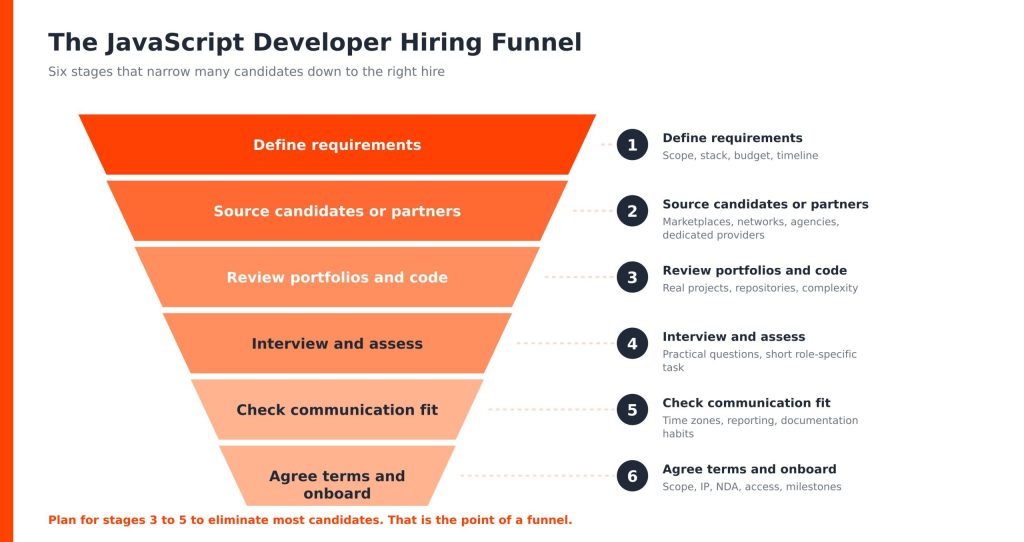
- Define Your Project Requirements
Write down the goals, scope and deliverables, frontend and backend needs, required frameworks, integrations and APIs, timeline, budget, and expected experience level. A one-page brief saves hours of mismatched conversations.
- Choose the Right Developer Profile
Match the brief to a profile from the table above: frontend, backend, full-stack, framework specialist, or consultant.
- Decide Where and How to Find Developers
To find a JavaScript developer, you can use developer marketplaces, professional networks, freelance platforms, recruitment agencies, JavaScript development companies, dedicated development providers, or offshore and remote teams. Each trades off speed, control, and screening effort differently, so choose based on the model you want (covered below).
- Review Portfolios and Previous Projects
Look for relevant applications, public repositories where available, code quality, project complexity, performance and scalability, and real business outcomes. Ask what the candidate personally built, not just what the team shipped. Red flags include portfolios with no live or reviewable work, vague answers about their own contribution, and projects that look impressive but show no tests, documentation, or maintenance history.
- Conduct Technical Interviews
Test practical knowledge, not trivia. Ask candidates to walk through a real bug or design decision they handled.
- Run a Practical Coding Assessment
Use a short, realistic, role-specific task. Keep it brief, and pay for anything that takes more than an hour or two. Long unpaid assignments push good candidates away.
- Verify Communication and Collaboration
Confirm availability, time-zone overlap, documentation habits, and how progress is reported. A brilliant developer who goes silent for days is a risk. For remote JavaScript developers, also agree on overlap hours, the tools for daily communication, how code reviews happen, and how access to repositories and environments is granted and revoked.
- Finalize the Agreement and Onboarding
Put scope, milestones, payment terms, intellectual property ownership, confidentiality or NDA, access controls, and code documentation requirements in writing. Then onboard properly: repository access, coding standards, and a first small task.
JavaScript Developer Hiring Models: Which One Should You Choose?
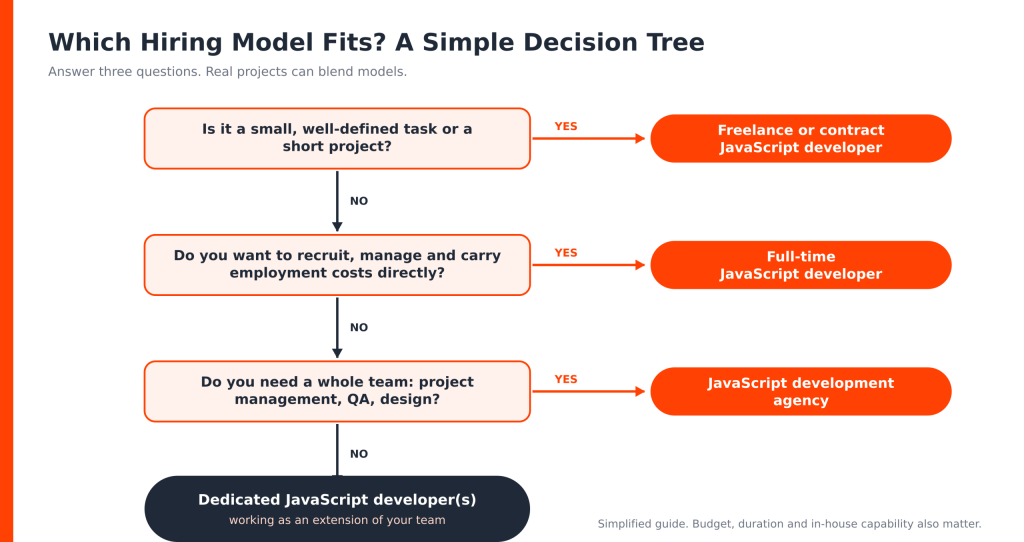
The right model depends on scope, duration, budget, and the capabilities you already have in-house. No model is best for everyone.
Freelance JavaScript Developer
Flexible and quick to start, and good for defined tasks. The trade-offs are variable availability and limited continuity.
Full-Time JavaScript Developer
The strongest control and product ownership over the long term, with the full cost and effort of recruiting, benefits, and management.
Contract JavaScript Developer
Suited to fixed-duration or temporary needs. It works well when you want to hire a JavaScript contractor for a peak workload without a permanent commitment.
Dedicated JavaScript Developer
When you hire dedicated JavaScript developers, they work as an extension of your team on an ongoing basis, usually on a monthly engagement. It is a middle path between freelancing and employment, and it can scale into a dedicated JavaScript team. See dedicated JavaScript developers for how this model works.
JavaScript Development Agency or Outsourcing Company
A JavaScript development agency or software development company brings project management, a wider team, and delivery processes. Outsourcing JavaScript work this way suits end-to-end builds, with shared control between you and the provider.
| Model | Cost structure | Control | Flexibility | Best for |
| Freelancer | Hourly or per project | Varies | High | Small or defined tasks |
| Full-time | Salary and employment costs | High | Lower | Long-term internal development |
| Contractor | Hourly, monthly or contract | High | High | Temporary requirements |
| Dedicated developer | Monthly engagement | High | High | Ongoing product development |
| Agency | Project or team-based | Shared | Medium to high | End-to-end development |
If you are unsure, start with a small paid pilot: a defined feature, a few weeks, clear acceptance criteria. It tests technical quality and communication with limited commitment. Hypothetical examples. A startup building an MVP might hire one full-stack developer or a small dedicated team. A SaaS company with a React front end and Node.js API might add dedicated developers to extend its own team. An enterprise modernizing an old jQuery application might start with a consultant for an audit, then bring in an agency to execute.
How Much Does It Cost to Hire a JavaScript Developer in 2026?
The honest answer is that it depends, and any single number without context should make you cautious. Rates vary with:
- Experience and seniority, and specialization (frontend, backend, or full-stack).
- Framework expertise and project complexity.
- Geographic location, communication needs, and time-zone overlap.
- Engagement duration, and whether you choose freelance, dedicated, or agency delivery.
We did not find reliable, comparable 2026 contract rates by seniority and country, so we are not printing invented ones. Here is what can be verified from official sources instead. Note that these are employee pay benchmarks for software developers generally, not JavaScript-specific contract rates. If you search for JavaScript developer pay, remember that published figures describe what employees earn, so use them as a sanity check, not as a quote.
| Location | Verified benchmark | What it measures |
| USA | Median annual wage of $133,080 for software developers, and $90,930 for web developers (May 2024). Source: BLS | Employee wages, all software developers, annual, USD |
| UK | Median full-time pay for programmers and software development professionals (SOC 2134) is in the mid-£50,000s. Source: ONS ASHE | Employee pay, annual, GBP. Published figures differ by release, so check the latest ONS table |
| India | No reliable official benchmark found for comparable contractor rates | Request itemized quotes from providers and compare like for like |
Salary vs Total Cost of Hiring
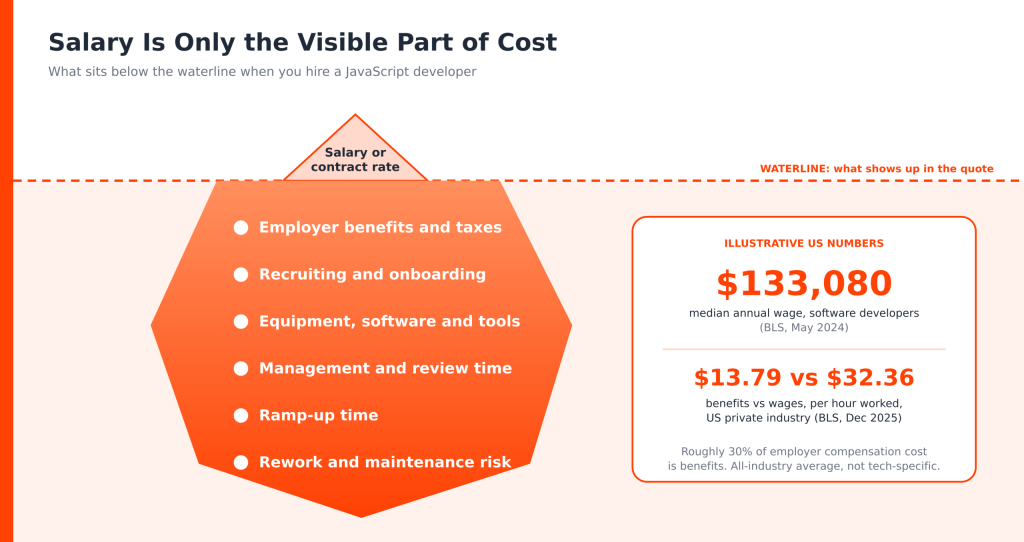
A salary is not the full cost. Add employer benefits and taxes, recruiting, equipment and software, management time, ramp-up, and the cost of rework. BLS data on employer costs show that in US private industry, benefits averaged $13.79 per hour against $32.36 for wages and salaries in December 2025, roughly 30% of total compensation (BLS ECEC).
An illustrative calculation: applying that average to a $133,080 salary suggests an employer cost near $190,000 a year before recruiting, tools, and management time. That ratio is an all-industry average, so treat it as a rough guide, not a quote.
For contractors and dedicated developers, use a simpler framework: monthly rate, plus your management time, plus onboarding, plus a realistic allowance for rework. Compare the same scope across providers.
When you compare quotes, ask what is included: who manages the work, how replacements are handled, how much time overlaps with your team, who owns the code, what the notice period is, and whether testing, documentation, and DevOps support are part of the price. Two quotes that look different are often quoting different things
WATCH OUT
A lower hourly rate does not automatically mean a lower project cost. Code quality, communication, rework, delivery speed, and long-term maintenance often outweigh a small rate difference.
Technical Interview Questions to Ask a JavaScript Developer
Good questions reveal how someone thinks, not just what they memorized. Try these:
- What is the difference between var, let, and const?
- How do closures work, and where have you used one?
- What is the difference between promises and async/await?
- How does the event loop work?
- What is the difference between == and ===?
- How do you manage state in a frontend application?
- How do you handle API errors and asynchronous operations?
- How do you improve JavaScript application performance?
- How do you secure a JavaScript application?
- How do you structure and test a scalable application?
What a strong answer shows. For the event loop, a strong candidate explains how asynchronous callbacks are queued and why long synchronous work blocks the interface. For performance, they mention measuring first, then reducing unnecessary work, bundle size, and re-renders. For var, let, and const, they explain scoping and why const is the default choice. For closures, they give a real use, such as keeping private state or building a function factory. For promises and async/await, they know async/await is syntax built on promises and can describe how errors are caught. For security, they name concrete risks such as injection and cross-site scripting, input validation, safe authentication, and dependency updates.
| Evaluation area | What to look for |
| JavaScript fundamentals | Strong understanding of core language concepts |
| Framework knowledge | Practical project experience |
| Problem-solving | Logical, maintainable solutions |
| Testing | Appropriate testing practices |
| Security | Awareness of common application risks |
| Communication | Ability to explain technical decisions |
Best Practices for Hiring the Right JavaScript Developer
- Define measurable outcomes, such as “checkout loads under two seconds,” not just “build the app.”
- Match experience to complexity: do not hire a junior for an architecture problem.
- Evaluate real project experience and check code quality.
- Test practical problem-solving with a short, fair task.
- Assess security and performance knowledge.
- Verify communication and collaboration early.
- Clarify ownership and contract terms before work starts.
- Plan onboarding so the first week is productive.
- Judge long-term fit, not only the initial price.
Pre-Decision Checklist
- □ The requirements brief is written and agreed.
- □ The developer profile matches the work.
- □ Portfolio and code samples were reviewed.
- □ A practical assessment was completed.
- □ Communication and time-zone overlap are confirmed.
- □ IP ownership, NDA, and access rules are in writing.
- □ The total cost, not just the rate, was compared.
- □ An onboarding plan exists.
Common Mistakes to Avoid When Hiring JavaScript Developers
- Choosing only on the lowest rate: cheap code that needs rewriting costs more.
- Ignoring fundamentals: someone who only knows a framework struggles when it changes.
- Confusing framework experience with JavaScript expertise: the two overlap but are not the same.
- Skipping a coding assessment: you learn about skill gaps after the contract starts.
- Not checking previous projects: claims go unverified.
- Hiring without defined scope: this invites budget creep and disputes.
- Ignoring communication and time zones: delays and misunderstandings multiply.
- Overlooking security and testing: vulnerabilities and regressions arrive later, at higher cost.
- Leaving deliverables and ownership vague: maintenance and legal problems follow.
Why Hire Dedicated JavaScript Developers from a Development Partner?
A development partner makes sense when you need capacity faster than you can recruit, or when you want flexibility to scale a team up and down. Typical advantages include access to screened talent, flexible team scaling, dedicated support, quicker onboarding, a lighter recruitment workload, ongoing collaboration, and complementary technical expertise.
HireDeveloper.dev (Talent Wing of Rightbyte Technologies Pvt Ltd) is one option for businesses that want dedicated and remote development resources, including JavaScript developers. It is intended for companies looking for development capacity, not for job seekers. Whichever provider you consider, evaluate its technical screening, communication, transparency, project fit, and delivery process, and ask for specifics instead of assuming them.
□ How are developers screened, and can you see evidence of that screening?
□ Can you meet the people who will work on your project before you commit?
□ What happens if a developer is not the right fit?
□ How is progress reported, and how often?
□ Who owns the code, and how is your data and access protected?
□ What is the notice period and exit process?
Conclusion
The best way to hire a JavaScript developer is to start with your requirements, not a résumé pile. Match the profile and hiring model to the work, evaluate real skills and communication, and compare total cost instead of the lowest rate. The right developer supports product quality, maintainability, and long-term growth.
Looking for dedicated or remote JavaScript developers?
If your business is planning a build or needs extra capacity, explore dedicated developers with HireDeveloper.dev and discuss your JavaScript requirements with the team.