






How to Hire Web Developers in India: Skills, Cost & Hiring Process 2026


A comprehensive toolkit for documenting and communicating legacy risk to leadership.

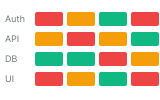
Clear red, amber, green visibility across all systems for board-level reporting.

What auditors and regulators actually expect to see documented.

30, 60, 90-day risk reduction plan without requiring downtime.
Sample Output
Legacy risk is no longer a maintenance concern. It is an operational, security, and governance issue.
End-of-life frameworks and runtimes
Security vulnerabilities with unclear ownership
Inability to produce audit evidence
Inability to produce audit evidence
"Most legacy systems do not need an emergency rewrite. They need clarity."
This assessment documents exposure, constraints, and control gaps so leadership can decide timing and sequencing safely.
Each system is evaluated across five dimensions: Security posture, Operational resilience, Release and rollback safety, Dependency concentration, and Compliance readiness.
0–15
Risk is documented, monitored, and actively managed. Evidence is available. No urgent action required.
16–30
Gaps exist in documentation, controls, or evidence. Remediation should be prioritized within 90 days.
31–40
Material exposure exists. Immediate board visibility and executive sponsorship required.
What auditors and regulators expect to see documented.
If evidence cannot be produced, the risk is treated as present.
A phased approach to reducing exposure without disruption.
Day 0
Undocumented exposure, unclear ownership, hidden risk
First 30 Days
Risk visibility, dependency mapping, evidence gaps identified
Next 60 Days
High-risk items addressed, rollback and release controls added
By 90 Days
Reduced exposure, documented posture, modernization options clarified
This framework is often used to:
Decide modernization vs stabilization
Choose refactor over rewrite
Prioritize zero-downtime controls
Validate whether outsourcing is safe
We respect your inbox. No sales pressure.
Execution Evidence
Review documented case studies where risk assessment frameworks informed modernization decisions with phased execution and measurable outcomes.