






Introduction
Choosing a CRM in 2026 is less about feature checklists and more about fit. Both platforms handle leads, pipelines, service cases and automation well. What separates them is the ecosystem around the product, how much you plan to customize it, and what the whole project costs. This Microsoft Dynamics 365 vs Salesforce comparison focuses on those factors.
Microsoft Dynamics 365 is often the stronger fit for organizations already running Microsoft 365, Teams, Power BI and Azure. Salesforce is often the stronger fit for businesses that value its CRM-first ecosystem, AppExchange marketplace and specialist talent. Neither wins universally. The better CRM depends on your technology stack, processes, customization needs, implementation capacity and total cost.
Microsoft Dynamics 365 vs Salesforce: Quick Comparison
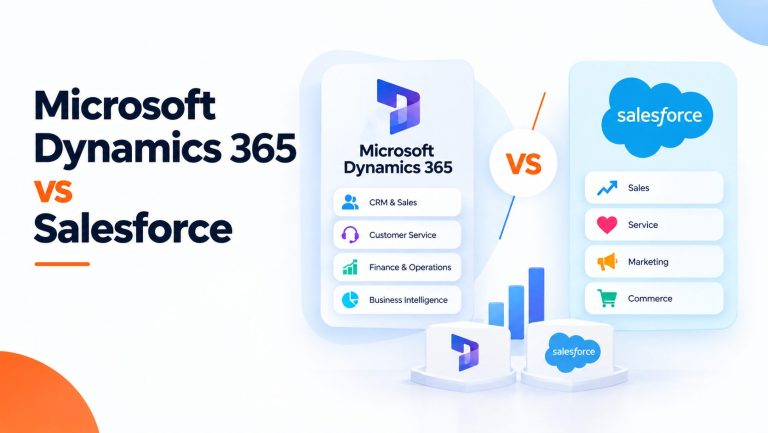
| Factor | Microsoft Dynamics 365 | Salesforce |
| CRM ecosystem | Microsoft stack: Microsoft 365, Teams, Power Platform, Azure | CRM-first: Salesforce Platform and AppExchange |
| Sales | Dynamics 365 Sales, usable from Outlook and Teams | Sales Cloud, highly configurable pipeline and forecasting |
| Customer service | Dynamics 365 Customer Service | Service Cloud |
| Field service | Dynamics 365 Field Service | Salesforce Field Service |
| Customization | Power Apps, Power Automate, Dataverse, .NET extensions | Flow, Apex, Lightning Web Components, APIs |
| Integrations | Native fit with Microsoft products | Wide third-party reach through AppExchange and APIs |
| AI capabilities | Copilot and agents across Sales and Service | Agentforce and Salesforce AI |
| Reporting | Power BI plus built-in dashboards | Built-in reports and dashboards, Tableau option |
| Developer ecosystem | .NET, Power Platform and Azure skills | Salesforce-specific skills and partner network |
| Implementation | Depends on in-house Microsoft skills | Depends on Salesforce admin and developer capacity |
| Pricing approach | Per user by app, plus add-ons | Per user by edition and cloud, plus add-ons |
| Best suited for | Microsoft-centric organizations | Salesforce-invested organizations |
What Is Microsoft Dynamics 365?
Microsoft Dynamics 365 is a family of connected business applications, not a single product. The Dynamics 365 CRM side includes Dynamics 365 Sales, Customer Service and Field Service, while ERP modules such as Finance and Supply Chain Management sit alongside. The apps share Microsoft Dataverse and extend through the Power Platform.
One distinction matters: Microsoft 365 is the productivity suite (Outlook, Teams, Word). Dynamics 365 is the business applications line that connects to it. Enterprises usually consider Dynamics 365 for exactly that connection.
What Is Salesforce?
Salesforce is a cloud CRM vendor built around one customer platform. Sales Cloud and Service Cloud cover pipeline and support, Salesforce Field Service covers mobile work, and the Salesforce Platform lets teams build custom apps with Apex and Lightning Web Components. AppExchange is its partner marketplace, and Salesforce Developers hosts the technical documentation.
Microsoft Dynamics 365 vs Salesforce: Detailed Comparison
Sales
Both cover lead, opportunity and account management, pipeline views, automation and forecasting. Dynamics 365 Sales works inside Outlook and Teams, so sellers can stay in the tools they already use. Salesforce Sales Cloud is known for deep configurability and a large catalog of add-ons. For most mid-market teams core capability is comparable, so the deciding factor is where your sellers spend their day.
Customer Service
Both provide case management, omnichannel routing, knowledge and workflow automation. Dynamics 365 Customer Service connects naturally to Teams and Power Automate. Service Cloud benefits from sharing data with Sales Cloud and a mature partner ecosystem. Test each with your real case volumes and channels.
Field Service
Which is better for field service? Neither universally. Both offer work orders, scheduling, dispatch and offline-capable mobile apps. The better choice follows your wider systems.
According to Microsoft Learn, Dynamics 365 Field Service uses a schedule board, optional automated scheduling optimization and a technician mobile app, with work orders generated from cases, agreements or IoT data. Salesforce Field Service offers a dispatcher console, scheduling and optimization, and a mobile app for iOS and Android. Dynamics 365 may suit organizations that also need Microsoft ERP, inventory or Azure-based IoT. Salesforce may suit teams whose service cases already live in Service Cloud.
Customization and Development
Dynamics 365 customization centers on Power Apps, Power Automate, Dataverse and .NET plug-ins, which suits teams with Microsoft skills. Salesforce customization centers on Flow, Apex, Lightning Web Components and APIs, which suits teams with Salesforce developers. Both support extensions and fully custom applications.
In practice, the skills you can hire matter more than the framework. Microsoft Dynamics 365 consulting services often draw on .NET and Power Platform talent, while Salesforce development services and Salesforce CRM development services rely on platform specialists. Teams building custom connectors or portals can also use custom software development services alongside either platform.
Integrations
Dynamics 365 integrates with Microsoft 365, Teams, Outlook, Power BI, Power Platform and Azure. Microsoft also states that Dynamics 365 contacts, accounts, leads, opportunities and cases can be searched in Microsoft 365 Copilot. The business implication is fewer custom bridges and one identity model.
Salesforce integrates through its APIs, platform tools and AppExchange packages, which helps when your stack is mixed or industry-specific. The trade-off is more integration design for Microsoft-heavy environments.
AI in 2026
Microsoft documents Copilot in Dynamics 365 Sales and a Sales agent that works across Microsoft 365 apps. Salesforce positions Agentforce as its platform for AI agents. Both depend on clean data and documented processes, so judge them in a pilot rather than a demo.
Microsoft Dynamics 365 Pricing vs Salesforce Pricing
Is Dynamics 365 cheaper than Salesforce? Not reliably. Both vendors price per user by application or edition, then add capacity, add-ons and premium tiers. Organizations with existing Microsoft agreements may find Dynamics 365 more economical, while a small sales team may find Salesforce entry editions sufficient. Model three years of total cost.
CRM license cost is not total implementation cost. Check current Microsoft Dynamics 365 pricing on the official Dynamics 365 Sales pricing page and Salesforce CRM pricing on the Sales Cloud pricing page, because editions and bundles change.
| Cost layer | What to evaluate |
| Licenses | Edition, user types, number of users, modules |
| Add-ons and capacity | Storage, AI features, premium tiers |
| Implementation and migration | Data cleanup, process design, partner fees |
| Customization and integration | Custom apps, connectors, middleware, testing |
| Training and adoption | Admin skills, onboarding, change management |
| Support and consulting | Managed services, upgrades, ongoing development |
Which CRM Is Better for Your Business in 2026?
Treat these as decision signals, not absolute rules.
Choose Microsoft Dynamics 365 if:
- You rely heavily on Microsoft 365, Teams and Outlook
- You use Azure, Power BI or Power Platform
- You want CRM connected with ERP, service and field operations
- You have .NET or Power Platform talent
Choose Salesforce if:
- You are already invested in the Salesforce platform
- You want AppExchange and its partner marketplace
- You have Salesforce admin and development expertise
- Your CRM strategy is built around Salesforce
Example 1, Microsoft-centric: A 300-person services firm runs Microsoft 365, Teams, Power BI and Azure. Staff live in Outlook and Teams. Dynamics 365 may have an ecosystem advantage because CRM data, identity and reporting connect to tools already in use.
Example 2, Salesforce-centric: A software company has run Sales Cloud for years, with AppExchange packages and certified admins. Migrating would mean rebuilding mature automation, so staying on Salesforce likely carries less disruption.
Decision rule: weigh existing ecosystem first, then business complexity, required modules, integration needs, customization, implementation capacity and total cost.
Microsoft Dynamics 365 vs Salesforce: Which One Should You Choose?
| If your priority is… | Consider |
| Microsoft ecosystem integration | Dynamics 365 |
| Salesforce ecosystem | Salesforce |
| Microsoft Power Platform | Dynamics 365 |
| Salesforce marketplace | Salesforce |
| Field service operations | Compare based on workflow |
| Enterprise customization | Evaluate both |
| Existing Microsoft investment | Dynamics 365 |
| Existing Salesforce investment | Salesforce |
Final Verdict
The better CRM is the one that fits your business context. Dynamics 365 tends to win where Microsoft already anchors daily work. Salesforce tends to win where its ecosystem, marketplace and specialist skills are already part of how the business runs.
Before deciding, pressure-test your technology stack, process complexity, required modules, integration scope, implementation complexity, budget and long-term scalability. Then shortlist both and pilot one real workflow.
Evaluating Dynamics 365 or building the team to support it? Our Microsoft development services and dedicated development teams can help you scope the work, or talk to our team.
Explore Our Other Services
- Hire Dedicated Developers — Core money page
- Hire React Developers — React development hiring
- Hire Node.js Developers — Node.js development hiring
- Hire .NET Developers — .NET development hiring
- Hire Java Developers — Java development hiring
- Hire Python Developers — Python development hiring
- Hire Angular Developers — Angular development hiring
- Hire Laravel Developers — Laravel development hiring
- Hire PHP Developers — PHP development hiring
- Hire Flutter Developers — Flutter development hiring
- Hire iOS Developers — iOS development hiring