






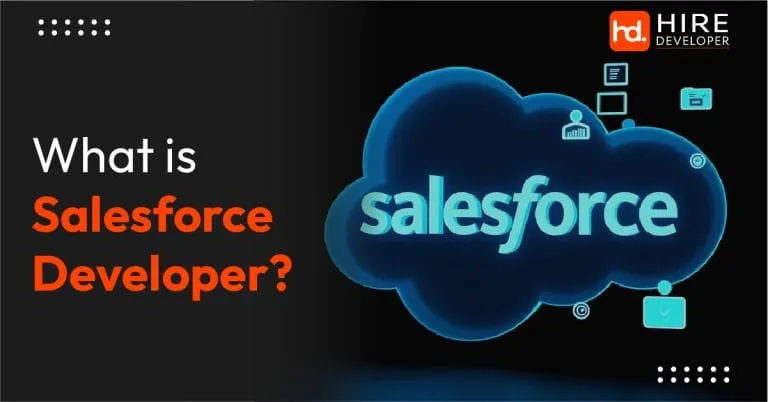
What Is a Salesforce Developer? Skills, Salary, Career Path and 2026 Updates
Most articles that answer this question were written in 2021 and have not been meaningfully updated since. They tell you that a Salesforce developer writes Apex code, earns a good salary, and should get certified. That is all true. It is also incomplete in ways that matter in 2026.
The Salesforce developer role has changed more in the past eighteen months than in the previous five years combined. Agentforce – Salesforce’s autonomous AI agent platform – has added a completely new engineering discipline. The launch of Salesforce Multi-Framework React at TrailblazerDX in April 2026 means developers no longer have to choose between their preferred JavaScript framework and the Salesforce platform. AI coding tools inside the free Developer Edition org now generate production-ready Apex with Claude Sonnet as the default model.
This guide covers what all of that means for the role in practice – for someone evaluating a Salesforce developer career, for a hiring manager assessing candidates, and for a business owner trying to understand what you actually get when you bring a Salesforce developer into your organization.
Who this is for:
People considering a career in Salesforce development. Hiring managers and CTOs vetting Salesforce developer candidates. Business owners trying to understand what a Salesforce developer can and cannot do. Non-technical founders who need to brief one effectively.
What Is a Salesforce Developer - A Precise, 2026-Accurate Definition
A Salesforce developer is a software engineer who builds, customises, and extends the Salesforce CRM platform using its proprietary programming language (Apex), its modern UI framework (Lightning Web Components), its query languages (SOQL and SOSL), and its REST and SOAP APIs for connecting Salesforce to other systems.
The definition sounds simple. The nuance that every beginner misses is this: Salesforce has two fundamentally different ways to build things on it. The declarative layer uses visual tools – Flow Builder, page layouts, validation rules, approval processes – that require no code at all. The programmatic layer uses Apex, LWC, and APIs for everything that configuration cannot achieve.
A Salesforce developer operates primarily in the programmatic layer. But the clearest signal of developer maturity is knowing when NOT to use code. Every requirement that can be solved declaratively should be. Code creates maintenance debt; configuration upgrades automatically with the platform and needs no test coverage. The judgment to know which tool fits which problem is what separates a senior Salesforce developer from a junior one.
The one-sentence definition that works for technical and non-technical readers alike:
A Salesforce developer is the person who makes Salesforce do things that clicking around in the settings cannot achieve.
DEVELOPER vs ADMINISTRATOR — THE FULL COMPARISON
Salesforce Developer vs Administrator - The Honest Comparison
This is the most-searched comparison in the Salesforce ecosystem, and most articles answer it with a two-column table that is out of date the moment it is published. Here is the full 2026 picture, including what each role is now expected to learn as the platform shifts toward AI.
| Dimension | Salesforce Administrator | Salesforce Developer |
|---|---|---|
| Primary tools | Flow Builder, page layouts, reports | Apex, LWC, REST APIs, SFDX |
| Approach | Declarative — no code needed | Programmatic — code when config cannot |
| Output | Workflows, dashboards, user management | Custom apps, integrations, portals |
| Entry certification | Salesforce Administrator | Platform Developer I |
| 2026 new skill | Agentforce Flow actions, Data Cloud | Agentforce @InvocableMethod, Multi-Framework React |
| Can they switch? | Yes, many admins become developers | Yes, many developers later architect |
The practical way to explain it to a non-technical stakeholder: an administrator manages what Salesforce is configured to do today. A developer changes what Salesforce is capable of doing at all.
In small organizations one person does both roles. In enterprises, they are separated, with developers in an engineering or IT function and administrators embedded in operations, sales enablement, or RevOps. Neither role is more important. They are complementary. A Salesforce org that has excellent developers but no skilled administrator is poorly governed. A Salesforce org that has excellent administrators but no developers hits a ceiling the moment the business requirements outgrow standard configuration.
WHAT A SALESFORCE DEVELOPER ACTUALLY BUILDS
What Does a Salesforce Developer Do - The Real Day-to-Day in 2026
The job description on most Salesforce developer postings lists ten responsibilities in bullet points. In practice, the work collapses into four categories. Understanding these four is more useful than memorising a list of tasks.
1.
Business Logic – The Code Layer That Configuration Cannot Reach
This is core Apex development. Triggers that fire when records are created, updated, or deleted. Classes that implement complex multi-step processing across multiple objects in a single atomic transaction. Batch jobs that run nightly across millions of records. Scheduled jobs that automate time-sensitive operations. REST API endpoints that expose Salesforce data to external systems.
The canonical example: a financial services firm needs a lead assignment engine that evaluates 14 criteria – AUM tier, product category, geographic territory, advisor certification, and availability – and routes the lead to the correct advisor team in milliseconds. Standard Salesforce assignment rules can handle three criteria. That gap is exactly where Apex lives.
2.
User Interface – Everything That Standard Page Layouts Cannot Do
Modern Salesforce UI development uses Lightning Web Components, which are built on web standards (Custom Elements, Shadow DOM, ES Modules) and render natively inside Salesforce Lightning Experience. A developer builds LWC components when business requirements demand bespoke interfaces: custom CPQ product configurators, interactive pipeline dashboards with drag-and-drop functionality, multi-step guided selling flows, document generation and in-browser preview tools.For a deep-dive into what is possible, see our complete guide on custom Salesforce application development on the platform.
As of April 2026, Salesforce has launched Multi-Framework React support in open beta. For the first time, developers can build native Salesforce apps using React, with Angular and Vue planned for subsequent releases. This does not replace LWC – both runtimes coexist – but it fundamentally changes the staffing conversation for teams with existing React expertise. See the LWC vs React decision table later in this guide.
3.
Integration – Connecting Salesforce to Everything Else the Business Uses
Salesforce rarely operates as an island. The developer builds and maintains the connections between Salesforce and the rest of the enterprise technology stack. ERP systems (SAP, NetSuite, Epicor), marketing platforms (HubSpot, Marketo, Salesforce Marketing Cloud), payment processors (Stripe, Braintree), data warehouses (Snowflake, BigQuery), and now AI model endpoints.
Integration development covers REST and SOAP API design, Platform Events for event-driven architecture, Change Data Capture for real-time data streaming to downstream systems, Named Credentials for secure credential management, and Connected Apps for OAuth authentication. For organisations using MuleSoft, the developer also needs to understand integration flow design and DataWeave transformation language.For businesses looking for a complete CRM partner rather than an individual hire, see our overview of top Salesforce development services in the USA.
4.
Agentforce Development – The Discipline That Did Not Exist Before 2024
This is the category that makes the 2026 Salesforce developer role genuinely different from what it was two years ago. Agentforce is Salesforce’s AI agent platform. Organisations deploy agents that autonomously handle customer service enquiries, internal HR workflows, sales outreach sequences, and complex multi-step business processes without human sign-off at every step.
Building an Agentforce agent involves defining agent topics in natural language so the AI understands what the agent is responsible for, creating actions that are either existing Flows and Apex methods decorated with @InvocableMethod or new Apex written specifically for agent consumption, writing prompt templates that govern how the agent reasons about inputs and decides what action to take, and designing guardrails that prevent the agent from taking actions outside its approved scope.
This discipline is architecturally different from traditional Apex. Traditional Apex is deterministic – given input A, it always produces output B. An Agentforce agent is probabilistic – it uses a large language model to reason about the input and decide which action to take. The developer’s role shifts from writing the logic to designing the system within which AI-generated logic operates safely. Developers who invest in this skill now are positioning ahead of the market, not catching up to it.
THE THING EVERY SALESFORCE DEVELOPER MUST UNDERSTAND – GOVERNOR LIMITS
Governor Limits Explained - The Most Important Technical Reality No Beginner Guide Covers Properly
Salesforce runs on a multi-tenant architecture. Thousands of organisations share the same underlying servers. To ensure no single organisation can monopolise shared computing resources, Salesforce enforces hard execution limits called governor limits on every transaction. These limits are not configurable. They cannot be purchased away. They apply equally to every Salesforce organisation regardless of licence tier. They are the defining architectural constraint of the platform.
Every Salesforce developer failure pattern – the trigger that works perfectly in development but crashes in production when a bulk data import fires it on 50,000 records simultaneously – traces back to governor limits. Understanding them is not an advanced topic. It is the foundation.
Here is the HTML document that creates a “Salesforce Governor Limits Guide” table with the first row styled in bold black text on a #ff4130 background, using clean minimal styles.
| Governor Limit | Hard Ceiling | Why Beginners Hit It and How to Avoid It |
|---|---|---|
| SOQL queries (sync transaction) | 100 | Writing SOQL inside a for-loop. Fix: move all queries outside loops. |
| DML statements (sync) | 150 | Inserting records one-by-one. Fix: collect records in a List, do one DML. |
| CPU time (sync) | 10,000 ms | Nested loops on large datasets. Fix: use Maps, avoid O(n²) logic. |
| Heap size (sync) | 6 MB | Loading entire object collections. Fix: null unused vars, stream data. |
| Future method calls (sync) | 50 | Calling @future in a loop. Fix: use Queueable or batch Apex instead. |
The most important pattern to understand is bulkification. Salesforce processes records in batches of up to 200 at a time. If a trigger fires on 200 records simultaneously and contains a SOQL query inside a loop, it will attempt 200 SOQL queries in one transaction – instantly hitting the 100-query limit and throwing an exception. Bulkified code moves all queries and DML operations outside loops, processes records in collections, and is designed from the first line to handle 200 records as efficiently as it handles one.
The interview question that instantly reveals governor limit understanding:
Ask any Salesforce developer candidate: “Walk me through how you would write a trigger to update a parent record when a child record changes – without hitting governor limits.” A developer who answers with SOQL inside a for-loop does not have production-ready Apex skills. A developer who immediately describes bulkification, Map-based queries, and a handler pattern does.
THE 2026 PLATFORM CHANGES THAT CHANGE WHAT A SALESFORCE DEVELOPER MUST KNOW
What Changed for Salesforce Developers in 2026 – The Updates That Matter
These are the changes announced at TrailblazerDX 2026 (April 15–16, San Francisco) that directly affect what a Salesforce developer is expected to know in 2026. None of these are in competing articles about the Salesforce developer role because they happened after those articles were last updated.
Multi-Framework React – Developers No Longer Have to Choose Between React and LWC
For years, the question every experienced web developer asked when entering the Salesforce world was: “Do I have to learn Lightning Web Components?” The answer was always yes. As of April 2026, that answer has changed.
Salesforce Multi-Framework is a new framework-agnostic runtime on the Agentforce 360 Platform. It lets developers build native Salesforce apps using React – with Salesforce’s enterprise authentication, security model, and governance built in. Data access works through GraphQL and Apex. Styling uses any library the team prefers. The Agentforce Vibes IDE can generate complete React apps from a natural language description.
Important caveats as of May 2026: Multi-Framework is in open beta and works only in sandbox and scratch org environments. It cannot be deployed to production yet. It does not replace LWC – both runtimes coexist. LWC remains the correct choice for all production UI work today. React is the right choice for teams who want to start building skills and pilot applications while waiting for GA.
| Factor | LWC (Lightning Web Components) | Multi-Framework React (Beta 2026) |
|---|---|---|
| Availability | GA – full production support | Open Beta – sandbox and scratch orgs only |
| Production deploy? | Yes | Not yet – GA expected 2026 |
| Data access | Wire Service, Lightning Data Service | GraphQL + Apex via Multi-Framework SDK |
| Styling | Lightning Design System (SLDS) | Any CSS library – Tailwind, shadcn, custom |
| Learning curve for SF newbies | Medium – SF-specific patterns to learn | Low if already know React |
| When to choose | Default choice for all production UI work | Pilot projects, React-heavy teams, future-proofing |
Free Developer Edition Now Includes AI Coding With Claude Sonnet 4.5
At TDX 2026, Salesforce announced that every free Developer Edition org now includes Agentforce Vibes IDE – a browser-based VS Code environment that launches directly from the org’s Setup menu, with no local installation required. Claude Sonnet 4.5 is the default coding model. Salesforce Hosted MCP Servers are also included at no cost.
The practical implication for anyone learning Salesforce development: the learning environment has improved dramatically. A developer starting today can describe what they want to build in natural language, receive a working Apex class or LWC component as a starting point, and then review, test, and modify it. AI accelerates the boilerplate. It does not replace the judgment required to design governor-limit-safe code, make architectural decisions, or define the boundaries of an Agentforce agent.
Agentforce Specialist Certification – The New High-Demand Credential
Salesforce introduced the Agentforce Specialist certification in 2025. By early 2026, it had become one of the most in-demand credentials in Salesforce developer job descriptions alongside Platform Developer II. The certification covers agent topic and action design, prompt template engineering, agent testing and validation, and guardrail configuration. Developers who hold this credential alongside Platform Developer II are commanding a significant salary premium in the current market.
THE QUESTION EVERYONE IS ASKING BUT NO BLOG ANSWERS PROPERLY
AI Writes Salesforce Code Now – What Does the Developer Actually Do?
This is the most asked question in Salesforce developer forums in 2026, and the most dishonestly answered. The typical answer from Salesforce marketing is “AI makes developers more productive.” The typical answer from AI skeptics is “developers will always be needed.” Both are correct and both miss the point.
Here is the honest answer, based on what is actually happening in Salesforce development teams right now.
What AI Does Well in Salesforce Development
• Generates boilerplate Apex code – trigger handler frameworks, basic CRUD operations, standard integration callout patterns
• Scaffolds test class structure including bulk test scenarios
• Suggests LWC component patterns based on a description of the desired UI behaviour
• Translates business requirements stated in plain English into candidate Flow configurations
• Identifies common governor limit antipatterns in existing code
• Generates documentation from code comments
What AI Cannot Do in Salesforce Development
• Make architectural decisions about data model design – wrong choices here compound over years
• Design the sharing model for a complex multi-cloud implementation
• Evaluate whether a requirement should be solved declaratively or programmatically
• Define the safe action boundaries for an Agentforce agent – this requires understanding the business, not just the platform
• Debug production failures that involve complex governor limit interactions across multiple async processes
• Stand in a discovery session and translate a messy stakeholder discussion into a coherent technical specification
• Take responsibility for a bad architectural decision – the developer still owns the outcome
The shift that is genuinely happening: AI tools have raised the floor of what a junior developer can produce. A junior developer using Agentforce Vibes with Claude Sonnet can produce working Apex faster than a junior developer without those tools. The ceiling – good architectural judgment, governor limit expertise, Agentforce agent design, stakeholder communication – has not moved. If anything, the ability to generate code faster makes the judgment about what to build more important, not less.
The 2026 Salesforce developer differentiator is not speed:
Any AI tool can write Apex faster than a human. The differentiator is the developer who knows when the AI-generated code is wrong, why it will fail at scale, and how to redesign it. That judgment is not in the training data. It comes from production experience.
SKILLS REQUIRED IN 2026
Salesforce Developer Skills – What Is Required in 2026
Technical Skills – The Non-Negotiables
-
Apex
: Salesforce’s proprietary programming language. Strongly typed, Java-influenced, compiled on Salesforce’s servers. Requires mastery of governor limits, bulkification patterns, trigger frameworks, async processing (batch, queueable, future), and REST API exposure.
-
Lightning Web Components (LWC)
: The current standard for Salesforce UI development. Requires modern JavaScript (ES6+), the Wire service for Salesforce data binding, Lightning Design System for accessible UI, and an understanding of how LWC’s shadow DOM model affects component communication.
-
SOQL and SOSL
: The query languages for accessing Salesforce data. Efficient SOQL design – understanding selective queries, index usage, and aggregate functions – is critical for governor limit compliance in bulk scenarios.
-
REST and SOAP API integration
: Both consuming external APIs from Apex and exposing Salesforce data as custom REST endpoints. Named Credentials, Connected Apps, and OAuth 2.0 flow management are standard requirements.
-
Salesforce DX and DevOps
: Source-driven development, scratch org methodology, SFDX CLI, unlocked packages, and CI/CD pipeline management via GitHub Actions, Copado, or Gearset. Modern Salesforce development is software engineering with proper version control.
-
Flow Builder (declarative)
: Despite being a developer, building and reviewing Flows is a daily requirement in 2026. Flow has replaced most Process Builder and Workflow functionality and handles a growing proportion of business automation.
-
Agentforce (2025 onwards)
: @InvocableMethod decoration, agent topic and action design, prompt template engineering, guardrail configuration, and probabilistic AI testing. Not required for junior roles yet but rapidly becoming a differentiator at mid-level and above.
Salesforce Developer Certifications – The Honest 2026 Roadmap
Salesforce certifications are globally standardized and independently verifiable at trailhead.salesforce.com. They require maintenance through Salesforce’s three annual release cycles – Spring, Summer, and Winter. Developers who allow certifications to lapse lose them permanently and must retake the exam.For a ranked comparison of certified consulting firms and how certifications translate into delivery quality, see our guide to top Salesforce consulting partners in 2026.
Foundation Level – Start Here
-
Salesforce Platform Developer I (PDI)
: The primary entry-point developer certification. Covers Apex fundamentals, SOQL, governor limits, basic testing, LWC basics, and deployment concepts. Required for essentially every Salesforce developer role. Exam: 65 questions, 65% passing score, $200 USD.
-
Salesforce JavaScript Developer I
: Covers JavaScript in browser and Node.js environments. Increasingly expected alongside PDI as LWC skills become a baseline requirement. Not Salesforce-specific – tests universal JavaScript competency.
-
Salesforce Certified App Builder
: Covers declarative development – Flow Builder, custom objects, Lightning App Builder. Valuable for demonstrating full-stack Salesforce knowledge even for programmatic developers.
Advanced Level – Progress Here
-
Salesforce Platform Developer II (PDII)
: The advanced developer credential. Covers complex Apex patterns, integration architecture, performance optimisation, advanced LWC, and Salesforce DX. One of the most respected credentials in the ecosystem.
-
Configuration vs code judgment
: Requires passing Data Architecture, Sharing and Visibility, Integration Architecture, and Development Lifecycle credentials. Validates the ability to design complete Salesforce solutions.
-
Documentation discipline
: Writing code that can be maintained by someone else. Inline documentation, data dictionaries, architecture diagrams, and maintenance runbooks are professional obligations, not optional extras.
-
Agentforce Specialist (2025)
: New credential covering agent design, action configuration, prompt engineering, and guardrail design. High-demand, relatively few certified professionals currently. Strong salary premium.
One Question Nobody Answers – What Happens If You Fail the Maintenance Exam?
This is genuinely not covered in any other certification guide. Salesforce pushes three release updates per year – Spring, Summer, and Winter. For each release, certified professionals must pass a short multiple-choice maintenance module on Trailhead within a defined window (typically 30–60 days after the release). If you miss the window, your certification is automatically retired and your Trailblazer profile reflects this publicly.
To reinstate a retired certification, you must retake and pass the full exam again. There is no grandfathering process. In practice, this means actively certified Salesforce developers are developers who dedicate 1–2 hours per release cycle to maintenance modules. The commitment is modest but consistent. This is also why company-level certification counts can be misleading – they may include certifications held by developers who have left the firm or whose credentials have since lapsed.
CAREER PATH AND SALARY DATA 2026
Salesforce Developer Career Path and Salary in 2026
| Career Level | Years | What You Own | US Salary Range |
|---|---|---|---|
| Junior Developer | 0–2 | Basic Apex triggers, admin support, Flow builds | $65,000 – $95,000 |
| Mid-Level Developer | 2–5 | Custom LWC, API integrations, data model design | $95,000 – $145,000 |
| Senior Developer | 5–8 | Architecture decisions, Agentforce builds, code review | $145,000 – $175,000 |
| Lead / Architect | 8–12 | Multi-cloud design, enterprise integrations, governance | $175,000 – $220,000 |
| Certified Technical Architect (CTA) | 12+ | Org strategy, review board-level design, C-suite advisory | $220,000 – $280,000+ |
A stat that reframes the market:
Salesforce developer positions have increased by 165% year-over-year on average in the past five years, according to Salesforce’s own data. IDC projects 9.3 million Salesforce-related jobs globally by 2026. Current certified professional count sits at approximately 2.1 million. The structural demand-supply gap is why salaries have continued rising despite broader tech sector hiring slowdowns.
Salesforce Developer Salary by Region in 2026
Here is the HTML document that creates a “Salesforce Developer Salary by Country & Level” table with the first row styled in bold black text on a #ff4130 background, using clean minimal styles.
| Country | Junior (0–2 yrs) | Mid-Level (2–5 yrs) | Senior / Architect |
|---|---|---|---|
| United States | $65K – $95K | $95K – $145K | $145K – $220K+ |
| United Kingdom | £35K – £55K | £55K – £80K | £80K – £120K+ |
| India | INR 5 – 10 LPA | INR 10 – 22 LPA | INR 22 – 45 LPA+ |
| Australia | AUD 70K – 95K | AUD 95K – 135K | AUD 135K – 185K+ |
| Canada | CAD 65K – 90K | CAD 90K – 125K | CAD 125K – 170K+ |
The Freelance Day Rate Question Nobody Answers
This is one of the most searched Salesforce developer queries that receives no adequate answer from existing content. Here are current market rates for independent Salesforce developer contractors as of mid-2026.
• United States: Mid-level developer $900 to $1,400 per day. Senior developer $1,400 to $2,000 per day. Certified architect $2,000 to $3,000+ per day. Agentforce specialists command a 20 to 30 percent premium above standard senior rates.
• United Kingdom: Mid-level £600 to £900 per day. Senior £900 to £1,400 per day. Architect £1,400+ per day.
• India-based, serving US clients: $300 to $600 per day for certified mid-senior developers through established consulting firms, with the same certification standards and globally standardized credential verification.For US businesses evaluating this option, our guide on India-based Salesforce consulting covers rates, timezone overlap, quality benchmarks, and contract protections in full.
HOW TO BECOME A SALESFORCE DEVELOPER IN 2026
How to Become a Salesforce Developer in 2026 – A Realistic Step-by-Step Path
The path is more accessible than it appears from the outside. You do not need a computer science degree. You need to learn one platform deeply, earn verifiable certifications, and build demonstrable projects. The average time from zero to first Salesforce developer role, based on community data, is 6–12 months for people with prior programming experience and 12–18 months for complete beginners.
1. Start on Trailhead – it is genuinely free and genuinely good. Trailhead at trailhead.salesforce.com is Salesforce’s free learning platform. Complete the Salesforce Platform Basics, Apex Basics and Database, and Lightning Web Components Basics trails in order. As of TDX 2026, every free Developer Edition org now includes Agentforce Vibes IDE with Claude Sonnet 4.5 – you have an AI coding assistant built in from day one. Use it to accelerate boilerplate. Then understand what it produced.
2. Earn Platform Developer I – this opens the vast majority of junior roles. Platform Developer I costs $200 USD and requires 65% on a 60-question exam. The correct preparation sequence: complete the relevant Trailhead modules, build three small projects in your Developer Edition org, take at least two mock exams from Focus on Force or Trailhead Academy, then book the real exam. Do not book the exam before you can consistently score 70%+ on mocks.
3. Build a portfolio of three to five real projects – not Trailhead challenges. Trailhead badges demonstrate that you followed instructions. A portfolio project demonstrates that you solved a problem. Build projects that demonstrate: one bulkified Apex trigger with a handler pattern and a proper test class with bulk scenarios, one LWC component that retrieves Salesforce data via the Wire service, one REST API integration connecting Salesforce to an external free API, and one Agentforce agent with a defined topic, at least two actions, and a tested prompt template.
4. Engage with the Trailblazer Community consistently. Answer questions on the Salesforce Trailblazer Community forums. Attend local or virtual Salesforce user groups. Contribute to open-source Salesforce projects on GitHub. Community visibility is a meaningful hiring signal in the Salesforce ecosystem in a way that is unusual for enterprise software.
5. Apply for junior roles and expect the admin-to-developer path. Many Salesforce developers enter through Salesforce Administrator roles at organisations that already use Salesforce, build Apex skills alongside their admin responsibilities, and transition to developer roles internally. This path typically takes 18–24 months but results in strong business context that purely technical developers often lack. Consider it a feature, not a compromise.If you are ready to work with clients immediately, hire a certified Salesforce developer through HireDeveloper and get matched within 48 hours.
Ready to turn ideas into products?
Conclusion - The Salesforce Developer Role in 2026 Is Broader, More Interesting, and More Valuable Than Any Previous Year
The honest summary: Salesforce development in 2026 is not what it was in 2020. It is broader, more technically interesting, and more consequential than it has ever been.
The core disciplines — Apex, LWC, SOQL, governor limit management, integration architecture — remain the foundation. On top of them, the platform has added Agentforce agent development, Multi-Framework React UI development, AI-assisted coding via Agentforce Vibes, and a shift from deterministic code to probabilistic AI system governance. A developer who is fluent in all of these is building one of the most versatile and in-demand skill sets in enterprise technology.
For someone considering this career: the demand fundamentals are structurally strong, the learning resources are genuinely free and good, and the certifications are globally standardised and independently verifiable. Start on Trailhead. Build something real. Earn your Platform Developer I. The market will find you.
For businesses looking to hire: the evaluation framework is straightforward. Verify individual certifications at trailhead.salesforce.com. Ask for governor limit knowledge in the technical screen. Confirm the candidate can explain the difference between declarative and programmatic development and when to use each. Check for a portfolio with real projects, not just Trailhead badges. HireDeveloper can have pre-vetted, individually certified candidates in your inbox within 48 hours.
Hire a Certified Salesforce Developer in 48 Hours — HireDeveloper
hiredeveloper.dev/hire/salesforce-developers/ | Call Us: +442081444732 | support@hiredeveloper.dev