






You Are Hiring the Wrong Salesforce Programmer. Here Is How to Fix That
Most articles about hiring a Salesforce programmer stop at ‘check their certifications and look at Trailhead badges.’ That advice was incomplete in 2020. In 2026 it will get you a developer who looks great on paper and produces code that fails in production the first time a bulk import fires it against 50,000 records simultaneously.
The Salesforce programmer market has never been more crowded and never been harder to hire correctly. IDC projects 9.3 million Salesforce-related jobs globally by 2026. Certified professionals number approximately 2.1 million. The gap between demand and supply means that underqualified candidates are successfully presenting themselves as senior Salesforce programmers at rates that assume senior experience. Knowing how to distinguish them is not a nice-to-have, it is the difference between an implementation that transforms your business and one that costs three times as much to rebuild.
This guide covers what a Salesforce programmer actually is versus what the job market calls one, the eight specialisations you may actually need, what genuine production competency looks like on a technical screen, what the role costs across every engagement model in 2026, where to source pre-vetted certified talent, and the red flags that predict a bad hire before you sign anything.
Who this guide is for:
CTOs, VP Engineering, RevOps leads, and operations executives evaluating their first Salesforce programmer hire or replacing a previous engagement that underdelivered. Also useful for technical leads conducting screening interviews./span>
WHAT IS A SALESFORCE PROGRAMMER, THE PRECISE DEFINITION
What Is a Salesforce Programmer, And How Is It Different From a Salesforce Developer?
 The terms Salesforce programmer, Salesforce developer, and Salesforce specialist are used interchangeably in job postings and on freelancer profiles. They are not the same thing, and the distinction matters when you are writing a job description or evaluating a hire.
Salesforce Programmer, The Technical Core
A Salesforce programmer writes code. Specifically: Apex (Salesforce’s proprietary programming language), Lightning Web Components (the modern UI framework), SOQL and SOSL (the query languages for Salesforce data), and REST or SOAP API integrations that connect Salesforce to external systems. The Salesforce programmer is the person who builds what configuration alone cannot achieve. For a full breakdown of what this role covers day-to-day in 2026, including Agentforce development, Multi-Framework React, and AI-assisted coding, see our complete guide to what a Salesforce developer is.
Salesforce Specialist vs Salesforce Programmer
A Salesforce specialist typically refers to a professional with deep expertise in one specific Salesforce cloud or product area. A specialist may or may not write code. A Sales Cloud specialist who focuses on pipeline design, lead routing, and CPQ configuration might achieve 90 percent of their outcomes through declarative tools. A Sales Cloud programmer, by contrast, writes the Apex trigger framework that handles complex lead assignment logic when standard assignment rules hit their ceiling.
When you hire a Salesforce specialist, confirm whether the role requires programmatic development. Many job postings use ‘specialist’ and ‘programmer’ interchangeably but have completely different skill requirements. Hiring a declarative specialist for a role that requires Apex is one of the most common and most avoidable Salesforce staffing mistakes.
Ready to turn ideas into products?
The Eight Salesforce Programmer Roles, and Which One You Actually Need
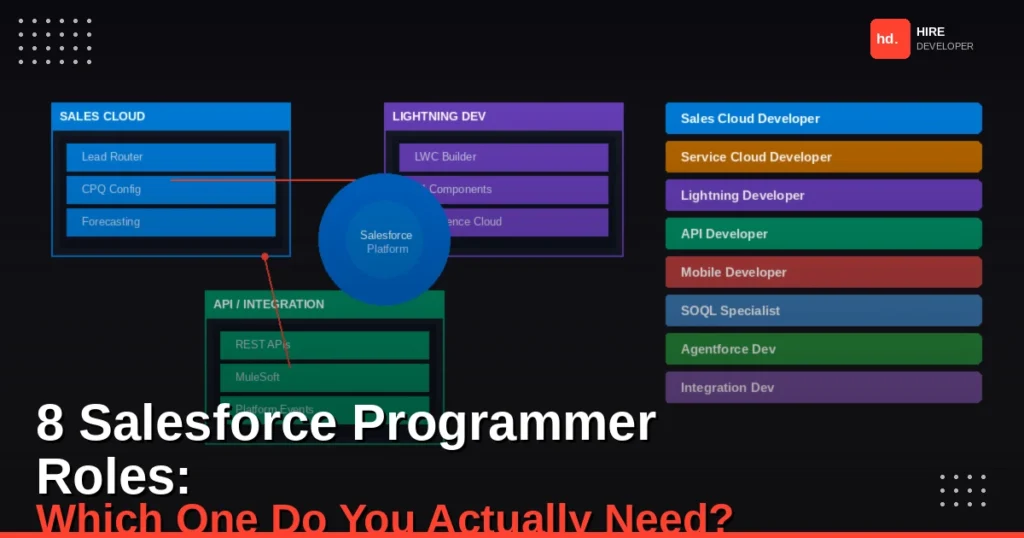
‘Hire a Salesforce programmer’ describes eight distinct specialisations. Each requires different certifications, different day-to-day skills, and different hiring criteria.
Salesforce Developer Roles | What They Build & Certification Needed
| Role / Title | What They Build | Certification Needed |
|---|---|---|
| Salesforce Programmer | Apex classes, triggers, batch jobs | Platform Developer I |
| Sales Cloud Developer | Lead routing, opportunity automation, CPQ | Sales Cloud Consultant |
| Service Cloud Developer | Case management, omnichannel, field service | Service Cloud Consultant |
| Lightning Developer | LWC components, custom UI, Experience Cloud | JavaScript Developer I |
| API / Integration Developer | REST/SOAP APIs, MuleSoft, Platform Events | Integration Architecture Designer |
| Mobile App Developer | Salesforce mobile SDK, offline apps | Platform Developer II |
| SOQL Developer | Complex queries, reports, analytics | Data Architecture Designer |
| Agentforce Developer | AI agents, @InvocableMethod, prompt design | Agentforce Specialist (2025) |
The question most job postings fail to answer:
Before you post a role or brief a staffing firm, define which of these eight programmer types you actually need. A Sales Cloud programmer with CPQ experience is a completely different hire from a Lightning developer who builds LWC components. Conflating them produces a job description that attracts the wrong candidates and wastes everyone’s time.
THE TECHNICAL REALITY, WHAT SEPARATES REAL PROGRAMMERS FROM TRAILHEAD GRADUATES
What Real Salesforce Programming Competency Looks Like, Beyond the Certifications
Every certified Salesforce programmer has passed an exam. Not every certified Salesforce programmer has shipped production code that handles real-world edge cases at scale. Understanding the difference is the most practically important skill in Salesforce hiring.
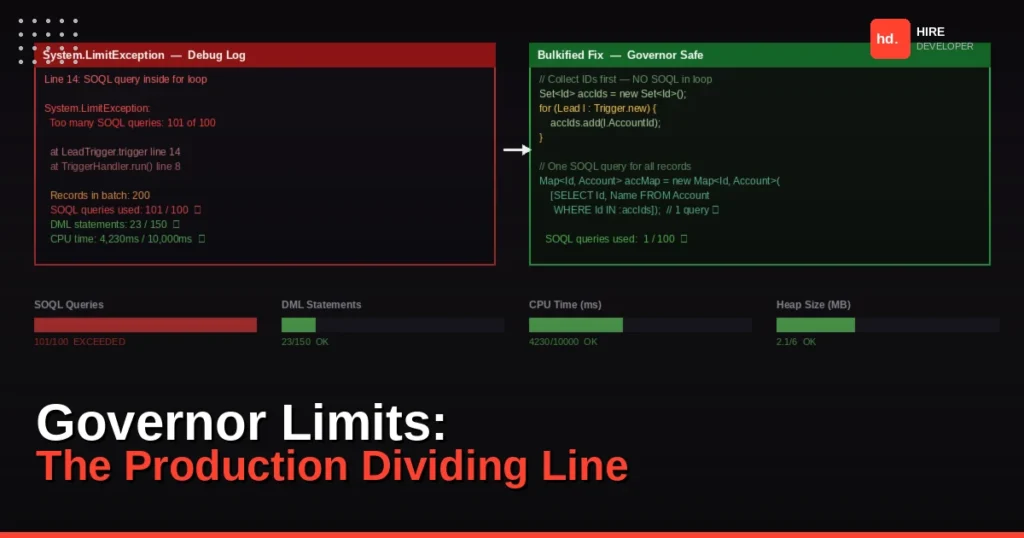
Governor Limits, The Production Dividing Line
Salesforce runs on a multi-tenant architecture where execution limits, called governor limits, are enforced on every transaction. The most critical limits for a programmer: 100 SOQL queries per synchronous transaction, 150 DML statements, and 10,000 milliseconds of CPU time. These limits cannot be disabled or purchased away. They are the defining architectural constraint of the platform.
A Salesforce programmer who does not understand governor limits from production experience will write triggers that pass sandbox testing and fail in production when a bulk data import fires the same logic against thousands of records simultaneously. This is not a corner case. It is the most common cause of Salesforce implementation failure, and it is 100 percent preventable with the right hire.
The interview question that reveals this: ask the candidate to walk you through how they would write a trigger to update a parent record when a child record changes, without hitting governor limits. A programmer with genuine production experience will immediately describe a handler pattern, explain why SOQL belongs outside loops, discuss DML collection strategies, and mention bulk testing with 200-record test data. A programmer without genuine production experience will give a textbook answer that would hit limits at scale.
The Config vs Code Judgment, The Senior Programmer Signal
Salesforce’s declarative layer, which includes Flow Builder, validation rules, formula fields, and dynamic forms, covers approximately 60 to 70 percent of what most businesses need. The remaining 30 to 40 percent requires Apex code. The judgment to know which requirements need code and which can be solved declaratively is the clearest indicator of Salesforce programmer seniority.
Code creates maintenance debt. Flow and configuration upgrade automatically with Salesforce’s three annual releases and require no test coverage. A programmer who reaches for Apex first on every requirement is not a senior programmer. They are a programmer who does not fully understand the platform. Ask candidates to describe a recent situation where they chose not to write code and solved a requirement through configuration instead. If they cannot describe one, treat that as a significant signal.
The 2026 Skill That Changes Everything, Agentforce
Since Salesforce launched Agentforce in late 2024, the programmer skill landscape has shifted. Agentforce agents connect to existing Apex methods and Flows via the @InvocableMethod decorator, enabling autonomous AI-driven workflows that handle customer service queries, sales outreach sequences, and complex internal approvals without human intervention at every step. More than 5,000 organisations have deployed Agentforce in production as of 2026.
For organisations planning Agentforce adoption in the next 12 months, asking programmer candidates about their @InvocableMethod experience, their understanding of agent topic and action design, and how they think about defining safe boundaries for probabilistic AI systems is now a worthwhile screening question. It is not yet a hard requirement for most roles, but programmers who have engaged with Agentforce are building a measurable market advantage over those who have not.
WHAT IT COSTS TO HIRE A SALESFORCE PROGRAMMER IN 2026
Salesforce Programmer Cost in 2026, Every Engagement Model With Real Numbers
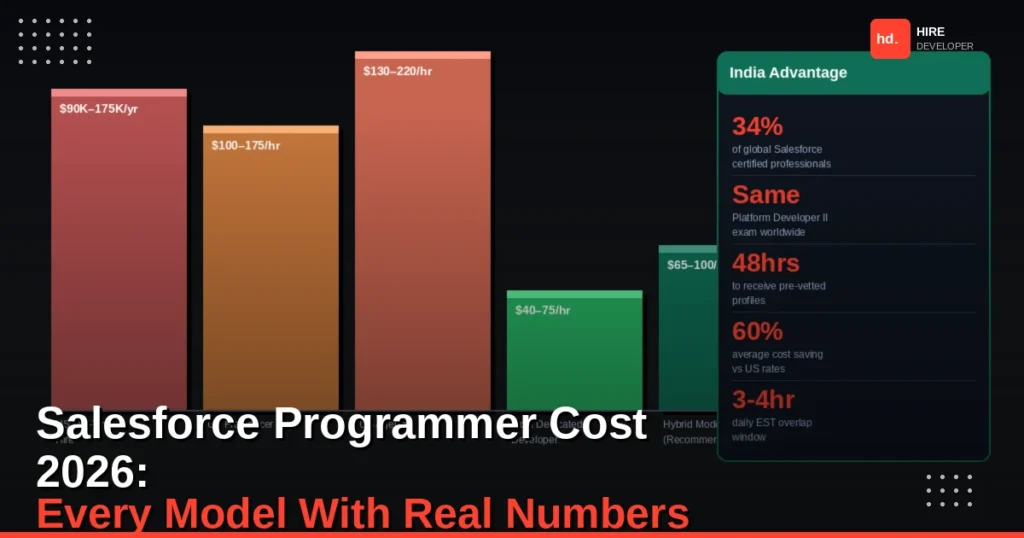
Cost transparency is rare in Salesforce staffing discussions. The following figures reflect actual market data as of mid-2026 across all engagement models.
Developer Hiring Models | Rate, Best For & Time to Start
| Model | Rate | Best For | Time to Start |
|---|---|---|---|
| US Full-Time Hire | $90K–$175K/yr | Long-term in-house build | 8–18 weeks |
| US Freelancer | $100–$175/hr | Short-term project, 1–3 months | 1–3 weeks |
| US Boutique Agency | $130–$220/hr | Full implementation, defined scope | 2–4 weeks |
| Dedicated India Dev | $40–$75/hr | Ongoing dev, managed retainer | 48 hours |
| Hybrid (US mgmt + India dev) | $65–$100/hr blended | Mid-market implementation, best ROI | 48 hours |
The India Advantage, Same Certifications, Significantly Lower Cost
India holds approximately 34 percent of all Salesforce-certified professionals globally. Salesforce certifications are globally standardised, Platform Developer II in Hyderabad has passed the same examination as Platform Developer II in Chicago. The cost differential is structural, not a quality trade-off.
The IST to US Eastern timezone overlap runs from approximately 8am to 11am EST when an India-based team works until 9:30pm IST. This 3-hour daily window covers standups, sprint demos, and architecture decisions in real time. Async tools handle the remaining coordination. Most US mid-market buyers who have worked with well-run India-based Salesforce programmer teams describe the experience as indistinguishable from a US-based team in terms of delivery quality, with a 40 to 60 percent cost reduction.
The Hidden Cost Nobody Quotes, The Rebuild
A Salesforce implementation delivered by a programmer without genuine production experience typically requires a health check and remediation within 18 months. That remediation costs 1.5 to 3 times the original implementation cost, plus the opportunity cost of 18 months of underperforming CRM. The correct cost comparison is not hourly rate A versus hourly rate B. It is the total cost of ownership across a 3-year horizon, including the probability of getting it right on the first build.
The calculation that changes every cost conversation:
A $75,000 implementation from a verified production-experienced programmer that ships correctly costs less over 3 years than a $45,000 implementation from an underqualified programmer that requires $90,000 to remediate 18 months later. Price-optimising the hire is the most expensive decision in Salesforce project history.
CLOUD-SPECIFIC HIRING, WHAT EACH SPECIALIZATION ACTUALLY REQUIRES
Hiring by Salesforce Cloud Specialization, What Each Programmer Role Actually Needs
Hire Salesforce Sales Cloud Developer
Sales Cloud is the most common Salesforce implementation and the most commoditised programmer role. The signal to screen for is not general Apex competency but Sales Cloud-specific domain knowledge: opportunity pipeline design that models your actual sales process (not a demo org), lead assignment rules that handle territory management at scale, CPQ configuration for complex product bundling, and forecasting customisation that surfaces the metrics your sales leadership actually uses.
Programmers who have only built standard Sales Cloud configurations with basic Apex triggers will deliver a functional system. Programmers who understand the relationship between campaign attribution, lead conversion, and closed-lost analysis will deliver a system your sales team will actually use. The adoption rate is the outcome metric, not the go-live date.
Hire Salesforce Service Cloud Developer
Service Cloud implementations require specific knowledge of case management architecture, omnichannel routing rules, Knowledge article structure and versioning, entitlement processes, and Field Service Lightning if your business has on-site technicians. The performance requirement is stringent: a case routing engine that routes incorrectly or slowly is visible to every customer-facing team member immediately.
The programmer you hire for Service Cloud should be able to describe how they would architect a case escalation path that automatically reassigns based on SLA breach timing, skill matching, and supervisor availability. If they describe this as a standard Escalation Rule with no mention of custom Apex or Platform Events for real-time triggering, their experience is with simple Service Cloud configurations, not high-volume service operations.
Hire Salesforce Lightning Developer
Lightning Web Component development requires a different skill profile from core Apex programming. LWC is built on web standards: Custom Elements, Shadow DOM, ES Modules, and the Lightning Design System. A Lightning developer needs strong modern JavaScript (ES6+), Wire service proficiency for Salesforce data binding, and an understanding of how LWC’s shadow DOM model affects component communication and event propagation.
As of April 2026, Salesforce’s Multi-Framework React is in open beta. This means that Lightning developer candidates can now be evaluated on both LWC and React capabilities. For teams with existing React expertise, the Multi-Framework path reduces the Salesforce learning curve significantly. Confirm whether you need LWC production experience, React experience, or both, before writing the job description.
Hire Salesforce API Developers and SOQL Developers
API and integration programmers are in high demand because integration is where most Salesforce implementations fail. The programmer you hire must understand REST and SOAP API design, error handling and retry logic, Named Credentials for secure credential management, Platform Events for event-driven architecture, Change Data Capture for real-time data streaming, and OAuth 2.0 flows for Connected App authentication.
SOQL specialists are a specific sub-category increasingly requested by organisations running large Salesforce orgs with complex reporting requirements. SOQL query optimisation, understanding of selectivity thresholds for indexed lookups, and aggregate query design for reporting objects require depth that most Apex programmers have not needed to develop unless they have worked in orgs with millions of records.
Hire Salesforce Mobile App Developers
Mobile development on Salesforce uses the Salesforce Mobile SDK, which supports both hybrid and native mobile applications. Salesforce mobile app programmers need specific experience with the Mobile SDK’s offline capabilities, SmartStore for local data caching, and the offline-first synchronisation architecture that allows mobile users to work in areas with unreliable connectivity and sync when a connection is restored. This is a specialised role that few general Salesforce programmers have, and requirements should be confirmed carefully before engaging a general Apex developer for a mobile-specific project.
Hire Remote Salesforce Developers
Remote Salesforce programmer hiring introduces additional evaluation criteria beyond technical competency. Communication structure in an async-first environment, documentation discipline as a substitute for in-person knowledge transfer, and responsiveness within a defined SLA window are operational requirements that determine whether a remote engagement succeeds regardless of technical skill level.
The practical checklist for evaluating remote Salesforce programmer candidates: confirm their async communication tool proficiency (Slack, Loom, Notion), ask for a sample of their written technical documentation from a previous project, and confirm their overlap window availability before discussing technical skills. A remote programmer with mediocre async communication skills creates coordination overhead that eliminates the cost advantage of the remote model.
WHERE TO FIND CERTIFIED SALESFORCE PROGRAMMERS IN 2026
Where to Find and Hire Certified Salesforce Programmers, Your Sourcing Options
Pre-Vetted Specialist Platforms
The fastest sourcing option with the most consistent quality floor. Pre-vetted platforms apply a technical assessment specifically covering governor limits, bulkification patterns, and integration architecture before a programmer enters their bench. The assessment screens for production competency, not certification count. HireDeveloper’s Salesforce programmer roster delivers pre-vetted Apex, LWC, Sales Cloud, Service Cloud, and multi-cloud specialists within 48 hours, with individually verified certifications from trailhead.salesforce.com, 7.2 years average experience, and a 2-week replacement guarantee. Engagement models include monthly retainer, dedicated developer, and fixed-scope project.
Salesforce Trailhead Talent Marketplace
Salesforce’s own marketplace at trailhead.salesforce.com lists credentialed candidates actively seeking roles. Every profile includes verified certification status that you can cross-check independently. The limitation is that the marketplace surfaces active job seekers, not the full population of qualified programmers, most of whom are employed and not searching. Good for junior roles and administrators. Less effective for senior programmers with production track records.
AppExchange Partner Directory
For organisations that want a consulting firm rather than an individual programmer, the AppExchange partner directory lists firms by tier, specialisation, and verified client reviews. Filter by cloud specialisation and review density rather than tier level alone. A Crest-tier boutique with 40 verified reviews in your industry is a more reliable choice than a Summit-tier global SI where your engagement is a small project staffed by junior consultants.
LinkedIn and Direct Sourcing
LinkedIn sourcing for senior Salesforce programmers requires filtering specifically for Platform Developer II certification, production deployment history in your target cloud, and org size experience relevant to yours. The challenge is that LinkedIn profiles self-report certifications without independent verification. Always request trailhead.salesforce.com credential links before advancing any LinkedIn-sourced candidate to a technical screen.
HOW TO EVALUATE A SALESFORCE PROGRAMMER, THE SCREENING FRAMEWORK
How to Evaluate a Salesforce Programmer Before You Hire Them
The five-question technical screen below works regardless of whether you are evaluating a candidate from a staffing platform, a LinkedIn source, or a consulting firm’s proposed delivery team. It takes 30 minutes and reveals more about genuine production competency than a full Trailhead profile.
Salesforce Developer Interview | Key Questions & Answers
| Ask This | What a Strong Answer Sounds Like |
|---|---|
| Walk me through a bulkified trigger you wrote | Mentions handler pattern, Map-based SOQL, bulk test with 200 records |
| How do you handle a failed API callout? | Describes retry logic, Platform Events, idempotency, Named Credentials |
| Config vs code, when do you write Apex? | Config first, code only when Flow hits limits or complex logic required |
| Describe a governor limit failure you fixed | Specific production scenario, root cause analysis, architectural fix |
| What is @InvocableMethod used for? | Flow invocable actions, Agentforce agent connections, REST exposure |
Step 1: Verify Individual Certifications, Not Company Totals
Request trailhead.salesforce.com credential verification links for every programmer who will work on your engagement. Aggregate company certification counts include credentials held by people not involved in your project and certifications that may have lapsed when a programmer missed a maintenance cycle. Salesforce certifications are maintained through three annual release cycles. A certification that was active in January may be retired by May if the programmer missed the Spring maintenance module.
Individual verification takes two minutes per programmer and is completely independent. Any firm that cannot provide this within 24 hours of the request is not managing its certification currency. That is a signal about how they manage other quality standards.
Step 2: Ask for Production References, Not Portfolio Links
A portfolio link shows you a sandbox project. A production reference confirms that a real business ran their CRM on this programmer’s code. Ask specifically for references from projects at similar scale and cloud configuration to yours. Ask the reference: if you were starting this project over today, would you use the same programmer? What was the hardest problem they solved? Was post-launch support structured or informal?
The pattern of answers to these questions tells you more about the programmer’s actual delivery quality than any technical assessment. References who answer with specific examples and honest assessments of challenges are credible. References who give only positive generalities have been coached.
Step 3: Confirm the Post-Delivery Support Model
Salesforce releases three major platform updates per year. Custom Apex, integrations, and Flow configurations can all be affected by each release. A Salesforce programmer with no structured post-delivery support model is optimised for project closure, not your long-term outcome. Confirm SLA commitments, named contacts, and response time guarantees for production issues before signing. For the complete evaluation framework including contract clauses that protect buyers and onboarding structure, see our Salesforce developer hiring ultimate guide.
RED FLAGS, WHAT PREDICTS A BAD HIRE BEFORE YOU SIGN
Red Flags When Hiring a Salesforce Programmer, What to Walk Away From
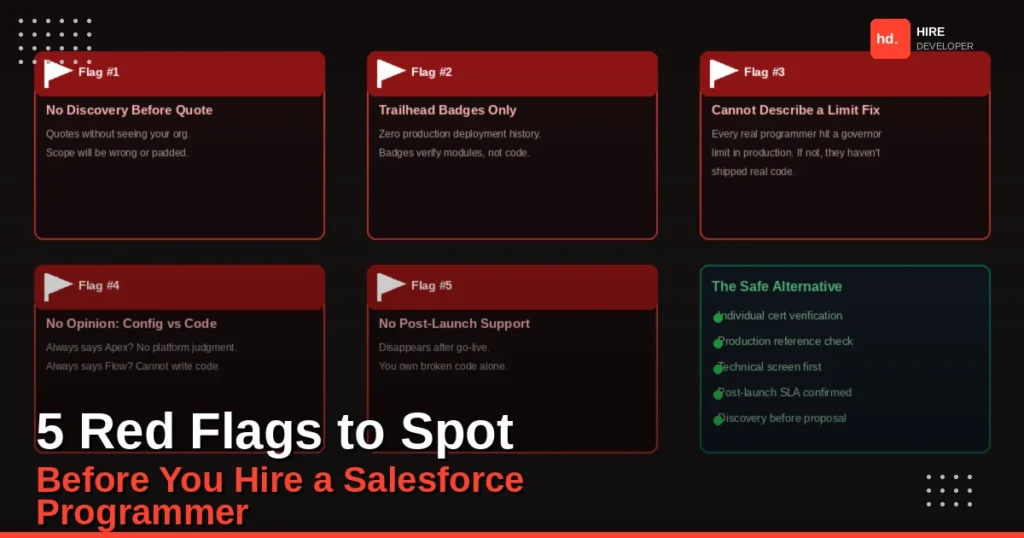
They Cannot Describe a Governor Limit Failure They Fixed
Every Salesforce programmer who has shipped production code has encountered a governor limit failure. It is not an edge case. It is an architectural challenge built into the platform. A programmer who cannot describe a specific governor limit issue they encountered, the root cause they identified, and the Apex pattern change they implemented has either not shipped production code or is omitting the context. Both are significant signals.
They Quote Without Discovery
Any programmer or firm that provides a fixed-price proposal without conducting a formal discovery session does not have enough information about your org, data model, and integration landscape to scope accurately. The proposal is either padded with contingency or wrong and heading toward change orders. A credible programmer insists on discovery before quoting. This is not a delay tactic. It is the basic due diligence required to commit to a scope and price with integrity.
Their Trailhead Profile Has No Production References
Trailhead badges verify that a programmer completed guided modules. They do not verify that the programmer architected a governor-limit-safe implementation under production pressure. A programmer whose entire portfolio is Trailhead badges and Playground projects has not been trusted with a real org. Treat certifications as a starting point for verification, not evidence of deployment capability.
They Have No Opinion on Config vs Code
Ask any Salesforce programmer candidate: would you solve this requirement with Flow or with Apex, and why? A programmer who always answers Apex has not developed the judgment to use the declarative layer efficiently. A programmer who always answers Flow does not understand when custom code is genuinely necessary. The right answer depends on the requirement. A programmer who can explain that dependency clearly has senior-level platform judgment. One who cannot is guessing.
No Post-Launch Support Commitment
A Salesforce programmer who does not proactively discuss post-launch support is treating your implementation as a deliverable rather than a system they are responsible for. Production Salesforce orgs require ongoing maintenance. Release updates affect custom code. APIs break when connected systems change their endpoints. A programmer who disappears after go-live leaves you with a system and no one who understands it.
Conclusion, The Salesforce Programmer Hire That Determines Your CRM Outcome
Every Salesforce implementation outcome traces back to a single decision: who wrote the code. A Salesforce programmer with genuine production experience, governor limit fluency, and post-launch discipline builds systems that sales teams use, executives trust, and operations teams can maintain. A Salesforce programmer without those qualities builds technical debt that compounds every release cycle.
The framework in this guide covers every stage of the hiring decision: defining which of the eight programmer specialisations you actually need, understanding what genuine production competency looks like beyond certifications, comparing cost across all engagement models, evaluating candidates against the five questions that reveal real skills, and identifying the red flags that predict delivery problems before you sign anything.
If you are ready to source pre-vetted certified Salesforce programmers, HireDeveloper’s Salesforce programmer programme delivers individually certified Apex, LWC, Sales Cloud, Service Cloud, and Agentforce specialists within 48 hours. Every profile includes verified trailhead.salesforce.com credentials, production deployment history, 7.2 years average experience, and a 2-week replacement guarantee. No long-term contracts required.