






Why AWS Consulting Matters for Businesses
Your cloud bill jumped again this month and nobody can say exactly why. A release took two days because deployments are still half manual. Someone just asked whether the production database is encrypted, and the honest answer is “probably.” If that sounds familiar, the problem is rarely AWS itself. It is that Amazon Web Services offers hundreds of services, and using them well takes planning, hands-on experience and steady attention.
That is the gap AWS consulting fills. Specialists assess your current setup, design the right architecture, move workloads, automate delivery, secure access and keep spending under control, either for a single project or on an ongoing basis.
QUICK ANSWER
AWS consulting is expert advice plus hands-on delivery that helps a business plan, build, migrate, secure, automate and optimize its workloads on Amazon Web Services. It can come from an independent consulting company, an AWS Partner Network member, or AWS Professional Services.
This guide follows the order a real engagement runs: what AWS consulting is, the services on offer, how migration, DevOps, security and cost work, how AWS partner tiers read in 2026, and how to choose and brief a provider. Several AWS programs and services have changed recently, so each technical point has been checked against current AWS documentation.
What Is AWS Consulting?
AWS consulting is the practice of getting expert help to adopt and run Amazon Web Services well. An AWS consultant works with your business and technical teams to turn goals such as faster releases, less downtime or a leaner bill into an architecture, a migration plan and working systems.
The role is part strategist, part engineer. On the strategy side, a consultant assesses what you run today and recommends an approach. On the technical side, they design accounts, networks and services, build or review infrastructure, and hand over documentation and runbooks.
Three terms often get mixed up:
- AWS consulting: project-based advice and delivery with a defined outcome.
- AWS Support: AWS’s own support plans for service issues and guidance, not a design or migration team.
- AWS managed services: ongoing operation of your environment, usually on a monthly agreement.
A simple example: a retailer runs its web app on two aging servers in a rented data center. A consultant maps the application, proposes a design with load balancing and a managed database, migrates in stages, sets up automated deployments and agrees a support plan. The retailer ends up with a platform it can scale and monitor, not a copy of the old servers in a new place.
What Are AWS Consulting Services?
AWS consulting services are the activities a provider can deliver across the cloud lifecycle. Most engagements draw from nine areas:
- Cloud strategy and assessment: where you are and where to go.
- Architecture and infrastructure design: the target state.
- Cloud migration: moving workloads and data.
- AWS implementation: building the environment.
- DevOps and automation: repeatable delivery.
- Security and compliance: access, protection, evidence.
- Monitoring and support: visibility and operations.
- Cost optimization: spend that matches value.
- Application modernization: updating how apps are built.
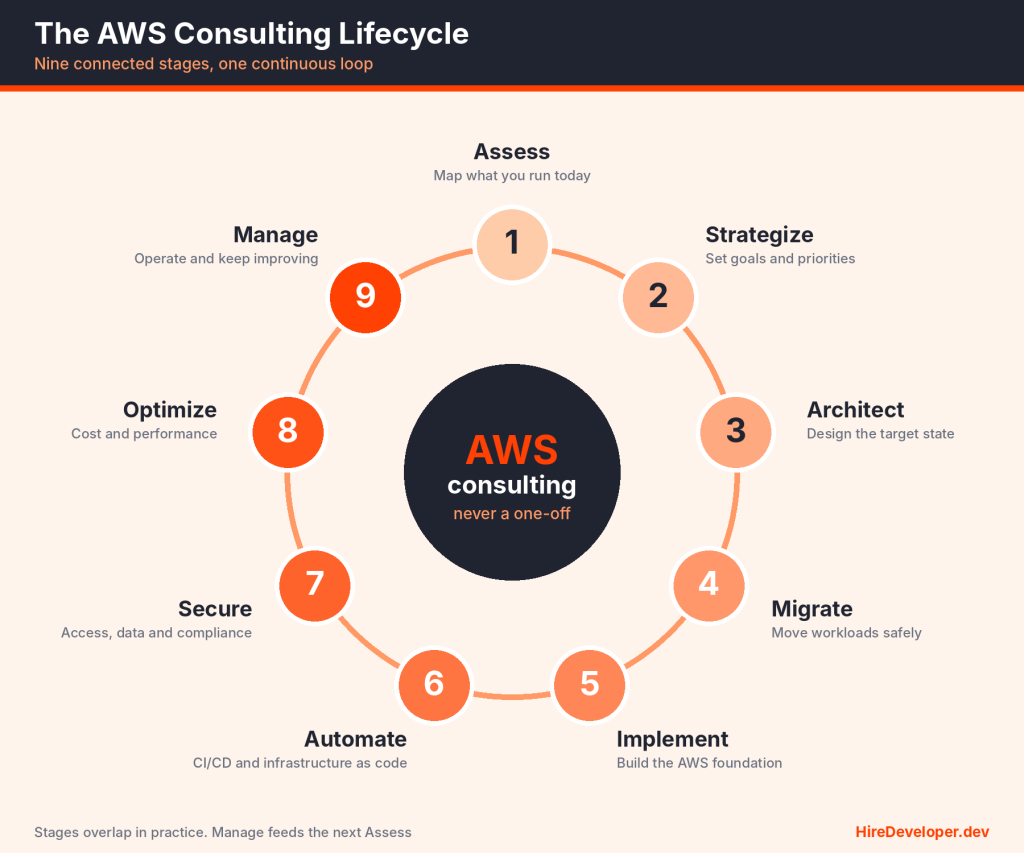
We will use one simple framework throughout: Assess, Strategize, Architect, Migrate, Implement, Automate, Secure, Optimize, Manage. Each stage feeds the next, and the last one loops back to the first, because cloud environments keep changing.
- Assess: inventory applications, infrastructure, costs and risks.
- Strategize: agree goals, priorities, budget and a cloud roadmap.
- Architect: design accounts, networks, data and resilience.
- Migrate: move workloads and data with tested cutover plans.
- Implement: build and configure the AWS environment.
- Automate: add CI/CD pipelines and infrastructure as code.
- Secure: apply access controls, encryption, logging and compliance checks.
- Optimize: tune performance and spending using real usage data.
- Manage: monitor, support and improve over time.
Scope depends on the provider’s expertise and the engagement model. Some firms specialize in migration, others in DevOps or security. That is why matching the provider to your problem matters more than choosing the longest service list.
Types of Amazon Web Services Consulting Solutions
Each solution category targets a different business problem. This table shows what each one covers and why it matters.
| Consulting solution | What it covers | Business value |
| Cloud strategy | Assessment, goals, cloud roadmap | Better cloud decisions |
| Architecture | Account structure, networking, resilience design | Systems that scale reliably |
| Migration | Workload and data migration | Structured cloud transition |
| Implementation | AWS environment setup | Reliable infrastructure foundation |
| DevOps | CI/CD and automation | Faster, repeatable deployments |
| Security | Access, protection, compliance | Reduced security exposure |
| Cost optimization | Resource and spending analysis | Better cloud cost control |
| Application modernization | Containers, serverless, re-architecture | Easier change and scaling |
| Managed services | Monitoring and operations | Ongoing infrastructure support |
Read the table as problems and outcomes. Strategy answers whether to move and in what order. Architecture makes sure what you build can scale and recover. Migration and implementation get workloads running safely on AWS. DevOps shortens the path from code to production. Security and cost work keep the environment trustworthy and affordable, and modernization and managed services keep it healthy as the business changes.
Which service fits your problem?
| Business challenge | Recommended consulting service |
| Legacy infrastructure is difficult to maintain | AWS migration consulting |
| Applications cannot scale reliably | AWS architecture consulting |
| Deployments are slow and manual | AWS DevOps consulting |
| Cloud bills are increasing unexpectedly | AWS cost optimization |
| Security controls are inconsistent | AWS security consulting |
| Application architecture needs modernization | AWS application modernization |
| No internal team manages cloud operations | AWS managed services |
AWS Cloud Consulting for Businesses
Needs change with company stage. Startups need a secure first foundation. SaaS businesses need to scale without rewriting everything. Enterprises need to modernize legacy systems and manage multi-account or multi-environment setups. Teams leaving on-premises infrastructure need a safe path across. Before any build starts, a consultant usually runs a cloud assessment to document what exists, an architecture review to test the proposed design against the Well-Architected Framework, and workload planning to decide what moves first and why.
Across all of them, cloud assessments, architecture reviews and workload planning remove avoidable risk before money is spent. These three examples are hypothetical, not real client projects.
HYPOTHETICAL SCENARIO | Startup: a secure foundation before launch
- Problem: a SaaS startup has a working product but no production-grade environment.
- Approach: set up separate AWS accounts for development and production, least-privilege access, infrastructure as code and basic monitoring.
- Services: AWS Organizations, IAM, VPC, Amazon ECS or EKS, CloudWatch.
- Improvement: a repeatable, auditable launch environment that can grow.
HYPOTHETICAL SCENARIO | Enterprise: legacy migration with controlled risk
- Problem: dozens of legacy workloads, tight dependencies and low tolerance for downtime.
- Approach: discover and group applications, choose a strategy per workload, migrate in waves with rollback plans.
- Services: AWS Transform, AWS Transform MGN, AWS Database Migration Service, Control Tower.
- Improvement: a governed landing zone and a migration that proceeds wave by wave.
AWS Professional Services Explained
If you have searched “what is ProServe,” here is the short version. ProServe is AWS Professional Services, the consulting organization inside AWS. Its specialists help customers with cloud adoption, migration, modernization and transformation, often on larger programs. AWS positions it as working alongside customer teams and partners, not replacing them. Typical engagement areas include cloud adoption strategy, large-scale migration, application and data modernization, security and governance design, and operating model changes.
Keep three parties apart: AWS is the cloud provider, AWS Professional Services is AWS’s own consulting organization, and AWS Partner Network members are independent companies. A partner is not part of AWS, and AWS Professional Services is not a partner.
Consider ProServe when you run a large, strategic program and want direct access to AWS service expertise. Consider an independent partner when you need hands-on delivery capacity, regional or industry knowledge, flexible budgets, long-term support, or work that spans more than AWS.
AWS Cloud Migration and Implementation
A good migration is not a server transfer. It is a sequence: assess infrastructure and applications, discover workloads, map dependencies, choose a strategy, plan data migration, check application compatibility, test, cut over with a rollback plan, then optimize after go-live. Data deserves its own plan: how much moves, how fast, how it stays in sync during the transition, and how you verify it arrived intact. Compatibility checks catch operating system versions, licensing terms and hard-coded server addresses that would otherwise surface on cutover night.
For discovery and planning, AWS now points new customers to AWS Transform, because AWS Migration Hub stopped accepting new customers on November 7, 2025. The rehosting engine formerly called Application Migration Service is now AWS Transform MGN. Competitor guides still use the old names.
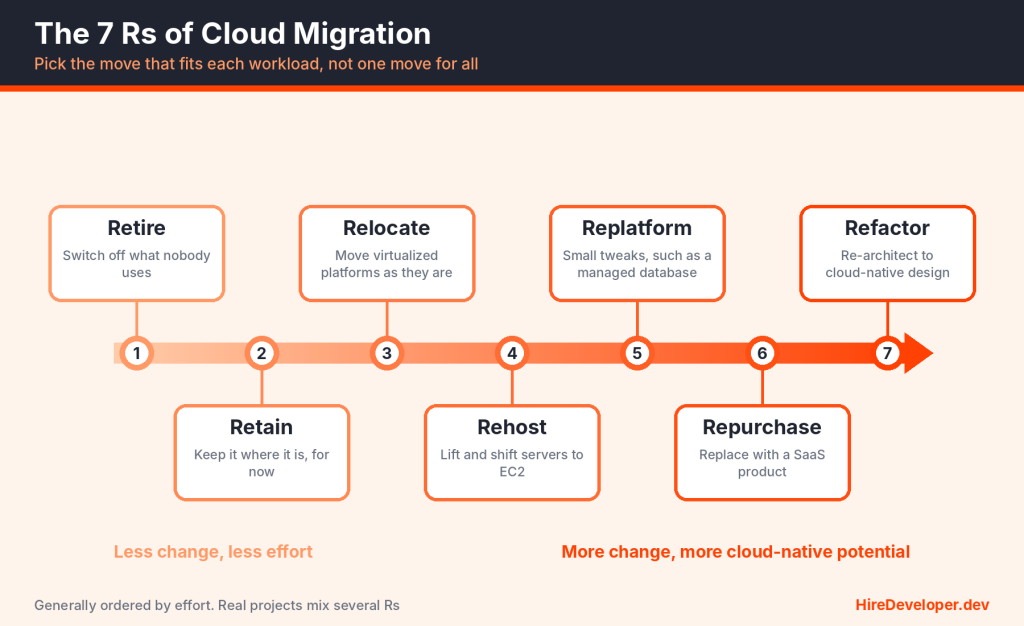
The 7 Rs of migration describe your options for each workload.
| Strategy | What it means | Consider | Suits |
| Retire | Switch off apps nobody needs | Check for hidden users | Duplicate or unused apps |
| Retain | Keep it where it is for now | Plan to revisit | Compliance limits, recent investment |
| Relocate | Move virtualized platforms as they are | Fit with the target platform | Large VMware estates |
| Rehost | Lift and shift servers to Amazon EC2 | Limited cloud benefit at first | Deadline-driven moves |
| Replatform | Small changes, such as a managed database | Testing effort | Less operations work without a rewrite |
| Repurchase | Replace with a SaaS product | Data migration, retraining | Commodity apps |
| Refactor | Re-architect as cloud-native | Highest cost and effort | Apps that need scale and agility |
Rehosting versus refactoring: imagine a booking app that runs on one large server. Rehosted, it runs on one large EC2 instance and keeps the same limits. Refactored, search, payments and notifications become separate services that scale independently. Rehosting is faster. Refactoring pays back over time.
A practical walk-through: a company runs an order system on Windows servers with SQL Server. The team maps dependencies, finds a nightly job that feeds finance, replatforms the database to a managed service, rehosts the application tier, rehearses cutover twice and keeps the old environment for rollback. If the codebase needs .NET work along the way, you can hire .NET developers to handle it.
AWS DevOps Consulting and Automation
DevOps consulting turns slow, manual releases into repeatable pipelines. Typical work covers CI/CD design, infrastructure as code, containerization, automated testing, release management, environment consistency, observability and DevSecOps checks inside the pipeline. Infrastructure as code matters most here: when networks, servers and permissions are defined in version-controlled templates, every environment is built the same way, changes are reviewed like application code, and a broken environment can be rebuilt instead of repaired by hand.
- CodePipeline and CodeBuild: orchestrate and run builds and tests.
- Amazon ECR, ECS and EKS: store images and run containers, with EKS for Kubernetes.
- CloudFormation: define infrastructure as code.
- Systems Manager: manage and patch fleets.
- CloudWatch: metrics, logs and alarms.
- CodeDeploy: automated deployments to EC2, on-premises servers and Lambda.
Service lifecycles do change. CodeCommit, for example, was de-emphasized and then returned to general availability. A good consultant checks the current status of each service before building on it, including CodeDeploy.
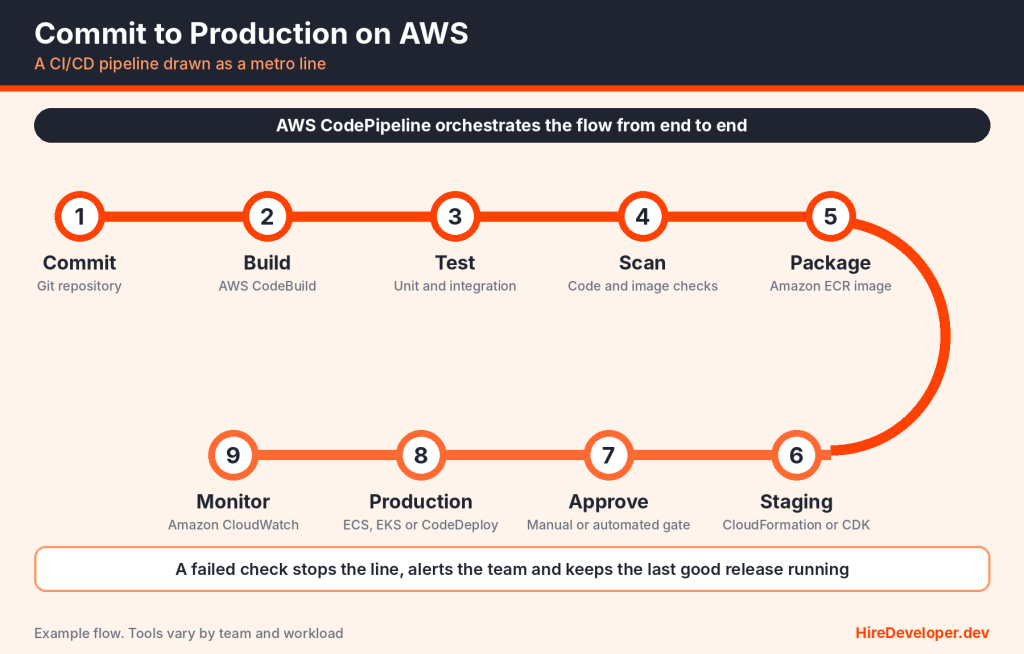
In plain terms: a developer commits code, the pipeline builds and tests it, scans it, packages it as an image, deploys to staging, waits for approval, releases to production, and monitors the result. If any gate fails, the release stops and the team is alerted. Release strategies such as blue/green or canary deployments add a safety net by exposing a new version to a small share of traffic first. Backend and API teams can hire Node.js developers to build the services that run through these pipelines.
AWS Cloud Architecture and Infrastructure Management
Good AWS architecture is reliable, scalable and easy to maintain. Consultants typically cover account and environment structure, VPC networking, compute and storage choices, database design, load balancing and auto scaling, high availability, disaster recovery, infrastructure as code and written architecture documentation. Multi-region designs make sense only when the business case justifies the added complexity.
Disaster recovery planning starts with two business questions: how much data can you afford to lose, and how long can you afford to be down? The answers set the backup frequency and the recovery design, from simple backups through to standby environments in a second region. A consultant should document both answers, test the recovery process and record decisions so the next engineer understands why the design looks the way it does.
The AWS Well-Architected Framework gives consultants a shared review language. It has six pillars:
- Operational Excellence
- Security
- Reliability
- Performance Efficiency
- Cost Optimization
- Sustainability
KEY TAKEAWAY Design for the workload you have, not the most impressive diagram. A simple, well-run architecture beats a complex one nobody can operate.
AWS Security, Monitoring and Support
Security starts with the shared responsibility model. AWS secures the cloud itself: facilities, hardware and the core services. You secure what you put in it: identities, data, configuration, network rules and applications. The split shifts by service. With Amazon EC2 you patch and harden the operating system yourself. With a managed database such as Amazon RDS, AWS handles much of the underlying patching while you still control access, data and configuration.
Consultants typically help with the customer side:
- Access: IAM with least privilege and multi-factor authentication.
- Data: encryption at rest and in transit, with AWS KMS for key management.
- Visibility: AWS CloudTrail for activity logs, AWS Config for configuration history, CloudWatch for metrics and alarms.
- Detection: Amazon GuardDuty and AWS Security Hub for findings.
- Resilience: AWS Backup, disaster recovery plans and incident response runbooks.
Using AWS does not make a business compliant with every regulation. Compliance depends on how you configure and operate your workloads. A consultant can map controls to your requirements, but your organization remains accountable.
AWS Cost Optimization and AWS Cost Explorer
Cost optimization is a habit, not a one-time cleanup. Consultants look for idle and underused resources, right-size compute, tune storage, match steady workloads to Savings Plans or Reserved Instances, use Auto Scaling, schedule non-production environments and watch data transfer charges. Commitment discounts work best after usage settles, so a consultant typically optimizes first and commits second, rather than locking in capacity for workloads that are about to change.
AWS Cost Explorer shows spending patterns and trends over time. It pairs with two related tools: AWS Budgets sets spending thresholds and alerts, and AWS Compute Optimizer recommends better-sized compute. Tagging and cost allocation tie spend to teams and products, and budgets with alerts give governance teeth. The AWS Pricing Calculator helps with forward estimates.
Example: a team finds that its staging environment runs all night and all weekend. They schedule it to shut down outside working hours, right-size two oversized instances and set a budget alert. The savings come from removing waste, not from reducing production quality.
KEY TAKEAWAY Cutting spend should never weaken performance, reliability or security. Optimize waste, not resilience.
AWS Consulting Partners: Network, Tiers and Requirements
The AWS Partner Network (APN) is AWS’s ecosystem of independent companies that build on, sell and deliver AWS. AWS runs it so customers can find providers with validated capabilities, and so no single organization has to deliver everything. For buyers, partner programs offer a useful first filter: a designation means AWS has reviewed a partner’s technical capability and customer work in a specific area.
Partners fall into different kinds. Consulting and services partners deliver advice, migration, implementation and managed services. Technology partners build software and products that run on or integrate with AWS. Recognition comes through designations such as competencies, service delivery designations, managed service provider (MSP) status and Well-Architected partner status.
When evaluating an AWS consulting partner, check:
- Relevant competencies and designations.
- Experience with workloads like yours.
- Technical delivery capability and team depth.
- Security and governance practices.
- Industry experience.
- Customer references and case studies.
- Post-migration support.
AWS Partner Path: Select, Advanced and Premier
AWS organizes partners into Partner Paths based on what they do. Firms that deliver consulting, professional, managed or reseller services follow the Services Path. Software companies follow a separate Software Path.
On the Services Path, the current tier names are Select, Advanced and Premier, as shown on AWS’s Services Partner Tiers page. Older material that says “Advanced Consulting Partner” reflects earlier naming.
Moving up generally means proving more: certified and accredited staff, launched customer engagements with AWS involvement, a partner business plan, and, at the top tier, additional program validations. Exact thresholds change, so this guide does not list numbers. Check the official page for current requirements. In practice, a partner’s experience, customer success, certified people, competencies and program participation all feed into how AWS recognizes it, and each step involves business and technical validation by AWS.
Before choosing a partner on tier alone, remember that a tier shows program progress, not how well a specific team will handle your project.
AWS Advanced Consulting Partner vs Other Partner Levels
| Tier | What it generally signals | What you should still verify |
| Select | Entry-level recognition with initial certified staff and delivery | Depth of experience with your workload |
| Advanced | A larger certified team and a record of launched customer work | Specialization, references and support model |
| Premier | Highest tier, with broader validation across programs | Fit for your size, budget and communication needs |
Higher recognition can signal broader validated capability, but it is not a ranking of guaranteed delivery quality. A smaller partner with the right specialization may serve you better than a larger one that treats your project as routine. Ask about similar projects, who will actually do the work, and what happens after go-live.
AWS Consultant vs AWS Cloud Architect vs AWS Developer
| Role | Primary responsibility | Typical work |
| AWS Consultant | Advises and guides cloud strategy and implementation | Assessments, migration planning, optimization |
| AWS Cloud Architect | Designs cloud infrastructure and technical architecture | Networking, security, scalability, reliability |
| AWS Developer | Builds and maintains applications using AWS services | APIs, serverless applications, integrations |
Small projects may need one person who covers two roles. Larger programs usually need a combined team: a consultant to align the plan with the business, an architect to design the platform, and developers to build and modernize applications. If the roadmap includes machine learning features, pairing cloud work with AI development services keeps both sides moving together. Titles vary between organizations, so judge by responsibilities, not labels.
When Should You Hire an AWS Expert or AWS Consultant?
Hiring AWS expertise makes sense when you are:
- Moving from on-premises infrastructure to AWS.
- Launching a new SaaS product.
- Facing rising cloud costs.
- Improving infrastructure security.
- Modernizing legacy applications.
- Automating deployments.
- Building a scalable architecture.
- Troubleshooting complex AWS infrastructure.
- Managing cloud environments without growing a permanent team.
An individual consultant suits focused advisory work or a specific review. A consulting company suits larger programs that need several skills, delivery management and continuity if one person leaves. When you hire an AWS expert, ask about the exact tasks you need done. When you hire AWS consultants as a team, define who owns architecture, delivery and support.
If the gap is engineering capacity rather than cloud advice, HireDeveloper.dev (Talent Wing of Rightbyte Technologies Pvt Ltd) can help you add dedicated development teams to build and extend the applications that run on AWS.
How to Choose the Best AWS Consulting Company
Use this ten-point framework to compare providers:
- AWS technical expertise
- Relevant project experience
- Migration and modernization capability
- DevOps and automation experience
- Security and compliance knowledge
- Architecture and scalability expertise
- AWS Partner Network credentials, where applicable
- Transparent communication and project planning
- Post-implementation support
- Pricing and engagement flexibility
Ask for references from customers with similar workloads and, where possible, a short paid discovery or proof of concept. It shows how a provider communicates, estimates and handles surprises before you commit to a larger program.
Ask these questions before you sign:
- Have you handled projects similar to ours?
- What AWS architecture would you recommend and why?
- How will you assess our existing infrastructure?
- How do you approach migration risks and rollback?
- How will you monitor AWS spending?
- What security controls will be implemented?
- What support is available after deployment?
- How will project success be measured?
Choose on delivery experience, not just price or partner tier. The cheapest quote often leaves out discovery, testing or support, and a high tier does not replace relevant experience. Before you start, confirm each item on this checklist:
- Business objectives are defined.
- Existing infrastructure is documented.
- Application dependencies are identified.
- Security and compliance requirements are understood.
- Migration scope is agreed.
- Architecture decisions are documented.
- Cost estimates and budgets are reviewed.
- Testing and rollback plans exist.
- Ownership and responsibilities are clear.
- Post-deployment support is agreed.
AWS Consulting Costs and Pricing Factors
There is no single global rate. Cost depends on project scope and complexity, the number of workloads, migration size, architecture needs, security and compliance requirements, the scope of DevOps automation, the expertise required, engagement length, ongoing support, and the consultant’s location and engagement model. A single migration can cost very different amounts depending on whether it covers three simple servers or thirty interdependent applications with compliance requirements, which is why credible providers scope the work before quoting it.
| Pricing model | Best for |
| Hourly consulting | Advisory work and reviews with an unclear scope |
| Fixed-scope project | Well-defined migrations or builds |
| Monthly retainer | Ongoing guidance and optimization |
| Dedicated cloud engineering team | Long programs that need steady capacity |
| Managed services agreement | Continuous operations and monitoring |
Keep consulting fees separate from AWS infrastructure charges. Consulting fees pay for people and expertise. AWS usage charges come from the services you run, and they continue after the project ends. Use the pricing calculator to estimate the second figure and ask providers to quote the first.
AWS vs Azure vs Google Cloud Consulting
| Evaluation area | AWS | Microsoft Azure | Google Cloud |
| Cloud ecosystem | AWS services and partner ecosystem | Microsoft ecosystem integration | Google Cloud ecosystem |
| Common business fit | Broad infrastructure and service options | Microsoft-centric enterprise environments | Data, analytics, AI and cloud-native workloads |
| Migration considerations | AWS workload and service compatibility | Microsoft workload and licensing considerations | Google Cloud service and workload compatibility |
| Consulting focus | Architecture, migration, DevOps, security, optimization | Enterprise integration, modernization, hybrid cloud | Data platforms, analytics, AI, infrastructure |
No platform is universally best. Choose based on your existing infrastructure, workload requirements, technology ecosystem, team skills, compliance needs, cost structure and integration requirements. Companies built around Microsoft products often weigh Azure heavily, and in that case Microsoft development expertise matters whichever cloud you pick. Be skeptical of any claim that one provider is always cheaper or faster.
AWS Consulting Implementation Process
A typical engagement moves through ten stages:
- Business discovery and requirement gathering
- Existing infrastructure assessment
- Cloud strategy and architecture planning
- AWS environment and account setup
- Migration or implementation
- DevOps and automation configuration
- Security and compliance validation
- Testing and performance validation
- Deployment and production cutover
- Monitoring, optimization and ongoing support
| Phase | Main activities | Expected deliverable |
| Discovery | Business and technical assessment | Requirements and assessment report |
| Planning | Architecture and migration strategy | Cloud roadmap |
| Implementation | AWS configuration and deployment | Working AWS environment |
| Validation | Testing and security checks | Validated deployment |
| Optimization | Monitoring and cost review | Improvement roadmap |
| Support | Ongoing operations | Managed cloud environment |
Timelines depend on scope, workload complexity and business requirements. Be wary of anyone who promises a fixed timeline before discovery. Good engagements also build in handover: documentation, runbooks and training so your team can operate what was built, or a clear agreement about who will.
Conclusion: Choosing the Right AWS Consulting Approach
AWS consulting matters because cloud success depends on planning, architecture, migration, security, DevOps and cost management working together. Choose a provider on project experience and fit with your requirements, not on price or a tier badge alone. Start with an honest assessment, fix the highest-risk gaps first, and treat the cloud as an environment you keep improving rather than a project you finish.
HireDeveloper.dev (Talent Wing of Rightbyte Technologies Pvt Ltd) can be a technology partner for the application and engineering side of your cloud plans.
Planning an AWS project?
Tell us about your infrastructure, migration or development requirements and we will help you size the engineering work. Discuss your requirements with our dedicated developers team.