






Introduction
Slow releases, hand-built servers, rising cloud bills, and incidents nobody saw coming often share one root cause: delivery and infrastructure work that has outgrown the people and processes handling it. If you need to hire DevOps engineers, the goal is not to fill a title. It is to put someone in charge of removing a specific bottleneck.
The short answer: define the business problem first, audit your current environment, match the role to your cloud platform, choose a hiring model that fits the project length, and test candidates with real pipeline, Infrastructure as Code, and incident scenarios instead of tool checklists. This guide walks through each step, with a readiness scorecard, an assessment rubric, cost context, and a 30/60/90-day plan you can adapt.
Key takeaways
Match the role to the problem. Release automation, cloud migration, reliability, and platform work call for different profiles.
Hire for your cloud. AWS and Azure environments need different hands-on experience.
Test with scenarios. Certifications and resumes do not prove production judgment.
Measure outcomes. Use DORA metrics and cost data, with baselines set before the hire.
What Is a DevOps Engineer and When Should You Hire One?
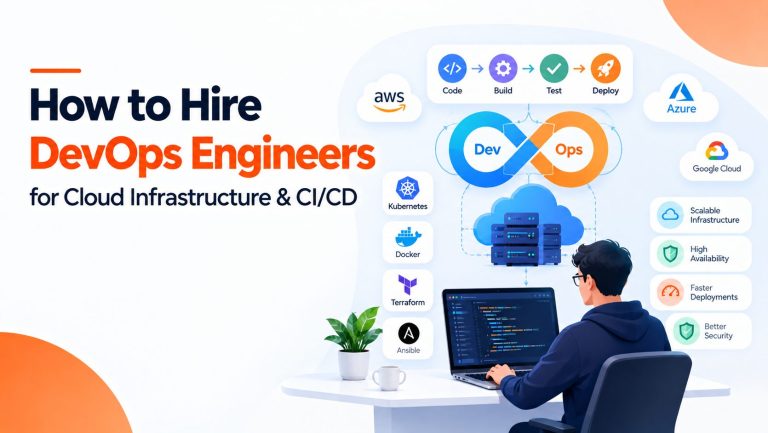
A DevOps engineer builds and runs the systems that carry code from a developer’s commit to a reliable production service. The role sits between software development and operations, which is why it covers more than servers or scripts. If you are asking what’s a DevOps engineer in practical terms, the answer is someone who shortens the path from code to stable production and keeps it stable as the system grows.
Depending on your environment, the work usually includes:
- Cloud infrastructure on AWS or Azure
- CI/CD pipeline design, testing, and release automation
- Infrastructure automation with Terraform, Bicep, or Ansible
- Containers and orchestration with Docker and Kubernetes
- Monitoring, logging, and observability
- Security automation, including secrets, scanning, and access control
- Deployment reliability and incident response
- Cloud cost management
Signs it is time to hire
Application developers can run basic deployments, but the cost shows up elsewhere. Consider hiring when:
- Developers lose sprint time to builds, environments, or release steps
- Releases depend on manual steps or one person who knows how they work
- Staging and production behave differently
- Customers report outages before your monitoring does
- Nobody owns cloud spend
- Security review happens after code is already live
DevOps engineer vs. SRE, cloud, platform, and CI/CD roles
| Role | Primary focus | Typical fit |
| DevOps engineer | End-to-end delivery: pipelines, infrastructure automation, deployment, and operations | Teams that need one owner for build, deploy, and run |
| Site reliability engineer (SRE) | Reliability targets, incident management, capacity planning | Mature services with uptime and latency commitments |
| Cloud engineer | Designing, migrating, and operating cloud infrastructure | Cloud migrations and environment design |
| Platform engineer | Internal developer platforms and self-service tooling | Many teams sharing standardized infrastructure |
| CI/CD specialist | Build, test, and release automation | Slow, flaky, or insecure pipelines |
Titles vary by company and responsibilities overlap, so judge the role by the work in the job description rather than the label.
What Skills Should You Look for When Hiring DevOps Engineers?
Do not ask for every tool on the market. Prioritize proven work in your own cloud, pipeline, and deployment stack, and treat adjacent tools as learnable. The table links each skill area to the responsibility it supports and a way to verify it.
| Skill area | Responsibility it supports | How to verify |
| Cloud platforms (AWS, Azure) | Networking, IAM, compute, storage, monitoring, cost control | Ask them to diagram a past environment and explain account, network, and permission boundaries |
| CI/CD and release automation | Builds, tests, artifacts, deployments, rollbacks, quality gates | Pipeline design exercise (see the assessment section) |
| Infrastructure as Code | Repeatable, reviewable environments with Terraform, CloudFormation, Bicep, or Ansible | Review a sample module; ask about state, environments, and drift |
| Containers and orchestration | Docker images, Kubernetes workloads, Helm, registries, scaling | Ask how they would debug a crash-looping pod and set resource limits |
| Scripting and automation | Python, Bash, PowerShell, and YAML to remove manual work | Review a script they wrote for error handling and readability |
| Security | Secrets, least privilege, vulnerability scanning, backup and recovery | Ask where secrets live in a pipeline and how access is reviewed |
| Observability and reliability | Logs, metrics, traces, alerting, incident response | Walk through an incident and the monitoring they added afterward |
| Collaboration | Documentation, communication, ownership, risk management | Ask for a runbook or design note they wrote and how they explain trade-offs |
AWS DevOps Engineer vs. Azure DevOps Engineer: Who Should You Hire?
Hire for the cloud you run. An engineer fluent in one platform can learn another, but the ramp-up costs time and risk, which matters most when you have live workloads, compliance duties, or a tight migration date.
| Area | AWS-focused engineer | Azure-focused engineer |
| CI/CD | CodePipeline, CodeBuild, CodeDeploy, or GitHub Actions and Jenkins deploying to AWS | Azure Pipelines, Azure Repos, or GitHub Actions deploying to Azure |
| Infrastructure as Code | CloudFormation, AWS CDK, Terraform | Bicep, ARM templates, Terraform |
| Identity and access | IAM roles and policies, AWS Organizations | Microsoft Entra ID, Azure RBAC, managed identities |
| Containers | Amazon ECS, Amazon EKS | Azure Kubernetes Service (AKS) |
| Monitoring | Amazon CloudWatch, AWS X-Ray | Azure Monitor, Application Insights |
| Governance | Service control policies, AWS Config | Azure Policy, management groups |
AWS describes its DevOps tooling around services such as CodePipeline, CodeBuild, CodeDeploy, CloudFormation, and CloudWatch. Microsoft documents Azure Pipelines as the Azure DevOps service that combines continuous integration, testing, and delivery. Use the official documentation to write precise job requirements. If your stack is AWS-heavy, you can also review AWS experts available through HireDeveloper.dev.
One naming trap: Azure DevOps is also Microsoft’s product suite, covering Boards, Repos, Pipelines, Artifacts, and Test Plans. When you hire Azure DevOps engineers or hire Azure DevOps developers, say whether you need Azure cloud infrastructure skills, Azure DevOps Services skills, or both. When you hire an AWS cloud DevOps engineer, name the services you actually run, such as ECS, EKS, or Lambda.
Hybrid and multicloud environments need extra care. Look for candidates who can keep identity, logging, and policy consistent across providers, and who use cloud-neutral tools such as Terraform and Kubernetes where they reduce lock-in rather than add complexity.
Credentials such as AWS Certified DevOps Engineer Professional and Microsoft Certified: DevOps Engineer Expert show structured study, and Microsoft’s expert credential requires an associate-level Azure certification first. They are useful signals, not proof of hands-on skill, so pair them with the assessments below.
How to Hire DevOps Engineers: A Step-by-Step Process
Each step should leave you with a written output. If you cannot produce it, the next step will be guesswork.
| Step | What to do | What you should produce |
| 1. Define the business problem | Choose the main outcome: release automation, migration, security, reliability, cost, or platform work | A one-paragraph problem statement with a measurable goal |
| 2. Audit the environment | Document cloud accounts, repositories, pipelines, monitoring, security controls, and bottlenecks | An environment inventory and a list of top operational pain points |
| 3. Define the role | Separate essential from optional skills; set seniority and specialization | A role scope with must-have and nice-to-have lists |
| 4. Choose the hiring model | Compare in-house, contract, dedicated, staff augmentation, and consulting options | A model decision using the matrices below |
| 5. Source candidates | Use referrals, technical communities, specialist DevOps recruitment firms, or development partners | A shortlist matched to the role scope |
| 6. Evaluate capability | Run a structured interview, a practical exercise, and a scenario assessment | A completed scorecard per candidate |
| 7. Verify experience | Probe past projects, architecture decisions, failures, and outcomes without confidential detail | Reference notes and verified claims |
| 8. Agree scope and metrics | Set responsibilities, access boundaries, deliverables, working arrangements, and reporting | A written scope, an access policy, and baseline metrics |
| 9. Onboard and review | Grant secure access, share documentation, and assign a prioritized backlog | A 30/60/90-day plan with review dates |
A DevOps engineer position description helps at step 3, but write it around outcomes, such as reducing release effort for one service, rather than a wall of tools. Employment terms like devops roles or devops engineer opportunities matter only for describing the work accurately to candidates.
Which DevOps Hiring Model Is Right for Your Business?
No model is always best or always cheapest. The right choice depends on how long the need lasts, how much management you can supply, and how specialized the work is. The ratings below are relative and qualitative; validate them against real quotes.
| Model | Hiring speed | Control | Long-term ownership | Specialist access | Flexibility | Mgmt overhead | Suitable duration |
| Full-time in-house | Slower; full recruiting cycle | High | High | Limited to who you hire | Low | High | Ongoing platforms |
| Contract engineer | Moderate | Medium to high | Low to medium | Depends on the individual | High | Medium | Defined projects |
| Remote engineer | Moderate; wider pool | Medium to high | Medium | Wider talent pool | Medium to high | Medium; needs overlap planning | Ongoing or fixed term |
| Dedicated DevOps developer | Depends on partner bench | High | Medium to high | Partner’s bench | Medium to high | Medium | Six months or more |
| Dedicated DevOps team | Depends on partner bench | Medium to high | High as a unit | Broad, multi-skill | Medium | Lower; team lead | Multi-quarter programs |
| DevOps consulting partner | Often quick for a scoped start | Lower to medium | Low unless handoff is planned | High, narrow expertise | High | Low | Weeks to months |
| Managed DevOps services | Varies by onboarding | Lower | Provider holds operations | Broad | Medium; contract terms | Low | Ongoing operations |
| Staff augmentation | Depends on vendor | High; you direct daily | Low to medium | Via vendor pool | High | Medium to high | Weeks to months |
In-house hires suit long-lived platforms that need continuous ownership. Contract and remote engineers, including teams that hire remote DevOps developers across time zones, suit defined projects but need planned knowledge transfer. To hire dedicated DevOps engineers or a dedicated DevOps team, ask how the partner vets and replaces them; this works like an extension of your group but still needs your direction. DevOps consultants, whether an independent expert, a DevOps consultant agency, or cloud DevOps consultants, fit scoped work such as audits, migrations, or pipeline rebuilds, so hire a DevOps consultant when the deliverable is clear. Managed DevOps services shift daily operations to a provider. DevOps staffing and staff augmentation fill gaps quickly when you already have a manager who can direct the work. Compare dedicated teams and staff augmentation before committing, and treat any DevOps engineer remote arrangement as a governance question as much as a hiring one.
Engineer vs. dedicated team vs. consulting partner
| Factor | Individual engineer | Dedicated DevOps team | Consulting partner |
| Project scope | One platform or pipeline area | Several workstreams at once, such as cloud, CI/CD, and security | A defined deliverable: audit, migration, or pipeline rebuild |
| Urgency | Limited by one person’s capacity | Higher capacity for parallel work | Good for focused starts when scope is clear |
| Duration | Ongoing or long project | Multi-quarter programs | Weeks to months, then handoff |
| Specialization | Depth in one or two areas | Breadth across specialties | Deep, narrow expertise on demand |
| Internal ownership | You need someone to direct and review the work | You need a technical lead to set priorities | You need a named owner to receive the handoff |
| Operational coverage | Single point of failure for on-call | Easier to cover rotations | Only if support is contracted |
Role selection decision tree
| If your main need is… | Consider |
| Automating releases | A CI/CD-focused engineer |
| Migrating or managing cloud infrastructure | A cloud DevOps engineer with AWS or Azure depth |
| Standardized infrastructure and developer self-service | Platform engineering expertise |
| Reliability targets and incident management | SRE capabilities |
| Several of the above delivered together | A dedicated DevOps team or a consulting partner |
Responsibilities overlap and titles differ between companies, so confirm the actual scope in the interview.
DevOps Hiring Readiness Scorecard
This self-assessment is an original editorial framework from HireDeveloper.dev, not an industry standard. Rate each dimension from 1 to 4 using the criteria below, then add the scores.
| Dimension | 1: Ad hoc | 2: Basic | 3: Defined | 4: Automated and measured |
| Cloud infrastructure maturity | Manual console changes; no standard accounts | Some standard setups; inconsistent environments | Documented architecture; consistent environments | Governed accounts, cost visibility, regular reviews |
| CI/CD automation | Manual builds and releases | Automated builds; manual releases | Automated test and deploy to staging and production | Automated gates, safe rollback, tracked delivery metrics |
| Infrastructure as Code | None | Partial; some drift | Most infrastructure in code with review | All infrastructure in code; drift and policy checks |
| Monitoring and incident response | Customers report problems | Basic uptime alerts | Dashboards, alerts, on-call, runbooks | Tracing, reliability targets, post-incident reviews |
| Security automation | Manual reviews; shared credentials | Some scanning | Secrets management and scanning in pipelines | Least privilege, supply chain controls, tracked remediation |
| Internal engineering capacity | No one can review or own infra work | One part-time owner | A lead who can direct and review | Engineers with time to own and extend the work |
| Total score | What it suggests |
| 6 to 11 | Foundation gaps in several areas. Consider a consulting partner for an assessment and roadmap, then a dedicated engineer or small team to execute. |
| 12 to 17 | Mixed maturity. Use the lowest-scoring dimensions to choose a specialist, such as a CI/CD or cloud engineer, under a contract or dedicated model. |
| 18 to 24 | Strong base. A senior hire or a platform or SRE specialist can refine reliability, cost, and developer experience. |
Two overrides matter more than the total. If internal capacity scores 1 or 2, a single engineer risks becoming a bottleneck, so favor a team or a consulting partner with documented handoff. If security automation scores 1, fix access and secrets handling before expanding automation.
How to Evaluate DevOps Engineers for Cloud Infrastructure and CI/CD
A resume and a certification show what someone has studied. They do not show whether the person can manage real production systems. Use scenarios that test reasoning, safety, and communication, and avoid syntax quizzes. Keep live exercises to about 60 to 90 minutes, or pay for longer take-home work.
Scenario 1: CI/CD pipeline design
Prompt: “Design a pipeline for a web application with automated tests, artifact storage, staging and production deployments, security checks, and rollback.” Evaluate: pipeline architecture, failure handling, secrets management, deployment safety, and maintainability.
Strong signs: versioned artifacts built once and promoted, approval rules for production, a tested rollback path, and short-lived cloud credentials. For example, GitHub Actions workflows can request short-lived tokens through OpenID Connect instead of storing long-lived cloud secrets. OWASP’s Top 10 CI/CD Security Risks is a useful checklist for what a security-aware design should cover, including flow control, identity, credential hygiene, and logging.
Scenario 2: Infrastructure as Code
Prompt: share a Terraform or Bicep configuration and ask the candidate to review it, or to explain one they built. Evaluate: modularity, state management, change review, secrets handling, environment separation, and drift management.
Strong signs: remote state with locking (Terraform’s remote state documentation explains how locking prevents concurrent runs), plan output reviewed before apply, separate state per environment, secrets kept out of code, and a method for detecting manual changes.
Scenario 3: Production incident
Prompt: “A deployment went out, latency has doubled, and your dashboards only show CPU. Walk me through the next 30 minutes.” Evaluate: troubleshooting, prioritization, communication, recovery, and post-incident prevention.
Strong signs: stabilizes first by rolling back or disabling the change, checks recent changes, separates application causes from infrastructure causes, communicates status, and proposes monitoring and process fixes afterward. Warning signs: debugging live with no rollback decision, or blaming another team.
Practical CI/CD assessment rubric
Ask for a pipeline diagram and a short written rollback plan rather than working code. Score each criterion from 1 to 4.
| Criterion | Strong answer (3 to 4) | Warning sign (1 to 2) |
| Pipeline architecture | Clear stages, fast feedback, parallel tests, artifact built once and promoted | Rebuilds per environment; unclear stage order |
| Failure handling | Fails fast, retries only safe steps, clear logs and ownership | Ignores flaky tests; silent failures |
| Security | Dependency and image scanning, least privilege, short-lived credentials, protected branches | Long-lived keys in variables; shared admin tokens |
| Deployment safety | Staged rollout such as blue/green or canary, health checks, tested rollback | “We would fix forward” with no rollback plan |
| Maintainability | Reusable templates, documented, versioned pipeline code | Copy-pasted configs per service |
| Business reasoning | Links choices to release speed, risk, and cost | Tool-first answers with no trade-offs |
Technical scorecard
The weights below are a proposed evaluation framework, not an industry standard. Adjust them to the role: a migration hire may weight cloud architecture higher, while a pipeline specialist may weight CI/CD higher.
| Criterion | Weight | Evidence to look for |
| Cloud architecture | 20% | Sound network, identity, and resilience choices on AWS or Azure |
| CI/CD and release automation | 20% | Score from the pipeline rubric above |
| Infrastructure as Code | 15% | State handling, modularity, review process, drift management |
| Security | 15% | Secrets, least privilege, scanning, backup and recovery |
| Observability and reliability | 15% | Metrics, alerting, reliability targets |
| Troubleshooting | 10% | Performance in the incident scenario |
| Communication and documentation | 5% | Clarity of explanations and written artifacts |
DevOps Engineer Interview Questions Employers Should Ask
Ten practical questions are enough. Each one tests judgment rather than definitions.
| Question | A strong answer shows |
| How would you design a secure CI/CD pipeline for a production application? | Staged promotion, scanning, protected branches, short-lived credentials, approvals, and audit logs |
| How do you manage Terraform state and prevent unsafe changes? | Remote state with locking, per-environment state, plan review, restricted apply permissions |
| How would you roll back a failed deployment? | Versioned artifacts, health checks, rollback criteria, and a plan for database changes |
| How do you manage secrets in build and deployment pipelines? | Secret manager use, rotation, short-lived identity, no secrets in logs or repositories |
| How would you investigate an unexpected increase in cloud costs? | Cost allocation tags, billing breakdown by service, recent change review, right-sizing, guardrails |
| How do you distinguish an application failure from an infrastructure failure? | Metrics, logs, and traces; dependency checks; comparison of recent deploys and config |
| What metrics would you use to evaluate deployment reliability? | DORA measures such as change fail rate and failed deployment recovery time, read in context |
| How would you migrate manual provisioning to Infrastructure as Code? | Inventory, importing existing resources, incremental migration, review workflow, drift checks |
| Describe a production incident you helped resolve and what changed afterward. | A specific timeline, their own role, honest mistakes, and concrete prevention work |
| How would you improve a pipeline that takes too long to deliver a release? | Measure first, then parallelize, cache, split slow tests, and remove manual waits |
How Much Does It Cost to Hire DevOps Engineers in 2026?
Cost depends on the model, so compare like with like. The salary data below comes from aggregators that blend sources and methods, which is why figures differ. Treat them as market context for an employed devops engineer position, not as a quote from any vendor.
| Cost model | What the figure measures | Data available for this guide |
| Annual employee salary, USA | Average base pay, early 2026, USD | Roughly $137,000 to $144,000 across aggregators. A salary roundup dated April 6, 2026 lists Glassdoor $142,104, Salary.com $139,121, and Indeed $136,897 |
| Annual employee salary, India | Average pay, 2026, INR per year (LPA = lakh per annum) | Roughly 7.8 to 10 LPA depending on source. A summary of AmbitionBox, PayScale, and Indeed India (AmbitionBox updated October 5, 2026) cites 8.8 to 9.8 LPA for 2 to 6 years of experience, a PayScale median of 9.98 LPA, and an Indeed average of 7.79 LPA |
| Hourly contractor rates | Freelance or contract hourly billing | No reliable, dated public benchmark found. Published vendor ranges differ widely and rarely state method or date, so this guide does not repeat them |
| Monthly dedicated engineer | Partner-billed monthly cost | Quote based; varies by seniority, skills, and overlap hours |
| Consulting and managed services | Project fees or service contracts | Scope based; compare against one written scope |
Salary is not total cost. In-house hiring also carries benefits, recruiting, equipment, tooling, and management time, while vendor models carry margin, onboarding, and replacement terms. Actual cost varies with:
- Experience and specialization, including AWS or Azure depth
- Kubernetes and platform engineering depth
- Security and compliance requirements
- On-call responsibilities
- Engagement duration and team size
- Time-zone overlap
- Scope of consulting or managed services
How to get comparable quotes: write one scope document, state seniority and overlap hours, ask for the fully loaded monthly cost, clarify on-call and replacement terms, confirm what tools and cloud spend are excluded, and compare total cost over six months. HireDeveloper.dev also publishes a developer cost estimate tool for general budgeting.
How to Measure the Impact of a DevOps Engineer
DORA now describes five software delivery performance metrics, grouped into throughput and instability. Many older guides still list four. DORA renamed the recovery metric, now focused on failed deployments, and added deployment rework rate as a fifth measure, as its history of the metrics explains.
| Metric | What it shows | Interpret with care |
| Deployment frequency | How often changes reach production | High frequency with high rework means shipping problems faster |
| Lead time for changes | Time from commit to production | Include review and approval waits, not only pipeline time |
| Change failure rate | Share of deployments that need immediate fixes | Define “failure” consistently across teams |
| Failed deployment recovery time | Time to recover from a failed deployment (formerly time to restore service) | Separate change-caused failures from external outages |
| Deployment rework rate | Share of deployments that are unplanned responses to production incidents | The newest DORA metric; a signal of firefighting |
| Supporting measures | Pipeline duration, provisioning time, availability, cloud cost per workload, security remediation time, developer time on operations | Pick the few that match your original business problem |
Set baselines before the engineer starts, choose two or three metrics tied to the original problem, and review them quarterly. One hire cannot move every metric automatically, because results also depend on code quality, team habits, and leadership support.
Common Mistakes to Avoid When Hiring DevOps Engineers
| Mistake | How to avoid it |
| Hiring from tool lists instead of demonstrated ability | Use scenario assessments and the scorecard |
| Expecting one engineer to own every cloud, security, and platform task | Split scope or use a team or partner |
| Not defining the business problem | Write a measurable problem statement first |
| Overlooking security and access controls | Define least-privilege access and secrets practices before day one |
| Ignoring documentation and knowledge transfer | Require runbooks and architecture notes as deliverables |
| Treating DevOps as a tool rollout | Involve developers, security, and operations in the change |
| Underestimating legacy infrastructure | Audit first and phase the work |
| Setting unrealistic delivery expectations | Agree on a 30/60/90-day plan with the engineer |
| Not budgeting for maintenance and improvements | Plan ongoing capacity, not only a one-time build |
| Having no success metrics | Baseline DORA and cost data before the start |
| Granting excessive production access | Use role-based access, approvals, and audit logs |
How to Choose a DevOps Consulting Company or Engineering Partner
Companies searching for DevOps consulting experts in USA or DevOps engineering services in USA should ask the same questions of every provider, whether the delivery team sits in the US, India, or both. Compare delivery locations on evidence, not assumptions:
| Factor | US-based delivery | India-based delivery |
| Capability | Depends on the specific engineers and track record, not the country | Depends on the specific engineers and track record, not the country |
| Communication and overlap | Natural overlap with US business hours and on-call | Needs an agreed overlap window and clear handoffs |
| Governance | Check contracts, access controls, and compliance fit | Check security certifications, access controls, data handling, and NDAs |
| Total engagement cost | Salary data suggests higher base rates; confirm with quotes | Salary data suggests lower base rates; add management, overlap, and rework costs |
Vendor evaluation checklist
- Demonstrable cloud and CI/CD experience, with verifiable case studies and references
- Relevant AWS or Azure capabilities for your environment
- Infrastructure as Code expertise and code review practices
- Security and compliance practices, including access control and secrets handling
- A technical evaluation process for the engineers they place
- Documentation and knowledge transfer built into the contract
- Named lead, communication cadence, and reporting
- Flexible engagement terms, including notice and scaling
- Ongoing support and incident management terms
- Transparent pricing and written scope
HireDeveloper.dev is one option for businesses exploring dedicated developers, remote engineering talent, or software development support. Its technology areas include cloud and DevOps, and you can learn how it works with dedicated development teams. As with any provider, request a scoped proposal and apply the checklist above.
First 30, 60, and 90 Days After Hiring
| Window | Focus | Typical outputs |
| Days 1 to 30 | Understand the environment, map risks, establish baselines, document critical systems | Architecture notes, risk register, baseline DORA and cost data, access review |
| Days 31 to 60 | Automate the highest-value bottleneck, improve the key pipeline or infrastructure, address agreed security gaps | One improved pipeline or IaC module in use, closed security items, updated runbooks |
| Days 61 to 90 | Review measured results, document operational procedures, propose the next roadmap | Metric comparison to baseline, operations documentation, next-quarter roadmap |
Adapt the plan to seniority and project complexity. A senior engineer may own a roadmap by day 60, while a more junior hire may need a narrower backlog and closer review.
DevOps Hiring Checklist for 2026
- Business objective defined
- Current infrastructure documented
- Cloud platform selected or confirmed
- Required experience and specialization established
- Essential skills separated from optional skills
- Security responsibilities defined
- Technical assessment prepared
- Budget and hiring model agreed
- Success metrics established
- Access and onboarding process prepared
- Knowledge transfer and documentation planned
Conclusion: Hire DevOps Engineers Who Solve the Right Problems
The best results come from matching the engineer to the problem. Define your business objective, confirm your cloud environment, assess CI/CD maturity honestly, and test technical depth with realistic scenarios. Choose a hiring model that fits the duration and ownership you need, build security and access control into the engagement from day one, and agree on metrics before work starts.
If you plan to hire DevOps engineers, treat the process as a way to fix delivery and infrastructure problems, not only to fill a role. To discuss your DevOps requirements or explore engineering support, you can talk to the HireDeveloper.dev team.
Our Other Services
- Hire Dedicated Developers
- Hire React Developers
- Hire Node.js Developers
- Hire .NET Developers
- Hire PHP Developers
- Hire Flutter Developers
- Hire iOS Developers