






Introduction
The global demand for AI engineers, SaaS developers, and cloud architects has outpaced the supply in most Western markets. Hiring timelines in the US and UK now stretch to three to six months for senior technical roles, and compensation for a single mid-level AI engineer can exceed $150,000 per year. Meanwhile, India has quietly built one of the deepest and most diverse technology talent ecosystems in the world.
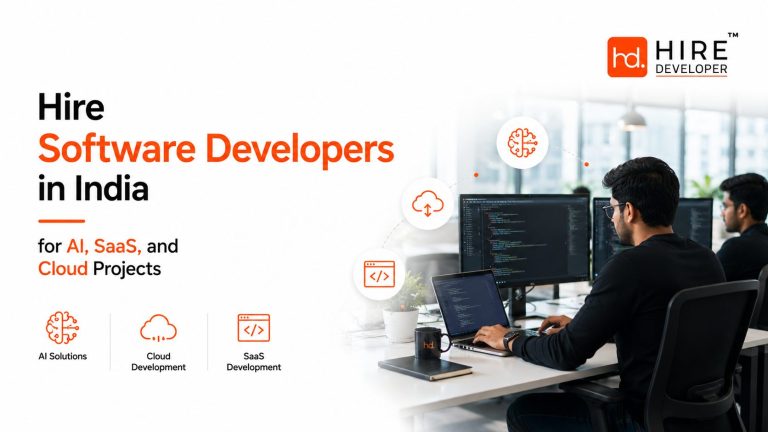
For founders scaling their SaaS platform, CTOs modernizing enterprise infrastructure, and product teams building AI-powered applications, India offers a practical and proven answer. This guide explains exactly how to hire software developers in India effectively, what skills matter for AI, SaaS, and cloud projects, how much it costs, and how to avoid the mistakes that slow most companies down.
Why Hire Software Developers in India?
India is the world’s largest pool of English-speaking software engineers, with over 5.4 million developers actively working across AI, SaaS, cloud, and product engineering. Companies in the US and UK hire Indian developers to cut costs by 60 to 75 percent, scale teams faster, and access deep expertise in generative AI, cloud-native architecture, and SaaS product development — without sacrificing quality.
Why Global Companies Are Hiring Software Developers in India in 2026
India’s Growing Role in Software Development
India is home to over 5.4 million software developers, producing more than 1.5 million engineering graduates each year. Cities like Bangalore, Hyderabad, Pune, Chennai, and Delhi NCR have grown into internationally recognized technology hubs with mature delivery ecosystems, reliable infrastructure, and deep experience across every major technology stack. Indian software exports exceeded $194 billion in FY2023, reinforcing India’s position as the preferred offshore software development destination for companies worldwide.
Rising Demand for AI, SaaS, and Cloud Talent
The explosion of generative AI tools, cloud-native applications, and subscription-based SaaS products has created enormous demand for specialized engineering skills. Indian developers have adapted quickly. A large number of engineering teams in India now specialize in building LLM-integrated applications, multi-tenant SaaS architecture, and cloud-based software solutions on AWS, Azure, and Google Cloud. The talent pool is no longer just about cost. It is about access to genuine expertise that is increasingly hard to find locally.
Why US and UK Companies Prefer Indian Developers
Beyond the well-known cost advantage, US and UK companies return to Indian development partners for two practical reasons: strong English communication and a culture that aligns well with Agile, scrum-based delivery. Indian developers are experienced working across time zones, adapting to US Eastern, Pacific, and UK schedules without significant friction. Many senior engineers hold international experience from stints at global tech companies, further narrowing any cultural gap.
Key Industry Statistics and Market Trends
- India graduates over 1.5 million engineering students annually, the largest STEM output globally.
- India’s IT sector revenue reached $227 billion in 2023-24 according to NASSCOM.
- Over 1,400 global capability centers (GCCs) operate in India, including units for Google, Microsoft, Amazon, and Goldman Sachs.
- The AI talent pool in India grew by 45 percent between 2022 and 2024, with a strong concentration of LLM, ML, and cloud-native engineers.
- Software development outsourcing to India is projected to grow at a CAGR of 7.2 percent through 2028.
What Types of AI, SaaS, and Cloud Projects Can Indian Developers Build?
AI-Powered Applications
From intelligent recommendation engines to computer vision systems, Indian AI engineers build production-grade AI applications across healthcare, fintech, edtech, and e-commerce. Most teams work with Python-based ML frameworks, vector databases, and cloud-hosted AI infrastructure to deliver scalable solutions with real business impact.
Generative AI and LLM Solutions
Generative AI development is one of the fastest-growing specializations among Indian developers in 2026. Teams build RAG-based search tools, LLM-powered copilots, AI document processors, and autonomous AI agents using frameworks like LangChain, LlamaIndex, and AutoGen. Experience with OpenAI, Anthropic, Gemini, and open-source LLMs like Mistral and LLaMA 3 is now common among senior Indian AI engineers.
SaaS Platforms and SaaS Products
Indian developers are highly experienced in building SaaS platforms and SaaS products from scratch. This includes designing multi-tenant architectures, building subscription and billing systems using Stripe or Paddle, implementing feature flags, and creating scalable REST or GraphQL APIs. Whether you are building a B2B SaaS tool, a marketplace, or a vertical SaaS application, you will find strong product engineering capability in India.
Cloud-Based SaaS Solutions and Infrastructure
Cloud-based SaaS solutions and cloud-native applications are a core strength of Indian engineering teams. Developers work across the full cloud stack: designing serverless backends, building containerized microservices, setting up CI/CD pipelines, and managing cloud infrastructure using Terraform and Kubernetes. Whether you need AWS development, Azure development, or Google Cloud development, there is a strong cohort of certified engineers available.
Cloud Migration and Application Modernization
Enterprises moving from on-premises systems to cloud-based software regularly partner with Indian teams for cloud migration services. This includes re-platforming monolithic applications to microservices, migrating databases to manage cloud services, and re-architecting legacy systems to support modern cloud management software and cloud project management software workflows.
What Skills Should You Look for When Hiring Software Developers in India?
Matching the right skills to your project type is the most important hiring decision you will make. Here is a practical skills map:
| AI / ML | SaaS & Cloud | DevOps & Security |
| Python, TensorFlow, PyTorch | React, Node.js, Golang | Docker, Kubernetes |
| LangChain, LlamaIndex, RAG | Multi-tenant architecture | CI/CD pipelines (GitHub Actions) |
| OpenAI, Gemini, Mistral APIs | REST & GraphQL APIs | AWS, Azure, GCP certifications |
| Prompt engineering | Stripe, Paddle integrations | Terraform, Helm, ArgoCD |
| Vector DBs (Pinecone, Weaviate) | SaaS billing & feature flags | SOC 2, GDPR compliance |
Security and Compliance
For SaaS applications handling user data, or cloud services software in regulated industries, look for developers who understand GDPR, SOC 2 Type II, HIPAA basics, and secure coding practices including OWASP Top 10. Security expertise is often the most overlooked skill during technical evaluation.
Product Engineering Knowledge
The best Indian developers for startup and SaaS environments bring more than coding ability. They understand product thinking: shipping MVPs, iterating based on user feedback, managing tech debt, and designing systems that scale. When hiring for a SaaS product company, always test for product engineering mindset alongside technical skills.
Benefits of Hiring Indian Software Developers for AI, SaaS, and Cloud Projects
Cost Efficiency Without Compromising Quality
The salary difference between a senior AI engineer in the US ($150,000 to $220,000 annually) and an equivalent developer in India ($24,000 to $54,000 annually) is significant enough to reshape a startup’s engineering budget. Most companies reinvest those savings into faster product development, broader test coverage, or a larger team.
Access to a Deep and Diverse Talent Pool
Hiring locally in the US or UK for niche roles like LLM developers, SaaS architects, or DevOps engineers with Kubernetes expertise can take four to six months. India offers immediate access to a much larger and rapidly growing pool of engineers with these exact skills.
Faster Team Scaling
When a SaaS product wins a large enterprise contract or a startup secures its Series A, the ability to double the engineering team in four to eight weeks becomes critical. Dedicated development teams in India, especially through platforms like HireDeveloper.dev, make this kind of rapid scaling possible without the recruitment overhead.
Communication Advantages
India has one of the highest concentrations of English-speaking technical professionals in the world. Senior developers at reputable firms are experienced in daily standups, sprint reviews, and stakeholder communication. Overlap windows with US time zones (morning IST) and UK time zones (afternoon IST) make synchronous collaboration manageable.
Long-Term Technology Partnership
The most successful offshore software development relationships are long-term partnerships, not short-term contracts. Indian development teams that understand your product evolve into strategic technology partners, helping you plan roadmaps, evaluate new technologies, and maintain scalable architecture as your business grows.
Cost of Hiring Software Developers in India in 2026
The following table shows monthly cost benchmarks for key roles across India, the US, and the UK. These are market estimates based on mid to senior experience levels and full-time equivalent engagement.
| Role | India (Monthly) | USA (Monthly) | UK (Monthly) |
| AI / ML Engineer | $2,000 – $4,500 | $12,000 – $20,000 | $10,000 – $17,000 |
| LLM / GenAI Developer | $2,500 – $5,000 | $14,000 – $22,000 | $11,000 – $18,000 |
| SaaS Full-Stack Developer | $1,800 – $3,500 | $10,000 – $16,000 | $9,000 – $14,000 |
| Cloud / DevOps Engineer | $2,000 – $4,000 | $11,000 – $18,000 | $9,500 – $16,000 |
| Backend Developer (Node/Go) | $1,500 – $3,000 | $9,000 – $15,000 | $8,000 – $13,000 |
Cost vs Value Note
These numbers reflect base compensation only. US and UK figures do not include employer taxes, benefits, equity, office costs, or recruiter fees — which can add 30 to 50 percent on top. Indian developers through a platform like HireDeveloper.dev come pre-vetted and can be onboarded without those overhead costs.
How to Hire Software Developers in India: A Step-by-Step Process
Step 1 — Define Requirements Clearly
Before posting a job or contacting a vendor, write a clear technical brief. Specify the technology stack, project type (AI, SaaS, cloud), team structure, expected milestones, and communication cadence. Vague briefs attract generalist candidates who are unlikely to fit specialized needs.
Step 2 — Choose a Hiring Model
Decide between a dedicated developer, a freelancer, or a full custom software development company. The choice depends on your project complexity, team size needs, and how long you plan to engage. For most SaaS and AI products, dedicated developers or a full software development company offer more reliability than freelancers.
Step 3 — Evaluate Technical Skills Rigorously
Use a structured technical assessment. For AI roles, test practical ML knowledge, prompt engineering, and system design. For SaaS developers, assess API design, database schema design, and multi-tenant architecture understanding. For cloud engineers, give a real-world infrastructure challenge. Avoid relying on resumes alone.
Step 4 — Assess Communication Quality
Run at least two video interviews, one technical and one process-oriented. Evaluate how candidates explain complex concepts, ask clarifying questions, and respond to ambiguous requirements. Communication quality predicts long-term collaboration success better than technical scores alone.
Step 5 — Run a Paid Pilot Project
A two to four week paid pilot gives you real data on code quality, deadline adherence, and communication. This is the single best predictor of long-term performance. Pay fairly for the pilot — candidates who see a genuine commitment reciprocate with genuine effort.
Step 6 — Scale the Team Systematically
Once a core developer proves reliable, onboard additional team members using the same evaluation process. Document your codebase, processes, and product requirements clearly to enable faster onboarding for each new hire. A strong developer handbook saves weeks of ramp-up time.
Dedicated Developers vs Freelancers vs Software Development Companies
Choosing the wrong engagement model is one of the most common and costly mistakes companies make when hiring in India. Here is how each model performs across critical dimensions:
| Factor | Dedicated Team | Freelancer | Dev Company |
| Cost | Medium | Low | Medium–High |
| Reliability | High | Variable | High |
| Scalability | Excellent | Limited | Good |
| IP Control | Full | Partial | Full |
| Best For AI Projects | Yes | No | Yes |
| Best For SaaS Builds | Yes | Limited | Yes |
| Best For Cloud Projects | Yes | No | Yes |
For AI product development, dedicated teams offer the context continuity and accountability that complex model-building requires. For SaaS builds, both dedicated developers and software development companies work well depending on team size. For cloud projects involving infrastructure, a company with DevOps engineers and cloud certifications is often the safest choice.
Common Mistakes Companies Make When Hiring Developers in India
Choosing Based Only on Cost
The cheapest developer in India is rarely the best value. Sub-market rates often signal underskilled candidates or firms that overpromise and underdeliver. Treat the hourly or monthly rate as one data point, not the primary filter.
Ignoring Domain Expertise
A developer who is technically strong but has never built a SaaS platform will struggle with subscription logic, tenant isolation, and feature entitlement systems. Always evaluate domain-specific experience alongside raw technical skills.
Weak Technical Evaluation
Hiring based on a resume and a 30-minute call is a guaranteed path to expensive rework. Invest in a proper technical assessment and a paid pilot. The cost of evaluating thoroughly is a fraction of the cost of replacing a bad hire.
Poor Communication Setup
Many outsourcing relationships fail not because of code quality but because of unclear communication processes. Define sprint cycles, async communication norms, code review expectations, and escalation paths before the project starts.
No Scalability Planning
Starting with one developer and having no plan for scaling the team creates bottlenecks at the worst possible moment. Establish a relationship with a partner who can add engineers quickly and reliably when your product roadmap demands it.
How to Evaluate a Software Development Company in India
When hiring through a software development company rather than direct freelancers, your evaluation criteria should shift toward organizational capability and delivery track record. Here is what matters most:
- Portfolio quality: Look for documented case studies in AI, SaaS, or cloud projects. Generic portfolio pages without technical depth are a red flag.
- Cloud certifications: AWS Certified Solutions Architect, Google Professional Cloud Architect, and Azure Administrator certifications confirm genuine cloud expertise.
- AI and SaaS specialization: Companies offering custom software development solutions across dozens of unrelated industries often lack the deep domain expertise that specialized AI and SaaS projects require.
- Team scalability: Ask directly how quickly they can add engineers if your project scope increases. A good custom cloud software development partner has a pipeline of available talent.
- Software development as a service model: Companies that operate on a software development as a service model — with clear SLAs, project managers, and delivery accountability — are safer for production-grade projects than informal freelance networks.
- Client references: Ask for two or three client contacts you can speak with directly. Verified references are the strongest signal of reliable delivery.
Why AI, SaaS, and Cloud Startups Prefer Dedicated Development Teams
The dedicated development team model has become the default choice for venture-backed startups and growing SaaS companies hiring in India. The reasons are straightforward:
Faster Product Delivery
A dedicated team that works exclusively on your product moves faster than developers split across multiple client accounts. Context continuity means less ramp-up time at the start of every sprint.
Reduced Hiring Risk
When you hire through a platform like HireDeveloper.dev, developers are pre-screened, technically assessed, and matched to your project requirements before you interview them. This eliminates most of the uncertainty that comes with self-sourcing engineers.
Easier Scaling
Adding a developer to a dedicated team is far simpler than starting a new recruitment cycle. The new hire joins an established team with existing documentation, processes, and codebase familiarity.
Full Ownership and Accountability
Dedicated developers treat your product as their primary focus. Unlike project-based vendors who hand off code after delivery, dedicated teams stay invested in the long-term health of the product, the architecture decisions, and the codebase quality.
Why Businesses Choose HireDeveloper.dev for AI, SaaS, and Cloud Projects
HireDeveloper.dev has built a curated network of pre-vetted Indian engineers specializing in the technologies that matter most for AI, SaaS, and cloud-native product companies. Here is what makes the platform a reliable hiring partner:
- Pre-vetted talent: Every developer on the platform has passed a multi-stage screening process covering technical skills, communication, and domain knowledge.
- AI engineering specialists: Access to ML engineers, LLM developers, generative AI specialists, and AI product developers with production experience.
- SaaS development expertise: Developers experienced in building multi-tenant SaaS platforms, subscription systems, API-first backends, and cloud-based SaaS solutions.
- Cloud and DevOps engineers: Teams skilled in AWS, Azure, and Google Cloud with certifications and hands-on infrastructure experience.
- Flexible engagement models: Hire a single dedicated developer, assemble a cross-functional team, or scale to a full product engineering squad based on your project needs.
- Fast onboarding: Most companies begin working with matched developers within 48 to 72 hours of initial contact.
- Reduced hiring risk: The combination of pre-screening, pilot project support, and ongoing talent management significantly lowers the risk of a bad hire.
Hire Software Developers in India with HireDeveloper.dev
Stop losing months to broken hiring pipelines. HireDeveloper.dev connects you with pre-vetted AI engineers, SaaS specialists, and cloud architects from India’s top technical talent pool. Whether you need a single dedicated developer or a full product engineering team, the platform is built for fast, risk-reduced hiring.
Every developer is technically assessed, communication-tested, and matched to your specific project needs before you spend a single hour interviewing. Most companies go from first contact to working developer in 48 to 72 hours.
Ready to build faster? Visit hiredeveloper.dev to post your requirements and get matched with the right developer today.