






Introduction
Most companies do not start out looking to hire full stack developers. They start with a product idea, a growth target, or a backlog that in house teams cannot clear fast enough. Somewhere in that process, a founder, CTO, or engineering manager realizes they need someone who can move between frontend, backend, database, and deployment work without constant handoffs. That is when the search for a full stack developer usually begins, and it is also where most hiring decisions go wrong.
India has become one of the largest sources of full stack engineering talent for companies in the United States, United Kingdom, Canada, Australia, and Europe, mainly because of the volume of computer science graduates entering the workforce each year and the maturity of its outsourcing and remote development industry. That scale does not automatically translate into the right hire for your project. Rates vary widely, skill depth varies widely, and the hiring model you choose changes both cost and risk.
What Is a Full Stack Developer?
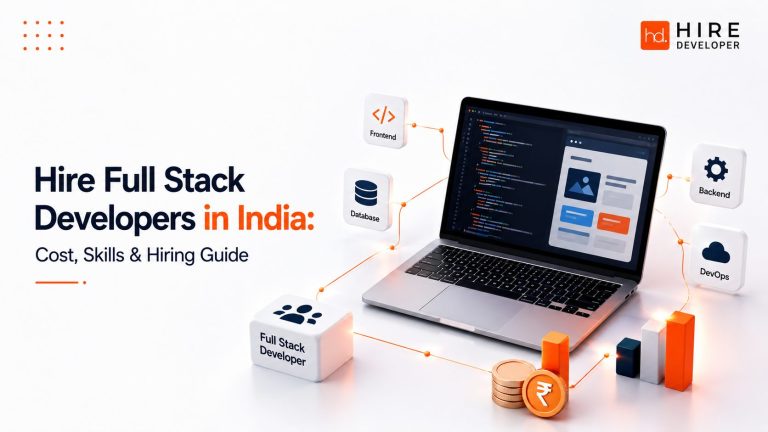
A full stack developer is a software engineer who can build and maintain both the frontend (what users see and interact with) and the backend (servers, databases, and business logic) of a web or software application. In practice, that means working across:
- Frontend: user interfaces built with frameworks such as React, Angular, or Vue.js
- Backend: application logic and APIs built with Node.js, Python, PHP, Java, or .NET
- Database: designing and querying relational databases like PostgreSQL and MySQL, or NoSQL databases like MongoDB
- APIs: building and consuming REST or GraphQL interfaces that connect frontend and backend
- Cloud: deploying and configuring services on AWS, Microsoft Azure, or Google Cloud
- Testing: writing unit and integration tests to catch defects before release
- Deployment: managing CI/CD pipelines so code reaches production reliably
- Security: applying secure coding practices across every layer of the application
For a business buyer, the practical definition matters more than the textbook one: a full stack developer is someone you can hand a feature end to end, from database schema to shipped UI, without needing to coordinate two separate specialists for every task.
Why Hire Full Stack Developers in India in 2026?
Companies hire full stack developers in India for a combination of practical business reasons rather than any single advantage. The main factors are:
- Talent pool size: India produces one of the largest annual pools of engineering graduates in the world, which gives buyers more candidates to filter through at every experience level
- Cost efficiency: salary and hourly cost structures in India are generally lower than in the US, UK, Canada, or Western Europe for comparable experience, though the gap varies by skill and seniority
- Remote-first maturity: Indian developers and development companies have years of experience working with distributed, remote-first teams across time zones
- Technology breadth: strong representation across modern stacks, including MERN, Python and Django, Laravel, Java and Spring Boot, and .NET
- Flexible scaling: it is generally easier to scale a team up or down through Indian development partners than to expand an in-house team quickly in a high-cost market
- Time-zone overlap: India’s working hours overlap partially with both US evening hours and UK/European working hours, which supports daily standups and async handoffs
None of this means Indian developers are universally the cheapest or the best option for every project. It means India is a market worth evaluating seriously, with the same diligence you would apply anywhere else.
What Does a Full Stack Developer Do?
Day to day, a full stack developer’s responsibilities typically include:
- Building user-facing features in a frontend framework
- Designing and implementing backend services and business logic
- Designing database schemas and writing efficient queries
- Building and integrating REST or GraphQL APIs
- Writing and maintaining automated tests
- Debugging issues across the full application stack
- Deploying code through CI/CD pipelines
- Configuring and monitoring cloud infrastructure
- Applying application security practices, such as input validation and access control
- Optimizing performance at the frontend, backend, and database level
- Maintaining and updating existing code as the product evolves
How Much Does It Cost to Hire Full Stack Developers in India?
The cost to hire full stack developers in India depends on five main factors: experience level, technology stack, project complexity, engagement model, and contract duration. Below are approximate, commonly observed ranges. These are estimates, not guaranteed pricing, and actual rates will vary by developer, agency, and project scope.
- Junior full stack developers (0 to 2 years): lower end of the market, suited to well-defined tasks with senior oversight
- Mid-level developers (2 to 5 years): can own features independently with moderate guidance
- Senior developers (5 to 8 years): can own architecture decisions for a feature or module
- Lead or architect-level developers (8+ years): can define system architecture and mentor a team
Hourly hiring tends to suit short, well-scoped tasks. Monthly or dedicated hiring tends to suit ongoing product development, since it gives you a consistent team member rather than fragmented hours. Freelancers are usually the lowest-cost option per hour but carry more availability and reliability risk than a dedicated developer sourced through an agency or platform. Staff augmentation and dedicated development models sit between freelance and full in-house hiring, offering more accountability than a freelancer while remaining more flexible and typically less expensive than building an equivalent in-house team in a high-cost country.
Full Stack Developer Hourly Rates in India by Experience
The table below summarizes typical hourly and monthly ranges by experience level. Treat these as directional benchmarks for budgeting conversations rather than fixed quotes.
| Experience | Typical Hourly Range (USD) | Typical Monthly Range (USD) | Responsibilities | Best Use Case |
| Junior | $15 to $25 | $1,000 to $1,800 | Feature implementation under guidance, bug fixes, small tasks | Simple features, MVP support tasks |
| Mid-Level | $25 to $40 | $1,800 to $3,200 | Independent feature ownership, API integration, code reviews | Core product development |
| Senior | $40 to $60 | $3,200 to $5,000 | Architecture decisions, complex integrations, mentoring | Scaling products, complex systems |
| Lead / Architect | $55 to $80+ | $5,000 to $8,000+ | System architecture, technical strategy, team leadership | Enterprise systems, multi-team projects |
Rates shift based on the specific technology stack, whether the developer works through a freelance platform or a development company, the complexity of the domain (fintech and healthcare projects, for example, typically command higher rates than standard business applications), and how long the engagement runs. Longer, more predictable engagements often unlock better rates than short, one-off contracts.
Full Stack Developer Cost by Technology Stack
Technology stack affects cost because some stacks have a larger supply of experienced developers in India, while others require more specialized or scarcer expertise.
| Stack | Typical Relative Cost | Notes |
| MERN (MongoDB, Express, React, Node.js) | Moderate | Large talent pool, strong for SaaS and startups |
| MEAN / MEVN | Moderate | Similar supply to MERN, Angular or Vue on the frontend |
| Python + React (Django or FastAPI) | Moderate to higher | Strong fit for data-heavy and AI-integrated applications |
| Laravel + Vue or React (PHP) | Lower to moderate | Cost-efficient for content platforms and business applications |
| Java + React (Spring Boot) | Higher | Common in enterprise systems, deeper backend specialization |
| .NET + React or Angular | Higher | Common in enterprise and Microsoft-stack environments |
Specialization affects cost more than framework popularity. A developer with strong Python and Django experience for a data-heavy or AI-integrated product may cost more than a generalist MERN developer, even though both are full stack developers, because the specialized skill set is scarcer relative to demand.
What Skills Should You Look for When Hiring a Full Stack Developer?
Technical Skills
- Frontend: JavaScript, TypeScript, React, Next.js, Angular, or Vue.js, along with HTML and CSS fundamentals
- Backend: Node.js and Express.js, Python with Django or FastAPI, PHP with Laravel, Java with Spring Boot, or .NET and ASP.NET Core
- Database: relational design with PostgreSQL or MySQL, and NoSQL modeling with MongoDB or Redis for caching
- API design: building and consuming REST APIs and, increasingly, GraphQL
- Cloud and DevOps: working knowledge of AWS, Azure, or Google Cloud, plus Docker, Kubernetes, and CI/CD pipelines
- Version control: fluency with Git and collaborative workflows on GitHub
- Architecture: understanding of microservices versus monolithic architecture and when each applies
- Security: awareness of common vulnerabilities and secure coding practices across the stack
- Testing: comfort writing unit tests and integration tests as part of normal development, not as an afterthought
Soft Skills
- Clear written and verbal communication, especially across time zones
- Problem-solving ability that goes beyond following a specification literally
- A sense of ownership over features and outcomes, not just tickets
- Habit of documenting decisions and code, particularly for remote and asynchronous teams
- Collaboration skills for working with designers, product managers, and other engineers
- Basic business understanding, enough to flag when a requirement does not make sense from a user or cost perspective
How to Hire Full Stack Developers in India
A structured hiring process reduces both cost and risk. The steps below reflect how experienced buyers typically approach hiring full stack developers in India:
- Define project requirements, including scope, timeline, and must-have features
- Choose a technology stack based on your product needs, not developer availability alone
- Define the seniority level required for the work, from junior support to lead-level ownership
- Create clear job or project requirements, including expected deliverables
- Source candidates through platforms, agencies, or dedicated development providers
- Review portfolios and prior project work relevant to your stack and domain
- Conduct an initial technical screening to confirm baseline skills
- Conduct a structured technical interview covering frontend, backend, and architecture
- Run a practical coding assessment or paid trial task
- Check communication ability directly, not just through a recruiter’s summary
- Verify experience through references or past project evidence
- Discuss and agree on the engagement model, whether hourly, monthly, or project-based
- Finalize the contract, including IP ownership, confidentiality, and payment terms
- Onboard the developer with clear documentation, access, and a defined first-week plan
Where Can You Find Full Stack Developers?
Businesses generally source full stack developers in India through one of several channels, each with different trade-offs:
- Developer marketplaces and hiring platforms: broad reach and fast access to vetted profiles, though quality varies by platform
- Freelance platforms: lowest entry cost, useful for short tasks, but weaker accountability and availability guarantees
- Recruitment agencies: useful for permanent, in-house style hiring, typically slower and costlier than platform-based hiring
- Software development companies: provide project accountability and delivery management, often at a premium over solo developers
- Staff augmentation providers: supply pre-vetted developers who work as an extension of your existing team, useful when you already have technical leadership in place
- Offshore development companies: handle sourcing, management, and delivery, useful when you need a full team rather than one individual
- Dedicated development providers: assign a specific developer or team to your project full time, combining the accountability of an agency with the continuity of an in-house hire
Dedicated Full Stack Developer vs Freelancer vs In-House Developer
Each hiring model fits different project stages and risk tolerances.
| Factor | Dedicated Developer | Freelancer | In-House Developer |
| Cost | Moderate, predictable | Lowest hourly, less predictable | Highest total cost (salary plus overhead) |
| Control | High | Moderate | Highest |
| Availability | Full time, consistent | Variable, often multi-client | Full time, consistent |
| Scalability | Easy to scale up or down | Difficult to scale reliably | Slow, requires new hiring cycles |
| Long-term commitment | Flexible, contract-based | Low | High |
| Best use case | Ongoing product development | Short, well-defined tasks | Core, long-term strategic roles |
Hire Remote Full Stack Developers vs Offshore Full Stack Developers
Remote hiring and offshore hiring are related but not identical. Remote hiring simply means the developer works outside your office, which could be in the same country or a different one. Offshore development specifically means working with a team or developer based in a different country, most commonly to access cost efficiency or a larger talent pool.
- Remote hiring: best when you want direct control over a specific individual developer, regardless of location
- Offshore development: best when you want an established team structure, project management, and delivery accountability handled by a partner
- Nearshore development: reduces time-zone gaps by choosing a geographically closer country, at the cost of some of the pricing advantage offshore hiring offers
- Staff augmentation: best when you have in-house technical leadership and simply need additional hands on your existing codebase
- Dedicated teams: best when you need a self-contained unit that can own a product area with minimal day-to-day oversight from you
How to Evaluate a Full Stack Developer Before Hiring
A structured evaluation reduces the chance of a bad hire more than years of experience alone. A practical scorecard weights the following areas:
| Evaluation Area | Suggested Weight | What to Look For |
| Technical Skills | 30% | Depth across frontend, backend, database, and APIs relevant to your stack |
| Architecture | 20% | Ability to reason about system design, not just write code to a spec |
| Problem Solving | 20% | How they approach an unfamiliar or ambiguous technical problem |
| Communication | 15% | Clarity when explaining technical decisions to non-technical stakeholders |
| Project Experience | 15% | Relevant past projects, domain familiarity, and delivery track record |
These weights are a starting point. A company hiring for a security-sensitive fintech product might weight architecture and security higher, while a company hiring for a fast-moving MVP might weight problem solving and communication higher.
Common Mistakes When Hiring Full Stack Developers
- Hiring based only on years of experience, without verifying actual skill depth
- Choosing the cheapest available developer without evaluating quality or reliability
- Ignoring communication ability until problems appear mid-project
- Not testing architecture knowledge, only surface-level coding ability
- Skipping portfolio or past project review entirely
- Starting the search with vague or incomplete project requirements
- Skipping a technical assessment or paid trial task before committing
- Having no onboarding plan, which slows down the first weeks of work
- Ignoring security practices during evaluation, especially for data-sensitive products
- Ignoring how well the developer’s approach will scale as the product grows
When Should You Hire a Full Stack Developer vs a Full Development Team?
A single full stack developer is usually sufficient for early-stage MVPs, small internal tools, simple websites with custom functionality, and maintenance work on an existing, relatively simple codebase. As complexity and scale increase, most companies eventually need a broader team, including:
- A dedicated frontend developer once UI complexity grows beyond what one generalist can maintain
- A dedicated backend developer once business logic and integrations multiply
- A DevOps engineer once deployment, infrastructure, and monitoring become full-time work
- A QA engineer once manual testing by developers is no longer sufficient for release confidence
- A UI or UX designer once product experience becomes a competitive differentiator
- A project manager once coordination overhead starts slowing delivery
- A tech lead once architectural decisions need a single accountable owner across a growing team
A practical rule of thumb: if your roadmap for the next six to twelve months only needs incremental features on an existing product, one strong full stack developer is often enough. If the roadmap includes a new product, a major redesign, or handling significantly more users, plan for a team from the outset.
Why Companies Hire Full Stack Developers Through Dedicated Development Models
Dedicated development models exist because hiring one individual at a time does not scale well once a company needs to grow its engineering capacity quickly. A dedicated model gives companies:
- Faster scaling, since additional developers can be added without running a full hiring cycle each time
- Flexible engagement, with the ability to adjust team size as project needs change
- Dedicated focus from developers who work exclusively on your project rather than juggling multiple clients
- Easier expansion into new skill areas, such as adding a backend specialist or DevOps support
- Lower hiring overhead compared to running recruitment, interviews, and onboarding entirely in-house
- Access to specialized talent that may be difficult to find or retain locally
Businesses that need to scale full stack development capacity without building an entire in-house engineering function from scratch can explore dedicated hiring models through platforms such as HireDeveloper.dev, which connect companies with vetted developers in India across common stacks.
Future of Full Stack Development in 2026
Several trends are changing what businesses should look for when they hire full stack developers in 2026:
- AI-assisted development: AI coding assistants are speeding up routine implementation work, which shifts developer value toward architecture, review, and judgment rather than raw typing speed
- Cloud-native and serverless approaches: more applications are built assuming cloud infrastructure from day one rather than being adapted to it later
- Microservices where justified: teams are more selective about when microservices genuinely help versus when a monolith is simpler to maintain
- Edge computing: some workloads are moving closer to users for latency-sensitive applications
- WebAssembly: enabling performance-sensitive code to run in the browser for specific use cases
- TypeScript and modern React, including frameworks like Next.js, continuing as a default choice for many new products
- AI-powered applications: more products now integrate AI APIs directly, so full stack developers increasingly need comfort working with AI model integrations alongside traditional backend work
For business buyers, this means the most valuable full stack developers in 2026 are not just fluent in a stack, they understand how to use AI tools to accelerate delivery while still owning architecture, security, and quality decisions themselves.
Conclusion
Deciding to hire full stack developers in India in 2026 comes down to a few clear factors: understanding realistic cost ranges by experience and stack, defining the skills that actually matter for your project, following a structured hiring and evaluation process, and choosing the right engagement model for your stage of growth. India offers a genuinely large and capable talent pool, but the advantage only pays off when paired with clear requirements and a disciplined evaluation process on your side.
If you are ready to move forward, the most reliable path is usually to define your requirements first, decide whether you need one developer or a team, and then evaluate candidates or partners against the framework in this guide rather than on rate alone. Companies that want support with this process can explore dedicated developer options through HireDeveloper.dev to hire full stack developers who fit their specific stack and project stage.
Ready to hire full stack developers in India?
Connect with pre-vetted, dedicated developers matched to your stack and project stage at HireDeveloper.dev.
Related Sources
- How to Hire ReactJS Developers in India: Cost, Skills & Best Practices
- How to Hire Top React JS Developers in the USA: 2025 Checklist
- 10 Best Websites to Hire React Developers in India
- Angular vs React vs Vue: The Ultimate Framework Comparison Guide
- Best Frontend Frameworks: Comparison Guide
- Top JavaScript Libraries: Complete Guide
- Hire Frontend Developers: The Must-Have Skills for Hiring
- Best Practices for Hiring Full-Stack JavaScript Developers