







Introduction
The frontend framework you choose in 2026 will shape your hiring pipeline, your performance ceiling, your SEO strategy, and how fast your team can ship. That is not a small decision.
The JavaScript ecosystem has matured dramatically. React’s dominance has been refined by a generation of meta-frameworks built on top of it. Vue and Angular have both shipped major architectural improvements. Svelte, Astro, and SolidJS have proven that alternative approaches to the virtual DOM are not just academic exercises. They genuinely perform better in specific contexts.
This guide synthesizes the most comprehensive data available across the frontend framework landscape for 2026: community size, performance characteristics, rendering strategies, real-world use cases, and the hiring realities that engineering leads need to understand.
What Is a Frontend Framework?
A frontend framework is a pre-built collection of code, tools, and conventions that helps developers build the user-facing side of web applications. Instead of writing every UI component from scratch, frontend frameworks provide reusable structures, state management patterns, routing systems, and rendering logic to speed up development and standardize code quality.
The frontend of an application is everything the user sees and directly interacts with: page layouts, navigation menus, form inputs, data visualizations, animations, and interactive components. Building all of this from raw HTML, CSS, and JavaScript for every project would be slow, inconsistent, and difficult to maintain.
Frontend frameworks solve this by providing structure. They typically include component systems for building reusable UI pieces, routing mechanisms for navigation between pages, state management patterns for tracking and sharing data, and tooling for building, testing, and deploying applications.
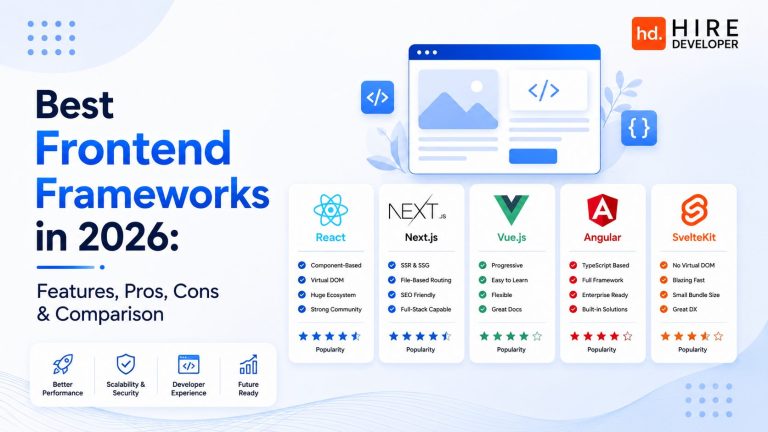
In 2026, virtually all production frontend frameworks are JavaScript-based. The dominant ones include React, Vue.js, Angular, Svelte, Next.js, Astro, SolidJS, and Nuxt.js. Each represents a different set of tradeoffs between simplicity, performance, feature completeness, and ecosystem maturity.
How the Frontend Framework Landscape Has Shifted in 2026
Understanding where the ecosystem is in 2026 requires knowing what changed between 2022 and now, because several major architectural shifts have reshaped the competitive landscape.
The Rise of Meta-Frameworks
The biggest shift has been the consolidation around meta-frameworks, particularly Next.js. According to the Stack Overflow Developer Survey 2024, Next.js is now used by a larger percentage of professional developers than Angular, which was historically one of the top three. Developers no longer choose between React and a framework. They choose between Next.js, Remix (now React Router 7), or standalone React tooling.
Server-Side Rendering Became Table Stakes
Every major framework now supports Server-Side Rendering (SSR). This matters because SSR improves initial page load times and search engine indexing. Astro ships no JavaScript by default. Next.js introduced partial pre-rendering. SvelteKit made SSR its default mode from day one. Frameworks that did not prioritize SSR in 2020 had to retrofit it, and some paid a real performance price.
The Compiler Paradigm
Svelte popularized the idea that a frontend framework could compile away its own runtime overhead. Instead of shipping a virtual DOM diffing library to the browser, Svelte compiles components to efficient vanilla JavaScript at build time. Solid.js took fine-grained reactivity even further. React’s compiler (introduced in React 19 as an experimental feature) signals that even the ecosystem’s dominant player is acknowledging this direction is important.
AI-Native Frontend Development
Tools like GitHub Copilot, Cursor, and Vercel’s v0 generative UI tool have changed how frontend code is written. V0 generates copy-paste-ready React and Tailwind code from natural language prompts. This has created a mild convergence effect where React and Next.js are even more dominant in AI-assisted development workflows, because most training data reflects their syntax.
Engineering teams scaling their frontend in 2026 often need framework-specific expertise, not just generic JavaScript developers. HireDeveloper.dev connects companies with pre-vetted React, Next.js, Vue, Angular, and Svelte developers ready to contribute immediately.
Find pre-vetted frontend developers at HireDeveloper.dev.
Key Criteria for Choosing a Frontend Framework
Before evaluating individual frameworks, establish which criteria matter most for your specific project. The answer varies dramatically depending on team size, project scale, performance requirements, and SEO needs.
| Criterion | Why It Matters in 2026 |
| Performance | Directly impacts Core Web Vitals, SEO rankings, and user experience, especially on mobile devices with slow connections |
| Learning Curve | Affects how quickly new developers can contribute and how expensive onboarding is |
| Ecosystem Size | Determines availability of third-party libraries, UI component kits, and tooling support |
| SSR / SSG Support | Critical for SEO-sensitive applications; static generation saves infrastructure costs |
| Community and Backing | Indicates long-term viability and the likelihood of regular security updates |
| Hiring Pool | Affects recruitment speed, talent cost, and team scaling capacity |
| TypeScript Support | Increasingly required for large teams needing type-safe codebases |
React: The Dominant UI Library
React Originally developed by Facebook / Meta. Open-source since 2013. GitHub: 227,000+ stars.
React is a JavaScript UI library for building component-based user interfaces. It uses a virtual DOM, JSX syntax, and a one-way data flow model. While technically a library rather than a complete framework, it is the most widely used frontend solution in the world and forms the foundation for Next.js, Remix, and other full-stack frameworks.
React’s position in 2026 is hard to overstate. It remains the most used web framework among professional developers according to the Stack Overflow Developer Survey 2024, where React received the highest retention ratio among developers. Instagram, Facebook, Airbnb, Shopify, Pinterest, Discord, and Netflix all use React in production.
React 19: What Changed
React 19 introduced server components as a first-class feature (without needing Next.js to use them), the React Compiler for automatic performance optimization, Actions for server mutations, and Document Metadata management. Critically, Create React App was officially deprecated in early 2025. The React team now recommends Vite for single-page app scaffolding or full-stack frameworks like Next.js and React Router v7.
Pros
- Largest developer ecosystem globally: the most third-party libraries, UI kits, and job openings
- Component reusability through JSX and React Hooks reduces code duplication
- Virtual DOM enables consistent performance for complex UIs
- React Native extends the same component model to iOS and Android
- React 19 Server Components improve SEO and initial load performance
Cons
- React is a UI library, not a complete framework: routing, state management, and SSR require additional choices
- JSX syntax has a genuine learning curve for developers coming from non-JavaScript backgrounds
- Frequent major releases (React 18, 19) require teams to keep pace with migrations
- Without a meta-framework like Next.js, raw React SPAs have weak SEO by default
Best For
Single-page applications, large product teams needing component reusability, mobile apps via React Native, and any project where the Next.js or React Router 7 ecosystem adds value.
Next.js: The Full-Stack React Framework
Next.js Created by Vercel. Built on React. GitHub: 125,000+ stars. Used by Hulu, WhatsApp, Spotify, TikTok, and Notion.
Next.js is a full-stack framework built on top of React. It adds SSR, SSG, App Router, Server Actions, image optimization, and built-in API routing to the React foundation. In 2026, it is the most popular way to build production React applications.
Next.js has evolved from a Server-Side Rendering convenience layer into a genuine full-stack application framework. The App Router (introduced in Next.js 13 and stabilized in 14-15) enables React Server Components, nested layouts, streaming with Suspense, and Server Actions to handle data mutations directly from server-rendered components.
Recent Features: Next.js 15
- Turbopack is now the default bundler for development builds, delivering significantly faster hot module replacement
- Partial Pre-Rendering combines static shell rendering with dynamic content holes for optimal performance
- Server Actions allow form submissions and data mutations to run on the server without explicit API endpoints
- React 19 support across both the App Router and Pages Router
Pros
- Zero-configuration SSR and SSG reduces backend infrastructure complexity
- Image optimization (next/image) with automatic WebP conversion and lazy loading
- App Router enables hybrid rendering strategies within a single application
- First-class TypeScript support out of the box
- Large enterprise adoption with strong long-term support from Vercel
Cons
- Frequent major releases mean frequent migration work for teams who stay current
- App Router’s Server Components model has a steep learning curve even for experienced React developers
- Overkill for simple marketing sites or prototypes that do not need SSR
Best For
E-commerce platforms, content-heavy SaaS products, any project where SEO matters, and full-stack applications where a separate backend API layer is undesirable.
Teams building production Next.js applications often need developers who understand Server Components, App Router patterns, and Vercel deployment architecture, not just React basics. HireDeveloper.dev pre-vets developers specifically for these production skills.
Find pre-vetted frontend developers at HireDeveloper.dev.
Vue.js: The Approachable Framework
Vue.js Created by Evan You. Community-driven. GitHub: 208,000+ stars. Used by Alibaba, GitLab, NASA, Zoom, and Xiaomi.
Vue.js is a progressive JavaScript framework for building user interfaces. It is designed to be incrementally adoptable: its core library focuses on the view layer, and can be integrated into existing projects without a complete rewrite. Vue 3 introduced the Composition API, TypeScript improvements, and significantly better performance than Vue 2.
Vue’s defining characteristic is approachability. Its single-file component format (.vue files combining template, script, and style in one file) is genuinely readable even for developers with limited JavaScript experience. This makes it a popular choice for teams where not everyone has a deep JavaScript background.
Unlike React, Vue is an actual framework rather than a library, providing routing (Vue Router), state management (Pinia, now the official recommendation replacing Vuex), and build tooling (Vite) in a more opinionated package.
Vue 3 Key Features in 2026
- Composition API: a more flexible, reusable way to organize component logic compared to Vue 2’s Options API
- Vapor Mode (experimental): a compilation approach similar to Svelte that reduces runtime overhead
- Improved TypeScript integration making type-safe Vue applications practical at scale
- Pinia as the official state management solution, simpler and more TypeScript-friendly than Vuex
Pros
- Gentle learning curve: the Options API is the most beginner-accessible of all major framework syntaxes
- Detailed and well-maintained documentation, frequently cited as the best in the frontend ecosystem
- Virtual DOM with reactive data binding means clean, predictable UI updates
- Flexibility in project structure: progressively adoptable from a simple script tag to a full SPA
Cons
- Smaller hiring pool than React, particularly in US and UK markets
- Some third-party plugins originally written in Chinese, reflecting community origins, though this has improved
- Less Silicon Valley adoption than React, which affects ecosystem momentum and community growth
Best For
Teams with mixed JavaScript experience levels, projects requiring flexible design structures, and organizations where Nuxt.js (the Vue meta-framework) is the production deployment target.
Angular: The Enterprise Standard
Angular Created and maintained by Google. Written in TypeScript. GitHub: 95,700+ stars. Used by Google, Gmail, Microsoft, PayPal, IBM, Nike, and Samsung.
Angular is a comprehensive TypeScript-based framework for building enterprise-grade web applications. Unlike React (a library) or Vue (a progressive framework), Angular is a complete opinionated solution including dependency injection, two-way data binding, a CLI, routing, forms management, and HTTP client all built in.
Angular’s position in 2026 is interesting. Its usage share has declined slightly relative to React and Next.js in broader developer surveys, but within enterprise software, financial services, government portals, and large-scale internal applications, it remains dominant. Google’s continued investment ensures it will not be abandoned, and its TypeScript-first design is increasingly an advantage as teams demand type safety.
Angular 2026 Key Developments
- Signals: reactive primitives that allow fine-grained state updates without triggering full component re-renders, similar to Vue’s reactivity system
- Deferrable Views: lazy-load component dependencies using @defer blocks, reducing initial bundle size
- Built-in Control Flow: @if and @for directives replace the older NgIf and NgFor structural directives with more readable syntax
- Non-destructive and Partial Hydration: SSR now reuses existing DOM nodes instead of destroying and rebuilding, eliminating the UI flicker that plagued earlier Angular Universal implementations
- NgOptimizedImage: built-in image optimization with lazy loading by default
Pros
- Complete framework: no decision fatigue over which router, state manager, or HTTP client to use
- Dependency injection system is the best implementation of DI among frontend frameworks
- Excellent for large teams where consistent patterns matter more than maximum flexibility
- Angular CLI automates code generation, testing setup, and deployment configuration
- Strong TypeScript integration since Angular was built in TypeScript from the ground up
Cons
- Steeper learning curve than any other major frontend framework
- Boilerplate-heavy for simple applications: overkill when you need a landing page or a prototype
- Slower to onboard developers who do not have TypeScript and RxJS experience
Best For
Enterprise applications, government portals, internal business systems with complex state requirements, and any organization deeply invested in Google’s broader ecosystem.
Svelte: The Compiler-First Framework
Svelte Created by Rich Harris, now backed by Vercel. GitHub: 78,200+ stars. Used by The New York Times, Apple, Spotify, and IKEA.
Svelte is a frontend framework that compiles your component code into efficient, vanilla JavaScript at build time rather than shipping a virtual DOM runtime to the browser. This results in smaller bundle sizes, faster initial load times, and simpler reactivity without the overhead of a runtime library.
Svelte’s core insight is that the virtual DOM is overhead, not a feature. By doing the work at compile time rather than runtime, a Svelte application ships less JavaScript to the browser and often performs faster on first interaction. SvelteKit, the full-stack framework built on Svelte, adds SSR, file-based routing, and server-side data loading.
Svelte 5 and SvelteKit 2 in 2026
- Runes: Svelte 5’s new reactivity system uses signals-based primitives ($state, $derived, $effect) for more explicit and predictable state management
- SvelteKit 2 includes improved SSR, better routing, and seamless adoption of Svelte 5
- Simpler syntax than any other major framework: less boilerplate, no JSX, no template compilation step visible to the developer
Pros
- Smaller bundle sizes than React or Angular for equivalent functionality
- No virtual DOM means less computational overhead in the browser
- Genuinely simpler syntax: easier to read, easier to onboard junior developers
- SvelteKit provides a full-stack solution with excellent SSR and static generation
- High developer satisfaction scores in Stack Overflow and State of JS surveys
Cons
- Smaller community and hiring pool than React, Vue, or Angular
- Fewer third-party UI component libraries compared to React
- Less tooling for complex enterprise patterns like sophisticated dependency injection
Best For
Performance-sensitive consumer applications, small-to-mid teams prioritizing developer productivity, and any project where initial bundle size directly impacts conversion rates.
Astro: The Content-First Performance Champion
Astro Founded 2021. GitHub: 45,500+ stars. Backed by Google, Netlify, Sentry, and Storyblok. Used by NordVPN, Firebase Blog, and Appwrite.
Astro is a frontend framework specifically designed for content-heavy websites. It ships zero JavaScript to the browser by default, using Island Architecture to selectively hydrate interactive components only where needed. This results in very fast page loads and exceptional Lighthouse scores.
Astro occupies a unique position in the frontend landscape in 2026. It is not trying to compete with React or Angular for application development. It is solving a different problem: how to build fast, content-rich websites where most of the page is static and only small sections need JavaScript interactivity.
Its Island Architecture is genuinely innovative. You can use React, Vue, Svelte, or SolidJS components within an Astro project, and each one only hydrates on the client when needed (client:load, client:visible, client:idle). The rest of the page is pure HTML.
Pros
- Zero JavaScript by default: the fastest initial page loads of any major framework for content sites
- Framework-agnostic: use React, Vue, Svelte, or SolidJS islands within the same project
- Outstanding SEO performance due to server-rendered HTML with no client-side JavaScript overhead
- Astro DevAudit UI automatically flags performance and accessibility issues during development
- View Transitions API support for smooth multi-page app navigation without JavaScript bloat
Cons
- Not designed for complex interactive applications: limited for SPA use cases with heavy client-side state
- Smaller ecosystem than React or Vue
- Requires a mindset shift for developers accustomed to client-side SPA frameworks
Best For
Marketing websites, blogs, documentation sites, e-commerce storefronts, and any content-heavy site where SEO performance and Core Web Vitals are the primary engineering goals.
Frontend framework selection has a direct impact on hiring strategy. HireDeveloper.dev helps teams find developers who specialize in the specific framework their product is built on, from Next.js architects to Svelte and Astro specialists.
Find pre-vetted frontend developers at HireDeveloper.dev.
SolidJS: The Fine-Grained Reactivity Challenger
SolidJS Created by Ryan Carniato. Open-source, community-backed. GitHub: 32,100+ stars. Used by OpenText and growing enterprise adopters.
SolidJS is the framework that makes experienced React developers reconsider their assumptions about performance. Where React re-renders entire component trees and uses reconciliation to determine what actually changed, Solid compiles JSX templates into fine-grained reactive primitives that directly update only the specific DOM nodes that have changed. No virtual DOM, no diffing.
SolidStart, the full-stack framework built on Solid, adds SSR, SSG, API routes, and server-side data loading. SolidJS consistently ranks among the highest-performance JavaScript frameworks in TechEmpower benchmark tests.
Pros
- Industry-leading runtime performance for interactive UIs with complex state
- JSX syntax means React developers can read Solid code immediately
- Signals-based reactivity is predictable and granular: only what changed updates
- SolidStart provides a full-stack solution competitive with SvelteKit and Next.js
Cons
- Small community and limited third-party ecosystem compared to React or Vue
- Mental model for reactivity differs from React in subtle but important ways
- Fewer job postings and hiring candidates with SolidJS-specific experience
Best For
High-performance interactive dashboards, real-time applications where UI update latency matters, and teams willing to invest in a smaller but technically superior ecosystem.
Nuxt.js: The Vue Ecosystem Full-Stack Solution
Nuxt.js Built on Vue.js. Open-source, Nuxt Labs-backed. GitHub: 54,100+ stars. Used by OpenAI, GitHub, NASA, Google, and GitLab.
Nuxt.js is to Vue what Next.js is to React. It takes Vue’s approachable component model and adds file-based routing, SSR, SSG, server API routes, and a module ecosystem that extends functionality without configuration overhead.
Nuxt 3, the current major version, is built on Vue 3 and Vite, providing the Composition API, Pinia for state management, and the Nitro server engine for flexible deployment across Node.js, Deno, Cloudflare Workers, and serverless environments.
Pros
- All of Vue’s approachability benefits combined with a complete full-stack framework
- Nitro server engine deploys to any JavaScript runtime, not just Node.js
- Nuxt DevTools provide deep runtime insights similar to Next.js DevTools
- Large enterprise adoption in organizations already using Vue
Cons
- Inherits Vue’s smaller hiring pool relative to React
- More complex than bare Vue.js: additional concepts (useFetch, useAsyncData, Nitro) require learning
Best For
Teams already working in Vue who need SSR, SEO-critical applications, and full-stack projects that want Vue’s developer experience with Next.js-level capabilities.
The Ones Worth Watching: Qwik, Remix, TanStack Start
Qwik: Resumability Over Hydration
Qwik (backed by Builder.io) introduces resumability, an approach where applications skip the client-side hydration process entirely. Instead of replaying event setup on the client after SSR, Qwik serializes event listeners into the HTML and only loads JavaScript when a specific user interaction actually occurs. For content sites with minimal interactivity, Qwik can achieve near-instant interactivity even on slow devices.
Remix / React Router 7: The Server-First React Experience
Remix, now merged with React Router as React Router v7, is a full-stack React framework that prioritizes web fundamentals. It uses HTML forms and native browser behaviors rather than JavaScript-heavy client-side patterns. OpenAI migrated from Next.js to Remix for parts of its product, and Shopify uses it in production. Its nested routing model and server-side data loading patterns produce clean, fast applications.
TanStack Start: The Modular Full-Stack Toolkit
TanStack Start is a full-stack React framework built on TanStack Router, currently in beta. TanStack’s library family (TanStack Query for data fetching, TanStack Table for data grids, TanStack Router for type-safe routing) has become a preferred alternative to Redux-heavy React setups for teams wanting modular, type-safe tooling without committing to a monolithic framework.
Server-Side Rendering vs Client-Side Rendering: Quick Answer
Server-side rendering (SSR) generates the HTML for a page on the server before sending it to the browser, which improves initial load speed and SEO. Client-side rendering (CSR) builds the page in the browser using JavaScript after the initial load, which can feel more app-like but is generally weaker for search visibility. Most frameworks in 2026, including Next.js, Nuxt, and SvelteKit, support both approaches and let teams choose per page.
Master Comparison Table: All Frameworks Side by Side
| Framework | Language | Rendering | Performance | Ecosystem | Learning Curve | Best Use Case |
| React | JS / TSX | CSR + SSR (with Next.js) | Good | Largest | Medium | SPAs, component-heavy apps |
| Next.js | JS / TSX | SSR + SSG + hybrid | Very High | Very Large | Medium-High | Full-stack, SEO, e-commerce |
| Vue.js 3 | JS / TS (.vue) | CSR + SSR (Nuxt) | High | Large | Low | Flexible, approachable apps |
| Angular | TypeScript | CSR + SSR (Universal) | High | Strong | High | Enterprise, large team apps |
| Svelte 5 | JS / TS (.svelte) | CSR + SSR (SvelteKit) | Very High | Medium | Low | Performance-first consumer apps |
| Astro | Multi (.astro) | SSG + partial SSR | Highest for content | Growing | Medium | Content sites, blogs, docs |
| SolidJS | JS / TSX | CSR + SSR (SolidStart) | Highest for SPAs | Small | Medium | High-interactivity dashboards |
| Nuxt.js | JS / TS (.vue) | SSR + SSG | High | Large (Vue) | Medium | Full-stack Vue applications |
| Remix (RR7) | JS / TSX | SSR-first | Very High | Growing | Medium | Server-first, data-heavy apps |
Which Frontend Framework Should You Choose in 2026? Decision Guide
| Your Scenario | Recommended Framework | Why |
| Content-heavy site, blog, documentation, marketing | Astro | Zero JS by default, best Core Web Vitals, multi-framework components |
| Full-stack product with SEO requirements | Next.js | Hybrid rendering, App Router, image optimization, massive ecosystem |
| Large enterprise application, complex team structure | Angular | Complete framework, DI system, TypeScript-native, Google backing |
| Team with Vue experience, needs SSR | Nuxt.js | Combines Vue approachability with full-stack capabilities |
| Performance-critical interactive dashboard | SolidJS or Svelte | Fine-grained reactivity or compile-time optimization for minimal overhead |
| Startup MVP or SPA with tight JavaScript budget | Svelte + SvelteKit | Smaller bundles, simpler syntax, faster time-to-market |
| React shop that wants server-first patterns | Remix (React Router 7) | Server-side data loading, form-based mutations, fast SSR |
| Small team, beginner-friendly project | Vue.js | Gentlest learning curve, excellent docs, flexible structure |
Hiring Frontend Developers: What Teams Use Which Framework
Framework choice has direct hiring implications. Developer availability and compensation vary significantly across the framework ecosystem. Here is a realistic picture for 2026:
| Framework | Hiring Pool Depth | Avg. US Senior Dev Rate | Demand Growth (2026) |
| React / Next.js | Very Large | $120,000 – $160,000+ | Very High |
| Angular | Large (enterprise-focused) | $115,000 – $155,000+ | Stable (enterprise) |
| Vue.js | Medium | $105,000 – $140,000+ | Moderate |
| Svelte | Small but growing | $110,000 – $145,000+ | Growing Fast |
| Astro | Small | $100,000 – $135,000+ | Emerging |
| SolidJS | Very Small | $115,000 – $150,000+ | Niche but High Quality |
| Nuxt.js | Medium (Vue ecosystem) | $105,000 – $138,000+ | Stable |
One pattern that consistently emerges: companies that choose less common frameworks like Svelte or Astro often find that the developers who know those frameworks well are more technically invested than average, which can offset the smaller pool size.
For teams hiring remotely from India, Eastern Europe, or Latin America, React and Angular have the deepest talent pools globally. Vue.js also has significant depth in Asian markets, reflecting its origins and community.
Whether you need a React architect, an Angular enterprise developer, or a Svelte specialist, HireDeveloper.dev pre-vets frontend developers for production skills across all major frameworks. Companies in the US, UK, Canada, and Australia use the platform to hire dedicated frontend teams faster.
Find pre-vetted frontend developers at HireDeveloper.dev.
Conclusion: Frontend Frameworks in 2026
The best frontend frameworks in 2026 are not competing with each other as much as they are specializing. React and Next.js have consolidated dominance in the full-stack application market. Astro has carved out a defensible position for content-first performance. Svelte and SolidJS have proven that compile-time and fine-grained reactivity are viable paths to performance. Angular has strengthened its position as the framework for large teams that need structure and predictability.
The frameworks that are struggling in 2026 are those that tried to do everything without a clear performance or developer experience advantage. The ones succeeding are those that identified a specific problem and solved it better than anyone else.
For most new projects: use Next.js if you need a full-stack React product, Astro if you are building a content site, Angular if you are building enterprise software with a large team, and Vue or Svelte if developer approachability and flexibility are the highest priorities.
The technology you choose matters less than the quality of the engineers building with it. A great React developer and a great Svelte developer will both build a great product. The framework is the foundation, not the house.
Whatever frontend framework your team is building with in 2026, HireDeveloper.dev helps you find and hire pre-vetted developers who know that stack in production. Trusted by teams in the US, UK, Canada, and Australia.
Find pre-vetted frontend developers at HireDeveloper.dev.
References
This guide was researched and compiled using insights from the following sources, combined and rewritten into original, unique content: