

Introduction
A mobile team ships an update on Friday. By Monday, support is flooded: one endpoint now returns a different date format, another answers every failure with a vague 500, and a partner’s integration has quietly broken. The code worked. The API design did not.
API design principles are the shared rules that keep an interface predictable for the people and systems that depend on it. In 2026, with microservices, mobile apps, partners, and AI-driven clients all calling the same services, a weak contract becomes everyone’s problem.
This guide covers the fundamentals, REST, and 12 practical best practices for secure, scalable, reliable APIs, followed by common mistakes, a release checklist, and FAQs.
What Is API Design?
THE SHORT VERSION
API design is the process of defining how clients interact with a service: its resources, requests, responses, errors, and rules. A well-designed API is consistent, secure, and usable without reading the source code.
API stands for Application Programming Interface: a defined way for one piece of software to ask another to do something. The API contract describes the endpoints (URLs), the requests clients may send, and the responses they get back.
Take a shopping app. It calls GET /products/42 to show product details and POST /orders to place an order, without ever touching the database. Designing the API means deciding what those calls look like. Implementing it means writing the backend that fulfills them. You can rewrite the implementation without changing the design, which is exactly why the contract must stay stable. The consumers might be a web frontend, a mobile app, another microservice, a partner, or an enterprise system, and each depends on that contract.
Also Read – https://hiredeveloper.dev/insights/api-development-guide-design-build-test-scale/
What Is a REST API and How Does It Work?
A REST API (REST application programming interface) is an HTTP API that follows the REST architectural style, where clients work with resources, such as users or orders, through uniform requests. REST stands for Representational State Transfer. It is an architectural style, not a protocol, and not every HTTP API is automatically RESTful.
REST rests on these constraints:
- Client-server: the interface and the data store are separate concerns.
- Stateless: each request carries everything needed to process it.
- Cacheable: responses say whether they can be reused.
- Uniform interface: resources are identified by URLs and handled through standard methods.
- Layered system: proxies and gateways can sit between client and server.
- Code on demand: servers may send executable code. This one is optional.
| HTTP method | Typical purpose |
| GET | Retrieve a resource |
| POST | Create a resource or trigger processing |
| PUT | Replace a resource |
| PATCH | Partially update a resource |
| DELETE | Remove a resource |
For example, GET /api/v1/users/123 asks for the representation, often JSON, of user 123. Clients work with representations of resources, not the resources themselves. Some REST designs also add links to related actions (hypermedia), though many practical APIs do not.
Why Are API Design Principles Important?
Good API design pays off long after launch. It supports:
- consistent communication between systems and easier developer adoption
- simpler integration with less guesswork
- security and access control built into the contract
- scalability and performance under growing load
- backward compatibility as the API evolves
- easier testing and maintenance
Each link between systems can fail, so design for timeouts, retries, and idempotency too. In short, the cost of a design mistake multiplies with every consumer who builds on it.
12 API Design Principles and Best Practices for 2026
Each principle covers what it means, why it matters, and how to apply it. They overlap by design: good naming helps documentation, and good documentation helps testing.
-
Design APIs Around Resources and Business Requirements
Start with the business, not the database. Identify the entities consumers care about, such as products, orders, and invoices, and model them as resources. Use nouns, and let HTTP methods supply the verbs. Talk to consumers first, because you are designing for their tasks.
Prefer GET /api/v1/products over GET /api/v1/getAllProducts. The second repeats the method in the URL and gets awkward once you add filtering. Never mirror internal tables either: a public contract should survive a schema change. A quick test: could a new consumer guess what an endpoint returns from its name? When an action does not fit a resource, model it as one, such as POST /orders/456/cancellations.
-
Use Consistent and Predictable Naming Conventions
Use plural nouns, one casing style for paths and fields, and obvious query names such as status or created_after. Nest only where ownership is real, and avoid going deeper than two levels.
Prefer GET /api/v1/orders/456/items over GET /api/v1/getOrderItemsByOrderId/456. Predictability is developer experience: once someone learns one endpoint, they can guess the next. Reuse the same parameter names and values everywhere, so if one endpoint filters by status, all of them do. Avoid several URLs for the same thing.
-
Follow RESTful Principles and Use HTTP Methods Correctly
Use each method for its defined purpose. RFC 9110 defines the semantics: GET is safe, and GET, PUT, and DELETE are idempotent, so retrying them is harmless. POST and PATCH are not guaranteed to be. PUT replaces a whole resource, while PATCH changes part of one, so they are not interchangeable. For example, PUT /users/5 with a full body replaces the user, while PATCH /users/5 with just a new status changes only that field. Safe means the request does not change server state, which is why changing data through GET is a design bug. Return 201 Created with a Location header after creation, and 204 after a successful delete.
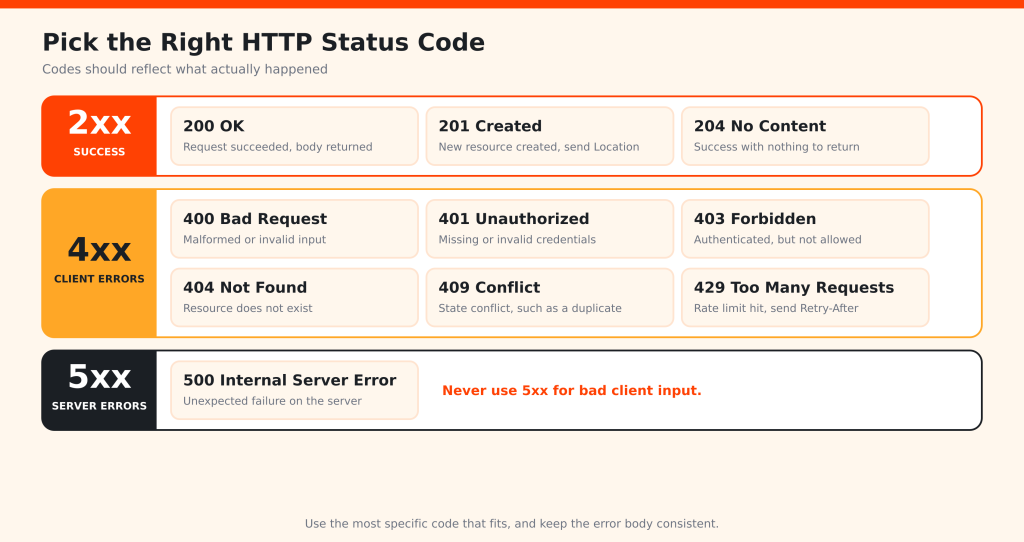
Status codes must tell the truth. A 401 means credentials are missing or invalid, while a 403 means the caller is known but not allowed. Do not return 200 with an error inside the body.
-
Design Clear and Consistent API Responses
Pick one response shape and keep it across endpoints: consistent field names, correct data types, a resource identifier, and ISO 8601 timestamps. Decide how optional and nullable fields behave and document it.

Collections should add consistent metadata, such as a cursor or total, so clients never guess. Decide how null and missing fields differ and document it. Use enumerated values such as “active” instead of magic numbers, and string identifiers if you do not want to reveal volume.
-
Implement Proper Error Handling and Meaningful Messages
Return one error format everywhere, with a correct status code, a machine-readable code, and a human-readable message. Include validation details and a request ID for troubleshooting, and never leak stack traces or internal details.

If you prefer a standard, RFC 9457 defines Problem Details (application/problem+json). Use 400 for malformed input and list each failing field for validation errors. Keep messages helpful without revealing internals: say the email is invalid, not which database constraint failed, and log the details server-side. Predictable errors turn debugging from guesswork into routine work.
| Area | Poor design | Better design and why |
| Naming | GET /getUser?id=5 | GET /users/5: noun-based, and the method is the verb |
| Method use | GET /orders/5/delete | DELETE /orders/5: GET must never change data |
| Responses | Dates in three formats | One ISO 8601 format, so clients parse once |
| Errors | 500 for bad input | 400 with details: clients can fix their request |
-
Build Security Into API Design From the Beginning
Authentication confirms who the caller is. Authorization decides what that caller may access. OAuth 2.0 handles delegated access, OpenID Connect adds an identity layer on top of it, and API keys identify the calling application, not a person, so they are not complete security on their own. Keys leak easily and are hard to scope, so use them for identification and quotas, and pair them with OAuth 2.0 for user-level access.
Use HTTPS everywhere, validate all input, apply least-privilege roles, store secrets in a secrets manager, rate limit abusive traffic, and keep audit logs. The OWASP API Security Top 10 (2023, still the current edition) is dominated by authorization failures, especially broken object level authorization: for GET /orders/456, always check that the caller may see order 456. Also guard against exposing or accepting properties users should not touch.
Secure by design means asking at contract time: who can call this, what can they see, and how often? Define scopes or roles per endpoint, and protect admin functions separately from ordinary ones. Validate bodies against the schema, reject unknown fields to prevent mass assignment, and return only the fields a caller needs. Keep errors generic, and log security events without recording secrets.
-
Design APIs for Scalability and Performance
Never return unbounded collections. Add pagination, filtering, and sorting, for example GET /api/v1/products?page=1&limit=20. Page-number pagination is simple, while cursor-based pagination holds up better on large or fast-changing data.
Use caching headers, compression where it helps, and efficient queries, and set Cache-Control to match how fresh the data must be. Move long-running work to asynchronous processing, returning 202 Accepted with a status resource. Rate limiting rejects requests over a threshold (429 with Retry-After), while throttling slows them. No single technique guarantees scale, so measure latency and throughput. Cap the page size so no client can request a million rows, filter on indexed fields, and support conditional requests with ETag. Offer field selection or separate detail endpoints to avoid oversized responses.
-
Use API Versioning and Maintain Backward Compatibility
APIs evolve. Adding an optional field is usually non-breaking. Removing or renaming fields, changing types (a price moving from a number to a string), or tightening validation is breaking. Version only when you must, and prefer additive changes.
URI versioning (/api/v1/products, /api/v2/products) is visible and simple, and header-based versioning keeps URLs clean. Neither is universally best. Publish a deprecation policy, give consumers a migration timeline, signal retirement with headers such as Sunset, and run compatibility tests. Announce changes early through a changelog and docs, run old and new versions side by side for a stated period, and watch traffic to see who still uses the old one.
-
Prioritize API Documentation and Developer Experience
The OpenAPI Specification describes HTTP APIs in a machine-readable form. Tools such as Swagger UI turn it into interactive docs, and Postman collections let developers try requests. OpenAPI is a description format, not a testing tool by itself.
Good docs include quick-start steps, authentication instructions, request and response examples, error documentation, version information, and usage limits. Update them with the contract, or they will mislead. Generate reference docs from the OpenAPI file so they cannot drift from the code, and include copy-paste examples.
-
Adopt API-First Design and Contract-Driven Development
API-first means you design and agree the contract, endpoints, and schemas before writing implementation code. Code-first, by contrast, generates documentation afterward from whatever was built. Review the OpenAPI contract with frontend and backend teams, mock it, and add contract tests. Frontend teams, for instance React.js developers building the UI, can then work in parallel against the mock. A typical flow is to draft the contract, review it with consumers, publish a mock, then implement. Changes made before implementation touch a document, not code. API-first is not waterfall: contracts still evolve in small, reviewed changes.
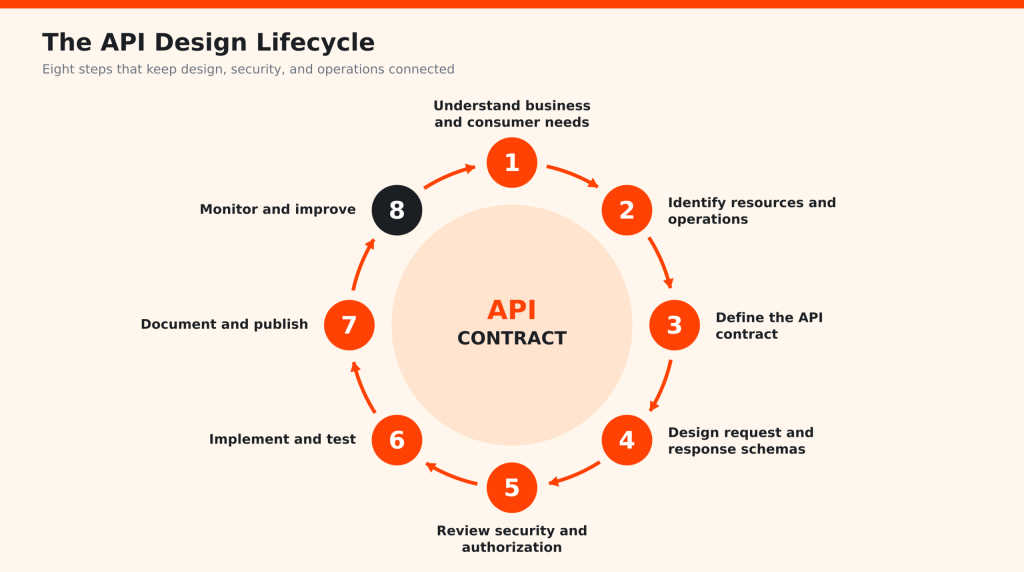
The lifecycle keeps security review and operations inside design, not after it.
-
Test APIs for Reliability, Security, and Correctness
Cover unit, integration, functional, contract, load, security, regression, and negative tests, and run them in CI/CD. Negative tests matter most: send bad tokens, oversized payloads, and other users’ IDs. Contract tests confirm the implementation still matches the OpenAPI document, and security tests should include authorization checks using two different users.
Common tools include Postman and Newman for collections, Jest and Supertest for Node.js APIs, Playwright for end-to-end flows, k6 for load, and OWASP ZAP for security scanning. Choose by architecture. If your backend runs on Node.js, experienced Node.js developers can set this up quickly.
-
Monitor APIs and Plan for Continuous Improvement
Quality does not end at deployment. Track availability, latency, and error rates, and collect logs, metrics, and traces. OpenTelemetry, Prometheus, and Grafana are common choices. Pass a correlation ID through every service so one request can be followed across the system.
In distributed systems, networks fail. Set timeouts, retry with backoff, and use idempotency keys so a retried POST does not create a duplicate. Watch usage analytics, consumer feedback, and deprecated-version traffic to plan capacity and retirements. Alert on symptoms users feel, such as error rate and latency percentiles, not only CPU, and review dashboards after each release.
Common API Design Mistakes to Avoid
Most API problems trace back to the same few habits, and each one is addressed by a principle above.
- Inconsistent naming: consumers cannot guess endpoints.
- Wrong HTTP methods: retries and caches misbehave.
- Poor error handling: debugging takes longer.
- Missing authentication or authorization: data is exposed.
- No pagination: large collections slow everything down.
- Exposing sensitive fields: privacy and compliance risk.
- Breaking changes without migration: integrations fail.
- Thin documentation: support requests pile up.
- Ignoring rate limits: abuse and outages.
- Skipping tests: regressions reach production.
- Modeling database tables, not resources: the contract leaks internals.
Applying the 12 principles above prevents each one.
API Design Best Practices Checklist
Run through this list before every release.
□ Resources are modeled around business needs.
□ Endpoint naming is consistent.
□ HTTP methods and status codes are correct.
□ Response and error formats are standard.
□ Authentication and authorization are in place.
□ Input is validated.
□ Pagination and performance controls exist.
□ A versioning strategy is defined.
□ OpenAPI documentation is current.
□ Automated tests run in CI/CD.
□ Monitoring and logging are active.
□ A backward compatibility review is done.
If your team needs extra backend capacity to build or run APIs, consider adding dedicated developers.
Conclusion
API design principles turn an interface into a dependable product. Consistent contracts and REST conventions make APIs easy to use, while security, performance, reliability, and documentation have to be designed together. Testing and monitoring keep that quality in place for the life of the API. If you are building API-driven applications and need a development partner, HireDeveloper.dev (Talent Wing of Rightbyte Technologies Pvt Ltd) can help you plan and build them. Start small: pick the one principle your API breaks most often, fix it, and build from there.
Building an API-driven application?
Discuss your backend and API requirements with the team at HireDeveloper.dev.
Related Sources