






Introduction
Modern applications rarely work alone. A mobile app needs a payment provider, a SaaS product needs a CRM, and a legacy system must share data with a cloud platform. An application programming interface (API) is the contract that lets these systems communicate.
API development is the discipline of designing, building, testing, securing, documenting, deploying, monitoring and scaling those interfaces. Done well, it lets teams ship integrations faster and change systems without breaking their consumers. Done poorly, it creates security exposure and rework.
In 2026 the stakes are higher because APIs now serve a new kind of consumer. Postman’s 2025 State of the API report found that 89% of developers use generative AI daily, yet only 24% design APIs for AI agents. This guide follows the full path, from definition to the decision of when professional services make sense.
What Is an API?
An API (application programming interface) is a defined set of rules that lets one software system request data or actions from another. A client sends a request to an API endpoint, the server processes it, and the API returns a structured response, usually formatted as JSON.
Client → API request → Server → API response → Client
- API client: the application that sends requests, such as a mobile app or another backend service.
- API server: the system that receives requests, applies business logic and returns results.
- Endpoint: a URL that exposes a resource, such as /products.
- Request: an HTTP method, a URL, headers and sometimes a request body.
- Response: a status code, headers and usually a JSON response body.
- HTTP methods: GET reads, POST creates, PUT and PATCH update, DELETE removes, as defined in RFC 9110.
Example: a shop’s mobile app sends GET /products/42. The server finds product 42 and replies with 200 OK and a JSON body holding the name, price and stock level.
APIs are also grouped by audience. A public API is open to external developers, a partner API is shared with selected businesses, and a private API connects a company’s own systems. A Discord integration, for instance, calls the Discord API, a third-party platform API that follows the same request and response pattern.
What Is API Development?
API development is the end-to-end process of creating an API that other software can rely on. It covers requirements, architecture, design, coding, testing, security, documentation, deployment, monitoring and maintenance.
Writing endpoint code is one small part. Most expensive API problems start before coding (unclear consumers, inconsistent design) or after release (no monitoring, no versioning plan). This guide uses our own explanatory model, not an industry standard.
The API Development Lifecycle
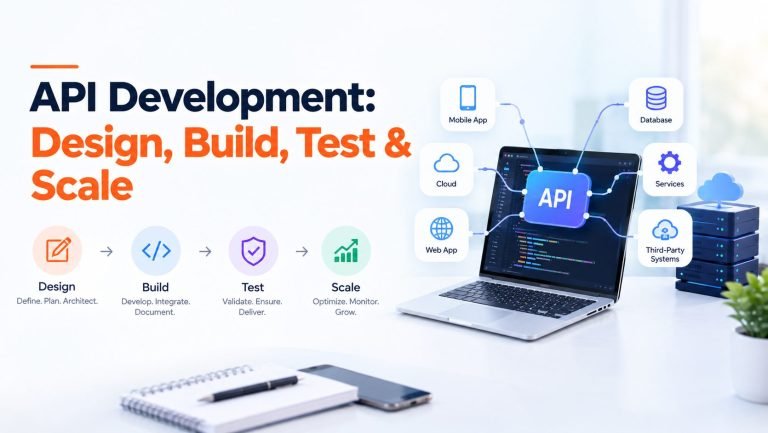
Plan → Design → Build → Test → Secure → Document → Deploy → Monitor → Scale
The stages overlap: monitoring data feeds the next design decision, and security starts at planning. Each published API is a long-lived commitment, because partners build on it.
API Development Process
The API development process turns a business need into a working, documented and monitored interface through twelve steps.
- Define requirements. State the business problem, the data involved and expected traffic.
- Identify API consumers. Internal teams, mobile apps and partners need different stability and support.
- Design resources and endpoints. Model the nouns of the domain, such as products and orders.
- Define request and response schemas. Specify fields, types, required values and error formats.
- Create the API contract. Capture the design in an OpenAPI description before code exists.
- Implement backend logic. Build handlers, validation and business rules.
- Integrate databases and services. Connect storage, queues and third-party APIs with timeouts.
- Add authentication and authorization. Decide who is calling and what they may do.
- Test. Verify behavior, contracts, security and performance.
- Document. Publish reference docs, examples and a changelog.
- Deploy. Release through an automated pipeline.
- Monitor and optimize. Track errors, latency and consumer behavior, then improve
API-first development
API-first development means designing and agreeing on the API contract before writing implementation code, and treating that contract as the source of truth.
Teams can then work in parallel, and mock servers can be generated from the contract. The OpenAPI Specification is the standard format for describing HTTP APIs. Version 3.2.0 (September 2025) added streaming media types and the QUERY method. AsyncAPI does the same job for event-driven interfaces. A schema flaw costs minutes to fix in a contract review and days after release.
For Hiring Developer Visit : https://hiredeveloper.dev/hire/dedicated-developers/
API Design Principles
API design principles are conventions that make an API predictable, safe to evolve and easy to consume. The core ones are resource-oriented URLs, consistent naming, correct HTTP semantics, clear errors, pagination, versioning and backward compatibility.
| Principle | Why It Matters |
| Consistent naming | Easier API consumption |
| Versioning | Safer evolution |
| Pagination | Controls response size |
| Idempotency | Safer retries |
| Clear errors | Easier debugging |
| Documentation | Better developer experience |
- Resource-oriented design: use nouns (/orders) and let HTTP methods express the action. Avoid /createOrder.
- HTTP semantics: GET must not change state. PUT and DELETE are idempotent by definition, POST is not.
- Status codes: 201 created, 400 invalid input, 401 missing credentials, 403 insufficient permission, 404 not found, 429 too many requests.
- Error handling: use one consistent error shape. RFC 9457 defines Problem Details for HTTP APIs.
- Pagination, filtering and sorting: never return unbounded lists, for example GET /orders?status=paid&sort=-created_at&limit=25.
- Idempotency: if a client retries a payment after a timeout, an idempotency key lets the server recognize the duplicate instead of charging twice.
- Versioning and backward compatibility: adding an optional field is usually safe, while renaming or removing one breaks consumers. Announce deprecations and allow a migration window.
A small API example
| GET /products
GET /products/{id} POST /orders GET /orders/{id} PATCH /orders/{id} DELETE /orders/{id} |
- GET /products returns a paginated list of products.
- GET /products/{id} returns one product.
- POST /orders creates an order from the request body.
- GET /orders/{id} returns the current state of one order.
- PATCH /orders/{id} updates selected fields, such as a delivery address.
- DELETE /orders/{id} cancels or removes an order, depending on business rules.
| The API Quality Stack (our explanatory model)
Usability → Reliability → Security → Performance → Observability → Maintainability Use it as a review order: an API that is hard to use or unreliable gains little from tuning. |
REST vs GraphQL vs Other API Approaches
No API style is universally best. REST suits resource-based public APIs, GraphQL suits clients that need flexible queries, gRPC suits fast service-to-service calls, and webhooks and WebSockets suit event-driven and real-time needs.
| Approach | Best Suited To | Trade-offs |
| REST | Public and partner APIs, resource operations, broad tooling | Fixed response shapes can cause over-fetching or extra round trips |
| GraphQL | Client-driven queries across related data, varied frontends | Needs query cost control, and HTTP caching is harder |
| gRPC | Internal microservice calls, low latency, streaming | Less direct browser support, binary format is harder to inspect |
| Webhooks | Notifying another system when an event occurs | Receiver must be reachable, verify signatures and handle retries |
| WebSockets | Persistent two-way real-time use such as chat or live dashboards | Stateful connections are harder to scale and load balance |
GraphQL lets a client name the exact fields it needs. gRPC uses Protocol Buffers over HTTP/2 for typed, efficient calls. Many systems combine styles: REST for partners, gRPC internally, webhooks for customer notifications.
What Is an API Key? Authentication & Authorization Explained
An API key is a secret string a client sends with each request so the API can identify the calling application. On its own it usually cannot prove who a human user is or what that user may do.
- Authentication answers “who is calling?” Authorization answers “what may this caller do?”
- Access token: a short-lived credential issued after authentication.
- JWT: a signed token format defined in RFC 7519, one way to represent an access token.
- OAuth 2.0: the delegation framework in RFC 6749 that lets an app obtain limited access on a user’s behalf without their password. RFC 9700 (January 2025) is the current security best practice for it.
| Method | What It Does | Typical Use | Limitation |
| API key | Identifies the calling application | Server-to-server calls, usage tracking | Weak for user-level access, easily leaked in client code |
| OAuth 2.0 | Issues scoped, expiring access on a user’s behalf | Third-party access, user-consented sharing | More setup and implementation complexity |
| JWT | Carries signed claims in a token | Stateless verification of access tokens | Revocation is harder, contents must be validated |
| Bearer token | Sent in the Authorization header | Presenting an access token | Anyone holding it can use it, so protect it |
API keys suit identifying trusted server-side applications and per-client rate limiting. They are a poor fit for protecting user data across untrusted clients, and must never be embedded in public JavaScript or mobile bundles. Postman’s 2025 report found that 46% of respondents worry about AI systems leaking API credentials, so scope keys narrowly and rotate them.
API Testing and Security
API Testing
API testing verifies that an API behaves correctly, keeps its promised contract, performs under load and resists misuse. It targets behavior directly, which is cheaper than testing through a user interface.
- Unit testing: individual functions, such as price calculations.
- Integration testing: the API with its real database and dependent services.
- Functional testing: each endpoint with valid and invalid input.
- Contract testing: the implementation matches the OpenAPI description and consumer expectations.
- Regression testing: earlier tests re-run on every change.
- Load and performance testing: latency and error rates as traffic grows.
Contract testing is the most neglected layer. Postman’s 2025 report, as summarized by DEVOPSdigest, puts functional and integration testing at 67% each but contract testing at 17%. Automate all six in CI (see Postman docs) so a broken contract fails the build.
API Security
API security is the set of controls that protect an API from unauthorized access, data exposure and abuse. The OWASP API Security Top 10 is the reference list, and its 2023 edition is still current.
The OWASP API Security Top 10 ranks broken object level authorization first: an attacker changes /orders/1001 to /orders/1002 and reads another customer’s data. Other listed risks include broken authentication, broken object property level authorization, unrestricted resource consumption, server-side request forgery, improper inventory management and unsafe consumption of APIs. NIST SP 800-228, updated in March 2026, adds lifecycle-wide controls for cloud-native APIs.
- Authentication and authorization: check object-level permission on every request, not only at login.
- HTTPS/TLS: encrypt all traffic.
- Input validation: validate against the schema and reject unexpected fields.
- Rate limiting: cap requests per client to protect availability.
- Access control: apply least privilege with narrow scopes.
- Secrets management: use a secrets manager and rotate keys.
- API inventory: track every API, version and environment, including forgotten ones.
- Monitoring: log authentication failures and unusual access patterns.
API Development Tools and Technology Stack
The right API stack depends on team skills, performance needs, existing infrastructure, compliance and cost. The table lists common options, not recommendations.
| Area | Examples |
| API Design | OpenAPI, Swagger |
| API Testing | Postman |
| Backend | Node.js, .NET, Java, Python, Go |
| API Gateway | Kong, AWS API Gateway, Azure API Management |
| Database | PostgreSQL, MySQL, MongoDB |
| Authentication | OAuth 2.0, JWT |
| Deployment | Docker, Kubernetes, Cloud |
| CI/CD | GitHub Actions, GitLab CI, Azure DevOps |
| Observability | OpenTelemetry, Cloud Monitoring |
A gateway handles routing, authentication checks and throttling in one place. A small internal API may need neither Kubernetes nor a gateway.
How to Build a Scalable API
A scalable API keeps acceptable latency and error rates as traffic grows. Find the real bottleneck first, then apply the fitting technique.
| Problem | Technique | Business Effect |
| Same data requested repeatedly | Caching (application, HTTP headers, CDN for public content) | Lower database load, faster responses |
| Large result sets slow responses | Pagination | Predictable response size and cost |
| One client floods the service | Rate limiting | Fair use, protected availability |
| One server cannot handle traffic | Load balancing and horizontal scaling | Capacity grows with instances |
| Slow work blocks requests | Asynchronous processing with message queues | Fast responses, background completion |
| Database becomes the bottleneck | Indexing, query tuning, read replicas | Lower latency at higher volume |
| Many services need common entry rules | API gateway | Central policy and traffic management |
| Cannot tell where slowness occurs | Observability (logs, metrics, distributed tracing) | Faster diagnosis, fewer outages |
Keep API servers stateless so any instance can serve any request, and measure before optimizing. For long operations, return 202 Accepted with a status URL or notify the client by webhook.
Custom API Development & API Development Services
Custom API development is the design and construction of an API built for one organization’s systems, data and rules, rather than relying only on an off-the-shelf connector or packaged product.
Common needs:
- Legacy modernization: expose old system data to new applications without a rewrite.
- SaaS, CRM and ERP integrations: exchange data with billing, support and planning tools.
- Mobile applications: apps need a stable backend API.
- Enterprise and payment systems: governed data exchange, audit trails and idempotent transactions.
- Third-party API integration: wrap, monitor and isolate external APIs.
- Microservices, internal platforms and data synchronization: clear service contracts and consistent records.
API development services can include architecture, design, development, integration, security review, testing, documentation, deployment, maintenance and modernization. Some organizations engage a full team, others add dedicated backend developers to an in-house team.
Cost and duration depend on endpoint count, business rule complexity, the number and quality of integrated systems, security and compliance needs, expected traffic and existing infrastructure. Published price tables rarely disclose their assumptions, so treat any fixed figure quoted before scoping with caution.
API Development Best Practices for 2026
The most useful 2026 practices move quality checks earlier and automate them: contracts before code, security in the pipeline, observability from release one and documentation machines can read.
- Design API contracts early, review them like code, and generate reference docs from them.
- Use consistent conventions, correct HTTP semantics and careful versioning with early deprecation notices.
- Automate testing in CI, including contract tests, and automate deployment.
- Build security in, using the OWASP API Security Top 10 as a review baseline, with least-privilege authorization and rate limiting.
- Monitor latency, errors and saturation, and track consumer experience such as time to first successful call.
- Maintain an API inventory, including retired and shadow APIs.
- Design for backward compatibility, and treat third-party API responses as untrusted input.
| The API Readiness Checklist (our explanatory model)
Contract + Security + Testing + Documentation + Monitoring + Scalability Before production: the OpenAPI description matches the implementation, authorization is verified per object, functional, contract and load tests pass, a new consumer can complete a first call from the docs alone, and dashboards and alerts cover errors and latency. |
What has changed by 2026
- AI agents are API consumers. Postman’s report found that 51% of respondents worry about unauthorized or excessive agent calls. Predictable schemas, typed errors and precise documentation matter more when the caller is software.
- MCP exposes APIs to AI applications. The Model Context Protocol lets AI apps discover and call tools, and its 2026-07-28 revision made the protocol stateless. An API exposed through MCP still needs authorization, validation and rate limits.
- Standards moved. OpenAPI 3.2.0 added streaming and QUERY support, and NIST published its March 2026 update to SP 800-228.
- Governance is automated. Teams lint OpenAPI files against shared style rules in CI.
How AI-assisted development affects API development
AI tools can help with code generation, drafting OpenAPI descriptions, documentation, test cases, endpoint discovery in large catalogs and security review flags. Generated output still needs human validation. An AI-drafted endpoint can look correct while missing an object-level authorization check, and a generated specification can misdescribe actual behavior. Review, test and security-check it like code from a new team member. AI does not remove the need for architects and developers who understand the domain and the trade-offs.
Common API Development Mistakes
- Poor API design. Endpoints built around database tables instead of consumer needs produce chatty APIs.
- Inconsistent endpoints. Mixed naming and error formats force consumers to learn special cases.
- Weak authorization. Checking that a user is logged in, but not that they own the object, is OWASP’s top-ranked API risk
- Exposing unnecessary data. Whole database records leak fields the client never needed.
- No versioning strategy. Every change then risks breaking a consumer.
- Poor documentation. Undocumented behavior becomes support tickets.
- Insufficient testing. Skipping contract and negative tests lets regressions reach production.
- No rate limiting. One faulty client can degrade service for everyone.
- Ignoring monitoring. Teams hear about outages from customers.
- Trusting third-party APIs automatically. External responses can be slow or malformed, so validate them, set timeouts and plan for failure.
Ready to Build or Modernize an API?
If your team is planning custom API development, an integration between core systems, an API modernization project or a security review of existing APIs, HireDeveloper.dev can help you scope the work and match you with pre-vetted backend developers. Share your systems, consumers and constraints, and we will outline a practical approach.
Sources
- OWASP API Security Top 10, 2023 edition
- OWASP API Security Top 10, 2023 release notes
- OpenAPI Specification v3.2.0
- OpenAPI Initiative, Announcing OpenAPI v3.2
- AsyncAPI documentation
- NIST SP 800-228, March 2026 update
- IETF RFC 9110, HTTP Semantics
- IETF RFC 9457, Problem Details for HTTP APIs
- IETF RFC 6749, OAuth 2.0 Authorization Framework
- IETF RFC 9700, OAuth 2.0 Security Best Current Practice
- IETF RFC 7519, JSON Web Token
- Model Context Protocol specification, 2026-07-28
- Postman, 2025 State of the API Report
- Postman Learning Center
- GraphQL documentation
- gRPC documentation
- OpenTelemetry documentation
- Discord Developer Documentation (platform API example)