






Introduction
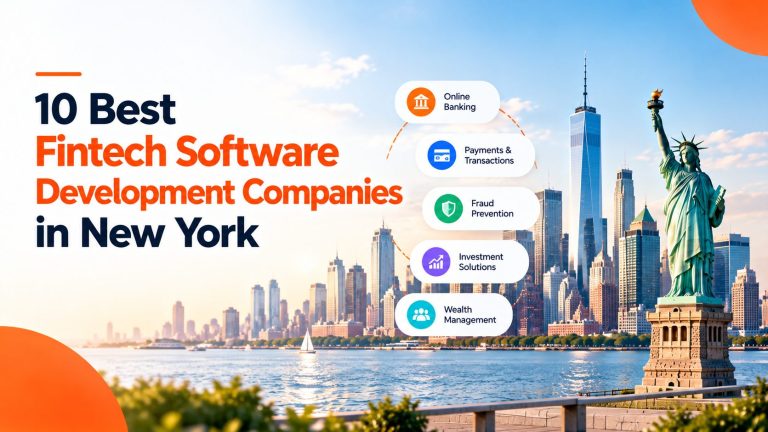
The best fintech software development companies for a New York business are the ones that can show verifiable financial services project evidence, secure engineering practices, and a delivery model that fits your regulatory exposure. A Manhattan address helps collaboration, but it does not prove technical quality. This guide compares 10 providers that serve US and New York buyers: three headquartered in New York City, one with a reported New York office, and six that serve New York clients from other US cities or from distributed delivery centers.
Choosing a partner is harder than it looks. You may need to launch secure digital banking, modernize a legacy core, integrate payment gateways, build a lending or wealth platform, or add AI without creating privacy and model risk. Since October 2025, New York’s financial regulator has also stated that regulated firms cannot delegate cybersecurity compliance to a vendor, which changes what a due diligence file should contain.
Below you will find the shortlist, the method behind it, a scoring table, and practical guidance on services, security, cost, and 2026 fintech trends.
Disclosure
HireDeveloper.dev publishes this article and appears in the list as company 9. It is the talent wing of Rightbyte Technologies Pvt Ltd. We scored it with the same framework as every other company, and it does not score first. Because the publisher has a commercial interest, use this list as one input to your own due diligence.
How We Selected the Best Fintech Software Development Companies
This is an editorial comparison built from public information. It is not an audit, a certification, or a formal ranking, and it does not guarantee project outcomes. We reviewed official websites, SEC filings, press releases, Clutch and DesignRush profiles, and six competing roundups, then checked each claim we repeat against the most primary source we could reach.
To enter the shortlist, a company had to sell software development or engineering services to clients, show evidence of financial services work, and publish enough information to profile fairly. Banks, payment brands, and fintech startups that only build their own products were excluded, because buyers cannot hire them as engineering partners.
Location labels. We separate four situations and never merge them:
- Headquartered in New York: company materials confirm a New York headquarters.
- New York office: a New York office is reported, but headquarters are elsewhere.
- US-based, no verified New York office: a US headquarters or office, with New York clients served remotely or by travel.
- Distributed delivery serving US clients: engineering is delivered mainly from outside the US, or location claims conflict.
Evidence labels. Verified means a credible primary or independent source supports the claim. Partially verified means some evidence exists but the full claim is not established. Not publicly verified means our research did not establish it.
Scoring framework. The weights below are our own editorial framework, not an industry standard. Each criterion is scored from 1 to 5: 5 means confirmed by a primary source and independently corroborated, 4 means confirmed by a primary source, 3 means partly confirmed or company-stated only, 2 means thin or conflicting evidence, and 1 means not publicly verified. A low score reflects thin public evidence, not proof of poor capability.
| Criterion | Weight |
| Verified fintech project experience | 25% |
| Technical capabilities and architecture expertise | 20% |
| Security, privacy, and relevant compliance practices | 15% |
| Relevance to US and New York business requirements | 15% |
| Verifiable client evidence and case studies | 10% |
| Engagement flexibility and delivery model | 10% |
| Transparency of public company information | 5% |
| Total | 100% |
10 Best Fintech Software Development Companies in New York for 2026
The numbering follows location group first, then score within each group. It is a curated shortlist, not a ranking of overall quality.
| Company | Verified location status | Fintech expertise | Core services | Best suited for |
| 1. Vention | HQ New York (Verified) | Fintech practice, payments and open banking work (company-stated) | Custom software, dedicated teams, staff augmentation | Startups and scale-ups wanting New York-led capacity |
| 2. DataArt | HQ New York (Verified) | Capital markets, asset management, banking | Engineering, data, cloud, AI, managed services | Capital markets and asset managers |
| 3. DOOR3 | HQ New York (Partially verified) | Financial services clients; generalist consultancy | Custom software, UX, AI strategy | Firms wanting a consultative local partner |
| 4. EPAM Systems | HQ Newtown, PA (Verified); NYC office (Partially verified) | Financial services is a named industry in SEC filings | Enterprise platform engineering | Large institutions with multi-year programs |
| 5. BairesDev | HQ San Francisco; nearshore delivery | 120+ financial services projects (company-stated) | Staff augmentation, dev teams, outsourcing | Teams wanting US-hours-aligned engineers |
| 6. ScienceSoft | HQ McKinney, TX; Atlanta office | Lending and BFSI since 2005 (company-stated) | Lending software, banking, AI, analytics | Lenders and banks with regulated workflows |
| 7. Simform | HQ Orlando, FL | Financial services engagements; Azure focus | Cloud, data, AI, product engineering | Fintech products built on Azure |
| 8. Itexus | Dover, DE office; delivery from Warsaw, Poland | Fintech-focused service lines | Banking, trading, lending, wallets, AI | Fintech startups wanting a specialist |
| 9. HireDeveloper.dev | HQ Indore, India; UK office (Verified) | No fintech-specific case study verified | Dedicated developers, staff augmentation, modernization | Teams adding engineers to an existing fintech roadmap |
| 10. Cleveroad | Location conflicting (Partially verified) | Fintech among several industries | Custom software, mobile, AI | Budget-aware builds with careful verification |
Group A: Headquartered in New York
-
Vention
Location status: Headquartered in New York (Verified)
Overview: Vention, formerly iTechArt Group, is a software engineering firm with a dedicated fintech practice and distributed engineering teams.
Location and US presence: Its fintech page states a New York headquarters with offices in San Francisco, Los Angeles, Atlanta, and Manahawkin, NJ.
Fintech evidence: The company says it has 15+ years in fintech and 200+ fintech products (company-stated, partially verified). A Clutch client review describes payment processing software built with Go and PHP developers and new microservices for the payment architecture. Directory listings name StoneX and Unlimint among its portfolio.
Capabilities: Custom software development, staff augmentation, dedicated teams, and open banking work referenced in its fintech leadership bios.
Best suited for: Startups and scale-ups that want a New York-headquartered partner with flexible team sizes.
Considerations: Confirm which delivery locations would staff your project and request security attestations. Practice-size figures are self-reported.
Official website: ventionteams.com/fintech
Editorial score: 4.00 out of 5 (see scoring table below)
-
DataArt
Location status: Headquartered in New York (Verified)
Overview: DataArt is a global software engineering firm founded in New York City in 1997. Financial services is one of its long-standing practices, spanning asset management, capital markets, and banking.
Location and US presence: Company materials and Business Wire releases place its headquarters in New York.
Fintech evidence: Its capital markets page claims 20+ years and 250+ clients served (company-stated). A Business Wire release announced a certified development partnership with OpenFin for financial desktop applications, and another described work with Invesco on a model portfolio application.
Capabilities: Cloud, data and analytics, AI, product and software engineering, and legacy modernization, per its published company profile.
Best suited for: Capital markets firms, asset managers, and banks that want deep finance domain knowledge.
Considerations: With 5,000+ experts across 40+ locations (per its LinkedIn profile), ask about minimum engagement size and the seniority of the team assigned to a smaller project.
Official website: dataart.com
Editorial score: 3.90 out of 5 (see scoring table below)
-
DOOR3
Location status: Headquartered in New York (Partially verified)
Overview: DOOR3 is a software and AI consultancy founded in 2002, with strengths in custom software, AI strategy, and UI/UX design.
Location and US presence: Its Clutch profile states a New York City headquarters. We did not retrieve its official site in this research, so the label is partial.
Fintech evidence: The company names Morgan Stanley and AIG among past clients (company-stated). Clutch reviews include a financial services consulting firm migrated from Rackspace to Azure and a technical assessment of a financing software company’s digital marketplace.
Capabilities: Custom software development, UX and usability work, data modernization, and AI strategy and implementation.
Best suited for: Financial firms that want a consultative, design-led local partner, especially for internal platforms and UX-heavy products.
Considerations: It is a generalist consultancy, not a fintech-only specialist. Verify payments or lending depth and ask for security documentation.
Profile: DOOR3 on Clutch
Editorial score: 3.00 out of 5 (see scoring table below)
Group B: New York Office
-
EPAM Systems
Location status: Headquarters Newtown, PA (Verified via SEC filing); New York office (Partially verified)
Overview: EPAM is a publicly listed digital platform engineering company that serves financial services among several industries.
Location and US presence: Its annual report on Form 10-K places corporate headquarters in Newtown, Pennsylvania. A third-party directory lists a New York office, which we could not confirm on an official page.
Fintech evidence: SEC filings list financial services as a served industry. We did not review a specific fintech case study, so project-level evidence is not publicly verified in this research.
Capabilities: Platform engineering, software development, cloud, data, and design services at global scale.
Best suited for: Large institutions running multi-year modernization or platform programs.
Considerations: Smaller buyers should ask about team seniority and engagement minimums. SEC filings give strong corporate transparency but not project evidence.
Official website: epam.com
Editorial score: 3.20 out of 5 (see scoring table below)
Group C: US-Based, No Verified New York Office
-
BairesDev
Location status: US headquarters in San Francisco (Verified through multiple directory listings); nearshore delivery
Overview: BairesDev is a nearshore software company founded in 2009 that places Latin American engineers with US clients.
Location and US presence: Directory listings show a San Francisco headquarters. A third-party listing shows a Brooklyn address that we could not confirm.
Fintech evidence: Its financial services page claims 120+ projects and 110+ engagements (company-stated). Published case studies include Azlo, a mobile banking platform built with Angular, and Xtensifi, a three-year full-stack engagement on a financial app for credit unions.
Capabilities: Payment gateways and POS software, fraud detection systems, mobile banking, and staff augmentation or full outsourcing.
Best suited for: US companies that want engineers in similar time zones and flexible team scaling.
Considerations: Ask who owns security governance on your project and request evidence for any certifications it cites.
Official website: bairesdev.com
Editorial score: 3.80 out of 5 (see scoring table below)
-
ScienceSoft
Location status: US headquarters in McKinney, TX with an Atlanta office (Verified on official contact pages)
Overview: ScienceSoft is an IT consulting and software development company founded in 1989 with a financial IT focus.
Location and US presence: Official pages list McKinney, Texas and Atlanta, Georgia offices. No New York office is listed, although its lending pages name NYDFS among the regulations its in-house compliance experts cover (company-stated).
Fintech evidence: Its pages cite lending software engineering since 2005, 750+ specialists, and ISO 9001 and ISO 27001 certification (company-stated, partially verified). Official testimonials reference mobile banking and banking product development.
Capabilities: Loan processing, P2P lending, lending analytics and AI, mobile banking, and investment software.
Best suited for: Lenders and banks with regulated lending workflows.
Considerations: Request copies of the ISO certificates and ask how compliance advice is separated from engineering delivery.
Official website: scnsoft.com
Editorial score: 3.75 out of 5 (see scoring table below)
-
Simform
Location status: US headquarters in Orlando, FL (Verified through directory listings)
Overview: Simform is a product engineering firm founded in 2010, focused on cloud, data, and AI work.
Location and US presence: Directory listings show an Orlando, Florida headquarters. No New York office was found.
Fintech evidence: Clutch engagements in financial services include custom development for an annuities servicing company, QA for an investment management app company, and mobile apps for an Android-based payment company. Its Clutch profile also cites Azure Expert MSP status (company-stated).
Capabilities: Azure and AWS engineering, data engineering, AI, and modernization.
Best suited for: Fintech products built on Microsoft Azure, or software vendors needing cloud and AI depth.
Considerations: Fintech is one of several industries. Verify depth in payments and lending compliance.
Official website: simform.com
Editorial score: 3.30 out of 5 (see scoring table below)
Group D: Distributed Delivery Serving US Clients
-
Itexus
Location status: US office in Dover, DE; delivery office in Warsaw, Poland (Verified on its official contact page)
Overview: Itexus is a fintech-focused software company founded in 2013.
Location and US presence: Its official contact page lists Dover, Delaware and Warsaw. Competing roundups claim Miami or New York offices, which the official page does not show. Clutch reviews do include New York City clients.
Fintech evidence: Official service pages cover banking apps, eWallets, trading platforms, lending systems, and insurance software. Client reviews on Clutch describe a web-based AI that answered users’ financial questions and a financial platform development engagement.
Capabilities: Banking-as-a-service, fintech consulting, trading and lending platforms, wallets, project audit and rescue, and AI development.
Best suited for: Fintech startups and scale-ups wanting a specialist rather than a generalist.
Considerations: Ask about US-hours overlap given Warsaw delivery, and request proof of any security certifications.
Official website: itexus.com
Editorial score: 3.70 out of 5 (see scoring table below)
-
HireDeveloper.dev
Location status: Headquartered in Indore, India with a UK office in Feltham (Verified on its website); offshore delivery
Overview: HireDeveloper.dev is the talent wing of Rightbyte Technologies Pvt Ltd. It supplies dedicated developers, staff augmentation, MVP builds, and legacy modernization. Its website claims 500+ developers placed and 100+ enterprise clients across 15 countries (company-stated).
Location and US presence: No US office is listed. Work is delivered offshore for US, UK, and European clients.
Fintech evidence: This is the weakest part of its public record. Its published case studies cover a real estate platform modernization, an EdTech stabilization, and a Series B DeFi protocol scaled from 8 to 20 Rust engineers, with details available on request. We found no named fintech client case study. A Capital One logo appears in its client logos, but the work is not described.
Capabilities: Go, Node.js, .NET, Java, Python, and React engineers, AI developers, and legacy modernization. Its site displays ISO 27001, ISO 9001, and CMMI claims, and mentions SOC 2 compliant processes and PCI-DSS support. Ask for the actual reports.
Best suited for: Fintech teams that already own product, architecture, and compliance leadership and need to add engineers quickly.
Official website: hiredeveloper.dev
Editorial score: 2.85 out of 5 (see scoring table below)
-
Cleveroad
Location status: Location conflicting (Partially verified)
Overview: Cleveroad is a custom software development company that lists fintech among several industries.
Location and US presence: Its own 2026 article on US fintech vendors states US headquarters in Claymont, Delaware. Clutch and other directories list a New York address. Resolve this before contracting.
Fintech evidence: A 2026 roundup reports a 4.9 Clutch rating from about 80 reviews. A competitor article lists payment and banking clients. Project counts differ between sources (200+ in its own article, 500+ in a directory), which lowers our confidence.
Capabilities: Custom software, mobile, web, AI, and API development.
Best suited for: Budget-aware builds where the buyer will verify references directly.
Considerations: Confirm the contracting entity, location, and fintech references.
Official website: cleveroad.com
Editorial score: 2.80 out of 5 (see scoring table below)
How the 10 Companies Scored
Scores use the 1 to 5 scale above and the stated weights. Columns are: experience (25%), technical (20%), security (15%), US and New York relevance (15%), client evidence (10%), flexibility (10%), transparency (5%).
| Company | Exp | Tech | Sec | US/NY | Evid | Flex | Open | Total |
| Vention | 4 | 4 | 3 | 5 | 4 | 4 | 4 | 4.00 |
| DataArt | 4 | 4 | 3 | 5 | 4 | 3 | 4 | 3.90 |
| DOOR3 | 3 | 3 | 2 | 4 | 3 | 3 | 3 | 3.00 |
| EPAM Systems | 3 | 4 | 3 | 3 | 2 | 3 | 5 | 3.20 |
| BairesDev | 4 | 4 | 3 | 3 | 4 | 5 | 4 | 3.80 |
| ScienceSoft | 4 | 4 | 4 | 3 | 4 | 3 | 4 | 3.75 |
| Simform | 3 | 4 | 3 | 3 | 3 | 4 | 3 | 3.30 |
| Itexus | 4 | 4 | 3 | 3 | 4 | 4 | 4 | 3.70 |
| HireDeveloper.dev | 2 | 3 | 3 | 2 | 3 | 5 | 4 | 2.85 |
| Cleveroad | 3 | 3 | 3 | 2 | 3 | 3 | 2 | 2.80 |
Security scores stay near the middle for most companies because certifications are mostly company-stated. We did not audit anyone.
Which Fintech Software Development Company Is Right for Your Project?
| Project requirement | Better-supported candidates | Why |
| Capital markets and asset management | DataArt | Dedicated practice, OpenFin partnership and Invesco work in press releases |
| Lending and credit platforms | ScienceSoft, Itexus | Lending service lines documented on official pages |
| Digital banking and payments | BairesDev, Vention, Itexus | Banking case studies, payment architecture review, wallet and banking services |
| Enterprise modernization | EPAM Systems, DataArt | Scale and modernization practices; confirm fintech references |
| AI-enabled applications | DataArt, Simform, ScienceSoft | Published AI practices; require production evidence and risk controls |
| Startup MVP | Itexus, Vention | Startup-oriented engagement models |
| Dedicated or distributed teams | BairesDev, Vention, HireDeveloper.dev | Staff augmentation and dedicated team models |
| Consultative local partner | DOOR3, DataArt | New York headquarters and consulting approach |
Fintech Software Development Services: What Can These Companies Build?
A fintech software development company builds or integrates the technology. Licensing, regulated activities, and permissions remain separate responsibilities that you must assess for your own business model. The table maps common needs to what to evaluate.
| Business need | What gets built | What to evaluate |
| Digital banking | Onboarding, account management, transaction history, banking integrations | Core banking integration, authentication, accessibility |
| Payments and embedded finance | Gateway integrations, wallets, reconciliation, embedded finance features | Idempotency, reconciliation, uptime, partner dependencies |
| Lending and credit | Loan origination, underwriting workflows, repayment, portfolio management | Audit trails, decision explainability, data integrations |
| Wealth and trading | Portfolio dashboards, market data, reporting, risk views | Data accuracy, latency, reporting controls |
| Financial SaaS and enterprise | Accounting integrations, treasury workflows, dashboards | ERP connectors, role-based access, scalability |
| Regtech and compliance | KYC and AML workflows, monitoring, audit trails | Case management, evidence retention, false-positive handling |
| AI-enabled fintech | Document processing, support assistants, fraud investigation support | Model evaluation, data governance, human review |
New York Fintech Ecosystem Snapshot
Reliable New York-specific fintech metrics are limited, and many reports cover all startup sectors. We use only figures we could trace, and we state scope for each. We could not verify that New York is the largest or fastest-growing fintech market, so we do not claim it.
| Metric | Figure | Scope and source |
| NYC startup funding, Q2 2026 | $8.88 billion across 233 deals, up 46% year over year | All sectors, NYC. AlleyWatch |
| NYC share of US venture dollars, June 2026 | 24.4% | All sectors, single month. AlleyWatch |
| Largest NYC fintech round, June 2026 | Ramp raised $750 million at a $44 billion valuation | Single company. AlleyWatch |
| NYC seed funding, H1 2026 | $1.13 billion across 240+ startups; fintech about $150 million | Seed stage only. Tech:NYC |
| NYC fintech ecosystem | 375 startups that raised over $21 billion, described as the number two fintech ecosystem | Undated claim on the NYC Economic Development Corporation page; definition not stated. NYCEDC |
Seed-stage fintech activity points toward payments, wealth, accounting, and financial operations infrastructure rather than consumer banking, according to Tech:NYC. For buyers, the practical implication is more competition for senior fintech engineers, which is one reason many New York companies add distributed capacity.
2026 Fintech Trends Shaping Software Development in the USA
Each trend below ends with what it means for architecture and vendor selection.
-
AI and Generative AI in Financial Workflows
Practical uses today include support assistance, document extraction, knowledge retrieval for analysts, and fraud investigation support, usually with a human reviewing the output. The hard engineering is data pipelines, access control, evaluation, and logging rather than the model itself. Limits matter: models can state wrong facts, customer data must not leak into prompts, and decisions need explanations a regulator can follow. The NIST AI Risk Management Framework is a useful voluntary reference. Treat adoption claims carefully, because pilots, production use, and measured results are different things.
-
Agentic AI and Controlled Automation
Agentic systems plan and execute multi-step tasks, such as triaging a financial crime alert. A Cambridge Centre for Alternative Finance 2026 survey, as reported by TechInformed, found 52% of respondents actively adopting agentic AI, though self-reported adoption is not proof of mature production use. The same report says the Financial Stability Board urged firms in June 2026 to define actions that are prohibited or need human approval, give each agent a documented identifier, and test behavior before widening access. An IMF note on agentic payments also points to separating agent reasoning from payment execution and keeping audit trails.
-
Real-Time Payments and Embedded Finance
Federal Reserve Financial Services reported more than 1,800 institutions live on FedNow in July 2026. A Richmond Fed brief counts 1,260 RTP network members as of May 2026 and notes that US fast payment volumes remain modest next to other countries. FedNow settled about 8.4 million payments worth $853.4 billion in 2025, per Digital Transactions. Always-on rails mean no overnight batching, so teams need idempotent processing, 24/7 reconciliation, real-time fraud scoring, and graceful handling of partner downtime.
-
Fraud Prevention, Digital Identity, and Cybersecurity
Faster payments shrink the window to stop fraud, which raises the bar for identity verification, device signals, step-up authentication, and transaction monitoring. In New York, the final phase of the amended 23 NYCRR Part 500, including enhanced multifactor authentication and asset inventory, took effect on November 1, 2025 for covered entities, according to Ropes & Gray. When evaluating vendors, ask for MFA design, privileged access controls, logging, and vulnerability management evidence rather than accepting a promise of strong security.
-
Open Banking and Financial Data Connectivity
The CFPB finalized its Section 1033 Personal Financial Data Rights rule in October 2024, but a federal court enjoined enforcement and the Bureau is rewriting it, per Cozen O’Connor. Consumer Finance Monitor reported that a new proposal went to the White House regulatory review office in August 2026. Do not plan around a fixed US mandate date. Build consent management, secure API access, and data minimization so you can adapt, and check the CFPB page for the latest status.
-
Cloud-Native Modernization and System Integration
Many institutions modernize gradually, placing API layers around legacy cores and moving components over time instead of rewriting everything at once. That demands observability, data migration testing, rollback plans, and clear dependency maps. Vendor concentration is a real risk, as Saigon Technology’s 2026 trends article notes in discussing the 2024 failure of a banking-as-a-service middleware provider. Ask any partner for an exit and portability plan.
-
Stablecoins, Tokenization, and Digital Assets
The GENIUS Act became law on July 18, 2025. Its effective date is the earlier of January 18, 2027 or 120 days after final implementing rules. The OCC published proposed rules in a March 2, 2026 Federal Register notice, Treasury followed on August 17, 2026 (Freshfields summary), and the Federal Reserve Board published an implementing Federal Register document on September 29, 2026. Include this area only if your product truly moves value on-chain. Most fintech products do not need blockchain, and key custody, sanctions screening, and legal classification add serious risk.
| Trend | Business application | Engineering implications | Risks to evaluate |
| AI and generative AI | Research and workflow assistance | Data pipelines, evaluation, access control | Accuracy, privacy, oversight |
| Agentic AI | Controlled task automation | Permission boundaries, approval gates, audit trails | Unauthorized actions, model risk |
| Real-time payments | Faster transaction processing | Idempotency, 24/7 reconciliation, monitoring | Fraud, availability |
| Digital identity and fraud | Secure onboarding | MFA, identity verification, monitoring | Impersonation, privacy |
| Open banking | Financial data connectivity | Consent management, API security | Changing rules, unauthorized access |
| Cloud modernization | Scalable services | Migration, observability, resilience | Downtime, data integrity, vendor lock-in |
| Stablecoins and tokenization | Selected payment and settlement products | Key management, on and off-ramps | Legal, custody, operational risk |
Trend-to-capability map. These are capability requirements, not proof that any named vendor has them. AI adoption calls for model evaluation, secure data pipelines, and human oversight. Real-time payments call for resilient integrations and reconciliation. Open banking calls for secure APIs and consent management. Modernization calls for migration planning and reliability engineering. Fraud prevention calls for identity, transaction analytics, and model validation.
How US and New York Fintech Businesses Should Evaluate Development Partners
A local New York presence supports workshops and stakeholder trust, but it does not prove engineering quality. A distributed model is not inherently weaker either. Judge the actual team, delivery process, security controls, and contract terms.
| Factor | New York-headquartered | Other US-based | Distributed or offshore |
| In-person collaboration | Easiest to arrange | Possible with travel | Mostly remote; plan visits |
| Financial services expertise | Varies by firm | Varies by firm | Varies by firm; check references |
| Time-zone overlap | Strong | Strong to good | Depends on shift arrangements |
| Security and governance | Verify attestations | Verify attestations | Verify attestations and access controls |
| Specialist skill availability | Often limited by local talent costs | Mixed | Often broader pool |
| Cost transparency | Ask for rate cards | Ask for rate cards | Ask for fully loaded pricing |
| Knowledge transfer | Contract and documentation matter | Contract and documentation matter | Contract and documentation matter |
| Long-term support | Confirm SLAs | Confirm SLAs | Confirm SLAs and continuity plans |
Vendor suitability checklist for a US financial services project:
- Business model and target users are defined.
- Financial product requirements are documented.
- Applicable regulatory obligations have been reviewed with counsel.
- Security requirements are written down.
- Integration requirements are mapped.
- Relevant vendor experience has been verified with references.
- Case studies have been checked, not just read.
- A technical evaluation or paid discovery is planned.
- Commercial assumptions are documented.
- Code ownership and IP terms are reviewed.
- Support and incident responsibilities are agreed.
- Success metrics are defined.
Security, Compliance, and Regulatory Considerations for Fintech Software
Outsourcing development does not transfer your legal responsibility. On October 21, 2025, NYDFS issued an industry letter on third-party service providers, including fintech and AI providers, stating that covered entities may not delegate Part 500 compliance and should vet providers on a risk basis, including whether they undergo external audits, per a law firm summary. The letter is guidance and does not create new obligations. Applicability depends on your activities, licenses, data, and contracts.
| Requirement | Type | When it applies | Notes |
| 23 NYCRR Part 500 (NYDFS) | State regulation | Entities licensed by NYDFS | Final amendment phase effective Nov 1, 2025; provider oversight under section 500.11 |
| GLBA Safeguards Rule (FTC) | Federal regulation | Non-bank financial institutions under FTC jurisdiction | FTC notice within 30 days for events affecting 500+ consumers, effective May 13, 2024 (Federal Register) |
| PCI DSS v4.0.1 (PCI SSC) | Industry standard, enforced contractually | Environments handling card data | Future-dated requirements mandatory since March 31, 2025 |
| SOC 2 | Voluntary attestation framework | Customer or partner request | Not a license or government certification |
| Bank Secrecy Act, AML, KYC | Federal law | Depends on being a covered institution or relying on a bank partner | Get legal advice on your model |
| NIST frameworks | Voluntary guidance | Any organization | Useful for secure development and AI risk |
| CFPB Section 1033 | Rule under reconsideration | Data providers and authorized third parties | Enforcement enjoined; monitor status |
Ask every development partner about: secure development lifecycle, least privilege access, encryption and secrets management, logging and audit trails, vulnerability management and penetration testing, third-party and dependency risk, data retention and deletion, incident response, business continuity and disaster recovery, and the documentation they can provide for compliance reviews.
How Much Does Fintech Software Development Cost in the USA?
Comparable, independent pricing data is weak. The figures below are vendor-published and do not disclose assumptions, so treat them as rough orientation, not estimates.
| Source | Range | Reliability note |
| Andersen, 2026 roundup | $20,000 to $50,000 simple MVP; $80,000 to $200,000+ business-ready product; $300,000 to $400,000+ enterprise platforms | Vendor estimate, scope and geography unstated |
| Saigon Technology, 2026 article listing | $50,000 to $500,000+ for a fintech app | Vendor estimate, assumptions unstated |
| HireDeveloper.dev website | $3,000 to $6,000 per month for a dedicated senior developer from India; AI developer day rates shown at $20 to $30 per hour | Publisher’s own published rates, offshore model, not a project estimate |
Real cost depends on product complexity, security and compliance scope, number of integrations, data migration, UX and accessibility needs, cloud infrastructure, testing and reliability requirements, team seniority, US versus distributed delivery, and ongoing support. If you cannot compare quotes, send each vendor the same request for proposal: scope, user roles, integrations, compliance assumptions, milestones, acceptance criteria, support terms, and a change request process.
How to Choose the Right Fintech Software Development Company
| Step | Action | Output or decision |
| 1 | Define the financial product, users, and workflows | Product brief |
| 2 | Define regulatory and security obligations | Obligations list and what stays with you |
| 3 | Identify required domain expertise | Payments, lending, banking, wealth, or data focus |
| 4 | Evaluate architecture and integrations | Integration map and risk list |
| 5 | Validate real experience with references | Verified evidence file per vendor |
| 6 | Compare delivery models | Fixed scope, dedicated team, staff augmentation, or partnership |
| 7 | Assess security and governance | Attestations, access model, incident terms |
| 8 | Review commercial terms | Scope, milestones, ownership, support costs |
| 9 | Define success metrics | Quality, reliability, delivery, security targets |
| 10 | Start with a paid discovery or pilot | Go or no-go before scaling |
Common Mistakes When Selecting a Fintech Development Company
| Mistake | Why it hurts | Fix |
| Choosing on price alone | Rework and security gaps cost more later | Compare total cost including support |
| Confusing fintech brands with development vendors | Product companies do not sell engineering | Check that the firm sells client services |
| Trusting unverified rankings | Directories and roundups can be paid or self-promotional | Verify against primary sources |
| Assuming a New York office proves fintech skill | Location is not capability | Ask for project references |
| Treating SOC 2, PCI DSS, and licenses as interchangeable | They answer different questions | Map each to its purpose |
| Ignoring financial data security | Breaches carry regulatory and trust costs | Require security evidence |
| Underestimating integrations and migration | Common cause of delay | Scope them in discovery |
| Adding AI without oversight | Model errors reach customers | Require evaluation and human review |
| Leaving IP ownership vague | Disputes and lock-in | Define ownership in the contract |
| Skipping maintenance planning | Incidents lack an owner | Agree support and incident terms |
| Accepting guaranteed outcomes | No vendor can guarantee compliance outcomes | Ask for evidence, not promises |
How HireDeveloper.dev Can Support Fintech Engineering Requirements
HireDeveloper.dev is the talent wing of Rightbyte Technologies Pvt Ltd. We are listed above as an engineering capacity option, not as a proven fintech specialist, and we have not published a named fintech case study. What we do offer is dedicated developers, IT staff augmentation, and AI developers who join an existing team, plus legacy modernization work, with published rates and a developer vetting process described on our site.
That fits fintech companies that already have product ownership, architecture, and compliance leadership and need extra engineers on Go, Node.js, .NET, Java, Python, or React stacks. It is a weaker fit if you need a partner to own regulatory design. We recommend asking for the actual ISO certificates and any SOC 2 report before sharing sensitive data, as you should with any vendor.
Not sure whether a dedicated team fits your roadmap?
Share your stack, timeline, and compliance constraints and we will tell you honestly whether extra engineers help. Discuss your software development requirements.
Conclusion: Choosing the Right Fintech Software Development Partner in 2026
The right fintech software development companies for you depend on your product, regulatory exposure, technical complexity, and internal capability. Prioritize verified fintech experience, architecture and integration skill, security evidence, a delivery model with real governance, total cost including support, and alignment with your roadmap. Use a New York presence as a convenience, not a proof of quality, and verify every claim in this list before you sign.
Exploring extra engineering capacity?
If you want to talk through dedicated developers or a software development engagement, get in touch with the HireDeveloper.dev team. No pressure, and we will say so if we are not the right fit.