






Introduction
Software projects rarely stay exactly as planned. Requirements shift, users react to early releases in unexpected ways, technical assumptions fail under real conditions, and the market moves while the team is still building. A plan that looked sensible in month one often looks optimistic by month four.
Adaptive software development (ASD) is an approach built for that reality. Instead of trying to plan uncertainty away, it treats change as a normal input and gives teams a repeating cycle for handling it: speculate, collaborate and learn.
This article explains what adaptive software development is, where it came from, how the adaptive software development life cycle works, its principles and phases, a practical example, its benefits and limits, and how to decide whether it suits your project in 2026.
What Is Adaptive Software Development?
Adaptive software development is an Agile-aligned software development methodology for projects where requirements and technical solutions are uncertain. Teams work in short iterative cycles of speculation, collaboration and learning, and use real feedback to revise plans and priorities. Its purpose is to keep delivery effective when change is expected, not treated as a deviation from the plan.
The methodology is associated with Jim Highsmith, who described it in his 2000 book, Adaptive Software Development: A Collaborative Approach to Managing Complex Systems. It grew out of his earlier work on rapid application development and on complex adaptive systems, where outcomes cannot be fully predicted in advance.
ASD predates the Agile Manifesto (2001), which Highsmith also helped write, and is generally grouped with the Agile family. It is less about ceremonies and roles, and more about how a team keeps learning when it cannot know everything upfront.
How Adaptive Software Development Works
Why the approach exists
Traditional planning assumes requirements can be known early and that the plan will hold. On complex projects that often breaks. Customers understand their needs better after seeing working software, engineers find constraints only when they build, and user behavior keeps moving.
ASD responds by treating uncertainty as a condition to manage, not a planning failure to eliminate.
How does adaptive software development work?
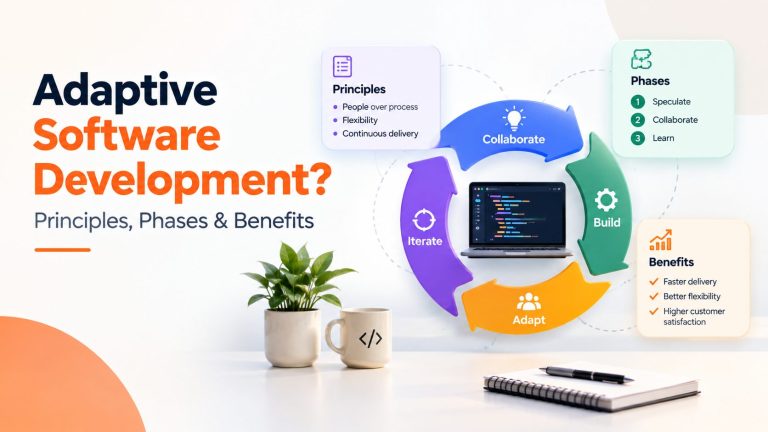
Adaptive software development works by setting an initial direction, building a small working increment, gathering feedback and using what the team learns to adjust the next cycle. Teams do not try to predict every detail upfront. They repeat this loop:
- Speculate: set the mission, state assumptions and plan the next cycle.
- Collaborate: developers, product owners and customers build and decide together.
- Learn: review the result, test assumptions and gather feedback.
- Adapt: revise priorities and requirements based on evidence.
- Repeat: start the next cycle with better information.
In a rigid sequential model, design is fixed before build and feedback arrives near the end, when change is expensive. In ASD, short cycles deliver increments and continuous feedback, so wrong assumptions surface while they are cheap to fix.
The 3 Phases of Adaptive Software Development
The three phases of adaptive software development are Speculate, Collaborate and Learn. Teams move through them repeatedly, and each pass leaves the next one better informed.
| Phase | Main Purpose | Typical Activities | Output |
| Speculate | Establish direction | Vision, assumptions, release and iteration planning | Initial direction |
| Collaborate | Build together | Development, communication, teamwork | Working increment |
| Learn | Validate and adapt | Feedback, testing, review | New insights and next actions |
-
Speculate
This phase sets the project vision, business objectives and initial requirements. The team records its assumptions, plans releases at a high level and plans the next iteration in detail.
ASD uses the word “speculate” instead of “plan” on purpose. The goal is not to skip planning. It is to be honest that a plan in an uncertain environment is a set of assumptions, and assumptions can be wrong. A speculative plan gives direction without pretending to be a guarantee.
-
Collaborate
Collaboration covers cross-functional teamwork between developers, testers, designers and product stakeholders, along with regular involvement from customers or users. It includes knowledge sharing, open communication, shared decision-making and collective ownership of the outcome.
This matters most while requirements and technical understanding are evolving. No one holds the full picture, so decisions improve when people who understand the users, the architecture and the business goals solve problems together.
-
Learn
Learning turns a finished iteration into information. Teams collect feedback, run tests, validate features with customers, hold retrospectives and review the assumptions they made during speculation. Then they adjust the next cycle.
Learning is not only about fixing defects. Teams also learn:
- What customers actually need, as opposed to what they first requested
- Which technical approaches work under real conditions
- Which assumptions were incorrect
- What should change in the next cycle
|
Speculate → Collaborate → Learn → New assumptions → Next cycle |
Key Principles of Adaptive Software Development
These are practical interpretations, not a rigid rulebook. Highsmith described ASD cycles as mission focused, feature based, iterative, timeboxed, risk driven and change tolerant.
- Embrace uncertainty. Expect change. A revised requirement is information, not project failure.
- Build iteratively. Deliver in repeated cycles instead of attempting one complete release.
- Keep learning. Use real results and customer feedback to improve later decisions.
- Collaborate. Share decisions and communicate across roles and disciplines.
- Involve customers. Use their feedback to validate assumptions and product direction.
- Adapt continuously. Let plans, priorities and implementation choices evolve with evidence.
- Stay mission focused. Keep every iteration tied to the broader product or business objective, so adaptation does not become drift.
- Improve through feedback. Treat each development cycle as a learning opportunity.
Read About AI Agents Framworks – https://hiredeveloper.dev/insights/top-ai-agent-frameworks/
Adaptive Software Development Life Cycle
The adaptive software development life cycle is a repeating loop, anchored by a mission and driven by feedback:
|
Mission / Vision → Speculation → Iteration → Collaboration → Development → Feedback → Learning → Adaptation → Next Iteration |
Highsmith described the cycle in terms of project initiation, adaptive cycle planning, concurrent component engineering, quality review, and final quality assurance and release. The mission stays stable while features and priorities are revisited each cycle, unlike a linear lifecycle where each stage finishes before the next begins.
| Traditional Linear Approach | Adaptive Approach |
| Detailed upfront planning | Direction plus evolving planning |
| Fixed assumptions | Test and revise assumptions |
| Sequential execution | Iterative cycles |
| Change can be disruptive | Change is expected |
| Feedback often arrives later | Feedback influences iterations |
| Predictability is emphasized | Learning and adaptation are emphasized |
Adaptive Software Development Example
This is an illustrative scenario, not a real case study. A company plans a SaaS customer analytics platform and uses adaptive software development to build it.
Initial assumption (Speculate). Based on early conversations, the team assumes users need a complex analytics dashboard with advanced visualizations. They define a mission, list this assumption openly and plan a first iteration around the highest-priority metrics.
First iteration (Collaborate). Developers, a product manager and two pilot customers build a basic dashboard with a few core metrics. The pilot customers review builds as they appear, not at a final demo.
Customer feedback and learning (Learn). Usage data and interviews show customers rarely explore the visualizations. They keep asking whether the product can tell them when something goes wrong, such as a sudden drop in a key metric. The team sees its original assumption was incomplete: users do not want to analyze data all day, they want to know when to act.
Adaptation. The next iteration prioritizes automated alerts and workflow automation. Advanced charting moves down the backlog.
Next cycle. The team ships alerts, gathers fresh feedback and tests new assumptions, such as which notification channels users prefer. Speculate, Collaborate and Learn start again with better information.
A fixed upfront plan would have delivered the complex dashboard on schedule and missed what customers wanted. Here, the gap surfaced after one cycle instead of after launch.
Adaptive Software Development vs Agile, Scrum & Waterfall
ASD is closely related to Agile thinking, not a competitor to it. Agile is a broad philosophy and family of methods, and Scrum is a specific, more prescriptive framework within it. ASD sits alongside Scrum as an Agile-aligned approach focused on uncertainty. Waterfall is the sequential contrast.
| Criteria | Adaptive Software Development | Agile | Scrum | Waterfall |
| Core focus | Managing uncertainty through learning and adaptation | Delivering value through iteration, collaboration and responding to change | Delivering increments in fixed-length sprints | Completing defined phases in sequence |
| Planning | Speculative, revised every cycle | Ongoing and adaptive | Product backlog and sprint planning | Detailed and upfront |
| Handling change | Expected, and shapes the next cycle | Welcomed | Absorbed between sprints via the backlog | Managed through formal change control |
| Feedback | Continuous, drives learning | Frequent | Sprint review and retrospective | Usually late, at testing or delivery |
| Iterations | Short, timeboxed adaptive cycles | Iterative delivery | Fixed-length sprints | None, phases are sequential |
| Collaboration | Central, with shared decisions | Core value | Defined roles and events | Handoffs between phases |
| Best suited to | High uncertainty and complex, evolving projects | Changing requirements and product work | Teams that want a structured cadence | Stable, well-defined, often regulated work |
Read about software development Companies
Benefits and Challenges of Adaptive Software Development
Benefits
Adaptive software development guarantees nothing, but it can help teams in several ways:
- Responds to changing requirements without crisis.
- Faster feedback from short cycles and frequent customer contact.
- Lower risk from wrong assumptions, because they are tested early.
- Continuous learning that improves both the product and the team.
- Better customer alignment, since real usage shapes priorities.
- Better handling of uncertainty in complex work.
- Incremental value delivery, so usable software arrives earlier.
- Stronger collaboration across developers, product and business roles.
Challenges
- It needs strong collaboration. Silos and slow decisions weaken it.
- Rigid organizations make it hard. Fixed budgets and approval gates work against adaptation.
- It needs real customer involvement. Without users to give feedback, cycles produce little learning.
- Scope can keep evolving. Without a clear mission, priorities can drift.
- Planning feels less predictable. Stakeholders expecting exact dates and scope may be uncomfortable.
- It works best with experienced teams that can decide with incomplete information.
- Poor feedback loops reduce its value. Iteration without learning is just fast repetition.
- Not every project benefits equally. Highly stable work gains less from high adaptability.
When Should You Use Adaptive Software Development?
Adaptive software development is a good candidate when requirements are uncertain, the product is innovative, customer feedback matters, the technology is evolving, the project is complex and market conditions may change. It is a weaker fit when requirements are stable, regulation demands strict predefined documentation and processes, the project is highly predictable, or change is intentionally minimized.
A simple selection framework
High uncertainty + evolving requirements + continuous feedback = ASD can be considered. Stable requirements + predictable execution + limited change = a more structured approach may be appropriate.
Treat this as a starting point, not an absolute rule. Many projects sit in between. Methodology choice should reflect project characteristics, organizational constraints and risk profile.
Teams facing evolving requirements often benefit from experienced developers who are comfortable with iterative delivery, whether hired in-house or added as dedicated developers.
Adaptive Software Development in 2026
The core idea of ASD, learn quickly and adapt based on evidence, matters as much in 2026 as it did in 2000. What has changed is the engineering environment around it. ASD does not require AI, DevOps, cloud-native architecture or Kubernetes. But several modern practices make adaptive development easier to run well:
- AI-assisted development and AI-generated code shorten the time to a first working version. Building the wrong thing faster is still building the wrong thing, so speculation, code review and validation matter more.
- Continuous delivery and DevOps lower the cost of small releases, supporting short cycles.
- Cloud-native applications and microservices can let teams change one part of a system without rebuilding everything, when the architecture is well designed.
- Automated testing gives fast technical feedback and makes frequent change safer.
- Observability and product analytics show how software behaves and how users behave in production, which feeds the learning phase with evidence.
- Platform engineering reduces tooling friction, so teams spend more time learning and less time waiting.
- Rapid product experimentation, such as feature flags and controlled rollouts, turns assumptions into testable hypotheses.
Conclusion
Adaptive software development is designed for software environments where uncertainty and change are the norm. Its core cycle of Speculate, Collaborate and Learn keeps iteration and feedback at the center, so teams adapt as new information arrives. It is not right for every project: stable, predictable or heavily regulated work may suit a more structured approach.
Practical takeaway: before your next project, list your five biggest assumptions, decide how the first iteration will test them, and agree who will give feedback. If those answers keep changing, an adaptive approach is worth considering.
Sources and Refrences
- Drish Infotech — https://drishinfo.com/adaptive-software-development/
- DRC Systems — https://www.drcsystems.com/blogs/adaptive-software-development-guide/
- ThinkPalm — https://thinkpalm.com/blogs/all-about-adaptive-software-development-asd/
- Kellton — https://www.kellton.com/kellton-tech-blog/adaptive-software-development-detailed
- PureLogics — https://purelogics.com/adaptive-software-development/guide