






Introduction
Picture this. Two founders sit down with the same budget, the same app idea, and roughly the same timeline. Six months later, one has a fast, polished app live on both app stores. The other is stuck untangling a bloated codebase, chasing a vendor who has gone quiet, and explaining to investors why the launch slipped again. The difference almost never comes down to luck. It comes down to who they hired.
Choosing a React Native app development partner is rarely about finding the cheapest quote. It is a decision that shapes how fast your product ships, how well it performs under real usage, and how easily your team can maintain it two years from now. Get it wrong and you inherit a sluggish app, mounting technical debt, a delayed launch, security gaps nobody flagged in time, or a codebase almost no one wants to touch.
React Native app development remains one of the most practical ways to build cross platform mobile applications for iOS and Android from a single codebase, which is exactly why demand for experienced React Native app development companies keep climbing. The catch is that the market is crowded, every vendor’s homepage sounds impressive, and marketing claims rarely tell you which company fits your project.
This guide cuts through that noise. It walks through what React Native app development really involves, the services a capable development company should offer, a transparent way to evaluate vendors, realistic 2026 cost ranges, how React Native stacks up against Flutter and native development, and how to hire React Native developers directly or through a company. By the end, you will have a decision framework you can actually use, not another recycled top ten list.
What Is React Native App Development?
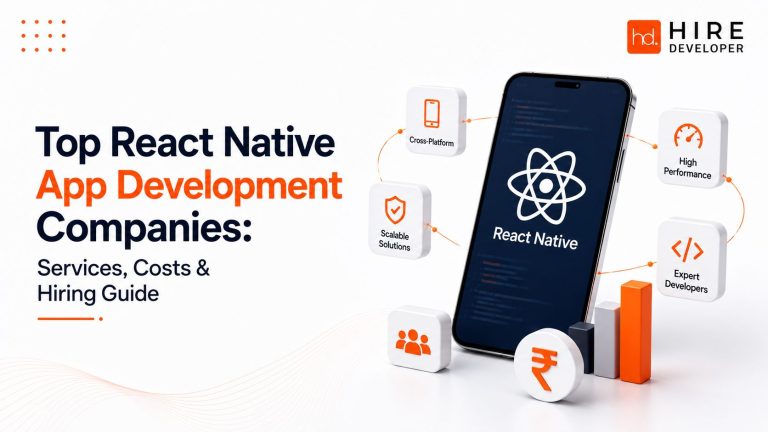
React Native app development is the process of building mobile applications for both iOS and Android using a single JavaScript or TypeScript codebase, rather than writing separate native apps in Swift and Kotlin. It is an open source framework originally released by Meta, built on top of React, and it renders real native components on screen instead of a webview.
React and React Native share the same component model and declarative programming style, but they target different environments. React renders to the browser DOM for web applications. React Native renders to native UI elements on Android and iOS, using native components such as buttons, lists, and navigation stacks that behave like a fully native app to the end user.
In practice, a React Native app development company writes most of the business logic, UI, and app flow once in JavaScript or TypeScript, then adds native modules in Kotlin or Swift only where platform specific functionality is required, such as certain hardware integrations or advanced native performance work. This is what allows React Native for mobile app development to significantly reduce duplicated engineering effort compared to building two fully separate native apps.
Why Choose React Native for Mobile App Development?
React Native app development earns its popularity for a specific, well understood set of reasons, not because it is automatically the best or cheapest option for every project. The biggest draw is that one codebase covers both Android and iOS, with 70 to 90 percent of the code shared between platforms depending on how the app is built. That translates directly into faster development cycles, since one team owns one codebase instead of coordinating two separate builds on two separate timelines.
React Native also sits inside one of the largest developer ecosystems in the world. Because it is built on JavaScript and TypeScript, the hiring pool is far wider than it is for platform specific native development, which makes it easier to scale a team up or replace a developer without stalling the project. When an app genuinely needs deeper platform integration, native modules and native components give it a way to tap into Android and iOS specific functionality without abandoning the shared codebase. For most business apps, SaaS products, and content driven platforms, that combination adds up to real cost efficiency, since one team effectively replaces two.
None of that makes React Native automatically cheaper or better for every use case. Extremely graphics intensive apps can still require native optimization work. Some advanced hardware or platform specific features demand custom native modules no matter which framework sits underneath them, and on very large, feature heavy applications, bridge and native module complexity can creep up if the architecture is not planned carefully from the start. The right choice always depends on the app’s complexity, its performance requirements, and how deeply it needs to reach into platform specific hardware or APIs.
What Services Do React Native App Development Companies Provide?
A capable React Native app development company rarely just writes screens. The engagement usually starts with custom mobile app development or MVP development for startups still validating an idea, paired with UI/UX design built specifically for mobile interaction patterns rather than repurposed web layouts. Underneath the interface sits backend development and REST API or GraphQL integration, along with native module development in Kotlin and Swift wherever the app needs to reach past what JavaScript alone can do.
Established companies also handle the less visible work that determines whether an app survives past launch. That includes app migration and modernization from legacy or native codebases, third party integrations such as payment gateways and Firebase, and push notification setup. Automated and manual testing, DevOps and CI/CD pipelines through tools like GitHub Actions, and App Store and Google Play deployment round out the delivery process, followed by ongoing maintenance, performance optimization, and security hardening once the app is live.
Need a team that covers React Native development end to end, from architecture to App Store release? Explore React Native developers at HireDeveloper.dev
Top React Native App Development Companies in 2026
The companies below were shortlisted using a transparent, editorial evaluation framework rather than search visibility, marketing spend, or self reported rankings. This is not an objective industry ranking. It reflects publicly available information about each company’s React Native focus, service scope, and typical client profile.
Evaluation Framework
| Criterion | Weight |
| React Native Expertise | 20% |
| Technical Capability | 15% |
| Portfolio / Case Studies | 15% |
| Industry Experience | 10% |
| Client Reviews / Reputation | 10% |
| Development Services Offered | 10% |
| Communication / Delivery Model | 10% |
| Maintenance & Support | 5% |
| Technology Depth (New Architecture, TypeScript, testing) | 5% |
HireDeveloper.dev
- Location / Primary Markets: India based, serving businesses across the United States and United Kingdom
- React Native Services: React Native app development, dedicated developer hiring, staff augmentation, full stack mobile and web development
- Core Technologies: React Native, TypeScript, Node.js, React, cloud platforms
- Typical Project Focus: Connecting US and UK businesses with vetted, English fluent Indian React Native developers on flexible engagement terms
- Ideal Client Type: Businesses that want direct access to vetted senior developers without the overhead of a traditional agency
- Key Strength: Transparent, developer first hiring model with flexible engagement options and direct communication with the development team
- Potential Limitation: Best suited to companies comfortable managing a remote, distributed development relationship
- Best For: Founders and product teams who want to hire React Native developers directly at competitive, transparent rates
- Website: hiredeveloper.dev
Vention
- Location / Primary Markets: United States, with distributed engineering teams across Latin America and Eastern Europe
- React Native Services: React Native app development, staff augmentation, dedicated teams, backend and cloud engineering
- Core Technologies: React Native, TypeScript, Node.js, AWS
- Typical Project Focus: Mid market to enterprise product engineering, often as an extension of an in house team
- Ideal Client Type: Companies that want a dedicated, embedded React Native team rather than a fixed scope agency engagement
- Key Strength: Strong staff augmentation and dedicated team model with senior engineering talent
- Potential Limitation: Better suited to longer engagements than small, fixed scope projects
- Best For: Scaling an existing product with an experienced dedicated team
- Website: ventionteams.com
WillowTree
- Location / Primary Markets: United States, with additional delivery hubs internationally
- React Native Services: React Native and native mobile app development, product strategy, UX design, enterprise integration
- Core Technologies: React Native, Swift, Kotlin, cloud backends
- Typical Project Focus: Enterprise and large scale consumer mobile products
- Ideal Client Type: Enterprises needing both strategic product input and engineering depth
- Key Strength: Deep enterprise delivery experience and strong design capability alongside engineering
- Potential Limitation: Typically positioned for larger budgets and enterprise scale engagements
- Best For: Large brands building flagship mobile products
- Website: willowtreeapps.com
STRV
- Location / Primary Markets: United States and Europe
- React Native Services: React Native app development, native iOS and Android development, product design
- Core Technologies: React Native, TypeScript, Swift, Kotlin
- Typical Project Focus: Startup and growth stage product development, often working closely with founders
- Ideal Client Type: Startups and scale ups that need a product minded engineering partner
- Key Strength: Strong design and engineering collaboration for early to growth stage products
- Potential Limitation: Positioned more for product partnership engagements than short, transactional projects
- Best For: Startups building or scaling a core mobile product
- Website: strv.com
Cheesecake Labs
- Location / Primary Markets: United States and Brazil
- React Native Services: React Native app development, MVP development, IoT and connected device apps
- Core Technologies: React Native, TypeScript, native modules for IoT integration
- Typical Project Focus: Startups and product teams, including hardware connected mobile apps
- Ideal Client Type: Startups needing an MVP or a product connected to hardware or IoT devices
- Key Strength: Practical experience combining React Native with native modules for hardware integrations
- Potential Limitation: Smaller scale than large enterprise focused firms
- Best For: MVP development and hardware connected mobile products
- Website: cheesecakelabs.com
Intellectsoft
- Location / Primary Markets: United States, with European delivery centers
- React Native Services: React Native app development, enterprise mobility, digital transformation consulting
- Core Technologies: React Native, cloud native architecture, enterprise integrations
- Typical Project Focus: Enterprise mobility and digital transformation projects
- Ideal Client Type: Enterprises modernizing operations through mobile applications
- Key Strength: Enterprise mobility experience and cloud native architecture depth
- Potential Limitation: Project budgets and engagement scope tend to skew toward enterprise rather than early stage startups
- Best For: Enterprise digital transformation initiatives
- Website: intellectsoft.net
Simform
- Location / Primary Markets: United States, with delivery operations in India
- React Native Services: React Native app development, cloud native development, QA and testing, dedicated teams
- Core Technologies: React Native, TypeScript, AWS, Azure
- Typical Project Focus: Cloud connected, scalable mobile applications for growing businesses
- Ideal Client Type: Companies that want React Native development paired with cloud architecture expertise
- Key Strength: Strong focus on scalability, cloud integration, and long term maintainability
- Potential Limitation: Larger engagements benefit most from their dedicated team model
- Best For: Businesses needing scalable, cloud connected React Native apps
- Website: simform.com
Appinventiv
- Location / Primary Markets: India, with a presence in the United States and United Kingdom
- React Native Services: React Native app development, UI/UX design, backend development, app modernization
- Core Technologies: React Native, TypeScript, Node.js, cloud platforms
- Typical Project Focus: Broad range of industries including fintech, healthcare, and on demand platforms
- Ideal Client Type: Businesses wanting a full service partner covering design through deployment
- Key Strength: Wide industry coverage and full lifecycle service offering
- Potential Limitation: Larger organization, so smaller projects may not get the most senior team by default
- Best For: End to end React Native builds across varied industries
- Website: appinventiv.com
Konstant Infosolutions
- Location / Primary Markets: India
- React Native Services: React Native app development, custom mobile app development for SMEs and enterprises
- Core Technologies: React Native, TypeScript, REST APIs
- Typical Project Focus: SME and mid market mobile app projects
- Ideal Client Type: Small and mid sized businesses seeking cost effective React Native development
- Key Strength: Practical, cost conscious delivery for SME budgets
- Potential Limitation: Less enterprise scale positioning compared to larger global firms
- Best For: SMEs and startups with defined budgets
- Website: konstantinfo.com
Company Comparison Table
| Company | RN Expertise | Services | Primary Markets | Best For | Engagement Model |
| HireDeveloper.dev | Strong | Dedicated hiring, full stack | India, US, UK | Direct developer hiring | Flexible / dedicated |
| Vention | Strong | Dedicated teams, full stack | US, LatAm, EU | Embedded team scaling | Staff augmentation |
| WillowTree | Strong | Strategy, design, engineering | US, global | Enterprise flagship apps | Project + retainer |
| STRV | Strong | Product design + engineering | US, EU | Startups, growth stage | Product partnership |
| Cheesecake Labs | Solid | MVP, IoT integrations | US, Brazil | MVP and hardware apps | Fixed scope / dedicated |
| Intellectsoft | Solid | Enterprise mobility | US, EU | Digital transformation | Project based |
| Simform | Solid | Cloud native, QA | US, India | Scalable cloud apps | Dedicated teams |
| Appinventiv | Solid | Full lifecycle development | India, US, UK | Multi industry builds | Project based |
| Konstant Infosolutions | Moderate | Custom mobile development | India | SME budgets | Fixed scope |
How Much Does React Native App Development Cost in 2026?
React Native app development costs vary widely based on scope, so treat the figures below as planning estimates rather than fixed quotes. Actual pricing depends on the development company’s location, seniority mix, and how well requirements are defined before work begins.
| App Type | Estimated Cost Range (USD) |
| Simple app (basic screens, limited backend) | $15,000 to $40,000 |
| Medium complexity app (APIs, auth, payments) | $40,000 to $90,000 |
| Complex app (marketplace, real time features, integrations) | $90,000 to $180,000 |
| Enterprise application (compliance, custom infrastructure) | $180,000 and above |
Factors that move a project up or down within these ranges include the number of features, UI/UX complexity, backend architecture, third party API and payment integrations, authentication and security requirements, cloud infrastructure, testing depth, the development team’s location, and the level of developer experience. Ongoing maintenance typically adds 15 to 20 percent of the original build cost per year.
Comparing quotes for a React Native build and want a clearer sense of realistic scope and pricing? Get matched with vetted React Native developers
React Native App Development Cost by Region
Hourly rates for React Native app development vary significantly by region, largely reflecting local cost of living and market demand rather than raw skill differences.
| Region | Typical Hourly Rate | Notes |
| United States | $80 to $180 | Highest cost, strong access to senior product and engineering talent |
| Canada | $70 to $150 | Comparable talent pool to the US at a modest discount |
| United Kingdom | $70 to $150 | Strong React ecosystem, similar cost profile to North America |
| Western Europe | $60 to $130 | Strong engineering standards, moderate time zone overlap with the US and UK |
| Eastern Europe | $35 to $75 | Good technical depth with lower rates than Western Europe |
| India | $20 to $50 | Large developer pool, strong React and JavaScript talent, cost efficient |
| Latin America | $30 to $65 | Favorable time zone overlap with North America |
Actual pricing always depends on scope, team structure, seniority, and engagement model, not region alone. A senior offshore team can outperform a junior local team on both cost and delivery quality, and the reverse is also true.
React Native Development Cost by App Complexity
| App Type | Complexity | Est. Timeline | Major Features | Relative Cost |
| Basic MVP | Low | 6 to 10 weeks | Core flows, basic auth, limited screens | $ |
| Business App | Low to Medium | 10 to 14 weeks | CRM style features, dashboards, notifications | $$ |
| Marketplace | Medium to High | 16 to 24 weeks | Listings, search, payments, messaging | $$$ |
| Social App | Medium to High | 16 to 24 weeks | Feeds, media upload, real time updates | $$$ |
| FinTech App | High | 20 to 30 weeks | KYC, payments, compliance, security layers | $$$$ |
| Healthcare App | High | 20 to 30 weeks | Compliance, data privacy, integrations | $$$$ |
| On Demand App | High | 18 to 28 weeks | Live tracking, matching, payments | $$$$ |
| Enterprise App | Very High | 24 weeks and up | Custom infrastructure, SSO, compliance | $$$$$ |
React Native vs Flutter vs Native App Development
Technology choice should follow the application’s requirements, not framework popularity. All three approaches are capable of producing strong production apps.
| Factor | React Native | Flutter | Native (Swift/Kotlin) |
| Development Speed | Fast, one codebase | Fast, one codebase | Slower, two codebases |
| Code Reuse | High, 70 to 90% | High, 70 to 90% | None between platforms |
| Performance | Near native, bridge managed via JSI | Near native, compiled to native ARM code | Fully native, highest ceiling |
| Native Integration | Strong via native modules | Strong via platform channels | Direct and unrestricted |
| Developer Ecosystem | Very large, JavaScript and TypeScript talent pool | Large and growing, Dart based | Deep but platform specific |
| Cost | Generally lower for cross platform scope | Generally lower for cross platform scope | Higher, two teams or two skill sets |
| Maintenance | One codebase to maintain | One codebase to maintain | Two codebases to maintain |
| Best Use Cases | Business apps, MVPs, content and commerce apps | UI heavy apps needing consistent design across platforms | Graphics intensive, hardware heavy, or performance critical apps |
When Should You Not Use React Native?
React Native handles the large majority of business and consumer app use cases well, but a few scenarios genuinely favor native development instead. Extremely graphics intensive applications, such as advanced games or real time 3D rendering, tend to push past what a cross platform bridge can comfortably handle. The same goes for apps that need deep, continuous access to highly specialized native hardware, or advanced AR and VR experiences that depend heavily on platform specific frameworks. If every millisecond of platform specific performance is business critical, or the product will require constant native module development regardless of framework, native development is often the more honest starting point.
If your app’s core value depends on graphics or hardware performance that pushes the platform to its limits, a technical discovery phase should evaluate native development or a hybrid approach before committing to React Native.
How Does React Native App Development Work?
- Discovery: defining business goals, target users, and technical constraints
- Requirements gathering: documenting features, integrations, and platform scope
- UI/UX design: wireframes and high fidelity designs for mobile interaction patterns
- Architecture planning: state management, navigation, native module needs, and backend structure
- React Native development: building screens, components, and business logic in JavaScript or TypeScript
- Backend and API development: building or integrating REST or GraphQL services
- Testing: automated unit and integration testing plus manual QA across devices
- Performance optimization: profiling, reducing bundle size, and tuning rendering
- Deployment: preparing and submitting builds to the App Store and Google Play
- Maintenance: monitoring, bug fixes, updates, and ongoing feature development
How to Choose a React Native App Development Company
Look past the pitch deck and check for verified React Native experience, not just general mobile development background, along with a portfolio that includes real case studies in a similar industry or app type. A company worth hiring can walk you through its architecture decisions, including how it handles state management and native modules, and can describe its testing process in specific terms rather than vague reassurances about quality.
Security practices, including how authentication and data are handled, should come up in the first serious conversation, not after a breach. Beyond the technical fit, pay attention to how transparent the pricing is, whether communication feels responsive from the first call, and whether post launch support is clearly defined rather than assumed. Full source code ownership, clear technical documentation, and a real plan for scaling as user volume grows are non negotiable for any company you are trusting with your product.
Hire React Native App Developers vs Hiring a Development Company
| Model | Cost | Control | Scalability | Best Use Case |
| Freelancer | Lowest | High, but limited technical coverage | Low | Small tasks, short term fixes |
| Direct hire (in house) | High long term investment | Highest | Depends on hiring speed | Long term core product teams |
| Staff augmentation / dedicated developers | Moderate | High | High, add or remove developers as needed | Extending an existing team |
| Development company (project based) | Moderate to high per project | Moderate | High, company manages scaling | Full builds with defined scope |
Freelancers work well for small, well defined tasks. Direct hiring makes sense when React Native is core to your long term product. Dedicated developers and staff augmentation suit teams that already have technical leadership and want to extend capacity. A full development company fits best when a business needs end to end delivery, including architecture, design, and project management, without building an internal team from scratch.
How to Hire React Native App Developers in India
India remains one of the most active markets to hire React Native app developers, offering a large, experienced talent pool at competitive rates. A structured process reduces hiring risk.
- Define your product requirements and target platforms
- Select an architecture approach, including state management and navigation
- Determine the required skill set, including TypeScript, native modules, or specific integrations
- Define the team structure, such as a single developer versus a dedicated team
- Source developers through vetted platforms or development companies
- Review portfolios for relevant, verifiable React Native projects
- Conduct technical interviews focused on real problem solving, not just theory
- Evaluate React Native specific expertise, including performance and native modules
- Check communication skills and English proficiency for remote collaboration
- Verify experience through references or past client feedback
- Agree on an engagement model, such as fixed scope, dedicated team, or hourly
- Onboard the team with clear documentation and communication norms
Looking to hire React Native app developer India based talent with verified experience? Browse vetted React Native developers in India
What Skills Should React Native Developers Have?
Strong React Native developers start with solid fundamentals in React and component based architecture, then build on that with practical React Native experience, including navigation and platform specific handling on both Android and iOS. JavaScript and TypeScript proficiency is table stakes, alongside state management experience and comfort integrating REST or GraphQL APIs. The developers who stand out can also write or work confidently with native modules in Kotlin and Swift when a project needs to reach beyond JavaScript.
Beyond core coding ability, look for Git and version control discipline, real testing experience covering both automated and manual QA, and a habit of profiling performance rather than guessing at it. Security awareness, CI/CD familiarity with tools such as GitHub Actions, hands on App Store and Google Play deployment experience, and working knowledge of cloud services like AWS, Google Cloud, or Microsoft Azure round out a well rounded profile.
Junior developers should show solid React and JavaScript fundamentals. Mid level developers should demonstrate independent feature ownership and API integration experience. Senior developers should be able to make architecture decisions, handle native modules, and mentor the rest of the team.
Common Mistakes When Choosing a React Native Development Company
The most expensive mistake businesses make is choosing a vendor on price alone, without ever digging into technical depth or asking how the team plans to architect the app before development starts. A close second is skipping portfolio verification and taking marketing claims at face value, or signing a contract without clarifying who owns the source code once the project wraps.
Plenty of otherwise solid projects go sideways for quieter reasons too. Maintenance gets treated as an afterthought until something breaks. Requirements stay vague going into development, which invites scope creep later. Security rarely comes up until it becomes a problem, and performance testing gets pushed to after launch instead of built into the process. Businesses also underestimate how much it matters to ask, upfront, how the app is expected to scale as usage grows, and how easily a generalist agency with limited React Native specific experience can end up costing more than a specialist would have.
React Native Development Trends in 2026
React Native New Architecture, Fabric, and TurboModules
The New Architecture, including Fabric and TurboModules, improves how native and JavaScript code communicate, reducing bridge overhead. For businesses, this translates into smoother animations and better performance on complex screens.
JSI and Hermes
The JavaScript Interface and the Hermes engine continue to improve startup time and runtime performance, which matters directly for user retention on lower end devices.
TypeScript as the default
TypeScript adoption across React Native teams reduces bugs and makes codebases easier to maintain, which lowers long term maintenance cost for businesses.
Expo maturity
Continued improvements to Expo make it a viable production choice for many apps, not just prototypes, simplifying build and deployment workflows.
AI assisted development
AI assisted coding tools are speeding up boilerplate work and testing, which can shorten timelines when a development company uses them responsibly alongside experienced engineers.
Cloud connected, API driven applications
More React Native apps are being built as thin, fast clients connected to cloud backends and third party APIs, which affects how businesses should scope backend and DevOps work.
Final Verdict: How to Choose the Right React Native Development Partner
The right React Native app development company depends on your specific situation, not a universal ranking. Consider project complexity, industry and compliance needs, budget, timeline, required technical depth, long term support needs, expected scale, and how much native integration your app truly requires.
A startup validating an MVP has different needs than an enterprise modernizing a legacy mobile app. A fintech product needs a team fluent in compliance and security. A consumer social app needs strength in real time features and performance at scale. Match the vendor’s demonstrated experience to your actual requirements, verify their claims through real case studies, and confirm source code ownership and post launch support before signing anything.
Conclusion
React Native app development gives businesses a practical way to build fast, capable, cross platform mobile apps without maintaining two separate native codebases. The right outcome depends less on the framework itself and more on the development company you choose, how clearly you define requirements, and how seriously both sides treat architecture, security, testing, and long term maintenance.
Use the evaluation framework, cost ranges, and comparisons in this guide to judge React Native app development companies on substance rather than marketing claims, and you will be in a strong position to choose a partner who can actually deliver.
Ready to move forward with a vetted React Native app development company? Start hiring React Native developers at HireDeveloper.dev
Reference Content
- https://mobidev.biz/blog/react-native-app-development-guide
- https://appinventiv.com/blog/react-native-for-mobile-app-development/
- https://www.coursera.org/in/articles/what-is-react-native
- https://www.freecodecamp.org/news/mobile-app-development-with-react-native/
- https://www.techaheadcorp.com/blog/how-does-react-native-app-development-work/
- https://www.intuz.com/react-native-development-guide/