








Why Businesses Prefer Dedicated Laravel Developers in 2026
You have a product to ship, a roadmap that keeps expanding, and a development timeline that seems to shrink every sprint. If that sounds familiar, you are not alone. In 2026, the biggest bottleneck for growing businesses and early-stage startups is not funding or ideas. It is a reliable, skilled engineering talent.
The demand to hire Laravel developer talent has grown sharply over the past two years. Laravel continues to power millions of web applications across SaaS, fintech, healthcare, and eCommerce, and businesses that move fast need developers who can keep up. The question is no longer whether to bring in Laravel expertise. It is how to structure that relationship in a way that actually scales.
There are three main models most businesses consider: hiring a freelancer for short bursts of work, engaging a Laravel development company for full project delivery, or bringing on a dedicated Laravel developer who becomes a real extension of your team. Each has its place. But if you are building a product with longevity, a dedicated developer consistently outperforms the alternatives on accountability, context retention, and output quality.
This guide breaks down everything you need to make a confident hiring decision in 2026. Whether you are a CTO scaling a B2B SaaS platform or a founder launching your first product, from skills to cost, platforms to processes, and remote management to onboarding, this is the blueprint you need.
Why Laravel Is Still the Top PHP Framework in 2026
Laravel has dominated the PHP ecosystem for over a decade, and in 2026 its position has only strengthened. With more than 77,000 GitHub stars, an active contributor base, and a rapidly evolving ecosystem, Laravel remains the go-to choice for teams building complex, scalable web applications. It is not just popular. It is production-battle-tested across industries and company sizes.
For startups, Laravel offers the development of velocity needed to launch quickly without sacrificing architecture. For scaling businesses, it provides the structure, security tooling, and performance capabilities required to grow without a full rewrite. That combination is rare and powerful.
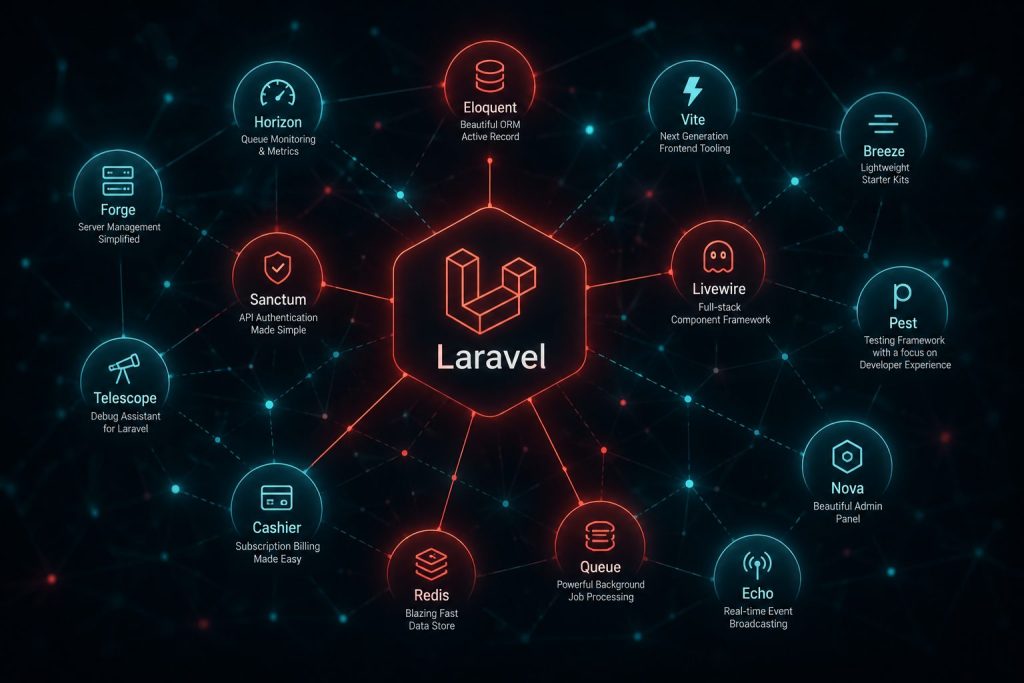
Laravel’s 2025-26 Ecosystem Updates
The Laravel ecosystem has seen substantial improvements heading into 2026. Laravel 11 and the upcoming Laravel 12 builds have brought a streamlined application structure, reduced boilerplate, and enhanced performance under high-concurrency conditions. The introduction of Folio for page-based routing, Volt for single-file Livewire components, and deeper Reverb WebSocket integration have made Laravel development services more expressive and efficient than ever.
Security enhancements, improved rate limiting, and native support for modern deployment patterns including containerized environments via Docker and Kubernetes have further cemented Laravel’s relevance for enterprise-grade development. AI-assisted developer tooling through Laravel Prompts and first-party integrations with services like Cloudflare R2 and AWS reflect an ecosystem that is genuinely future-forward.
Industries That Rely on Laravel
Laravel application development services span a wide range of commercial sectors. SaaS businesses rely on it for multi-tenant architecture, subscription billing via Spark or Cashier, and robust API layers. Fintech companies trust Laravel’s strict validation, encryption capabilities, and access control systems. Healthcare platforms use HIPAA-adjacent workflows, data security, and reliable background job processing.
Logistics and supply chain platforms use Laravel for real-time tracking APIs and warehouse management systems. Marketplaces and eCommerce applications benefit from its queue systems, caching layers, and native support for multiple payment gateways. If your business falls into any of these categories, hiring a dedicated Laravel developer who understands your vertical is one of the highest-leverage hiring decisions you can make.
Laravel vs Other Frameworks (Node.js, Django, Rails)
When comparing Laravel against Node.js, Django, or Ruby on Rails, the conversation often comes down to team familiarity and project requirements. Node.js is ideal for real-time applications but introduces JavaScript complexity on the backend. Django offers strong data handling but requires Python expertise and can feel rigid in rapid-iteration environments. Rails have historically been a strong startup choice but have seen declining community momentum compared to Laravel.
Laravel stands out for its all-in-one philosophy. Authentication, queueing, caching, broadcasting, testing tools, and database migrations are built into the framework. Teams spend less time assembling a stack and more time shipping features. For most web application use cases, Laravel software provides the right balance of structure, flexibility, and community support to outperform the competition in real-world delivery timelines. Businesses that invest in Laravel software early consistently report faster MVP cycles and lower long-term maintenance overhead.
Read – Django vs Laravel
What Skills Should a Dedicated Laravel Developer Have in 2026?
Hiring a Laravel developer without a clear skills framework is one of the most common and costly mistakes businesses make. Not every PHP developer is a Laravel expert, and not every Laravel developer can handle the scale, and architecture demands of a modern SaaS product. Here is what to evaluate.

Core Technical Skills Checklist
Before shortlisting any candidate, verify proficiency in the following areas:
- PHP 8.2+ including typed properties, enums, fibers, and attributes
- RESTful API design and consumption, including versioning and rate limiting
- MySQL and PostgreSQL with a strong grasp of indexing, query optimization, and migrations
- Git version control with branch strategies, PR workflows, and code review habits
- Docker and containerization for local and production environments
- Redis for caching, session management, and queue backends
- Laravel testing tools including PHPUnit, Pest, and feature tests
- CI/CD pipeline integration via GitHub Actions, Bitbucket Pipelines, or GitLab CI
- Cloud deployment experience with AWS, GCP, DigitalOcean, or Laravel Forge
Laravel-Specific Expertise to Look For
Beyond core PHP competency, a genuinely skilled Laravel developer should demonstrate hands-on experience with:
- Eloquent ORM including relationships, eager loading, scopes, and performance-conscious querying
- Laravel Queues and Horizon for background processing at scale
- Laravel Livewire or Inertia.js for full-stack reactive interfaces
- Sanctum and Passport for API authentication and OAuth flows
- Event broadcasting with Laravel Reverb or Pusher
- Laravel Nova or Filament for admin panel development
- Multi-tenancy patterns for SaaS applications
- Telescope and pulse for application monitoring and diagnostics
When you hire expert Laravel developer talent, these are the differentiators that separate mid-level developers from those who can lead architecture decisions and unblock teams. For startups specifically, knowing how to hire expert Laravel developer candidates who understand product context is just as important as evaluating their PHP proficiency.
Soft Skills and Communication Traits
Technical skills get a developer through the interview. Soft skills determine whether they become a real asset to your team, especially when you hire remote Laravel developers across time zones.
Look for candidates who document their decisions clearly, ask clarifying questions before diving into implementation, and communicate with blockers early. Asynchronous communication hygiene including clear commit messages, thorough PR descriptions, and updated task statuses matters more than live availability in distributed teams. The ability to work independently while staying aligned with team goals is non-negotiable in a dedicated remote engagement.
Junior vs Mid-Level vs Senior Laravel Developer: Which Do You Need?
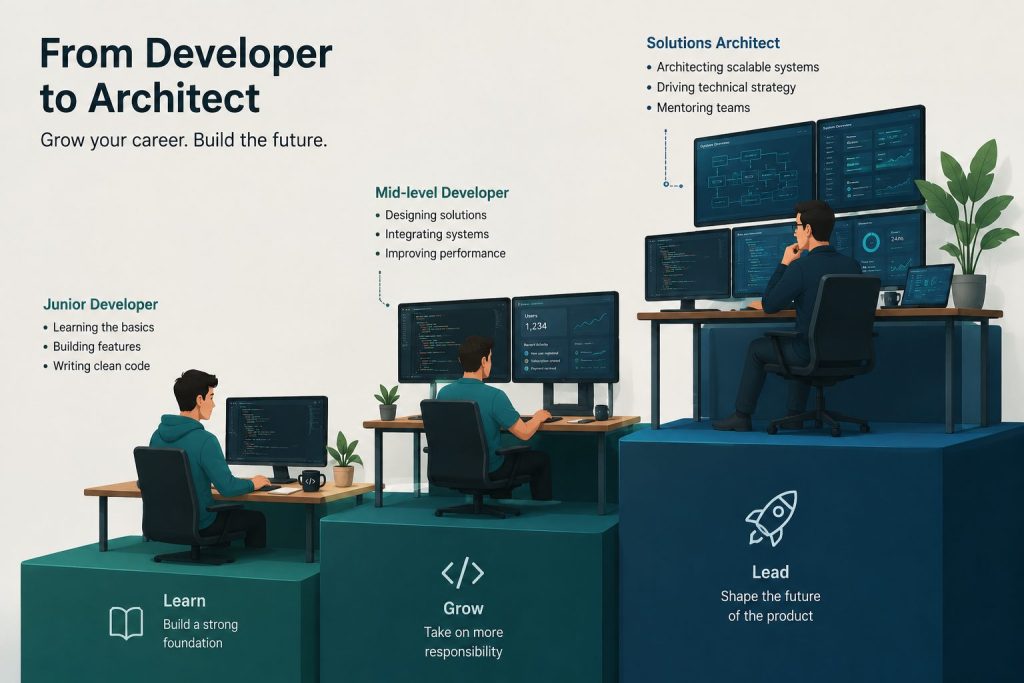
Choosing the wrong seniority level is an expensive mistake in both directions. Over hiring leads to unnecessary cost and underutilization. Under hiring leads to technical debt, slower delivery, and architectural problems that become harder to fix over time.
|
Level |
Experience | Best For |
Avg. Monthly Cost (India) |
| Junior | 0 – 2 years | Simple MVPs, bug fixes, support tasks | $1,500 – $2,500 |
| Mid-Level | 2 – 5 years | Feature-rich SaaS apps, API integrations | $2,500 – $4,000 |
| Senior | 5+ years | Architecture, complex systems, team lead | $4,000 – $6,500 |
| Laravel Consultant | 7+ years | Audits, migrations, scaling strategy | Project-based |
Role Breakdown by Project Complexity
Junior developers work well on defined tasks with clear requirements. They handle bug fixes, build simple CRUD modules, or work on templating tasks. Mid-level developers are your workhorses: they can design and build features end-to-end, handle API integrations, and operate independently within a defined architecture. Senior developers bring architectural thinking, mentoring capability, and the judgment to make trade-off decisions that affect the product for years.
For most early-stage startups building an MVP, a strong mid-level developer is the right hire. For scaling products with complex systems, integrations, or high-availability requirements, a senior developer or hire dedicated laravel developer with a product background is worth the premium.
When to Hire a Laravel Consultant Instead
Sometimes you do not need a full-time developer. You need targeted expertise. A Laravel consultant is the right choice when you need a codebase audit before a major refactor, an architecture review before scaling, performance diagnostics for a slow application, or guidance on migrating from an older Laravel version to a modern stack.
Consultants typically engage on a fixed-scope, time-boxed basis. They deliver a decision framework, a technical document, or a scoped recommendation rather than ongoing feature delivery. If you hire laravel consultant talent for the right use case, you can save weeks of internal uncertainty and avoid costly architectural mistakes. A second engagement with a hire laravel consultant is often triggered when a product crosses 50,000 monthly active users and performance start to degrade.
Dedicated Developer vs Freelancer vs Laravel Agency: Which Model Is Right for You?
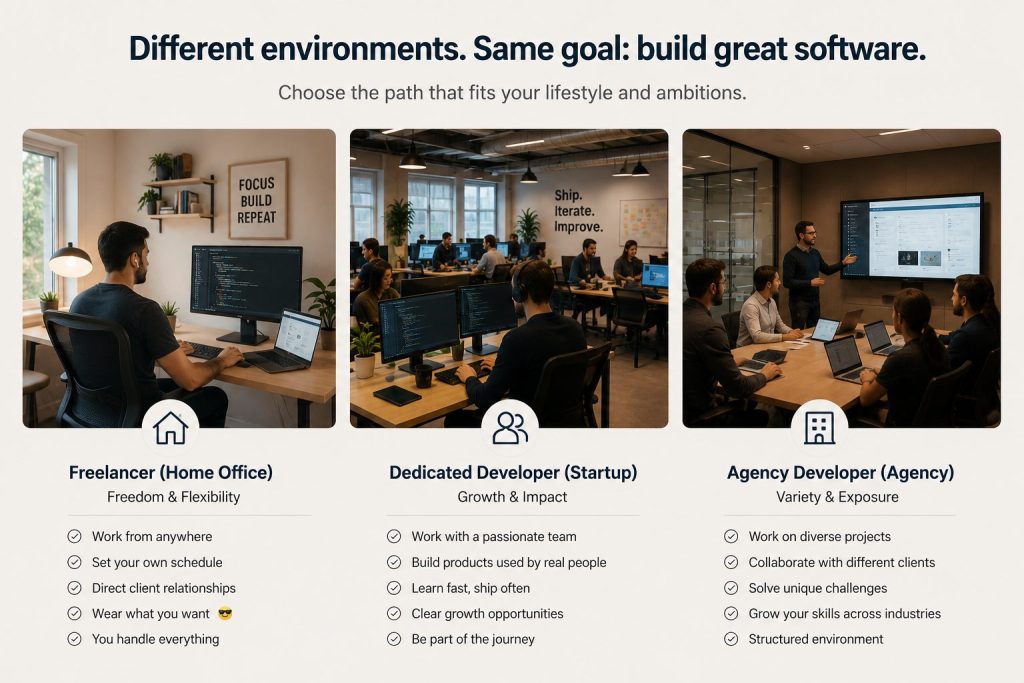
The hiring model you choose will shape your project’s velocity, communication quality, and long-term cost trajectory. Each option carries distinct trade-offs, and the right choice depends heavily on your stage, team structure, and product roadmap.
| Factor | Dedicated Developer | Freelancer | Laravel Agency |
| Cost | Medium | Low – Medium | High |
| Scalability | High | Low | Medium – High |
| Team Integration | Full | Minimal | Partial |
| Long-term Reliability | High | Variable | High |
| IP Ownership | Clear | Negotiable | Contract-based |
| Communication | Direct and structured | Informal | Managed |
| Best For | Ongoing SaaS products | Short tasks / MVPs | Full-project delivery |
Dedicated Model: Pros and Cons
A dedicated developer works exclusively on your product, integrates with your team’s rituals, and builds context over time. This is the model that makes the most sense for growing businesses with a continuous development backlog.
Pros: Full product context, predictable cost, direct communication, strong team alignment, IP ownership clarity.
Cons: Requires onboarding investment and management overhead. Not ideal for one-off feature builds.
Freelancer Model: Pros and Cons
Freelancers offer flexibility and lower short-term costs. They work best for isolated tasks that have a defined start and end point. For businesses with laravel programmers to hire needs that are project-specific and time-boxed, a freelancer is a rational choice.
Pros: Fast to engage, no long-term commitment, cost-efficient for discrete deliverables.
Cons: High context-switching cost, inconsistent availability, limited accountability, risky mission-critical systems.
If you find yourself repeatedly cycling through laravel programmers for hire on short engagements, that is usually a signal that your project scope has outgrown the freelancer model, and a dedicated developer would deliver better ROI.
Laravel Development Agency: Pros and Cons
A Laravel development agency provides a full team including developers, QA, and project management, and handles delivery end-to-end. This model suits businesses that need to complete project outsourcing rather than staff augmentation.
Pros: Full delivery ownership, managed communication, built-in redundancy if a developer leaves.
Cons: Higher cost, less direct access to developers, potential misalignment on product vision.
Decision Matrix: How to Choose
Use this framework to guide your decision:
- Ongoing product with a growing backlog? Choose a dedicated developer.
- Short-term feature spike or MVP prototype? Consider a freelancer.
- Full product build with no internal technical team? Engage a Laravel development agency.
- Cost is primary constraint and timeline is flexible? India-based dedicated hire or offshore model.
- Compliance, security, or enterprise-grade quality required? Senior dedicated developer or agency with proven track record.
For More Detail Reading About – Dedicated Laravel Developer Vs Freelancer Vs Agency 2026
Companies building modern SaaS platforms often rely on HireDeveloper.dev to access pre-vetted dedicated Laravel developers without the overhead of a traditional recruitment process.
Where to Hire Dedicated Laravel Developers in 2026
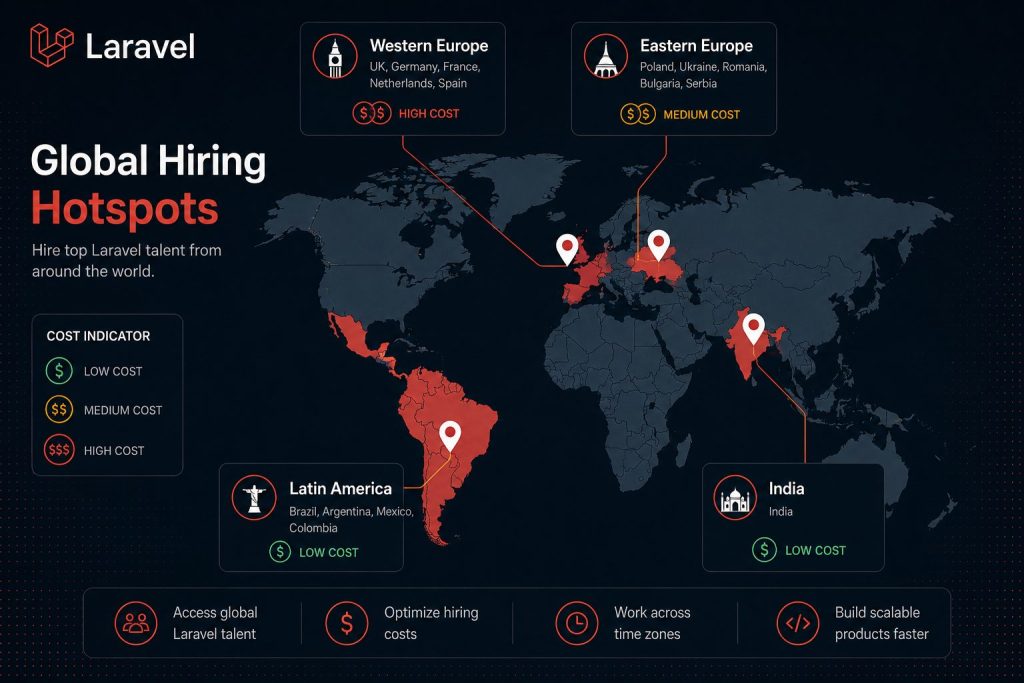
The channel you use to find Laravel talent will determine the quality of candidates you see, the speed of hiring, and your access to vetted versus unvetted profiles. There is no single best platform. The right choice depends on whether you prioritize speed, cost, or depth of vetting.
Top Platforms and Marketplaces
The most used platforms for hiring Laravel developers include:
- Toptal: Highly vetted, top 3% of applicants, premium pricing, fast matching for senior talent
- HireDeveloper.dev: Specialized platform for hiring pre-vetted dedicated developers with a focus on Laravel and full-stack engineering talent
- Upwork: Large talent pool, variable quality, good for mid-range budgets and trial engagements
- Clutch: Best for finding a laravel development agency or managed team rather than individual developers
- LinkedIn: Effectiv for hiring locally or for senior roles where reputation and network matter
- GitHub: Useful for evaluating open-source contributions and code quality before outreach
Hiring from India: Why It’s Popular
India remains the most popular destination for businesses looking to hire laravel developers india for good reason. The country produces over 1.5 million engineering graduates annually, with a significant proportion specializing in PHP and Laravel development. Developer costs are 60 to 75 percent lower than US or Western European equivalents at comparable skill levels.
English proficiency is strong in the Indian developer market, and timezone coverage, particularly the overlap between Indian Standard Time and European working hours, makes async-first remote collaboration practical. For businesses looking to hire dedicated laravel developers in india, the quality ceiling has also risen considerably. Senior Indian Laravel developers are building enterprise SaaS products, fintech platforms, and high-availability APIs at the same standard as their Western counterparts. Many global SaaS businesses that hire dedicated laravel developers in india report that team output is comparable to domestic hires at 40 to 60 percent of the cost.
Offshore and Remote Laravel Hiring Guide
When you hire offshore laravel developer talent, the commercial upside is significant, but the process requires more structure than a domestic hire. Key considerations include:
- Contracts must clearly specify IP ownership, confidentiality, and data handling obligations
- NDA agreements should be signed before any codebase, or product information is shared
- Milestone-based payment structures reduce risk for both parties in project-based engagements
- Communication workflows including standup cadence, sprint reviews, and async update expectations must be documented before the engagement starts
- Time zone gaps exceeding six hours require deliberate overlap windows to avoid communication delays that compound into sprint failures
How Much Does It Cost to Hire a Dedicated Laravel Developer in 2026?
Cost is one of the most searched topics for businesses evaluating Laravel hiring decisions, and for good reason. Getting this wrong in either direction, overpaying for the wrong fit or underpaying and accepting poor quality, has real consequences on product timelines and budgets.
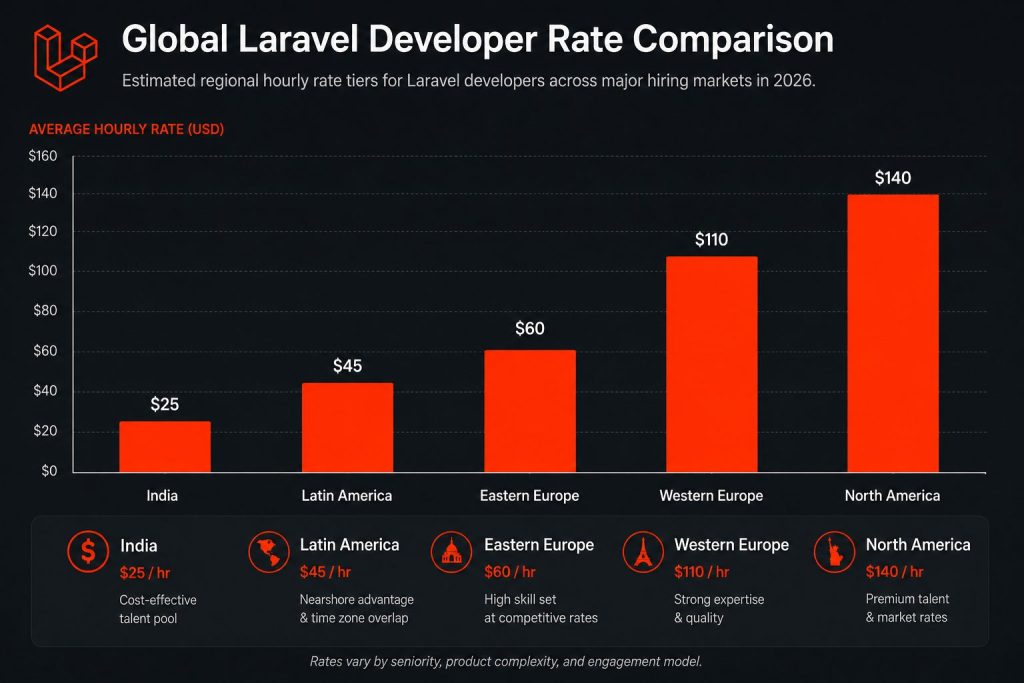
Hourly Rates by Region
Here is a current breakdown of market rates for dedicated Laravel developers across major hiring regions:
| Region | Hourly Rate | Monthly (Full-time Equiv.) | Best For |
| USA / Canada | $80 – $150/hr | $12,000 – $20,000+ | High-compliance SaaS products |
| Western Europe | $50 – $90/hr | $8,000 – $14,000 | Enterprise-grade applications |
| Eastern Europe | $30 – $60/hr | $5,000 – $9,000 | Scaling startups, EU timezone |
| India | $15 – $35/hr | $2,500 – $5,500 | Cost-efficient, deep talent pool |
| Latin America | $25 – $50/hr | $4,000 – $8,000 | US timezone overlap preferred |
Monthly Retainer vs Project-Based Pricing
For dedicated hiring, a monthly retainer model is almost always the right structure. You pay a fixed monthly fee for a dedicated developer’s full working capacity, typically 160 hours per month. This provides predictable cost, eliminates per-task negotiation, and aligns the developer’s incentive with your team’s velocity rather than billing hours.
Project-based pricing makes more sense for agencies or freelancers delivering a bounded scope. For laravel development services structured around ongoing product work, the retainer is cleaner, cheaper over time, and better for developer motivation. The all-in monthly cost of a dedicated developer in India, including platform fees and management overhead, typically ranges from $3,000 to $6,000, compared to $12,000 to $20,000 for a comparable US-based hire.
Hidden Costs to Watch For
Beyond the developer’s rate, growing businesses frequently underestimate the following costs:
- Onboarding time: a new developer typically takes two to four weeks to reach full productivity on an unfamiliar codebase
- Tool and license costs: IDEs, staging environments, API subscriptions, and communication tools add up
- Communication overhead: managing distributed developers requires structured process time from your internal team
- Technical debt cleanup: if vetting is skipped, code quality issues can create downstream remediation costs that dwarf the original saving
Step-by-Step Process to Hire a Dedicated Laravel Developer
A structured hiring process is the single best way to reduce mismatch risk and increase time-to-productivity. Here is the five-step framework that consistently produces the best outcomes for SaaS teams and businesses.
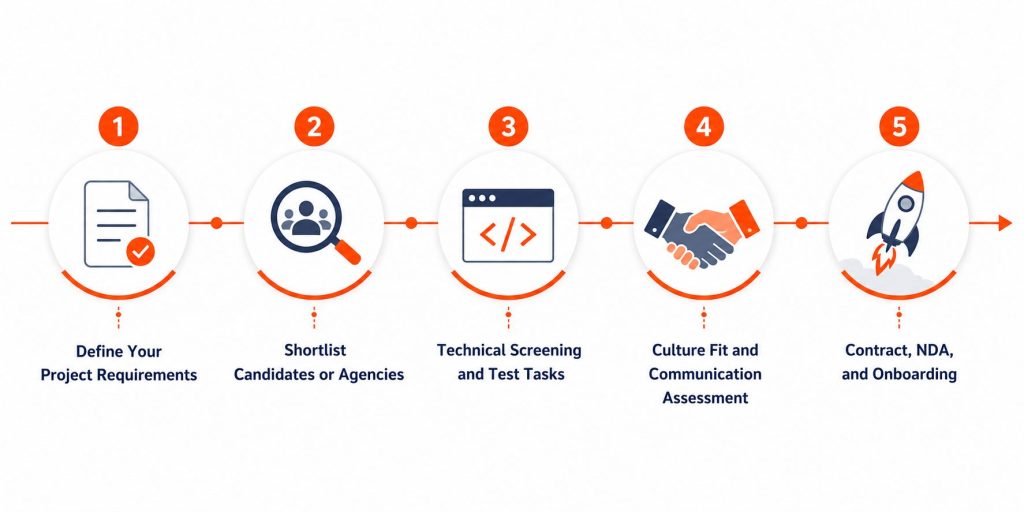
Step 1: Define Your Project Requirements
Before opening any job listing or platform, document what you actually need. Define your tech stack, the specific Laravel version in use, the type of features the developer will own, and the expected output cadence. Clarify whether the role requires frontend capability (Livewire, Inertia.js, Vue) or is purely backend API and architecture work. If you have laravel application development services requirements tied to specific integrations including payment gateways, third-party APIs, and ERP systems, document those upfront. Vague requirements attract vague candidates.
Step 2: Shortlist Candidates or Agencies
Review portfolios for evidence of work similar to your use case. For individual developers, GitHub activity, open-source contributions, and past project descriptions are strong signals. For agencies or platforms, check Clutch reviews and client retention rates. Ask for references from clients with comparable product complexity. For managed platforms like HireDeveloper.dev, shortlisting is accelerated by pre-screening. You review a curated set of matched profiles rather than filtering hundreds of applications.
Step 3: Technical Screening and Test Tasks
A structured technical evaluation is non-negotiable when you want to hire expert laravel developer talent rather than just a Laravel developer with a polished resume. Practical screening methods include:
- A live coding task focused on Eloquent query optimization or API design (60 to 90 minutes)
- A take-home architecture challenge: design a multi-tenant SaaS feature or a scalable background job system
- Code review of a provided snippet to assess code quality judgment, not just execution ability
- Discussion of past projects with specific questions about technical decisions, trade-offs, and lessons learned
Red flags to watch over-reliance on tutorials for basic concepts, inability to explain architecture decisions, and avoid performance or security considerations in code reviews.
Step 4: Culture Fit and Communication Assessment
Technical skills are necessary but not sufficient. For remote engagements, especially, a developer who communicates poorly or requires constant supervision will create more friction than value. Assess communication in the interview itself: Are they asking good questions? Do they structure their answers clearly? Can they explain technical decisions in business terms?
For hire remote laravel developers’ engagements, run at least one asynchronous task as part of the evaluation, such as a written technical proposal or a documented solution to a system design problem. How someone writes reveals how they will communicate day-to-day across Slack and Notion.
Step 5: Contract, NDA, and Onboarding
Before a single line of code is written, protect your business with the right legal foundation. Contracts for hire dedicated laravel developer engagements should include IP assignment clauses, confidentiality obligations, payment milestones, and clear termination terms. NDAs should be mutual to establish trust. Onboarding documentation including architecture overview, dev environment setup guide, team communication norms, and sprint cadence reduces ramp-up time and sets clear expectations from day one.
Businesses looking to skip the procurement overhead can partner with HireDeveloper.dev to access pre-screened Laravel developers who are ready to engage within days, not weeks.
How to Manage a Dedicated Remote Laravel Developer Effectively
Hiring is only half of the challenge. The businesses that get the most from dedicated remote developers are the ones that invest in clear structures, honest feedback loops, and appropriate tooling. Managing a remote Laravel developer well is a learnable skill, and the returns are significant.
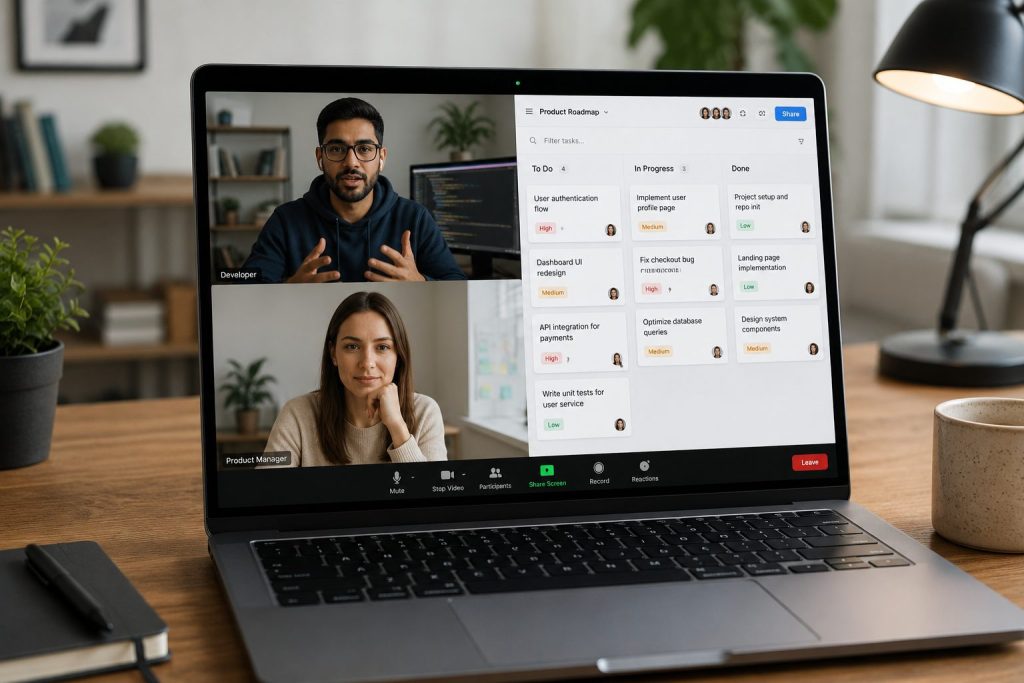
Tools and Workflows for Remote Laravel Teams
The right tooling stack eliminates friction and gives visibility into progress without micromanagement. For most laravel development services teams operating remotely, a practical stack looks like this:
- Jira or Linear for sprint planning, ticket tracking, and backlog management
- GitHub or GitLab for source control with enforced PR review processes
- Slack for real-time communication with defined channel norms and async-friendly etiquette
- Notion or Confluence for architecture documentation, onboarding guides, and decision logs
- CI/CD pipelines via GitHub Actions or Bitbucket Pipelines for automated testing and deployment
- Laravel Telescope or Pulse for production monitoring and performance visibility
Setting KPIs and Performance Benchmarks
Vague expectations produce vague results. Establish measurable benchmarks early and revisit them in monthly check-ins. Practical KPIs for hire offshore laravel developer or remote engagements include:
- Pull request merge rate: are tickets moving from in-progress to merged within the expected sprint window?
- Bug reopen rate: how frequently does delivered work require fixes after QA review?
- Ticket cycle time: How long does a task take from assignment to completion, and how does that compare to estimates?
- Code review participation: is the developer contributing constructively to team code reviews?
Time Zone and Communication Best Practices
Time zone differences are manageable with structure, but they compound quickly without it. Establish a mandatory daily overlap window of at least two to three hours where the developer is reachable for synchronous questions. Use async-first communication for everything that does not require a live decision, such as status updates, code feedback, and documentation requests.
Weekly sprint reviews via video call provide a regular touchpoint that builds team cohesion and surfaces blockers before they become sprint failures. Keep meetings short, well-documented, and tied to concrete outcomes. The teams that struggle with remote Laravel developers are usually the ones expecting office-style availability without providing office-style structure.
Onboarding Your Dedicated Laravel Developer: A Practical Checklist
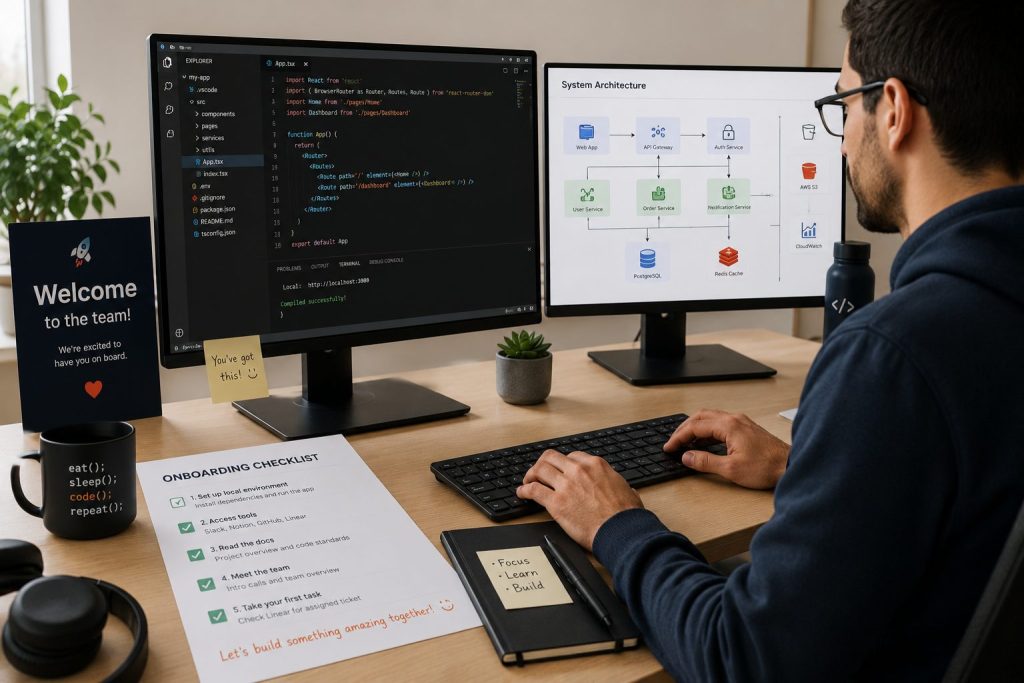 The first two weeks of a dedicated developer engagement define the trajectory of the entire relationship. A structured onboarding process reduces time-to-contribution, sets expectations clearly, and signals to the developer that they are joining a professional operation.
First Week: Access, Setup, and Context
Day one priorities for any hire dedicated laravel developer engagement:
- Repository access with appropriate branch protection rules and contribution guidelines
- Local development environment setup guide including Docker Compose. env configuration, and seed data
- Architecture walkthrough: system overview, data models, core services, third-party integrations
- Introduction to team communication channels, sprint cadence, and documentation standards
- Access to staging and testing environments with deployment instructions
30-60-90 Day Plan for New Hires
Structure the first three months around progressive ownership:
Days 1-30: Shallow end. The developer resolves bugs, builds familiarity with the codebase, and delivers one or two well-defined features. Focus on learning, not output volume.
Days 31-60: Full depth. The developer owns a feature from planning to deployment. Review architectural decisions together before implementation begins.
Days 61-90: Independent operation. The developer participates in sprint planning, estimates with confidence, and identifies technical debt proactively. A developer who is not operating independently by day 90 signals either a hiring mismatch or an onboarding failure, both of which are correctable.
How to Measure Early Performance
Early performance signals to watch for a hire laravel programmers’ engagement:
- Quality of pull requests: are descriptions clear, are tests included, is the code well-structured?
- Communication frequency and clarity: are blockers communicated proactively?
- Ramp speed: how quickly is the developer contributing independently versus requiring guidance?
- Collaboration engagement: is the developer participating in code reviews and sprint ceremonies meaningfully?
For teams that regularly hire laravel programmers on a dedicated basis, a standardized 30-day review template accelerates this process and reduces subjectivity in early performance assessments.
Common Mistakes Businesses Make When Hiring Laravel Developers (and How to Avoid Them)
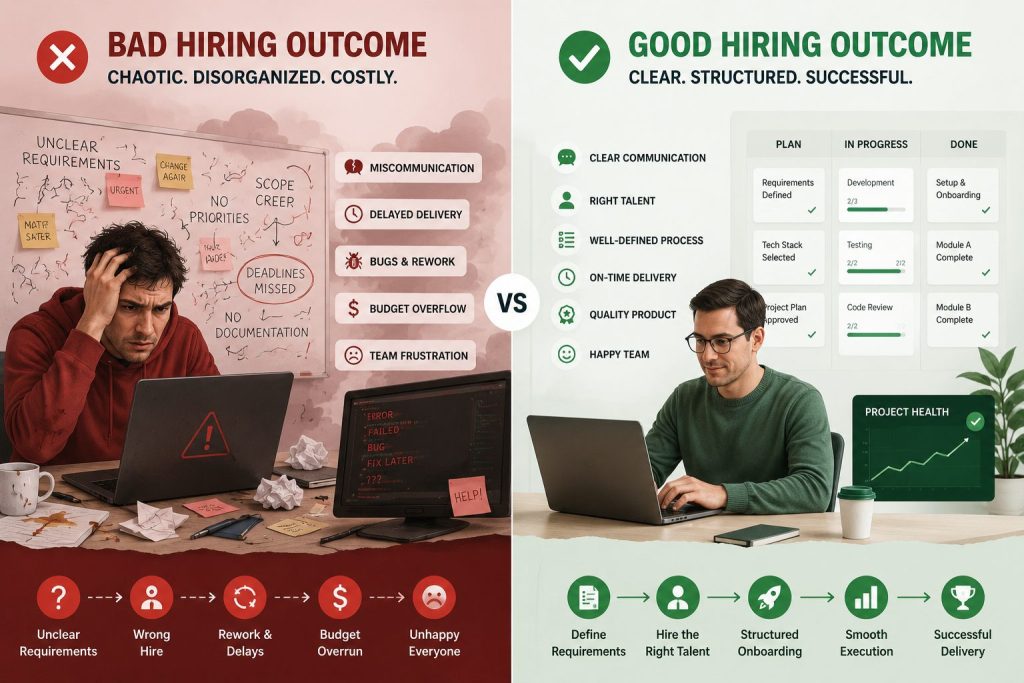 Most hiring mistakes are predictable and preventable. The businesses that repeatedly hire wrong developers are usually making the same structural errors. Here are the four most costly ones.
Hiring for Price Over Skill
The cheapest developer is almost never the cheapest outcome. When you prioritize the lowest hourly rate over demonstrated competency, the real cost shows later in bug fixes, refactors, architectural rewrites, and delayed launches. This is especially true in hire expert laravel developer engagements where the codebase is complex or the product is live.
The right question is not what does this developer cost per hour, but what does a poorly built system cost to fix over six months? Set a realistic budget, define a minimum skill floor, and hire the best developer within that range.
Skipping Technical Vetting
Resume screening and portfolio reviews are not the same as technical vetting. A developer who has five years of Laravel on their profile may still struggle with query optimization, API design patterns, or writing testable code. If you want to hire laravel expert talent that actually delivers, you need a practical evaluation rather than a credential review.
Even a single well-designed technical assessment dramatically improves hire quality and reduces the risk of a mismatch that costs you two months of onboarding and offboarding overhead.
No Clear Project Scope or Documentation
Unclear requirements are the leading cause of Laravel development services engagements that run over budget and over timeline. Developers cannot build what has not been defined. Before any developer starts, you should have a documented feature set, a clear definition of done, a tech stack decision, and a deployment target. The more clarity you provide upfront, the faster and cheaper the development will be.
Ignoring Time Zone and Cultural Fit
For businesses that hire offshore laravel developer talent, cultural and timezone fit are not soft considerations. They are operational risks. A developer six time zones away with no overlapping work hours will create communication latency that multiplies across every sprint. Combined with communication style differences, this can produce a relationship where issues are invisible until they become crises.
Screen for async communication quality, not just technical skills. Run a written task as part of your evaluation. Ask how the candidate prefers to communicate blockers and how they have handled disagreements with clients or team leads in the past.
Ready to Hire a Dedicated Laravel Developer for Your Business?
Building a scalable product in 2026 means making smart, structured decisions about how and where you source engineering talent. The frameworks in this guide are designed to help founders, CTOs, and product leaders cut through the noise and make confident, informed hiring decisions.
Key Takeaways from This Guide
- Laravel remains the most production-ready PHP framework in 2026, with a rapidly evolving ecosystem and strong enterprise adoption.
- Dedicated developers consistently outperform freelancers and agencies for ongoing product development that requires context retention and team alignment.
- India offers the strongest value proposition for businesses hiring offshore, combining cost efficiency, technical depth, and growing senior-level talent availability.
- Structured hiring including skills evaluation, technical screening, and documented onboarding, dramatically reduces mismatch risk and accelerates time-to-productivity.
- Remote Laravel teams perform best with clear communication norms, measurable KPIs, and a defined onboarding framework from day one.
HireDeveloper.dev: Get a Free Consultation
If you are ready to move from research to action, HireDeveloper.dev makes it straightforward. The platform connects growing businesses and startups with pre-vetted, dedicated Laravel developers who are matched to your stack, budget, and stage. No long recruitment cycles, no unvetted profiles, no agency markups.
Whether you need a single dedicated developer to accelerate your roadmap or a small, dedicated team to take ownership of your Laravel backend, HireDeveloper.dev provides the matching infrastructure and ongoing support to make the engagement successful from day one.
Ready to turn ideas into products?
Visit HireDeveloper.dev to explore your options, submit your requirements, and get matched with a pre-vetted Laravel developer within 72 hours.