






Why This Decision Matters More in 2026
The backend framework you choose in 2026 is not just a technical preference. It is a hiring decision, a cost structure, and a long-term infrastructure bet rolled into one. Get it right and you build a foundation that scales with your product. Get it wrong and you spend the next 18 months refactoring.
Django and Laravel are both mature, battle-tested frameworks with enormous global communities. Django, written in Python, Powers Instagram, Pinterest, and Disqus. Laravel, written in PHP, powers hundreds of thousands of production applications and has one of the most active developer ecosystems in the world. According to the 2024 Stack Overflow Developer Survey, PHP remains in active use by 18.2% of professional developers while Python stands at 45.3% overall, though backend-specific usage narrows that gap considerably.
This is not a theoretical comparison. It is a decision framework built for founders, CTOs, and engineering leads who need to pick up the right tool and build the right team around it.
Django vs Laravel: A Side-by-Side Overview
Before going deep, here is the honest comparison at a glance.
| Category | Django (Python) | Laravel (PHP) |
| Language | Python | PHP 8.x |
| First Released | 2005 | 2011 |
| Architecture | MVT (Model-View-Template) | MVC (Model-View-Controller) |
| ORM | Django ORM (built-in) | Eloquent ORM |
| Learning Curve | Moderate | Gentle to moderate |
| Performance | High (async support via ASGI) | High (Laravel Octane + Swoole) |
| Best For | Data-heavy, ML-adjacent apps | Rapid SaaS/CMS product builds |
| Laravel vs Rails | N/A | Laravel has gentler curve, better PHP ecosystem |
| Community Size | Very large (Python) | Very large (PHP, one of the largest) |
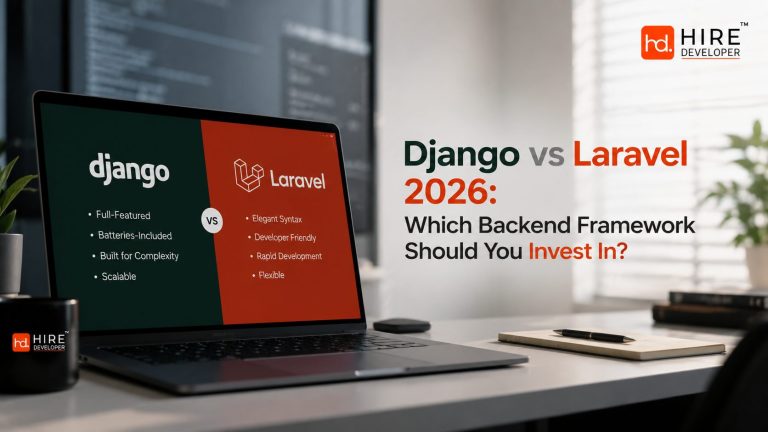
Both frameworks ship with built-in authentication, database migrations, routing, and testing tools. The choice between them almost never comes down to raw features. It comes down to team expertise, use case fit, and the talent market you are hiring from.
Performance and Scalability: Does It Actually Matter?
Performance comparisons between Django and Laravel are frequently cited out of context. In raw benchmark tests, both frameworks are capable of handling tens of thousands of requests per second with proper infrastructure. The bottleneck in real production applications is rarely the framework itself. It is the database query layer, caching strategy, and deployment architecture.
Django Performance
Django added ASGI support in version 3.0, enabling asynchronous views and full async capabilities. Combined with tools like Celery for task queues, Redis for caching, and Gunicorn or Uvicorn as the WSGI/ASGI server, a well-optimized Django application handles significant production load. Instagram, which serves over 2 billion active users, runs on Django at its core. That alone is a data point worth noting.
Laravel Performance
Laravel’s performance ceiling got a significant lift with the introduction of Laravel Octane in 2021, which runs the framework on high-performance application servers like Swoole or RoadRunner, eliminating the traditional PHP bootstrapping overhead on every request. Benchmarks from the Laravel team show Octane delivering up to 5x throughput improvement over standard PHP-FPM configurations. For most SaaS applications, this completely closes to any historical performance gap between PHP and Python in web contexts.
The practical takeaway for 2026: both frameworks scale to enterprise-level traffic when deployed correctly. Choose based on your use case, not benchmark spreadsheets.
Developer Ecosystem and Hiring: The Real Differentiator
This is where the comparison gets commercially meaningful. The framework you choose determines the talent pool you hire from.
According to GitHub’s 2024 Octoverse report, Python is the most popular language on GitHub for the third consecutive year. Laravel remains the most starred PHP framework on GitHub with over 77,000 stars. Both communities are genuinely large and active.
Hiring Django Developers
Python developer demand has been amplified by the AI and machine learning boom. This creates an interesting dynamic: there is an enormous supply of Python developers, but senior Django-specific engineers who understand production deployments, async architecture, and ORM optimization are in high demand. Companies hiring Django developers for SaaS products often compete with AI companies for the same talent, pushing rates up.
Hiring Laravel Developers
The Laravel developer market is large, well-priced, and globally distributed. PHP remains one of the most widely taught languages globally, and Laravel is the dominant PHP framework, meaning the pipeline of developers entering the Laravel ecosystem is consistently high. For companies looking to hire Laravel developers offshore or in nearshore markets, the cost-to-quality ratio is often stronger than comparable Python/Django talent pools.
A senior Laravel developer in India typically costs $18 to $35 per hour. A senior Django developer in the same market typically costs $20 to $40 per hour. Neither is dramatically cheaper, but the available volume of vetted Laravel developers in markets like India and Eastern Europe gives Laravel a practical hiring advantage for cost-conscious teams.
HireDeveloper.dev specializes in sourcing pre-vetted Laravel developers and Django engineers for SaaS teams. Their screening process tests framework-specific production knowledge, not just language familiarity. Visit hiredeveloper.dev to get matched with the right developer in under 48 hours.
Laravel vs Node.js vs Rails: Putting Laravel in Context
Decision makers evaluating Laravel rarely do so in isolation. They are usually comparing it against Node.js, Ruby on Rails, or Django simultaneously. Here is the honest positioning.
| Framework | Language | Best For | Hiring Market | Learning Curve |
| Laravel | PHP | Rapid SaaS builds, CMS, APIs | Very large, cost-effective | Low-moderate |
| Node.js (Express) | JavaScript | Real-time apps, APIs, microservices | Very large | Moderate |
| Ruby on Rails | Ruby | Rapid prototyping, convention-heavy apps | Smaller, niche | Low-moderate |
| Django | Python | Data-heavy apps, ML-adjacent products | Large, premium-priced | Moderate |
Laravel vs Rails
Laravel was heavily inspired by Ruby on Rails and shares its philosophy of convention over configuration. The practical advantage Laravel has over Rails in 2026 is the hiring market. The PHP developer pool is significantly larger than the Ruby pool globally. Ruby on Rails has an elegant, loyal community but finding senior Rails developers has become harder as the language loses market share. If you are choosing between the two for a new project, Laravel wins on talent availability and long-term ecosystem momentum.
Laravel vs Node.js
Laravel vs Node.js is less about which is technically superior and more about use case alignment. Node.js, particularly with frameworks like Express or Fastify, excels at real-time applications, high-concurrency APIs, and systems where JavaScript consistency across frontend and backend matters. Laravel excels at structured application development where you need a rich ORM, built-in authentication, queues, and a full MVC architecture out of the box. Many scaling companies use both: Laravel for their main application and Node.js for specific real-time microservices.
Django vs Rails vs Laravel
When you put all three together, Django wins for data science proximity, Rails wins for opinionated elegance, and Laravel wins for the balance of developer productivity, ecosystem richness, talent availability, and commercial viability in 2026. That is not a slight to Django or Rails. It reflects the current state of the developer market and the practical realities of building and scaling engineering teams.
When to Choose Django for Your Project
Django is the stronger choice in these specific scenarios:
- Your product is data-intensive: If your application handles large datasets, needs native integration with data science libraries (Pandas, NumPy, scikit-learn), or has a roadmap that touches machine learning, Django’s Python foundation is a strategic advantage. Django REST Framework pairs naturally with ML pipelines in a way that Laravel simply does not.
- You are building an internal tool or admin platform: Django’s built-in admin interface is one of the best in any framework. For internal dashboards and CRUD-heavy admin tools, Django’s admin panel saves weeks of development time.
- Your team already knows Python well: Technology choices should reflect team strengths. If your existing engineers are strong Python developers, forcing a switch to Laravel for the sake of it introduces unnecessary risk.
- You are in a regulated or scientific domain: Healthcare data pipelines, scientific research tools, and financial analytics platforms benefit from the Python ecosystem’s depth in those specific verticals.
When to Choose Laravel for Your Project
Laravel is the stronger choice in these scenarios:
- You are building a SaaS product quickly: Laravel’s rapid application development capabilities are industry leading. With Laravel Breeze or Jetstream for authentication scaffolding, Livewire for reactive UI, and Nova for admin panels, a full SaaS MVP can be production-ready in weeks, not months.
- You need a rich CMS or e-commerce application: Laravel powers thousands of content-heavy and e-commerce platforms through frameworks like Statamic, Bagisto, and AvoRed. Custom Laravel web development for e-commerce is a well-documented, well-staffed specialization.
- You want the best developer tooling in the PHP world: Laravel’s first-party tooling is exceptional: Forge for server provisioning, Vapor for serverless deployment on AWS, Horizon for queue monitoring, and Telescope for debugging. Few frameworks offer this level of integrated production tooling.
- You are hiring globally and want cost efficiency: As established above, the Laravel developer market is broader and more competitively priced than comparable Django talent in most offshore markets. For companies doing custom Laravel application development with distributed teams, this is a significant factor.
- Your team comes from a PHP background: Millions of developers worldwide learned PHP as their first server-side language. Laravel transforms that PHP knowledge into modern, elegant engineering practice. The upgrade path from legacy PHP to Laravel is smoother than switching languages entirely.
Startups and scale-ups choosing Laravel for their next product build can find experienced Laravel application development teams through HireDeveloper.dev. Their developers are screened specifically on Laravel, Eloquent ORM, and production deployment, not just general PHP knowledge.
Cost of Development: Django vs Laravel in Real Numbers
Building a product on either framework involves three cost layers: development time, developer rates, and infrastructure.
Development Time
For a standard SaaS MVP (authentication, billing integration, user dashboard, API layer), Laravel’s scaffolding tools typically reduce time-to-launch by 15 to 25% compared to Django, purely because of the pre-built starter kits and ecosystem integrations. Django closes this gap on data-heavy features where its ORM and admin panel outpace Laravel’s built-in capabilities.
Developer Rates in 2026
| Region | Senior Laravel Dev | Senior Django Dev | Mid Laravel Dev | Mid Django Dev |
| United States | $110-$160/hr | $120-$175/hr | $75-$110/hr | $80-$120/hr |
| United Kingdom | $70-$110/hr | $80-$120/hr | $50-$80/hr | $55-$85/hr |
| India | $18-$35/hr | $20-$40/hr | $12-$22/hr | $14-$25/hr |
| Eastern Europe | $30-$55/hr | $35-$60/hr | $22-$40/hr | $25-$45/hr |
| Latin America | $25-$50/hr | $28-$55/hr | $18-$35/hr | $20-$38/hr |
Source: Glassdoor, LinkedIn Salary Insights, Hired.com 2024 Software Engineer Report, Arc.dev Developer Rate Report.
Infrastructure Costs
Both Django and Laravel applications deploy comfortably on standard cloud infrastructure. Django applications typically run on AWS EC2, GCP, or Heroku with Gunicorn/Nginx. Laravel’s Vapor product enables serverless deployment on AWS Lambda, which can dramatically reduce infrastructure costs for applications with variable traffic. A Laravel Vapor deployment can start at under $5 per month for low-traffic applications, scaling linearly with usage. This is a genuine cost advantage for early-stage products.
Django vs Laravel 2026 — Making the Right Call
There is no universally correct answer to the Django vs Laravel 2026 debate. Both frameworks are production-proven, actively maintained, and capable of powering companies from startup to scale. The right answer depends on three things: your use case, your current team’s strengths, and the talent market you plan to hire from.
If your product roadmap involves data science, machine learning, or heavy analytics, Django’s Python foundation gives you a structural advantage that compounds over time. If you are building a SaaS product, content platform, e-commerce application, or API-driven web application, Laravel’s developer experience, first-party tooling, and broader hiring market make it the stronger commercial choice in 2026.
The Laravel vs Node.js and Laravel vs Rails comparisons further reinforce Laravel’s position as one of the most commercially viable backend choices available. It combines rapid development of velocity, enterprise-grade tooling, and the largest PHP talent pool in the world.
For most B2B SaaS founders and engineering leaders making this decision today, Laravel is the better investment. Not because Django is inferior, but because the hiring market, ecosystem trajectory, and development speed advantages compound into real business outcomes.
Hiredeveloper.dev: Build Your Laravel or Django Team the Smarter Way
Whether you are choosing Laravel for your next SaaS product or Django for a data-heavy platform, the quality of your engineering team determines how much value the framework decision actually delivers. HireDeveloper.dev provides access to pre-vetted Laravel developers and Django engineers who have passed multi-stage technical assessments covering framework architecture, production deployment, ORM optimization, and real-world problem-solving.
Their dedicated developer model gives you full-time engineering capacity at 40 to 60% of the cost of equivalent US in-house hiring, with developers ready to start in under 4 business days. No recruiting fees, no 45-day hiring cycles, no guessing about technical depth.
Ready to turn ideas into products?
Visit hiredeveloper.dev today. Tell them your framework choice, your stack requirements, and your timeline. Get matched with a pre-vetted developer in under 48 hours and start building faster.