







Must Read Intro
Computer vision applications are set to transform the way businesses operate. By utilizing computer vision technology, businesses can automate visual tasks and make better decisions faster and more accurately.
Today, businesses are generating massive amounts of visual data from sources such as cameras, scanners, drones, and smartphones. However, the secret to gaining a competitive advantage does not lie in the generation of data but in the extraction of insights from the data.
Computer vision development assists businesses in building intelligent applications that can detect objects, decode patterns, monitor activities, and automate decision-making in real-time.
This guide will take you through practical applications, key business benefits, and development resources required to build scalable computer vision applications.
What Are Computer Vision Applications?
Computer vision applications are software applications that utilize images and videos to extract valuable information automatically.
In a business environment, computer vision applications automate image analysis with continuous, consistent, and scalable image analysis. Computer vision applications analyze thousands of images per minute accurately.
Some of the applications of computer vision in business include:
- Quality inspection
- Surveillance and security
- Operational analytics
- Compliance monitoring
- Automated classification and tagging
Types of Computer Vision Applications
1. Image Classification
Image classification involves assigning a tag to the entire image.
Business applications:
Medical scan screening
Ecommerce product categorization
Insurance claim validation
Document identification
Business applications: Reduces manual review of workload and increases processing speed.
2. Object Detection
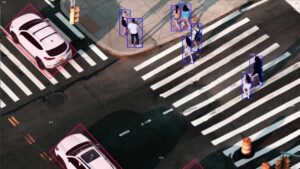
Object detection identifies and locates multiple objects within an image or video frame.
Business use cases:
- Retail shelf monitoring
- Warehouse inventory tracking
- Vehicle detection in traffic systems
- Security threat identification
Business impact: Improves operational visibility, prevents losses, and enhances situational awareness.
3. Image Segmentation
Image segmentation analyzes images at the pixel level to isolate specific regions, defects, or objects.
Business use cases:
- Manufacturing defect detection
- Tumor identification in medical imaging
- Crop disease detection in agriculture
- Autonomous vehicle navigation
Business impact: Enables high-precision analysis in quality critical operations.
4. Pose Estimation and Motion Tracking
Pose estimation analyzes posture and movement using video input.
Business use cases:
- Workplace safety monitoring
- Sports performance analytics
- Fitness tracking applications
- Gesture-controlled systems
Business impact: Enhance safety compliance and behavioral insights.
Business Benefits of Computer Vision Applications
Reduced Operational Costs
Automation minimizes reliance on manual inspection teams and reduces human error.
Improved Accuracy and Consistency
Algorithms deliver standardized performance without fatigue or variability.
Real-Time Monitoring
Live video analysis enables instant alerts and faster incident response.
Scalability
Systems can process thousands of images or video frames per minute without increasing labor costs.
Data-Driven Insights
Visual data becomes structured performance metrics that inform strategic decisions.
Industries Using Computer Vision Solutions
Manufacturing
Automated quality inspection and defect detection.
Healthcare
Medical image analysis to support diagnostics and treatment planning.
Retail
Shelf monitoring, inventory optimization, and customer behavior analytics.
Logistics and Supply Chain
Visual tracking systems for inventory and shipment monitoring.
Agriculture
Drone-based imaging for crop health and yield optimization.
Smart Cities
Traffic monitoring and public safety systems.
Tools for Computer Vision Development
Cloud platforms include:
When to Invest in Computer Vision Development
Your organization should consider investing in computer vision solutions if:
- You rely heavily on camera-based monitoring
- Manual inspection creates operational bottlenecks
- Quality control requires higher precision
- You need real-time visual analytics
- Your operations must scale without proportional labor growth
Build Computer Vision Solutions with HireDeveloper.dev
Developing production-ready computer vision applications requires expertise in:
- Data engineering
- Model training and optimization
- Backend architecture
- Cloud deployment and scalability
HireDeveloper.dev helps businesses design and implement scalable computer vision systems aligned with operational goals.
If you’re evaluating computer vision development for your organization, connect with HireDeveloper.dev to assess your use case and build a solution tailored to measurable business outcomes.