Intro
Imagine you buy a pair of running shoes online. You type in your card details, press Pay, and a few seconds later a confirmation page appears. Behind that short moment, a service has quietly passed your payment information to the right places and brought back an answer. That service is a payment gateway.
If you have ever wondered what is a payment gateway, this article explains it in plain language. You will learn how a gateway works, the main types, what payment methods it can support, its benefits and limits, how safe it is, and how a business connects one to a website.
What Is a Payment Gateway?
A payment gateway is a service that securely passes payment information and transaction requests between a customer’s checkout and the systems that process the payment. It lets an online business accept payments such as cards and wallets without handling the whole payment network itself.
A useful comparison is a card machine in a shop. The machine reads your card and sends the details onward for approval. A payment gateway does the same job for websites and apps, where there is no physical terminal.
The gateway sits between the checkout page and the payment processing systems. Businesses use it because it connects a store to banks and card networks through one provider, so they do not need to build those connections themselves.
One point often confuses beginners. The gateway passes information along. It is not necessarily the bank that holds your money, and it does not always make the final decision to approve a payment. That decision comes from the customer’s bank or the relevant payment network.
How Does a Payment Gateway Work?
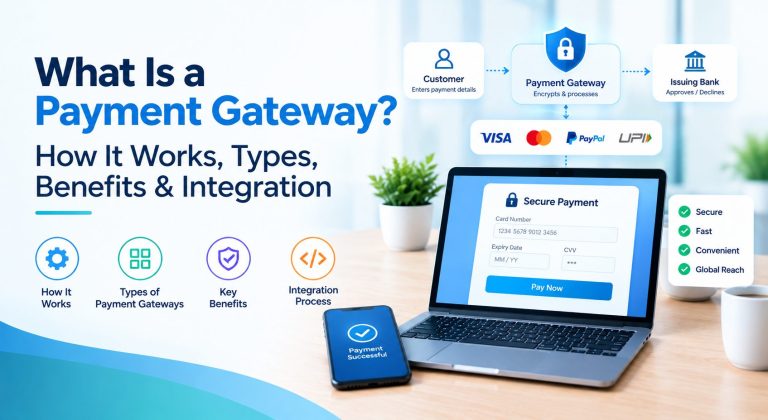
Here is the shoe purchase again, step by step. Details vary by payment method and provider, but the general journey looks like this:
- You choose the shoes and go to checkout.
- You pick a payment method and enter your details on the checkout form.
- The payment gateway securely sends the transaction information onward.
- The payment processor and other financial institutions or payment networks check the request. Which ones take part depends on the payment method.
- The transaction is approved or declined.
- The store receives the result and shows you a confirmation or an error message.
- The money is settled and paid out to the business on the schedule set by its payment provider.
A simple text version of the flow:
Customer → Checkout → Payment Gateway → Payment Processing Network
→ Authorization Result → Merchant Confirmation
Approval is not the same as receiving money. When your payment is approved, the bank agrees the payment can go ahead. Settlement, when the funds actually move, usually happens later, so a business does not always have the money the moment you see “Payment successful”.
The whole check usually takes only seconds, but several systems are involved. The gateway’s job is to keep that chain organized and secure, and to report the outcome back clearly so the store can respond correctly.
Terms you will see
- Merchant: the business selling the product or service.
- Issuer: the bank that issued the customer’s card.
- Acquirer: the bank that receives payments on the merchant’s behalf.
- Authorization: the approval that lets a payment go ahead.
- Settlement: the later movement of funds to the merchant.
Knowing these five words makes most payment explanations much easier to follow.
What Are the Different Types of Payment Gateways?
Gateways are commonly grouped by how they connect to a business. The groups overlap, and a single provider may offer several of them.
| Type | How it works | Main advantage | Common use |
| Hosted | The customer is sent to a payment page run by the provider, then returned to the store. | Quick to set up; the provider handles the payment page. | Small shops and new online businesses |
| Integrated or embedded | Payment fields appear inside the business’s own site or app. | Customers stay on the store’s pages; branding is consistent. | Growing stores that want a smooth checkout |
| API-based | The business’s software talks to the provider through an API. | More control over the payment experience. | Subscriptions, marketplaces, custom flows |
| Mobile | Payments are built into a mobile app or mobile checkout. | Designed for phones and tablets. | Retail, delivery and service apps |
An API is a set of rules that lets two pieces of software exchange information. Many providers support more than one approach, so a business can start with a hosted page and move to an embedded or API-based setup later.
What Payment Methods Can a Payment Gateway Support?
A payment method is how the customer pays. The gateway is what lets the business accept it. Common methods include:
- Credit and debit cards: the most widely accepted online payment methods in many places.
- Digital wallets: services such as Apple Pay and Google Pay that store payment details for faster checkout.
- Bank transfers: payments made directly from a bank account.
- Local methods: region-specific options such as UPI in India or iDEAL in the Netherlands.
- Recurring payments: repeat charges for subscriptions, where the provider supports them.
Not every gateway supports every method. Availability depends on the provider, the business’s account, its location, the currency and local requirements. A business should check what a provider supports before choosing it.
What Are the Benefits of Using a Payment Gateway?
For customers and businesses, the main advantages are practical:
- Convenient checkout: customers can pay online at any hour without visiting a shop or sending a cheque.
- More payment options: offering the methods people prefer can make buying easier.
- Protected data in transit: payment details are sent using security measures rather than as plain text.
- Quick results: many transactions return an approval or decline within seconds.
- Support for online operations: a business can sell without a physical till.
- Records and reporting: dashboards help businesses track payments, refunds and payouts.
- Recurring billing: subscription charges can run automatically where available.
- Wider reach: a business may serve customers in more markets, depending on where its provider operates.
There are limits. A gateway does not remove fraud, guarantee more sales or make every payment instant. Providers charge fees, which vary and may be based on transactions, subscriptions or other charges. Some payment methods are unavailable in some countries.
Is a Payment Gateway Safe?
A well-run payment gateway uses several layers of protection, but safety is never absolute. Common ones are:
- Encryption: scrambles data while it travels so outsiders cannot read it.
- Tokenization: swaps card details for a random reference, so the store does not need to keep your card number.
- Authentication: for supported card payments, 3-D Secure may ask you to confirm with a code or banking app. The standard is maintained by EMVCo.
- Fraud monitoring: systems look for unusual patterns, such as many failed attempts in a short time.
- Security standards: businesses that handle card data must follow rules such as PCI DSS, set by the PCI Security Standards Council.
How safe a payment is also depends on the provider, how the business set the gateway up and which standards apply. Protections are not identical everywhere.
What you can do as a customer: check that the site looks legitimate and uses a secure connection, avoid links in unexpected emails or messages, use strong and unique passwords, and review your statements.
What Is the Difference Between a Payment Gateway and a Payment Processor?
A payment gateway collects and securely sends payment information from checkout. A payment processor handles the work of moving that request through banks and card networks and supports settlement.
| Payment gateway | Payment processor | |
| Main role | Securely captures and passes on payment details | Handles the transaction with banks and networks |
| Place in the flow | Near the start, connected to the checkout | Further along, between gateway and financial institutions |
| Link to the merchant | Connects the store or app to the payment system | Works with the merchant’s bank arrangements |
| Contribution | Secure transmission and result reporting | Authorization requests and settlement support |
In practice the line is blurry. Many companies sell both under one product, so a business may never see them as separate parts. Real payment systems also differ by payment method, so treat this table as a simplified guide.
How Is a Payment Gateway Integrated Into a Website?
Payment gateway integration means connecting a gateway to a website or app. Here is a high-level view, not a technical tutorial:
- Decide which payment methods and markets you need.
- Choose a suitable payment provider.
- Create and set up the required provider or merchant account.
- Connect your site using a plugin, a hosted checkout or an API.
- Switch on the test environment and run test transactions.
- Check that payment status, failures and confirmation messages behave correctly.
- Complete security checks, then move to live payments.
- Monitor transactions and match payment records with your sales.
The exact process depends on the website platform, the provider and the business model. Stores built on common platforms often use ready-made plugins, while custom products may need a developer. Choosing among payment solutions, including payment gateway software and gateway services, is easier once the business knows its methods, markets and budget.
Conclusion
A payment gateway is the secure link between an online checkout and the systems that process a payment. It passes information along, receives the result and helps a business accept cards, wallets and other methods. The right choice depends on the payment methods you need, your location, your website setup and your business requirements. Understanding the basics makes provider documentation and conversations with advisers much easier to follow.