






Introduction
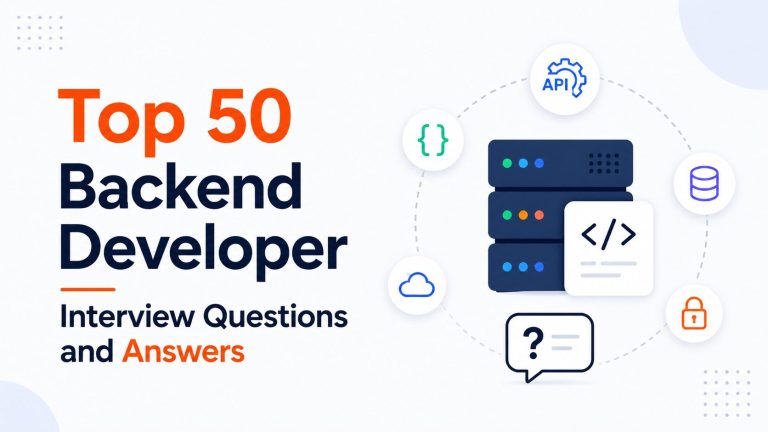
Whether you are a hiring manager preparing to evaluate backend developer candidates or a software engineer getting ready for your next big opportunity, this guide covers everything you need. Backend development sits at the core of every modern application, from the APIs that power mobile apps to the database systems that store critical business data. Getting the interview right matters.
This resource brings together the 50 most relevant backend developer interview questions for 2026, organized by category, with direct answers that reflect real-world expectations. Each question is designed to test practical skills, conceptual depth, and problem-solving ability across the most in-demand backend developer languages and frameworks.
| Quick Answer: What Is Backend Development?
Backend development refers to the server-side layer of a web or mobile application. It includes everything that users do not see directly: server logic, databases, APIs, authentication systems, and application infrastructure. Backend developers write the code that powers the frontend and ensures data is stored, retrieved, and processed reliably. Common backend developer languages include Node.js, Python, Java, Golang, PHP, and Ruby. |
What This Guide Covers
This article is structured across ten core categories. Here is a quick overview of what each section addresses:
| Category | Questions Covered |
| Core Fundamentals | Q1-Q5: What backend development is, how it differs from frontend, and core responsibilities |
| APIs and REST | Q6-Q10: RESTful API design, HTTP methods, authentication, and API versioning |
| Databases | Q11-Q16: SQL vs NoSQL, indexing, normalization, transactions, and query optimization |
| Node.js | Q17-Q21: Event loop, async patterns, middleware, and Node.js backend development best practices |
| Python | Q22-Q26: Python for backend development, Django vs Flask, async with FastAPI, and more |
| Java | Q27-Q30: Java backend developer concepts, Spring Boot, JVM, and threading |
| System Design | Q31-Q35: Scalability, caching, load balancing, microservices, and architecture patterns |
| Security | Q36-Q39: Authentication, authorization, SQL injection, XSS, and secure coding practices |
| DevOps Basics | Q40-Q43: Docker, CI/CD, environment variables, and deployment workflows |
| Behavioral & Hiring | Q44-Q50: Soft skills, remote work, team collaboration, and what interviewers really want |
Core Backend Development Fundamentals
Q1. What is backend development, and why does it matter?
Backend development is the practice of building and maintaining the server-side components of a software application. This includes writing server logic, designing APIs, managing databases, handling authentication, and ensuring the application performs reliably under load.
When a user logs into an app, fills out a form, or makes a purchase, the backend processes all of that activity. It validates the input, queries the database, applies business rules, and returns a response. Without a well-built backend, even the most beautiful frontend will fail.
Backend development matters because it determines how scalable, secure, and performant an application is. Companies that hire backend developers are investing in the reliability and longevity of their product. From custom backend development services to full-scale enterprise systems, the quality of backend work directly impacts business outcomes.
| Q1. What is backend development in simple terms?
Backend development is everything that happens on the server side of an application. It is the code that processes requests, talks to databases, applies business logic, and sends responses back to the user. Users never see it directly, but they experience the results every time they use an app. |
Q2. What is the difference between backend vs frontend development?
Frontend development focuses on the user interface. It deals with HTML, CSS, JavaScript, and frameworks like React or Vue.js. The goal is to create a visually engaging, responsive, and accessible experience that runs in the browser or on a device.
Backend development handles the logic, data, and services that power the frontend. It runs on servers, not in browsers. A backend developer writes APIs that the frontend calls, sets up the database schemas the app relies on, and ensures that the system stays secure and performant.
The clearest way to understand backend vs frontend development is this: the frontend is what users see, and the backend is what makes it all work. Many modern applications also have a fullstack architecture, where one developer handles both layers, but specialized backend and frontend roles remain the industry standard for larger teams.
| Q2. Backend vs frontend: what is the main difference?
Frontend development builds the user interface using HTML, CSS, and JavaScript. Backend development builds the server-side logic, APIs, and databases that the frontend communicates with. Frontend runs in the browser; backend runs on the server. |
Q3. What do backend developers do on a day-to-day basis?
The daily responsibilities of a backend developer vary depending on the team and project, but core activities typically include:
- Designing and building RESTful or GraphQL APIs
- Writing database queries and managing schema migrations
- Debugging server-side errors and performance bottlenecks
- Integrating third-party services such as payment gateways or email providers
- Writing unit and integration tests for backend logic
- Reviewing code and collaborating with frontend and DevOps teams
- Participating in sprint planning, standups, and architecture discussions
What do backend developers do that sets them apart from other roles? They are responsible for the invisible layer that keeps everything running. Whether it is mobile app backend development or custom backend development for enterprise software, backend developers make sure data flows correctly, securely, and at scale.
Q4. What are the most common backend developer languages in 2026?
The backend development ecosystem supports a wide range of programming languages. Each has strengths depending on the use case, team preferences, and performance requirements.
| Language | Common Use | Why Developers Use It |
| Node.js | APIs, real-time apps | Non-blocking I/O, huge npm ecosystem, JavaScript on server |
| Python | Web apps, data-heavy services | Simple syntax, rich libraries (Django, Flask, FastAPI) |
| Java | Enterprise systems | Strong typing, JVM performance, Spring Boot ecosystem |
| Golang | Microservices, CLIs | Fast compilation, low latency, built-in concurrency |
| PHP | CMS, legacy systems | Laravel ecosystem, shared hosting friendly |
| Ruby | Rapid prototyping | Rails framework, convention over configuration |
| Rust | Systems programming | Memory safety, extreme performance |
Q5. What is the backend developer roadmap for 2026?
A backend developer roadmap in 2026 typically follows this progression:
- Fundamentals: Understand how the internet works, HTTP, DNS, and client-server architecture
- A Backend Language: Master at least one: Node.js, Python, Java, Golang, or PHP
- Version Control: Git and GitHub for collaboration and source management
- Databases: Learn both relational (PostgreSQL, MySQL) and NoSQL (MongoDB, Redis)
- API Design: RESTful APIs, GraphQL, and API documentation practices
- Authentication: JWT, OAuth 2.0, session management, and role-based access control
- Testing: Unit testing, integration testing, and test-driven development
- DevOps Basics: Docker, CI/CD pipelines, cloud platforms (AWS, GCP, Azure)
- Caching: Redis, Memcached, and CDN strategies
- System Design: Microservices, message queues, load balancing, and scalability patterns
APIs and REST Architecture
Q6. What is a RESTful API, and how does it work?
A RESTful API is an interface that allows different software systems to communicate over HTTP using standard methods like GET, POST, PUT, PATCH, and DELETE. REST stands for Representational State Transfer, and it is based on a set of architectural constraints that make APIs predictable and stateless.
In a REST API, each URL represents a resource. A GET request to /users retrieves a list of users. A POST request to /users creates a new one. A DELETE request to /users/42 removes the user with ID 42. This predictable structure makes RESTful APIs easy to understand, document, and consume.
| Q6. How does a REST API work?
A REST API uses HTTP methods and URLs to represent operations on data. GET retrieves data, POST creates it, PUT or PATCH updates it, and DELETE removes it. The server and client remain stateless, meaning each request contains all the information needed to process it, without relying on session state stored on the server. |
Q7. What is the difference between REST and GraphQL?
REST uses fixed endpoints for each resource. You call /users to get users, /orders to get orders. Each endpoint returns a defined structure. GraphQL uses a single endpoint and lets clients specify exactly what data they need in a query. This reduces over-fetching and under-fetching, which is especially useful for mobile clients on limited bandwidth.
REST is simpler to cache and easier for teams unfamiliar with GraphQL to work with. GraphQL is better when frontend teams need flexibility and when you are aggregating data from multiple backend sources. The choice depends on team skill, client needs, and API complexity.
Q8. What is the difference between PUT and PATCH in HTTP?
PUT replaces the entire resource with the request payload. If a user has 10 fields and you send a PUT request with 2 fields, the other 8 get cleared. PATCH applies a partial update. You only send the fields you want to change, and everything else stays the same.
Best practice is to use PUT for full replacements and PATCH for partial updates. Many APIs use PATCH more frequently because it avoids accidentally overwriting data.
Q9. How do you handle API authentication and authorization?
Authentication answers who you are. Authorization answers what you are allowed to do. Both are critical in any backend development service.
- JWT (JSON Web Tokens): Stateless tokens issued at login, validated on each request without a database call
- OAuth 2.0: Delegated authorization for third-party access, commonly used for social login flows
- API Keys: Simple token-based access for machine-to-machine communication
- Session-based auth: Server stores session data, client holds a session cookie
For role-based access control, define permissions in the database and check them in middleware before processing any request. Never trust client-side input to determine what a user can access.
Q10. What is API versioning and why is it important?
API versioning lets you make changes to an API without breaking existing clients. When you release a new version with breaking changes, existing consumers can stay on the old version while new clients adopt the updated one.
Common versioning strategies include URL versioning (/api/v1/ vs /api/v2/), header versioning (Accept: application/vnd.api+json;version=2), and query param versioning (?version=2). URL versioning is the most transparent and widely used approach.
Databases and Data Modeling
Q11. What is the difference between SQL and NoSQL databases?
| Attribute | SQL (Relational) | NoSQL (Non-Relational) |
| Schema | Fixed, predefined schema | Dynamic, flexible schema |
| Data Model | Tables, rows, columns | Documents, key-value, graph, column-family |
| Query Language | SQL (structured) | Varies: MongoDB, DynamoDB, Cassandra query syntax |
| Scaling | Vertical (scale up) | Horizontal (scale out) |
| Consistency | Strong ACID compliance | Often eventual consistency (BASE) |
| Best For | Financial apps, ERP, analytics | Real-time apps, catalogs, user profiles |
| Examples | PostgreSQL, MySQL, SQL Server | MongoDB, Redis, Cassandra, DynamoDB |
Q12. What is database indexing and when should you use it?
A database index is a data structure that speeds up query performance by allowing the database to locate rows without scanning the entire table. Think of it like an index at the back of a book: instead of reading every page, you jump directly to what you need.
You should add indexes on columns that appear frequently in WHERE clauses, JOIN conditions, and ORDER BY operations. However, indexes slow down write operations because they need to be updated on every INSERT, UPDATE, and DELETE. The right indexing strategy balances read performance against write overhead.
Q13. What is database normalization? Explain the normal forms.
Normalization is the process of organizing a relational database to reduce data redundancy and improve data integrity. It involves applying a series of rules called normal forms.
- 1NF (First Normal Form): Each column must contain atomic values. No repeating groups or arrays in a cell.
- 2NF (Second Normal Form): All non-key columns must depend on the entire primary key. Eliminate partial dependencies.
- 3NF (Third Normal Form): Non-key columns must not depend on other non-key columns. Eliminate transitive dependencies.
- BCNF (Boyce-Codd Normal Form): A stricter version of 3NF where every determinant is a candidate key.
Most production databases are normalized to 3NF. Sometimes controlled denormalization is applied for read-heavy applications where join performance becomes a bottleneck.
Q14. What is a database transaction, and what are ACID properties?
A transaction is a sequence of database operations that are treated as a single logical unit. Either all operations succeed and are committed, or none of them are applied. This is essential for maintaining data consistency in operations like bank transfers or order processing.
- Atomicity: All operations in a transaction succeed or all are rolled back.
- Consistency: The database moves from one valid state to another. No half-baked data.
- Isolation: Concurrent transactions do not interfere with each other.
- Durability: Once committed, the transaction is permanently saved, even after a crash.
Q15. What is the N+1 query problem?
The N+1 problem occurs when an application executes one query to get a list of records and then executes an additional query for each record in the list. If you fetch 100 users and then query each user’s profile separately, that is 101 queries total instead of 2.
The solution is eager loading. In ORMs like Sequelize, Prisma, or Hibernate, you join the related data in the original query using include or join statements. This collapses 101 queries into 1 or 2 and dramatically improves performance.
Q16. What is the difference between an ORM and a raw SQL query?
ORMs (Object-Relational Mappers) like Prisma, Sequelize, TypeORM, or Hibernate let developers write database queries using programming language syntax instead of raw SQL. They speed up development, reduce boilerplate, and prevent many common SQL injection vulnerabilities by default.
Raw SQL gives you complete control over your queries. It is faster for complex operations, easier to debug, and necessary when an ORM cannot express what you need efficiently. Many experienced backend developers use a hybrid approach: ORM for standard operations and raw SQL for performance-critical queries.
Node.js Backend Development
Q17. What is the Node.js event loop and why does it matter?
The Node.js event loop is what makes non-blocking I/O possible in a single-threaded environment. Instead of waiting for database queries, file reads, or HTTP calls to complete before moving on, Node.js registers a callback and continues processing other requests. When the I/O finishes, the callback is added to the event queue and executed.
This architecture is why Node.js backend development scales well for I/O-heavy applications like APIs, real-time chat, and streaming services. It handles thousands of concurrent connections without the overhead of spawning a new thread for each request.
| Q17. How does the Node.js event loop work?
The Node.js event loop is a mechanism that processes asynchronous operations in a single-threaded environment. It works through phases: timers, I/O callbacks, idle/prepare, poll, check (setImmediate), and close callbacks. When an async operation completes, its callback is pushed into the event queue and executed in the appropriate phase. This allows Node.js to handle high concurrency without blocking. |
Q18. What is the difference between callbacks, promises, and async/await?
These are three patterns for handling asynchronous operations in JavaScript-based backend developer code.
- Callbacks: A function passed as an argument to another function, called when the async operation completes. Gets messy with nested operations (callback hell).
- Promises: An object representing a future value. Uses .then() and .catch() chains. Cleaner than callbacks but still verbose for complex flows.
- Async/Await: Syntactic sugar over promises. Allows asynchronous code to be written in a synchronous style. Much easier to read, debug, and maintain.
In 2026, async/await is the standard for Node.js backend development. Most new Node.js projects use it by default, and many libraries have been updated to return promises that work naturally with await.
Q19. What is middleware in Express.js?
Middleware in Express.js is a function that sits between the incoming request and the route handler. It has access to the request object, the response object, and the next middleware function. Middleware runs in sequence, and each piece can modify the request, terminate the response, or pass control to the next function.
Common middleware use cases include authentication checks, request logging, JSON body parsing, rate limiting, CORS handling, and error management. Writing clean, composable middleware is a sign of mature Node.js backend development skills.
Q20. How do you handle errors in a Node.js application?
Good error handling in Node.js means catching both synchronous and asynchronous errors without letting the application crash. For synchronous code, use try/catch. For async code with async/await, wrap your code in try/catch as well.
Express.js uses a special error-handling middleware with four parameters (err, req, res, next). Any error passed to next(err) will be caught here. A well-structured Node.js application centralizes error handling, logs errors with context, and returns appropriate HTTP status codes to the client.
Q21. What is the difference between process.nextTick and setImmediate?
process.nextTick queues a callback to run after the current operation completes but before the event loop continues to the next phase. It has higher priority. setImmediate queues a callback to run in the check phase of the event loop, after I/O callbacks. It fires on the next iteration of the event loop.
Use process.nextTick when you need something to happen before any I/O. Use setImmediate when you want to defer execution until after I/O events have been processed. Misusing either can cause performance issues or even block the event loop.
Python for Backend Development
Q22. Why is Python popular for backend development?
Python for backend development has grown significantly because of its clean syntax, large standard library, and rich ecosystem of web frameworks. It is especially popular for applications that combine web APIs with data processing, machine learning, or automation.
Python’s readability reduces the learning curve for new team members and speeds up development cycles. Frameworks like Django provide everything you need out of the box. Flask and FastAPI give you more control for lightweight or high-performance services.
| Q22. What makes Python good for backend development?
Python is good for backend development because of its readable syntax, extensive library support, and mature frameworks like Django, Flask, and FastAPI. It handles web APIs, database access, task queues, and integrations well. Python also excels in applications that mix backend logic with data science or machine learning workloads. |
Q23. What is the difference between Django and Flask?
Django is a full-featured, batteries-included web framework. It comes with an ORM, admin interface, authentication, form validation, and more out of the box. It is ideal for large applications where you want a structured, convention-over-configuration approach.
Flask is a micro-framework. It gives you the basics: routing and request handling. Everything else, including the database layer, auth, and validation, you add yourself. Flask is better for smaller services, APIs, or when you want full control over your architecture.
FastAPI has emerged as a third strong option for Python backend development, especially for high-performance REST APIs. It is async-first, uses type hints for validation, and automatically generates OpenAPI documentation.
Q24. How does Python handle concurrency in backend applications?
Python has a Global Interpreter Lock (GIL) that prevents true multi-threaded CPU execution. For CPU-bound tasks, Python uses the multiprocessing module to spawn separate processes. For I/O-bound tasks, Python uses threading or the asyncio library.
FastAPI and async Django both use asyncio for non-blocking I/O. When running with an ASGI server like Uvicorn, Python applications can handle thousands of concurrent connections efficiently, similar to Node.js. This makes modern python backend development highly competitive with other async frameworks.
Q25. What is a Python decorator and how is it used in web frameworks?
A decorator is a function that wraps another function to extend its behavior without modifying it. In Python web frameworks, decorators are used to define routes, apply middleware, require authentication, and cache responses.
In Flask, @app.route(‘/users’) maps a URL to a function. In Django, @login_required protects a view from unauthenticated access. These patterns make Python backend developer code expressive and DRY.
Q26. How do you optimize a slow Python API endpoint?
- Profile first using tools like cProfile or line_profiler to find the actual bottleneck
- Add database query optimization: check for N+1 queries, missing indexes, or missing .select_related() in Django
- Implement caching with Redis for repeated expensive queries
- Use async views or background tasks for operations that do not need to block the response
- Enable pagination to avoid returning thousands of records in one call
- Consider moving computation-heavy work to Celery workers
Java Backend Developer Questions
Q27. What is Spring Boot and why do Java backend developers use it?
Spring Boot is a framework built on top of the Spring Framework that removes much of the configuration boilerplate required to build Java backend applications. It provides auto-configuration, embedded servers (Tomcat, Jetty), production-ready monitoring, and a large ecosystem of starters for database access, security, messaging, and more.
Java backend developer jobs frequently require Spring Boot knowledge because it is the de facto standard for enterprise Java applications. It accelerates development, enforces good architecture through dependency injection, and integrates cleanly with cloud platforms and containerized deployments.
Q28. What is dependency injection and how does it work in Spring?
Dependency injection is a design pattern where a class receives its dependencies from an external source rather than creating them itself. This makes components loosely coupled, easier to test, and easier to swap out.
In Spring, you use annotations like @Autowired, @Component, @Service, and @Repository to tell the framework which classes to manage and inject. The Spring container handles the instantiation and wiring at runtime. This is one of the core patterns every java backend developer is expected to understand deeply.
Q29. What is the difference between an abstract class and an interface in Java?
Abstract classes can have both abstract methods (no implementation) and concrete methods (with implementation). A class can extend only one abstract class. Use abstract classes when you want to share code among related classes.
Interfaces define a contract. All methods are abstract by default (prior to Java 8). A class can implement multiple interfaces. Use interfaces to define behavior that can be applied across unrelated classes.
In modern Java, interfaces can have default and static methods, which blurs the distinction slightly. But the rule of thumb holds: abstract classes for shared base behavior, interfaces for behavioral contracts.
Q30. How does the JVM garbage collector work?
The JVM garbage collector automatically manages memory by identifying objects that are no longer reachable from any live reference and reclaiming their memory. This frees developers from manually allocating and deallocating memory, which reduces memory leaks and pointer errors.
The JVM uses a generational garbage collection model with young, old, and (historically) permanent generations. Short-lived objects accumulate in the young generation and are collected frequently (minor GC). Long-lived objects are promoted to the old generation and collected less frequently (major or full GC).
Java backend developer jobs in performance-sensitive environments often require knowledge of GC tuning: choosing between G1, ZGC, and Shenandoah collectors based on latency and throughput requirements.
System Design and Architecture
Q31. What is the difference between monolithic and microservices architecture?
A monolithic application packages all functionality into a single codebase and deployment unit. It is simpler to develop, test, and deploy in the early stages of a project. However, as the application grows, monoliths become harder to scale, and a bug in one module can bring down the entire system.
Microservices break the application into small, independently deployable services. Each service owns its own data and communicates with others via APIs or message queues. This allows teams to deploy, scale, and update services independently. Node.js backend development and Golang are popular choices for building lightweight microservices.
| Q31. When should you use microservices instead of a monolith?
Use microservices when teams are large enough to own separate services, when different parts of your system have vastly different scaling requirements, or when you need to deploy changes to parts of the system without affecting the whole. Start with a monolith if you are building an early-stage product and want to iterate quickly. Most successful microservices architectures started as well-structured monoliths. |
Q32. What is caching and when should backend developers use it?
Caching stores frequently accessed data in a fast storage layer such as Redis or Memcached to reduce database load and improve response times. Instead of querying the database on every request, the backend checks the cache first and returns the stored result if it exists.
- Cache database query results for read-heavy endpoints
- Cache API responses for slow third-party integrations
- Cache session data to reduce database lookups on auth checks
- Use cache-aside, write-through, or write-behind patterns depending on consistency requirements
Cache invalidation is one of the hardest problems in backend development. You need a strategy for when to expire or update cached data when the underlying database changes.
Q33. What is a message queue and when would you use one?
A message queue is a system that enables asynchronous communication between services by passing messages through a shared buffer. Producers write messages to the queue; consumers process them independently. This decouples services and handles traffic spikes gracefully.
You would use a message queue when you have tasks that do not need to be completed synchronously. Sending a welcome email after signup, processing an uploaded video, or updating a search index are all good candidates. Popular message queue systems include RabbitMQ, Apache Kafka, AWS SQS, and Redis Streams.
Q34. How do you design a URL shortener service?
This is a classic system design question in backend developer interviews. A URL shortener needs to generate a short code for a long URL, store the mapping, and redirect users when the short URL is visited.
- Storage: A key-value database like Redis or a simple SQL table with short_code and original_url columns
- Code Generation: Base62 encoding of an auto-incrementing ID or a hash of the URL with collision handling
- Redirects: An HTTP 301 (permanent) or 302 (temporary) redirect, depending on whether you want caching
- Scalability: Cache frequently accessed short codes in Redis, use a CDN for redirect performance
- Analytics: Log click events to a time-series store or analytics pipeline
Q35. What is horizontal vs vertical scaling?
Vertical scaling means adding more resources (CPU, RAM) to an existing server. It is simple but has a ceiling. You cannot infinitely add resources to one machine.
Horizontal scaling means adding more servers and distributing the load across them. It is more complex but far more elastic. Load balancers distribute traffic, and stateless backends can run on any node. Most custom backend development for high-traffic applications is designed with horizontal scaling in mind.
Backend Security Best Practices
Q36. What is SQL injection and how do you prevent it?
SQL injection is an attack where malicious SQL code is inserted into an input field and executed by the database. For example, entering ‘ OR ‘1’=’1 into a login form could bypass authentication if the query is not properly sanitized.
Prevention methods include:
- Parameterized Queries: Use prepared statements where user input is never concatenated into SQL strings
- ORMs: Most modern ORMs escape input by default
- Input Validation: Validate and sanitize all user input before processing
- Least Privilege: Database users should have only the permissions they need
SQL injection remains one of the top vulnerabilities in web applications. Every backend developer is expected to know how to prevent it without thinking twice.
Q37. What is XSS (Cross-Site Scripting) and how do you prevent it?
XSS attacks inject malicious scripts into web pages viewed by other users. When a user visits the affected page, the script runs in their browser and can steal cookies, session tokens, or other sensitive data.
Backend prevention strategies include escaping output before sending it to the client, setting Content Security Policy headers, and validating that user input does not contain executable script tags. Never trust user input and never render it directly into HTML without sanitization.
Q38. How do JWT tokens work?
A JSON Web Token (JWT) consists of three parts: a header, a payload, and a signature, separated by dots. The header identifies the algorithm. The payload contains claims like the user ID and expiry time. The signature is created by hashing the header and payload with a secret key.
When a user logs in, the server creates a JWT and sends it to the client. The client stores it and includes it in the Authorization header of future requests. The server validates the signature on each request without needing to query the database. This makes JWT authentication stateless and well-suited for distributed backend systems.
Q39. What is the principle of least privilege?
The principle of least privilege means that every component, user, or service should have only the minimum permissions necessary to perform its function. A database user for a read-only reporting service should not have INSERT or DELETE permissions. An API key for a data ingestion service should not be able to modify user accounts.
Applied consistently, least privilege limits the blast radius of any security breach. Even if an attacker gains access to one service, they cannot use those credentials to compromise everything else.
DevOps Basics Every Backend Developer Should Know
Q40. What is Docker and why do backend developers use it?
Docker is a containerization platform that packages an application and all its dependencies into a container image. The container runs the same way on any machine, eliminating the classic it works on my machine problem.
For backend development solutions, Docker means reproducible environments, faster onboarding, and cleaner deployments. Every service in a microservices system typically runs in its own container. Docker Compose orchestrates multiple containers locally, while Kubernetes handles production at scale.
Q41. What is a CI/CD pipeline and why does it matter?
CI/CD stands for Continuous Integration and Continuous Deployment. A CI pipeline automatically runs tests whenever code is pushed to a repository. A CD pipeline automatically deploys the application to staging or production when tests pass.
For backend developer jobs in modern companies, CI/CD is table stakes. Platforms like GitHub Actions, GitLab CI, and CircleCI are commonly used. A well-designed pipeline catches bugs early, reduces deployment risk, and lets teams ship code multiple times a day with confidence.
Q42. What are environment variables and why should you use them?
Environment variables are key-value pairs set outside the application code that configure its behavior at runtime. Database connection strings, API keys, JWT secrets, and feature flags should all be stored as environment variables, never hardcoded in source code.
Using environment variables keeps secrets out of version control, makes it easy to run the same application in different environments (development, staging, production), and allows configuration changes without redeploying code.
Q43. What is the difference between a process manager like PM2 and a container?
PM2 is a Node.js process manager that keeps your application running, restarts it on crashes, manages logs, and handles clustering. It runs on the host machine and is typically used for simpler Node.js deployments without Docker.
Docker containers package the application with its full environment and run isolated from the host. They are more portable, more consistent, and better suited for cloud and microservices deployments. Most modern backend development infrastructure uses Docker or Kubernetes rather than PM2 in production.
Behavioral and Soft Skill Questions
Q44. How do you handle disagreements about technical decisions in a team?
Strong backend developers bring data and rationale to technical disagreements. If you disagree with a decision, explain your reasoning clearly, present alternatives with trade-offs, and listen to the counterarguments. When the team decides, commit fully to the chosen approach even if it was not your preference.
Interviewers ask this question to assess whether you can collaborate effectively and separate your ego from your technical opinions. The ability to disagree productively is a mark of senior backend developer maturity.
Q45. How do you prioritize tasks when working on multiple backend features?
Prioritization starts with understanding business impact and urgency. Security vulnerabilities and production bugs take priority over feature work. Among features, work with your product manager to align on business value, dependencies, and deadlines.
Tools like sprint boards, dependency mapping, and daily syncs help keep backend and frontend teams aligned. Good backend developers communicate blockers early and flag scope changes before they become delivery problems.
Q46. How do you approach learning a new backend technology or framework?
Start with the official documentation. Then build a small project that mirrors a real use case you might encounter. Reading tutorials is useful, but nothing replaces writing code that actually runs and breaks. Join the community: GitHub discussions, Discord servers, and Stack Overflow threads surface the edge cases that documentation skips.
For hiring managers evaluating backend developer candidates, this question reveals whether a developer is self-directed or dependent on structured training. The best backend developers are perpetually curious.
Q47. Tell me about a time you improved the performance of a backend system.
This is a classic STAR (Situation, Task, Action, Result) question. When answering, be specific about the problem (slow API responses, high database CPU), what you investigated, the specific changes you made (added an index, implemented Redis caching, optimized a query), and the measurable result (latency reduced from 2.1 seconds to 180ms).
Vague answers do not land well. Interviewers want to hear that you understood the problem at a technical level and took a deliberate, measurable approach to solving it.
Q48. How do you ensure the code you write is maintainable?
Maintainable backend code follows clear naming conventions, has single-responsibility functions and classes, includes meaningful comments on non-obvious logic, and is covered by automated tests. Code reviews are essential: they share knowledge and enforce standards.
Document your APIs. Leave meaningful commit messages. Write error messages that help future developers understand what went wrong. The goal is to write code that your future self, or a new team member, can understand six months from now without needing to ask anyone.
Q49. What is your approach to writing unit tests for backend code?
Unit tests verify that individual functions or classes behave correctly in isolation. For backend developer code, this means mocking database calls, external API requests, and file system operations so tests run fast and deterministically without side effects.
A good unit test is FIRST: Fast, Independent, Repeatable, Self-validating, and Timely. Aim for high coverage on business logic, validation functions, and utility helpers. Integration tests cover the interaction between components. End-to-end tests validate full user flows.
Q50. Why should we hire you as a backend developer?
The best answer to this question is specific and evidence-based. Tie your experience directly to the company’s tech stack and challenges. If they run Node.js microservices, talk about your Node.js backend development work at scale. If they are migrating to Python, mention your python backend development experience.
Show that you understand what backend development service quality looks like: clean APIs, solid data models, robust error handling, and performance awareness. And be honest about what you are still learning. Intellectual humility combined with demonstrable skills is what separates great backend developer hires from average ones.
What Interviewers Really Look for in a Backend Developer
Beyond the technical questions, experienced engineering managers are evaluating a few things throughout the interview:
- Problem decomposition: Can you break a complex problem into manageable parts without being told how?
- Communication: Can you explain a technical decision clearly to someone with a different background?
- Pragmatism: Do you choose the right tool for the job, or do you over-engineer?
- Ownership: Do you take responsibility for your work end to end, from design to deployment?
- Growth mindset: Are you constantly learning, or do you coast on what you already know?
These qualities matter regardless of whether the role is a Java backend developer position, a Node.js backend development role, or a Python-focused backend engineer opening. Technical skill is table stakes. These qualities are what separate good backend developers from exceptional ones.
Backend Developer Salary in 2026: What to Expect
Backend developer salary varies widely by location, experience level, technology specialization, and company size. Here is a general overview based on market data:
| Experience Level | US (USD/yr) | UK (GBP/yr) | India (INR/yr) |
| Junior (0-2 yrs) | $65K – $95K | £28K – £45K | INR 4-8 LPA |
| Mid-Level (2-5 yrs) | $95K – $140K | £45K – £70K | INR 8-18 LPA |
| Senior (5-8 yrs) | $140K – $185K | £70K – £95K | INR 18-35 LPA |
| Lead/Architect (8+ yrs) | $185K – $250K+ | £95K – £130K+ | INR 35-70+ LPA |
Looking to Hire Backend Developers for Your Team?
| HireDeveloper.dev: Pre-Vetted Backend Engineers, Ready to Deploy
If you are scaling your product and need backend developers who can actually do the work, HireDeveloper.dev specializes in placing pre-vetted Node.js, Python, Java, and Golang engineers with companies in the US, UK, and Europe. Every candidate is technically screened before they reach your interview stage. You save time, skip the noise, and hire with confidence. |
Whether you need to hire dedicated backend developers for a long-term engagement, fill a backend developer job vacancy quickly, or find specialized talent for mobile app backend development, HireDeveloper.dev has the infrastructure to move fast.
- Pre-vetted talent: Every developer passes a multi-stage technical screening covering backend developer code, system design, and communication
- No time wasted: You only interview candidates who meet your technical bar
- Flexible models: Full-time placement, dedicated teams, or contract engagements
- Global talent, local accountability: Developers in India delivering custom backend development services to clients in the US, UK, and Europe
Visit hiredeveloper.dev to post a requirement or speak with our team about your next backend developer hire.
Final Thoughts
Preparing for a backend developer interview in 2026 means going beyond memorizing syntax. The strongest candidates understand why design decisions are made, not just how to implement them. They can explain trade-offs between REST and GraphQL, between SQL and NoSQL, between monoliths and microservices, with real context and experience behind their answers.
Whether you are a backend developer getting ready for your next role or a team lead looking to hire backend developers who can grow with your product, the questions and answers in this guide reflect what modern engineering interviews actually test. Use them as a starting point, then go deeper on the areas most relevant to your technology stack and level.
Backend development is not a static field. The best backend developers in 2026 are the ones who stay curious, ship reliable code, and keep improving. That mindset, more than any single answer, is what interviewers are ultimately looking for.
Related source
- https://internshala.com/blog/backend-developer-interview-questions/
- https://github.com/arialdomartini/Back-End-Developer-Interview-Questions
- https://www.coursera.org/resources/back-end-development-interview-prep-guide
- https://www.ideamotive.co/backend/interview
- https://roadmap.sh/questions/backend
- https://hiredeveloper.dev/hire/nodejs-developers/
- https://hiredeveloper.dev/insights/hire-dedicated-node-js-developer-step-by-step-process/
- Tips for Hiring and Retaining Top Tech Talents in a Competitive Market
- Reduce Your Developer Hiring Cost
- Reduce Development Cost with Hire Developer
- Why Does Software Development Require Skill-Based Hiring?
- A Comprehensive Guide to Developing a Strategic Recruitment Plan for 2024
- Addressing Talent Acquisition Challenges: Tips to Find the Right Talent Swiftly
- Overcoming Tech Hiring Challenges: A Guide for Modern Recruiters
- Remote Work Is Revolutionizing Ways to Hire Developer
- Top IT Staffing Trends
- 3 Reasons Why STEM Shortage in UK