






Introduction
A decade ago, most healthcare apps did one job well: booking an appointment or showing a patient portal. That era is over. In 2026, patients expect an app to remember their history, a clinician expects it to reduce paperwork rather than add to it, and a hospital IT team expects it to plug directly into existing clinical systems without months of custom integration work.
AI, connected devices, remote care, personalization, interoperability, automation, and cybersecurity are no longer separate initiatives. They are converging inside a single product experience, and that convergence is redefining what “good” healthcare app development looks like. A polished interface is no longer enough. What separates a healthcare app that gets adopted from one that quietly disappears is whether it solves a real clinical or operational problem, integrates cleanly with the systems already in use, and holds up under scrutiny from security and compliance teams.
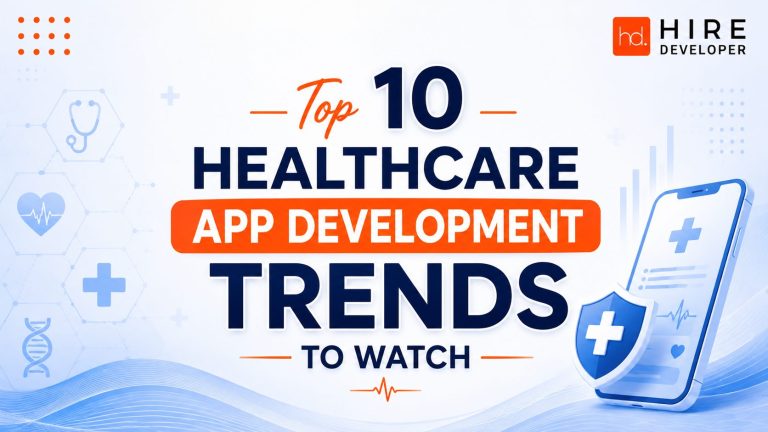
This article walks through the ten most important healthcare app development trends to watch in 2026, what each one means in practice, and how businesses can decide which trends are worth prioritizing for their specific product and audience.
Quick Answer: Biggest Healthcare App Development Trends in 2026
In 2026, healthcare app development is being shaped by AI-powered clinical support, remote patient monitoring, hybrid telemedicine, personalization, FHIR-based interoperability, voice interfaces, predictive analytics, security-by-design, digital therapeutics, and cloud-native scalability. The common thread is integration: apps that connect cleanly to devices, EHR systems, and care teams are outperforming standalone, feature-heavy apps built in isolation.
The 10 trends covered in this article:
- AI-Powered Clinical and Patient Support
- Remote Patient Monitoring and Connected Health Devices
- Telemedicine and Hybrid Care Platforms
- Personalized Patient Experiences
- Healthcare Interoperability and FHIR-Based Integrations
- Voice and Conversational Healthcare Interfaces
- Healthcare Data Analytics and Predictive Intelligence
- Security and Privacy by Design
- Digital Therapeutics and Medication Management
- Cloud-Native, Scalable Healthcare Architecture
Trend #1: AI-Powered Clinical and Patient Support
What it means
AI is moving from a bolt-on feature to a core layer inside healthcare applications, powering symptom triage assistants, clinical documentation tools, and personalized health recommendations.
Why it matters in 2026
In 2026, patients expect apps that respond intelligently rather than just display static information, and clinicians expect tools that reduce administrative load rather than add to it.
Real-world healthcare use cases
- AI-assisted symptom checkers that help patients decide whether to seek urgent, routine, or self-managed care
- Ambient documentation tools that convert clinician-patient conversations into structured notes
- Predictive alerts that flag patients at risk of missed appointments or medication non-adherence
- Personalized content recommendations based on a patient’s condition and history
Technologies involved
Large language models, natural language processing, machine learning classifiers, and retrieval systems connected to clinical knowledge bases.
Business impact
Faster triage, reduced documentation time for clinicians, and more relevant patient engagement, all of which can lower operating costs and improve retention.
What businesses should consider
AI should support a clinician’s judgment, not replace it. Apps that offer AI-generated health information need clear disclaimers, human escalation paths, and validation against clinical guidelines before launch.
Trend #2: Remote Patient Monitoring and Connected Health Devices
What it means
Mobile applications increasingly act as the bridge between wearables, connected medical devices, and care teams, turning continuous data streams into usable clinical signals.
Why it matters in 2026
Chronic disease management, post-surgical recovery, and elderly care are shifting from periodic in-person checkups to continuous, app-mediated monitoring.
Real-world healthcare use cases
- Cardiology apps that pull heart rate and rhythm data from connected wearables
- Diabetes management apps syncing with continuous glucose monitors
- Post-surgical recovery apps tracking mobility and pain levels through connected sensors
- Elderly care apps that alert family members or caregivers to unusual activity patterns
Technologies involved
Bluetooth Low Energy and IoT device integrations, cloud data pipelines, and real-time alerting systems built on top of mobile SDKs.
Business impact
Fewer unnecessary in-person visits, earlier intervention for at-risk patients, and stronger data for value-based care reporting.
What businesses should consider
Device fragmentation is real. Businesses need to decide early which device ecosystems to support and how to handle data gaps when a patient’s device goes offline.
Trend #3: Telemedicine and Hybrid Care Platforms
What it means
Telemedicine apps are evolving past simple video calls into complete digital care journeys that combine scheduling, messaging, digital prescriptions, and follow-up monitoring in one experience.
Why it matters in 2026
Patients now expect the same continuity in virtual care that they get in person, and providers need hybrid workflows that blend in-person and remote visits without duplicating work.
Real-world healthcare use cases
- Virtual-first primary care apps that route patients between video visits and in-person follow-ups
- Behavioral health platforms combining scheduled video sessions with asynchronous messaging
- Specialist referral apps that hand off patient context between providers automatically
- Post-visit apps that bundle prescriptions, care instructions, and follow-up reminders
Technologies involved
WebRTC-based video infrastructure, secure messaging APIs, e-prescribing integrations, and calendar or scheduling engines.
Business impact
Higher visit completion rates, reduced no-shows, and expanded reach into underserved or rural populations.
What businesses should consider
State-by-state and country-specific telehealth regulations still vary, and video quality expectations are now high. A platform built for one region may need real rework to expand.
Trend #4: Personalized Patient Experiences
What it means
Healthcare apps are tailoring content, reminders, and care pathways to each patient rather than offering a generic experience to every user.
Why it matters in 2026
Personalization improves adherence and engagement, both of which are difficult to achieve with static, one-size-fits-all healthcare content.
Real-world healthcare use cases
- Medication reminder timing adjusted to a patient’s actual routine rather than a fixed schedule
- Care pathway content that adapts based on diagnosis, recovery stage, or risk level
- Behavioral nudges based on engagement patterns, such as re-engagement prompts after inactivity
- Segmented onboarding flows for different patient populations within the same app
Technologies involved
User segmentation engines, behavioral analytics, and rules-based or ML-driven personalization layers.
Business impact
Higher daily and weekly active usage, better medication and care plan adherence, and stronger patient satisfaction scores.
What businesses should consider
Personalization should stay within clinical boundaries. Recommendation logic that touches treatment decisions needs clinical review, not just product experimentation.
Trend #5: Healthcare Interoperability and FHIR-Based Integrations
What it means
Interoperability is the ability of a healthcare app to exchange data cleanly with electronic health record and electronic medical record systems using standardized formats.
Why it matters in 2026
An app that cannot connect to a hospital’s EHR or a clinic’s practice management system has limited value in most clinical settings, regardless of how polished its interface is.
Real-world healthcare use cases
- Patient portals pulling lab results and visit history directly from an EHR
- Remote monitoring apps pushing vitals data back into a provider’s clinical record
- Referral apps exchanging structured patient summaries between health systems
- Population health tools aggregating data across multiple provider organizations
Technologies involved
FHIR (Fast Healthcare Interoperability Resources) APIs, HL7 messaging standards, and integration engines that map data between systems.
Business impact
Reduced duplicate data entry, fewer errors from manual transcription, and a much stronger case for adoption by hospitals and health systems.
What businesses should consider
Every EHR vendor implements FHIR slightly differently in practice. Budget real time for integration testing rather than assuming a single connector will work everywhere.
Trend #6: Voice and Conversational Healthcare Interfaces
What it means
Voice assistants and conversational AI interfaces are being added to healthcare apps to help patients navigate appointments, ask questions, and complete tasks hands-free.
Why it matters in 2026
Voice interfaces improve accessibility for elderly patients, patients with mobility limitations, and anyone who finds typing on a small screen difficult, which is a meaningful share of healthcare app users.
Real-world healthcare use cases
- Voice-guided appointment booking and rescheduling
- Conversational symptom intake before a virtual visit
- Medication reminder confirmations through voice response
- Navigation support for patients using screen readers or voice control
Technologies involved
Speech-to-text and text-to-speech engines, conversational AI frameworks, and accessibility APIs built into iOS and Android.
Business impact
Better accessibility compliance, higher task completion rates for users who struggle with traditional touch interfaces, and a more modern brand experience.
What businesses should consider
Voice accuracy for medical terminology and diverse accents still varies. Sensitive health conversations captured by voice also raise privacy questions that need to be addressed in the data handling design.
Trend #7: Healthcare Data Analytics and Predictive Intelligence
What it means
Beyond collecting data, healthcare apps are increasingly expected to turn that data into dashboards, risk scores, and operational insight for both patients and healthcare organizations.
Why it matters in 2026
Providers and payers are under pressure to manage population health proactively, and apps that only store data without analyzing it are becoming a competitive disadvantage.
Real-world healthcare use cases
- Population health dashboards that flag high-risk patient cohorts
- Operational analytics for hospitals tracking bed utilization or staffing needs
- Patient-facing trend views showing progress over weeks or months
- Predictive models estimating readmission or no-show risk
Technologies involved
Data warehousing, business intelligence dashboards, and predictive modeling built on structured clinical and operational data.
Business impact
Better resource planning, earlier identification of at-risk patients, and stronger evidence for demonstrating outcomes to payers.
What businesses should consider
Predictive models are only as good as the data feeding them. Businesses should plan for ongoing model validation rather than treating a model as a one-time build.
Trend #8: Security and Privacy by Design
What it means
Security in 2026 is being treated as an architectural decision made from day one, not a checklist item added before launch.
Why it matters in 2026
Healthcare apps handle protected health information, which makes them a high-value target, and a single breach can end patient trust and provider partnerships permanently.
Real-world healthcare use cases
- Role-based access control separating what patients, clinicians, and administrators can see
- Multi-factor authentication for accounts that access sensitive clinical data
- Encrypted data in transit and at rest across mobile, API, and storage layers
- Audit logging that tracks who accessed what patient data and when
Technologies involved
End-to-end encryption, secure API gateways, identity and access management systems, and automated audit logging pipelines.
Business impact
Reduced breach risk, easier compliance reviews, and stronger trust with hospital procurement and enterprise buyers who now vet security posture closely before signing.
What businesses should consider
Security cannot be retrofitted cheaply. Businesses that treat it as a late-stage add-on typically face expensive rework and possible compliance delays. HireDeveloper.dev does not provide legal or compliance advice; organizations should work with qualified compliance counsel for regulatory requirements such as HIPAA.
Trend #9: Digital Therapeutics and Medication Management
What it means
Apps are increasingly designed to actively support treatment, not just track it, through structured medication reminders, adherence coaching, and behavioral support programs.
Why it matters in 2026
Chronic conditions like diabetes, hypertension, and mental health disorders depend heavily on day-to-day adherence, and apps can fill the gap between clinical visits.
Real-world healthcare use cases
- Structured medication schedules with adherence tracking and refill reminders
- Behavioral support programs for chronic condition management
- Patient education modules tied to a specific diagnosis or treatment plan
- Progress tracking that clinicians can review during follow-up visits
Technologies involved
Reminder and notification engines, adherence tracking logic, and content management systems for patient education.
Business impact
Improved adherence rates, fewer preventable complications, and a stronger value proposition for payers interested in outcomes-based programs.
What businesses should consider
Some digital therapeutics fall under regulatory definitions of a medical product depending on the claims made. Businesses should clarify early whether their app is a wellness tool or a regulated digital therapeutic, since the development and compliance path differs significantly.
Trend #10: Cloud-Native, Scalable Healthcare Architecture
What it means
Healthcare apps are being built on cloud-native, microservices-based architectures so they can grow from a pilot with a few hundred users to a platform serving millions without a rebuild.
Why it matters in 2026
Successful healthcare apps rarely stay small, and an architecture that cannot scale becomes a business risk once adoption accelerates.
Real-world healthcare use cases
- A telemedicine app scaling from a single clinic pilot to a multi-state platform
- A remote monitoring app expanding from one device type to a full connected-device ecosystem
- A hospital system consolidating multiple point solutions into one scalable platform
- A healthcare SaaS company supporting multiple client organizations on shared infrastructure
Technologies involved
Cloud infrastructure such as AWS, Azure, or Google Cloud, containerization, microservices, CI/CD pipelines, and observability tooling.
Business impact
Lower long-term infrastructure costs, faster feature releases, and the ability to onboard new clients or patient populations without major re-engineering.
What businesses should consider
Over-engineering for scale too early can slow down an MVP. The right architecture decision depends on realistic growth projections, not worst-case assumptions.
Healthcare App Development Trends at a Glance
| Trend | Primary Use Case | Business Value | Complexity | Best For |
| AI-Powered Support | Triage, documentation | Efficiency, engagement | High | Startups, hospitals |
| Remote Monitoring | Chronic disease, recovery | Fewer visits, earlier intervention | High | Chronic care platforms |
| Telemedicine | Virtual visits, follow-up | Access, retention | Moderate | Startups, clinics |
| Personalization | Adherence, engagement | Retention, satisfaction | Moderate | All healthcare apps |
| Interoperability (FHIR) | EHR/EMR data exchange | Adoption by hospitals | High | Hospitals, SaaS |
| Voice Interfaces | Accessibility, navigation | Inclusivity, usability | Moderate | Patient-facing apps |
| Data Analytics | Population health, ops | Resource planning | Moderate/High | Hospitals, payers |
| Security by Design | PHI protection | Trust, compliance readiness | High | All healthcare apps |
| Digital Therapeutics | Adherence, coaching | Outcomes, payer value | Moderate/High | Chronic care platforms |
| Cloud-Native Architecture | Scalability, uptime | Lower long-term cost | Moderate/High | Healthcare SaaS |
Which Healthcare App Trends Should Your Business Prioritize?
Not every organization needs all ten trends on day one. The right starting point depends on who the app serves and what problem it is solving first.
For healthcare startups
- Patient experience and onboarding
- Telemedicine or virtual care features
- AI-assisted support for common patient questions
- Basic analytics to track engagement
For hospitals and health systems
- Interoperability and EHR integration
- Remote monitoring for high-risk patient cohorts
- Security and compliance readiness
- Operational analytics
For chronic care platforms
- Wearable and connected device integration
- Remote patient monitoring
- Personalization for adherence
- Medication management and digital therapeutics
For healthcare SaaS companies
- Cloud-native, scalable architecture
- API-first design for partner integrations
- Analytics for multi-client reporting
- Security and interoperability as core product features
How Much Does Healthcare App Development Cost in 2026?
Healthcare app development cost depends on the feature set, the platforms targeted, the integrations required, whether AI functionality is included, security and compliance requirements, UI/UX complexity, the size and location of the development team, testing scope, and ongoing infrastructure and maintenance needs.
| App Type | Complexity | Major Cost Drivers |
| Basic health app | Low | UI, authentication, core APIs |
| Telemedicine app | Medium to High | Video infrastructure, scheduling, payments |
| Patient portal | Medium to High | EHR integration, security, identity management |
| Remote monitoring app | High | Device integrations, data pipelines, alerting |
| AI healthcare platform | High | AI infrastructure, model integration, data pipelines |
| Enterprise healthcare platform | Very High | Multi-system integrations, security, scalability |
Exact pricing varies widely by vendor, region, and scope, so treat these as directional categories rather than fixed quotes. Getting a detailed estimate from a development partner familiar with healthcare compliance is the most reliable next step.
How to Choose a Healthcare App Development Company
Portfolio size alone is a weak signal. A vendor with hundreds of general mobile apps but limited healthcare experience can still struggle with the compliance, integration, and clinical workflow realities that make healthcare software different. When evaluating a healthcare app development company, look at:
- Healthcare domain expertise, not just general mobile development experience
- Track record with security practices relevant to protected health information
- API and integration capabilities, including EHR and EMR systems
- Familiarity with FHIR and HL7 data exchange standards
- Cloud infrastructure and DevOps maturity
- Practical AI implementation experience, not just AI marketing language
- Quality assurance processes for regulated or sensitive applications
- Post-launch support and long-term maintenance capacity
- Clear, responsive communication throughout the engagement
- Ability to scale the team as the project grows
Top 3 Healthcare App Development Companies to Research
If your organization is evaluating a partner to turn these trends into a production healthcare application, the following companies are worth researching. This is not a ranking based on independent testing, and inclusion here does not imply endorsement by the research sources cited at the end of this article.
-
HireDeveloper.dev
Website: https://hiredeveloper.dev/
HireDeveloper.dev is a developer hiring platform that connects businesses with remote software developers, including mobile and full-stack engineers who can support healthcare application projects. Rather than functioning as a single fixed-scope agency, it gives healthcare businesses a way to build out a dedicated development team, whether that means hiring individual developers for a specific technology stack or assembling a broader team for an end-to-end build.
Relevant capabilities include mobile app development, custom software development, and access to developers experienced in frameworks commonly used for healthcare and business applications, such as React Native and Flutter for cross-platform mobile builds. This flexible hiring model tends to suit healthcare startups and product teams that want control over their technical roadmap, along with hospitals or healthcare SaaS companies that need to scale a development team quickly without going through a traditional agency engagement.
Best suited for: healthcare startups and product teams that want dedicated, cost-efficient development talent for an ongoing build, rather than a one-time fixed-scope project.
-
ScienceSoft
Website: https://www.scnsoft.com/
ScienceSoft is a global IT consulting and software development company with a healthcare IT practice dating back to 2005. It holds ISO 13485, ISO 9001, and ISO 27001 certifications and works on projects across compliance frameworks such as HIPAA, GDPR, and FDA requirements for medical device software.
Relevant capabilities include custom healthcare software, medical device and SaMD software development, EHR-related integrations using HL7 and FHIR, and enterprise-scale healthcare IT consulting.
Best suited for: hospitals, medical device companies, and enterprise healthcare organizations that need deep regulatory and compliance experience alongside development.
-
Arkenea
Website: https://arkenea.com/
Arkenea is a healthcare-focused software development company founded in 2011 that works exclusively within the healthcare and medical software space. Its services span custom healthcare software, healthcare mobile app development, telemedicine platforms, and custom EHR development for practices where off-the-shelf systems fall short.
Best suited for: HealthTech entrepreneurs and healthcare organizations that want a partner exclusively focused on healthcare, rather than a generalist agency that treats healthcare as one vertical among many.
How These Trends Will Shape Healthcare Apps Beyond 2026
The individual trends above are meaningful on their own, but the more significant shift is how they are converging. AI models are becoming more useful as they gain access to structured, interoperable patient data through FHIR. Remote monitoring devices are becoming more valuable as cloud-native architectures make it possible to process continuous data streams at scale. Security and privacy design is becoming inseparable from every other trend, since AI, remote monitoring, and interoperability all depend on data moving safely between systems.
Looking beyond 2026, expect healthcare applications to look less like standalone products and more like connective tissue between patients, providers, devices, and health systems. Businesses that build with integration, security, and scalability in mind from the start will be far better positioned to adapt as new regulations, devices, and AI capabilities continue to emerge.
Conclusion
Healthcare app development in 2026 is increasingly about connection rather than isolated features: connecting patients, providers, data, devices, and intelligent software into one coherent experience. AI, remote monitoring, telemedicine, interoperability, and cloud-native architecture are not separate checkboxes to tick off. They work together, and a business that treats them as connected priorities will build a stronger product than one chasing each trend individually.
The right combination of trends depends on patient needs, business objectives, the regulatory environment, technical feasibility, security requirements, and scalability goals. Getting that combination right is exactly where a healthcare app development partner earns its value.
Planning a healthcare application around these emerging trends?
The right development team can help turn product requirements into a scalable mobile solution. HireDeveloper.dev helps businesses explore dedicated and remote development talent for software projects.
REFERENCE SOURCES
- https://www.daffodilsw.com/healthcare-app-development/
- https://emerline.com/blog/mobile-technology-healthcare-trends
- https://digitalscientists.com/blog/healthcare-app-development-in-2026-a-guide-for-business-leaders/
- https://www.sctinfo.com/blog/healthcare-web-app-development-trends-dominating-2026/
- https://www.linkedin.com/pulse/7-emerging-healthcare-app-trends-reshaping-sector-fv0uc
- https://kms-technology.com/blog/healthcare-app-development/