






Introduction
Ten years ago, when a US or European company wanted to expand operations in India, the default answer was outsourcing. Hand the work to a vendor, sign a contract, review the deliverables. Repeat.
That model worked, until it did not.
As technology moved from a support function to the core of every business, companies realized something uncomfortable: they had outsourced not just tasks, but knowledge. And knowledge, once handed away, is very hard to get back.
Enter the Global Capability Centre. Instead of hiring a vendor, you build your own team. Instead of paying for outputs, you own the people who produce them. Instead of managing a contract, you manage a culture.
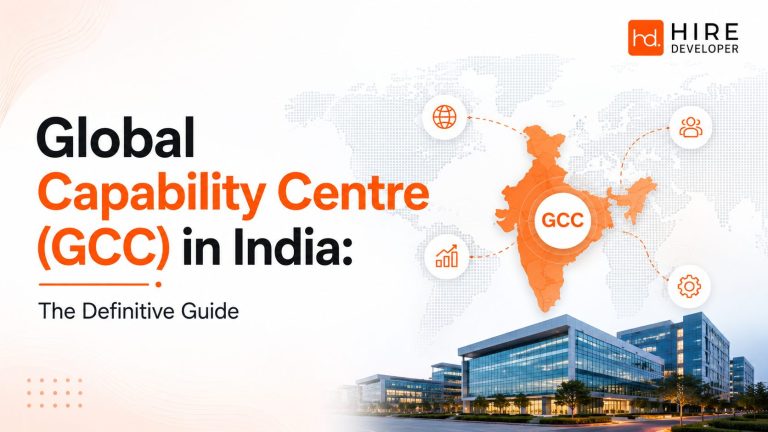
India now hosts over 2,100 Global Capability Centres as of mid-2026, employing more than 2.3 million professionals and generating revenues exceeding $70 billion annually. NASSCOM projects this ecosystem will reach $105 billion and 2.8 million employees by 2030. These are not back-office headcounts. These are product engineers, AI researchers, data scientists, cybersecurity architects, and finance transformation specialists doing the same high-value work that headquarters teams do.
This guide is written for business leaders, founders, and decision-makers who want to understand what a GCC really is, why India is the undisputed global leader, what the setup actually costs, and how to hire the right people to make it work.
No jargon. No fluff. Just the full picture.
What Is a Global Capability Centre (GCC)?
Quick Answer: A Global Capability Centre (GCC) is a wholly owned subsidiary or offshore unit established by a multinational company to deliver core business functions from a strategic location. Unlike outsourcing, a GCC is staffed by the parent company’s own employees, governed by its own policies, and embedded in its strategic operations.
The cleanest way to understand a GCC is through contrast. When you outsource, you pay a third-party company to perform tasks on your behalf. When you set up a GCC, you build your own team in a different country to perform those tasks under your direct control.
Think of a GCC as your company’s second headquarters, positioned in a talent-rich, cost-efficient market, operating on your processes, your culture, and your IP. The employees work for you, not a vendor. The output belongs to you, not an agency.
GCCs are also referred to as Global In-house Centres (GICs), captive centres, or shared service centres. While these terms carry slightly different nuances depending on the region and era, they all describe the same core concept: an enterprise-owned entity that delivers capability rather than a commodity.
What Makes a GCC Different from a Subsidiary?
A subsidiary is typically a market-facing entity set up to sell products or services in a new country. A GCC, by contrast, is an internal delivery engine. It exists to support and strengthen the parent company’s global operations, not to generate revenue in the local market.
A GCC can sit inside a subsidiary structure, but the purpose is distinct. The GCC is about building capability. The subsidiary is about building market presence.
GCC Full Form and What the Name Actually Means
GCC stands for Global Capability Centre. Each word in that name carries meaning worth unpacking.
| Word | What It Signals |
| Global | The centre serves the parent company’s worldwide operations, not just one region |
| Capability | The focus is on building deep skills and expertise, not just executing repetitive tasks |
| Centre | It is a physical and organizational hub with dedicated leadership, infrastructure, and culture |
The word capability is the most important shift in this terminology. Earlier versions of these centres were called captive centres or shared service centres, names that emphasized containment and cost control. The move to capability centre reflects a real strategic evolution: companies are no longer building these offshore units just to save money. They are building them to own expertise.
In India specifically, the GCC full form has taken on additional weight because Indian GCCs have consistently punched above their original mandate. Teams hired to handle IT support have evolved into AI engineering hubs. Teams hired for finance back-office work now run global treasury operations.
How GCCs Have Evolved: From Cost Centers to Innovation Engines
The history of Global Capability Centres in India is a story of constant scope expansion. What started as a cost-reduction play in the late 1990s has become one of the most strategically significant shifts in how global enterprises operate.
| Era | Key GCC Examples | Primary Functions |
| 1990s to 2000s | Texas Instruments, GE, American Express | Basic IT support, transaction processing, call centre operations |
| 2000s to 2010s | JP Morgan, Citibank, IBM | Finance functions, HR operations, software development |
| 2010s to 2018 | Google, Amazon, Microsoft | Product engineering, data analytics, cloud infrastructure |
| 2018 to 2022 | Walmart, Goldman Sachs, Boeing | AI/ML, R&D, cybersecurity, product ownership |
| 2022 to 2026 | OpenAI, McDonald’s, Entain | Full innovation mandates, AI platforms, global leadership roles |
The numbers tell the same story. In 2015, fewer than 1,000 GCCs operated in India. By 2020, that number crossed 1,300. By early 2026, it exceeded 2,100. More critically, the nature of work has transformed. Roughly 80 percent of new GCCs launched in 2026 are prioritizing AI and machine learning capabilities as their core mandate, a complete reversal from the infrastructure-support focus of the previous decade.
Companies like McDonald’s have launched their largest GCC outside the US in Hyderabad. OpenAI established a presence in India. Entain India rebranded and consolidated 3,400 employees under a unified innovation identity. These are not back-office plays. These are strategic bets.
Building a tech team for your India operations?
HireDeveloper.dev connects US and UK businesses with pre-vetted Indian software engineers for AI, SaaS, cloud, and full-stack development projects. Visit hiredeveloper.dev to get started.
Why India Is the GCC Capital of the World in 2026
India does not just lead the GCC market. It dominates it. With over 2,100 active Global Capability Centres employing 2.3 million professionals, India accounts for nearly 50 percent of all GCCs globally. No other country comes close.
The reasons are structural, not accidental.
Talent at Scale
India produces 2.5 million STEM graduates annually. The engineering pipeline is not just large; it is deep. Capabilities in AI, machine learning, cloud architecture, data engineering, cybersecurity, and product development are available at both scale and specialization. For a company trying to hire 50 senior engineers in one city, India offers options that simply do not exist in the same way anywhere else.
Cost Advantage That Still Matters
Operating a GCC in India delivers 40 to 60 percent cost savings compared to equivalent operations in the US or UK. This gap narrows as seniority increases, but it remains significant even at leadership levels. A senior engineering lead in Bengaluru typically commands a salary that would represent a strong mid-level package in San Francisco.
Time Zone Leverage
India Standard Time runs 5.5 hours ahead of GMT and 10.5 hours ahead of US Eastern Time. This creates a natural follow-the-sun model for companies that need near-continuous engineering coverage. Many GCC teams handle overnight releases, monitor production systems during off-peak hours, or complete development cycles while US counterparts sleep.
Mature Ecosystem
India’s GCC ecosystem is three decades old. The supporting infrastructure, from legal and compliance frameworks to co-working spaces designed for enterprise tenants to recruitment agencies specializing in GCC mandates, is well developed. A company setting up in Bengaluru today is not building in a vacuum. It is plugging into a system that has hosted hundreds of successful GCC launches.
Policy Support
The Union Budget 2026 to 2027 introduced several GCC-friendly provisions. The Safe Harbour threshold was expanded from INR 300 crore to INR 2,000 crore, dramatically reducing transfer pricing disputes. Tax breaks for cloud and data centre services were extended through 2047. Automated tax approvals for five-year blocks are now in place for qualifying GCCs. Andhra Pradesh offers salary reimbursements of up to INR 3 lakh per employee as part of its Swarna Andhra Vision 2047 campaign.
2026 GCC India Snapshot (Source: NASSCOM, Zinnov, EY GCC Pulse Survey 2025)
- Active GCCs: 2,100+
- Total employees: 2.3 million+
- Annual revenue generated: $70 billion+
- NASSCOM projection for 2030: $105 billion, 2.8 million employees, 2,400+ centres
- New GCCs added in 2025 to 2026: 100+
- GCCs prioritizing AI/ML: 80%+ of new setups
GCC Models: Which Structure Is Right for Your Business?
Not every Global Capability Centre looks the same. The right model depends on your budget, timeline, risk tolerance, and how much control you want to maintain from day one.
Model 1: Wholly Owned Captive
You register a legal entity in India, hire directly, manage payroll and compliance independently, and own all IP. This model gives you maximum control and long-term cost efficiency, but it requires the highest upfront investment and the most internal bandwidth to manage.
Best for: Companies with a clear long-term India strategy, existing legal infrastructure, and the management capacity to run a subsidiary.
Model 2: Build-Operate-Transfer (BOT)
A GCC partner builds and runs the centre on your behalf for an agreed period, typically 18 to 36 months. At the end of that period, ownership transfers to you. You get speed-to-market and guided setup without losing the long-term ownership ambition.
Best for: Mid-market companies that want to own their GCC eventually but lack the local expertise or management capacity to set it up independently.
Model 3: Managed GCC
A third-party provider manages the centre on an ongoing basis on your behalf. You own the branding and strategic direction, but day-to-day operations are outsourced. This model sits closest to traditional outsourcing but retains more control than a pure vendor relationship.
Best for: Companies that need India presence quickly but are not yet ready to manage a subsidiary independently.
Model 4: Hybrid
Some functions are run as a wholly owned captive. Others are delivered through a managed partner. This allows companies to prioritize ownership for IP-critical work while using managed services for non-core functions.
| Model | Key Benefit |
| Wholly Owned Captive | Maximum control, IP ownership, long-term cost leadership |
| Build-Operate-Transfer | Speed to market, guided setup, ownership path |
| Managed GCC | Low internal overhead, flexible scaling, less control |
| Hybrid | Balanced control and flexibility across function types |
What Functions Do GCCs Actually Handle?
The range of functions handled by Global Capability Centres in India has expanded dramatically. Here is the complete 2026 picture.
Technology and Engineering
- Software product development and engineering
- AI, machine learning, and data science platforms
- Cloud infrastructure and DevOps engineering
- Cybersecurity operations and threat intelligence
- Embedded systems, IoT, and hardware engineering (growing in automotive and industrial GCCs)
Business and Corporate Functions
- Finance transformation and global accounting
- Human resources operations and talent acquisition
- Legal, compliance, and risk management
- Procurement and supply chain analytics
- Customer experience and CX analytics
Innovation and Research
- Engineering Research and Development (ER&D)
- Intellectual property development
- Product design and UX research
- Market intelligence and competitive analytics
- Advanced analytics and business intelligence
One of the most notable 2026 trends is the growth of ER&D centres, which are expanding 1.3 times faster than the broader GCC ecosystem. Automotive companies like Ford and Renault Nissan, industrial firms, and semiconductor manufacturers are building deep engineering capability in India that feeds directly into global product development pipelines.
Top Cities for GCC Setup in India in 2026
Where you set up your GCC matters as much as how you set it up. Each city offers a different cost-talent-attrition profile, and the wrong choice can cost you years.
| City | GCC Footprint (2026) | Best For |
| Bengaluru | 880+ GCCs, 36% of GCC talent | AI/ML, product engineering, cloud, SaaS |
| Hyderabad | Fastest growing Tier-1 city | Finance, analytics, pharma tech, AI operations |
| Pune | 360+ GCCs, 20-25% cost advantage over Bengaluru | ER&D, automotive, manufacturing tech, engineering |
| Chennai | Deep engineering and automotive talent | Automotive ER&D, BFSI, industrial tech |
| Mumbai | BFSI proximity, senior talent depth | Capital markets, risk analytics, fintech |
| NCR (Delhi/Gurgaon/Noida) | Large talent pool, central location | BFSI, consulting functions, retail tech |
| GIFT City (Ahmedabad) | Fintech incentives, SEZ benefits | BFSI, fintech, renewable energy tech |
Tier-2 cities are no longer just cost plays. Cities like Coimbatore, Kochi, Visakhapatnam, and Vadodara are attracting serious GCC investment because of strong talent stability, lower attrition rates than Tier-1 cities, and aggressive state-level incentives. Andhra Pradesh specifically targets Visakhapatnam as a GCC hub with direct salary subsidies.
The hub-and-spoke model is becoming standard for larger GCCs. Leadership and strategy roles concentrate in Bengaluru or Hyderabad. Scaled engineering operations run from Pune or Chennai. Cost-sensitive back-office functions operate from Tier-2 cities.
Hiring developers for your India team?
HireDeveloper.dev helps businesses across the US and UK hire dedicated Indian developers for cloud, AI, SaaS, backend, and full-stack roles, without the agency markup. Explore talent at hiredeveloper.dev.
GCC vs BPO vs Outsourcing: A Clear Comparison
This is one of the most searched questions among business leaders exploring India operations. The confusion is understandable because the lines blurred significantly over the past decade. Here is the clearest breakdown.
| Factor | GCC | BPO | Outsourcing |
| Ownership | Parent company owns | Third-party BPO provider | Third-party vendor |
| Employees | Work for parent company | Work for the BPO firm | Work for the vendor |
| IP Ownership | Parent retains all IP | Shared or vendor-retained | Vendor-retained |
| Control | Full strategic control | Limited, SLA-governed | Limited, contract-governed |
| Cost Model | CapEx + OpEx, long-term savings | OpEx, fixed or variable | Project or retainer |
| Best Use Case | Strategic, IP-sensitive work | High-volume transactional ops | Time-bound projects |
| Talent Loyalty | Loyal to parent brand | Managed by BPO firm | Managed by vendor |
The key distinction is ownership and intent. A GCC is built for the long term. A BPO or outsourcing arrangement is built for flexibility. Neither is inherently better. The right choice depends on whether the function you are offshoring is a commodity or a competitive advantage.
If you are routing customer service calls through a standard script, a BPO makes sense. If you are building the AI platform that will power your next decade of products, you almost certainly want a GCC.
How to Set Up a Global Capability Centre in India: Step-by-Step
Setting up a GCC is not a weekend project. A typical timeline from decision to operational runs 12 to 18 months for a Wholly Owned Captive, 6 to 12 months for a BOT arrangement. Here is the roadmap.
Step 1: Define the Mandate (Months 1 to 2)
Before you pick a city or draft a JD, you need clarity on what the GCC is actually supposed to do. Is it supporting the parent company? Co-owning functions? Fully owning strategic operations? The mandate determines everything else.
- List the functions you plan to move to the GCC
- Define decision rights: which decisions stay at HQ, which move to India
- Set a 3-year headcount and capability roadmap
- Identify the executive sponsor who will champion the GCC internally
Step 2: Choose Your Operating Model (Months 1 to 2)
Review the four models covered in Section 5. The BOT model is increasingly popular for mid-market companies because it compresses the setup timeline and reduces early-stage risk without sacrificing long-term ownership.
Step 3: Select the City and Micro-Location (Months 2 to 3)
Match your function type to the city profile. ER&D work fits Pune or Chennai. AI and product engineering fits Bengaluru. Finance transformation fits Hyderabad or Mumbai. Once the city is chosen, assess Grade A office availability, proximity to talent pools, and campus-style infrastructure options for scale.
Step 4: Register the Legal Entity (Months 3 to 5)
- Register a Private Limited Company under the Companies Act 2013 or set up as a Branch Office or Liaison Office depending on the operating model
- Apply for Permanent Account Number (PAN) and Tax Deduction Account Number (TAN)
- Register under the Goods and Services Tax (GST) framework
- Consider SEZ registration for tax benefits if the location and volume qualify
- Set up Provident Fund and ESIC registration for employee benefits compliance
Step 5: Build the Leadership Layer (Months 4 to 7)
The single biggest predictor of GCC success is the quality of in-country leadership. You need a GCC head who understands both your parent company culture and the Indian market. This person sets the tone for everything from hiring to governance.
Most companies either rotate a senior HQ leader to India for the first two to three years or hire an experienced GCC leader from the local market. Both approaches work. What fails is under-investing in this role.
Step 6: Establish Governance and Reporting Cadence (Months 5 to 8)
- Define escalation paths and decision-making authorities
- Set up monthly steering committee meetings between HQ and GCC leadership
- Establish shared OKRs between parent and GCC teams
- Build a real-time visibility dashboard for key operational metrics
Step 7: Build Digital Infrastructure (Months 6 to 10)
Your GCC needs secure, cloud-native infrastructure from day one. Plan for VPN and zero-trust security architecture, cloud tenancy setup aligned with HQ environments, collaboration tooling, HRMS, and payroll systems compliant with Indian regulations.
Step 8: Hire, Onboard, and Scale (Months 8 to 18)
Begin hiring in phases. Seed hires, typically 20 to 50 people in the first cohort, set the cultural foundation. Subsequent waves scale based on validated delivery. Partner with specialized GCC recruiters or developer hiring platforms rather than generic job boards for technical roles.
GCC Setup Costs in India: What to Budget in 2026
Cost clarity is where most GCC planning conversations break down. The range is wide because it depends heavily on city, model, function, and speed. Here is a realistic framework.
| Cost Component | 2026 Estimate |
| Legal entity registration | INR 50,000 to 2,00,000 (one-time) |
| Grade A office space (per seat/month) | INR 8,000 to 22,000 depending on city and grade |
| IT infrastructure setup (per seat) | USD 1,500 to 4,000 (one-time CapEx) |
| Talent acquisition (per hire) | 15 to 25% of annual CTC for specialized roles |
| Mid-level software engineer (annual CTC) | INR 18 to 35 lakh depending on stack and city |
| Senior architect / tech lead (annual CTC) | INR 35 to 70 lakh |
| GCC head / VP Engineering (annual CTC) | INR 60 to 1.5 crore |
| HR, legal, compliance (annual) | INR 30 to 80 lakh for a 50-person centre |
| BOT partner fee (if applicable) | 15 to 25% margin on operating costs |
A realistic all-in budget for launching a 50-person technology GCC in Bengaluru or Hyderabad, from entity registration to having 50 productive engineers on Day 90, runs between USD 2.5 million and USD 4 million in the first year. This includes office fit-out, IT infrastructure, talent acquisition, salaries, compliance, and operating overhead.
The savings materialize in Year 2 and beyond. A 50-person engineering team in Bengaluru costs roughly USD 1.8 to 2.5 million annually. An equivalent team in San Francisco would exceed USD 7 million.
Government Policies and Incentives Supporting GCCs in India
India’s regulatory environment for GCCs has improved substantially in 2025 and 2026. Here are the most material policy updates for business leaders evaluating a GCC setup.
Union Budget 2026 to 2027: Key GCC Provisions
- Safe Harbour Expansion: Transfer pricing safe harbour threshold raised from INR 300 crore to INR 2,000 crore, eliminating tax uncertainty for mid-to-large GCCs
- Standardized IT/ITeS Margin: Uniform 15.5% margin replaces the previous variable range of 17 to 24%, simplifying compliance
- Automated Tax Approvals: Five-year block approvals for qualifying GCCs reduce annual compliance burden
- Cloud and AI Tax Holiday: Tax relief on cloud and data centre services extended through 2047
- APA Fast-Track: Unilateral Advance Pricing Agreements now targeted for resolution within two years
Special Economic Zone (SEZ) Benefits
GCCs operating within designated SEZs qualify for income tax exemptions on export income for up to 15 years, customs duty exemptions on capital goods and raw materials, and GST zero-rating on eligible supplies. GIFT City in Ahmedabad offers particularly attractive conditions for BFSI-focused GCCs.
State-Level Incentives
- Karnataka: India’s first GCC-specific state strategy (2024 to 2029), targeting 350,000 new jobs and 500 new centres, with a Beyond Bengaluru initiative promoting secondary cities
- Andhra Pradesh: Salary reimbursements of up to INR 3 lakh per employee under Swarna Andhra Vision 2047
- Telangana: Hyderabad Innovation Hub support, dedicated GCC facilitation desk, and plug-and-play infrastructure in HITECH City
- Maharashtra: Pune’s IT corridor benefits from state-backed Grade A office incentives and talent connectivity programmes
Challenges of Setting Up a GCC (And How to Overcome Them)
Every GCC success story has a chapter on what almost went wrong. Here are the most common challenges and how experienced GCC operators navigate them.
Challenge 1: Talent Attrition
The reality: India’s GCC talent market is competitive. Attrition rates in Bengaluru and Hyderabad range from 18 to 25 percent annually for mid-level tech roles.
The fix: Invest in employer branding from the start. GCCs that clearly communicate their global mandate, leadership track, and technology stack attract and retain talent at 30 to 40 percent lower attrition than those that run India operations as a cost centre with limited visibility.
Challenge 2: HQ Alignment
The reality: GCCs often struggle because HQ teams do not know how to work with them. Work trickles in at the wrong level, or the GCC is treated as an execution arm rather than a strategic partner.
The fix: Governance is the solution. Defined shared OKRs, monthly steering cadence, and explicit decision-authority mapping prevent the GCC from being sidelined.
Challenge 3: Compliance Complexity
The reality: India has layered employment laws, state-specific labour regulations, and complex transfer pricing rules for MNC subsidiaries.
The fix: Invest in a qualified India-based legal and compliance partner from Day 1. The cost of proper compliance is a fraction of the cost of fixing a breach.
Challenge 4: Underestimating Setup Time
The reality: Leaders often plan for a 6-month setup and find themselves 14 months in with 40 percent of headcount filled.
The fix: Add 30 to 40 percent buffer to every GCC timeline. Legal entity registration alone can take 45 to 90 days. Senior hiring takes 3 to 6 months. Build the buffer in before you present the roadmap to your board.
GCC Hiring: How to Build the Right Tech Team
Hiring is where GCC plans succeed or fail. India has the talent, but finding the right engineers for your specific stack, seniority level, and culture is a precision exercise, not a volume one.
What the Hiring Landscape Looks Like in 2026
- GCCs generally offer 12 to 20 percent salary premiums over traditional IT services firms
- Average annual salary increment in GCCs is 10.4 percent in 2026, significantly above the IT sector average
- 64 percent of GCCs in India plan to increase fresher hiring in 2025 to 2026, often bypassing traditional recruitment in favor of hackathons and internships
- 185+ specialized AI/ML Centres of Excellence are now operational, creating concentrated demand for AI talent
Roles Most in Demand at Indian GCCs in 2026
- AI and ML engineers (Python, TensorFlow, PyTorch, LLM fine-tuning)
- Cloud architects (AWS, Azure, GCP, multi-cloud design)
- Backend engineers (Node.js, Golang, Java, .NET)
- Full-stack developers (React, Next.js, TypeScript)
- Data engineers and analytics platform builders
- Cybersecurity engineers (SOC operations, threat intelligence, zero-trust architecture)
- DevOps and platform engineers (Kubernetes, Terraform, CI/CD pipeline design)
Hiring Options for GCC Leaders
| Hiring Channel | Best For / Trade-off |
| Direct sourcing via LinkedIn/Naukri | Good for senior hires; slow and expensive at scale |
| Campus recruitment | Strong for fresher pipelines; requires 6 to 9 month planning |
| GCC specialist recruiters | Faster for mid-senior hiring; higher agency fee |
| Developer hiring platforms | Pre-vetted talent, faster time-to-hire, suitable for project and dedicated roles |
Need to hire pre-vetted Indian developers quickly?
HireDeveloper.dev specializes in placing experienced engineers with US and UK companies building SaaS, AI, cloud, and backend products. Browse available developers at hiredeveloper.dev.
The Future of Global Capability Centres: Trends for 2026 and Beyond
The GCC story is not peaking. It is accelerating. Here are the forces shaping what Global Capability Centres look like over the next three to five years.
Trend 1: AI-First GCC Design
Approximately 80 percent of GCCs launched in 2026 are AI-first in mandate. This means AI is not an add-on capability. It is the primary reason the centre exists. Generative AI engineering, LLM deployment, AI governance frameworks, and machine learning infrastructure are the core competencies these centres are built around.
Trend 2: Tier-2 City Expansion
The Bengaluru and Hyderabad markets are tightening. Attrition is high, real estate is expensive, and senior talent has its pick of employers. Tier-2 cities like Coimbatore, Kochi, Vadodara, and Visakhapatnam are becoming genuine GCC destinations, not just overflow locations. State incentives are making the economics compelling, and talent stability in these markets significantly outperforms Tier-1.
Trend 3: GCCs as Global Leadership Hubs
The days of India-based GCCs being execution arms with HQ-retained strategy are ending. A growing number of GCCs now have global function ownership: the India team does not just support the product, it owns the product. This shift is creating demand for P&L leadership, program management, and cross-functional decision authority in India-based teams.
Trend 4: Non-Tech Sector Entry
McDonald’s. Carlsberg. DAMAC. The entry of QSR, FMCG, real estate, and hospitality companies into the India GCC market signals that the model has crossed from tech into mainstream enterprise strategy. Any company that operates at scale and has recurring knowledge work is now a potential GCC operator.
Trend 5: Fresher Pipeline Professionalization
With 64 percent of GCCs planning fresher intake increases, the relationship between GCCs and Indian engineering colleges is formalizing rapidly. Multi-year campus partnerships, co-designed curricula, and guaranteed internship-to-hire pipelines are replacing one-off campus drives.
A Snapshot: Notable Global Capability Centres in India (2026)
Understanding which companies have committed to India at scale helps benchmark what a serious GCC looks like. This is a representative sample, not a comprehensive directory.
| Company | Primary Location | Core GCC Function |
| Walmart | Bengaluru and Chennai | Retail engineering, product development, tech infrastructure |
| Goldman Sachs | Bengaluru and Hyderabad | Engineering, risk analytics, technology platforms |
| BlackRock | Hyderabad | AI, cloud engineering, data analytics, investment tech |
| McDonald’s | Hyderabad | Global technology, digital transformation, operations tech |
| OpenAI | India (multiple) | AI research, safety engineering, product operations |
| Morgan Stanley | Mumbai | Trading systems, risk platforms, investment banking tech |
| Ford | Chennai | Automotive ER&D, connected vehicle platforms, product engineering |
| Entain India | Multiple | Platform engineering, AI personalization, real-time trading |
| Carlsberg | Multiple | FMCG technology, managed services, automation |
| T-Mobile | Multiple | Telecom technology operations, innovation hub |
Final Thoughts: Why GCCs Are Not Optional Anymore
The question for most global enterprises is no longer whether to build a GCC in India. It is when and how.
The companies that have been building GCCs for the past decade are now operating at a structural advantage. They own deep engineering talent. They have reduced their dependency on third-party vendors for core capabilities. They have built institutional knowledge in one of the world’s most productive technical ecosystems.
For mid-market companies and growth-stage businesses, the window to start is now. The talent pipeline is strong. Government incentives are at a historic high. The supporting ecosystem, from legal to recruitment to co-working infrastructure, is fully mature. And the companies entering India today will benefit from 2030’s projected $105 billion GCC economy at a fraction of what it will cost to enter then.
The GCC model is not without its challenges. Setup takes longer than most leaders expect. Governance requires real investment. Hiring demands precision, not volume. But every one of these challenges is solvable with the right partners and the right plan.
If you are building a technology-first business in 2026, your GCC is not a nice-to-have. It is a strategic asset.
Start Building Your India Engineering Team Today
HireDeveloper.dev connects US and UK businesses with pre-vetted Indian software developers across AI, SaaS, cloud, backend, and full-stack engineering. No agency overhead. No hiring delays. Just the right developers, faster.Visit hiredeveloper.dev to find your next hire.
Related Sources
1. Zinnov-NASSCOM GCC Landscape Report FY2026 (Primary Data Source)
https://zinnov.com/centers-of-excellence/zinnov-nasscom-india-gcc-landscape-2026-report/
The most cited GCC report in India. Contains the 2,117 GCCs, $98.4B revenue, and 2.36M talent figures directly.
2. EY GCC Pulse Survey 2025 (Published November 2025)
https://www.ey.com/en_in/newsroom/2025/11/58-percent-gccs-in-india-investing-in-agentic-ai-two-third-creating-dedicated-innovation-teams-to-globalize-ideas-ey-gcc-pulse-survey-2025
Covers AI adoption, attrition rates, reskilling trends, and hiring data across India’s GCC ecosystem.
3. NASSCOM GCC Summit 2026 Coverage
https://gcc-pulse.com/gcc-news/trends-insights/at-nasscom-gcc-summit-2026-indias-gcc-story-shifted-from-scale-to-ownership/
Summit findings including the shift from scale to ownership, 96% of post-2021 GCCs launching with product mandates from Day 1.
4. GCC Pulse: Union Budget 2026 Safe Harbour Analysis
https://gcc-pulse.com/enablers-corner/legal-regulatory/safely-harboured-what-budget-2026-signals-and-whats-still-missing-for-indias-gccs/
Best single source covering the INR 300 crore to INR 2,000 crore safe harbour expansion and automated approval changes from Budget 2026.
5. Karnataka GCC Policy 2024-2029
https://community.nasscom.in/communities/global-capability-centers/karnataka-gcc-policy-2024-2029-vision-global-capability
India’s first state-level GCC policy. Covers the 500 new GCC target, 350,000 jobs, $50B output goal, and Beyond Bengaluru initiative.
6. Business of GCC Industry Report 2026
https://www.businessofgcc.com/gcc-data/reports/the-gcc-industry-report-2026
Covers global GCC market size ($601B), India’s 50% share of global GCCs, city rankings, and Tier-2 expansion trends. Free to download.