






Introduction
Choosing among the many Python web frameworks available today is rarely just a technical decision. It shapes how fast your engineering team ships features, how well your application scales under real traffic, how easy it is to hire and onboard developers, and how much technical debt you carry three years from now. For CTOs and founders evaluating Python web frameworks for a new SaaS product, an internal platform, or an AI powered API, the stakes are higher than a simple comparison chart suggests.
Python remains one of the most trusted languages for backend development, AI integration, and API first architecture. But “Python” is not one thing. Django, FastAPI, Flask, and a handful of specialized frameworks each solve different problems, and picking the wrong one early can quietly cost a company months of rework later. This guide breaks down the Python web frameworks that matter in 2026, how they compare on performance and scalability, and how to match a framework to your actual business goals rather than to whatever is trending on developer forums.
What Is a Python Web Framework?
Quick Definition
A Python web framework is a collection of libraries, tools, and conventions that handle the repetitive plumbing of web development, routing, request handling, database access, templating, and security, so engineering teams can focus on building product features instead of rebuilding infrastructure from scratch.
Frameworks exist because every web application needs the same underlying pieces: a way to receive HTTP requests, a way to talk to a database, a way to render responses, and a way to guard against common security threats. Without a framework, a team would rebuild this foundation on every project, which is slow and error prone.
The core components most Python web frameworks provide include:
- Routing, mapping incoming URLs to the correct code
- An ORM or database toolkit for working with PostgreSQL, MongoDB, or similar systems
- Request and response handling, including JSON serialization for APIs
- Built in security protections against SQL injection, CSRF, and XSS
- Middleware support for authentication, logging, and rate limiting
- Testing utilities and a project structure that scales as the codebase grows
The business benefit is straightforward. A well chosen framework reduces development time, lowers the cost of hiring since more developers already know it, and gives a codebase enough structure that it stays maintainable as the team grows.
Why Python Continues to Dominate Modern Web Development
Python’s position in modern web development is no longer just about readability or a gentle learning curve. In 2026, three forces keep pulling backend teams toward Python: the AI ecosystem, the API economy, and cloud native infrastructure.
Python is the default language for machine learning and AI tooling, which means teams building AI powered products can share one language across data science, model serving, and the web backend. This removes the translation layer that used to exist between a data science team working in Python and a backend team working in something else.
Python web frameworks like FastAPI were also built specifically for the API first world, with native support for OpenAPI documentation, async request handling, and strict data validation. Combined with strong support for Docker, Kubernetes, and the major cloud providers, Python has become a natural fit for microservices and serverless architectures, not just monolithic web apps. Enterprise teams increasingly choose Python web frameworks because the ecosystem covers backend APIs, data pipelines, and AI integration under one roof.
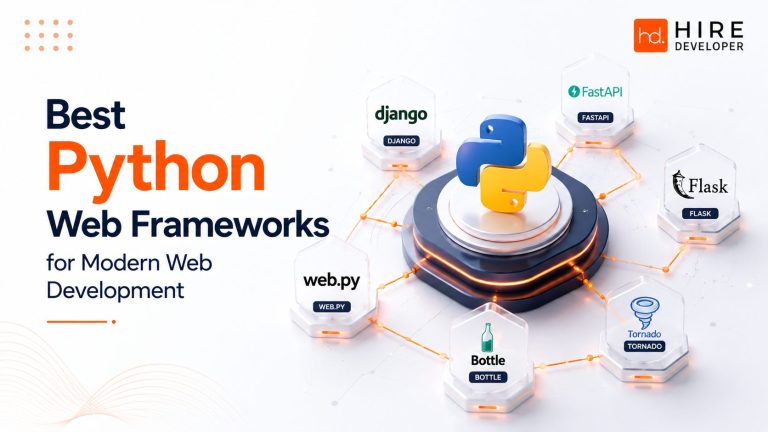
Top Python Web Frameworks in 2026
There is no single best python web framework for every situation. The right choice depends on project type, team size, and performance requirements. Here is how the major Python web development frameworks compare.
Django
Django is the most complete Python web application framework available, often described as batteries included because it ships with an ORM, an admin panel, authentication, and form handling out of the box.
- Key features: built in admin dashboard, ORM, authentication, security defaults
- Advantages: fast to build full featured applications, mature ecosystem, strong documentation
- Limitations: heavier than needed for small APIs, opinionated project structure
- Best use cases: SaaS platforms, content heavy sites, marketplaces, admin heavy internal tools
- Performance: good for typical web traffic, not the fastest for high concurrency workloads
- Scalability: scales well horizontally with standard WSGI deployment patterns
- Learning curve: moderate, straightforward for teams that want structure
- Ideal business size: startups to large enterprises building full products
FastAPI
FastAPI is the fastest growing Python api framework in the past few years, purpose built for asynchronous APIs, automatic validation, and auto generated OpenAPI documentation.
- Key features: native async support, automatic Swagger and OpenAPI docs, type hint based validation
- Advantages: excellent performance, great developer experience, strong fit for microservices
- Limitations: smaller ecosystem than Django for full stack features like admin panels
- Best use cases: REST APIs, machine learning model serving, microservices, real time data APIs
- Performance: among the fastest python web frameworks available, built on Starlette and ASGI
- Scalability: strong, designed for async and high concurrency workloads
- Learning curve: low to moderate, especially for teams already using type hints
- Ideal business size: startups building AI products through to enterprise microservice teams
Flask
Flask is a minimalist python web app framework that gives developers just the essentials and lets them add exactly the libraries a project needs.
- Key features: lightweight core, flexible routing, large extension ecosystem
- Advantages: simple to learn, highly flexible, ideal for small to mid size services
- Limitations: requires manually assembling tools that other frameworks include by default
- Best use cases: small APIs, internal tools, prototypes, lightweight microservices
- Performance: solid for moderate traffic, depends heavily on chosen extensions
- Scalability: scales well when paired with proper deployment and caching practices
- Learning curve: low, one of the easiest frameworks for new teams
- Ideal business size: startups and small to mid size engineering teams
Pyramid
Pyramid is a flexible framework designed to scale from simple applications to complex enterprise systems without forcing a rewrite.
- Key features: flexible configuration, strong URL routing, works for both small and large apps
- Advantages: scales gracefully as complexity grows, does not lock teams into one pattern
- Limitations: smaller community, fewer ready made extensions
- Best use cases: applications expected to grow significantly in complexity over time
- Performance: good, comparable to Flask depending on configuration
- Scalability: strong, built with growth in mind
- Learning curve: moderate
- Ideal business size: mid size teams anticipating long term platform growth
Tornado
Tornado is an async capable framework and networking library built for handling large numbers of simultaneous long lived connections.
- Key features: native async support, built in websocket handling, non blocking networking
- Advantages: excellent for real time features like chat and live notifications
- Limitations: smaller ecosystem, steeper learning curve for teams new to async patterns
- Best use cases: real time applications, chat systems, live dashboards, polling services
- Performance: strong under high concurrency with long lived connections
- Scalability: good, especially for websocket heavy workloads
- Learning curve: moderate to high
- Ideal business size: teams building real time or streaming features
Bottle
Bottle is a single file micro framework with no dependencies beyond the Python standard library, built for very small applications.
- Key features: single file distribution, simple routing, minimal footprint
- Advantages: extremely lightweight, fast to prototype with
- Limitations: not intended for large or complex applications
- Best use cases: small internal tools, quick prototypes, teaching projects
- Performance: good for small workloads
- Scalability: limited, not designed for enterprise scale
- Learning curve: very low
- Ideal business size: small teams or single developer projects
CherryPy
CherryPy is an object oriented framework that lets developers build web applications much like they would build any other Python application.
- Key features: minimal configuration, built in tools for caching, sessions, and static content
- Advantages: simple mental model, good for teams that prefer plain object oriented code
- Limitations: smaller community and fewer modern integrations
- Best use cases: internal business tools, small to mid size web applications
- Performance: adequate for moderate traffic
- Scalability: moderate
- Learning curve: low
- Ideal business size: small to mid size internal engineering teams
Falcon
Falcon is a minimalist framework built specifically for high performance REST APIs and microservices.
- Key features: extremely lean core, low overhead request handling
- Advantages: very fast, minimal resource usage, good fit for microservices
- Limitations: fewer built in conveniences than Django or FastAPI
- Best use cases: high throughput APIs, backend services behind an existing frontend
- Performance: excellent, one of the leaner python web frameworks available
- Scalability: strong for microservice architectures
- Learning curve: moderate
- Ideal business size: engineering teams optimizing for API performance
Quart
Quart is an async framework built to feel familiar to Flask developers while adding full asynchronous support.
- Key features: Flask like syntax, native async and await support
- Advantages: easy migration path for existing Flask teams moving to async
- Limitations: smaller community than Flask or FastAPI
- Best use cases: teams upgrading Flask applications to handle async workloads
- Performance: strong, comparable to other ASGI based frameworks
- Scalability: good for async heavy services
- Learning curve: low for existing Flask teams
- Ideal business size: startups and mid size teams modernizing existing Flask apps
Sanic
Sanic was built from the ground up for speed, using async request handling to serve high volumes of concurrent requests.
- Key features: async first design, built in web server, fast request routing
- Advantages: high throughput, good for latency sensitive services
- Limitations: smaller ecosystem, less enterprise tooling than Django
- Best use cases: high concurrency APIs, real time data services
- Performance: very strong, built specifically for speed
- Scalability: strong for async workloads
- Learning curve: moderate
- Ideal business size: startups and scale ups with performance sensitive APIs
Python Framework Comparison Table
| Framework | Performance | Scalability | Learning Curve | API Support | Async Support | Security | Community | Enterprise Ready |
| Django | Good | Strong | Moderate | Strong | Partial | Strong | Very large | Yes |
| FastAPI | Excellent | Strong | Low to moderate | Excellent | Native | Strong | Large, growing fast | Yes |
| Flask | Good | Good | Low | Good | Via extensions | Good | Very large | Yes, with setup |
| Pyramid | Good | Strong | Moderate | Good | Partial | Good | Small to mid | Yes |
| Tornado | Strong | Good | Moderate to high | Moderate | Native | Good | Mid size | Partial |
| Bottle | Fair | Limited | Very low | Basic | No | Basic | Small | No |
| CherryPy | Fair | Moderate | Low | Moderate | No | Good | Small | Partial |
| Falcon | Excellent | Strong | Moderate | Strong | Partial | Good | Small to mid | Yes, for APIs |
| Quart | Strong | Good | Low | Good | Native | Good | Small, growing | Partial |
| Sanic | Excellent | Strong | Moderate | Good | Native | Good | Mid size | Partial |
Which Python Framework Is Best for Your Project?
The right python web development framework depends on what you are actually building. Here is a practical breakdown by project type.
- Startup MVP: Flask or FastAPI, for speed and low overhead
- Enterprise software: Django, for structure, security, and long term maintainability
- AI applications: FastAPI, for native async support and seamless integration with ML libraries
- Machine learning APIs: FastAPI, for automatic validation and fast model serving
- Microservices: FastAPI, Falcon, or Sanic, for lightweight and high performance services
- REST APIs: FastAPI or Falcon, for API first design and OpenAPI support
- High traffic applications: Sanic or FastAPI, for async concurrency at scale
- Real time applications: Tornado, for websocket and long lived connection handling
- Ecommerce: Django, for its mature ecosystem of commerce ready packages
- FinTech: Django or FastAPI, for strong security defaults and structured architecture
- Healthcare: Django, for compliance friendly structure and mature security tooling
- SaaS platforms: Django for the core product, paired with FastAPI for internal or public APIs
How to Choose the Right Python Web Framework
Use this simple decision framework before committing to a python web framework for your next project.
- Define the primary workload: full web application, API only, or real time service
- Estimate expected concurrency and traffic patterns over the next 12 to 24 months
- Check how easily you can hire developers with experience in the framework
- Evaluate how much built in tooling you need versus how much flexibility you want
- Confirm the framework’s compatibility with your cloud, container, and CI/CD setup
- Weigh long term maintenance costs, not just initial build speed
Python Framework Performance and Scalability
Performance conversations around python web frameworks usually come down to one architectural choice: WSGI versus ASGI. WSGI, used by Django and Flask by default, handles one request at a time per worker, which is well suited to typical web traffic. ASGI, used by FastAPI, Starlette, Quart, and Sanic, supports asynchronous request handling, which allows a single process to manage many concurrent connections efficiently.
In production, scalability rarely comes from the framework alone. It comes from how the framework is deployed. Common patterns include Redis for caching and session storage, Gunicorn or Uvicorn as the application server, Nginx as a reverse proxy and load balancer, and Docker with Kubernetes for container orchestration across AWS, Azure, or Google Cloud. Teams building for scale from day one should treat framework choice and infrastructure choice as a single decision, not two separate ones.
Python Framework Security Best Practices
Regardless of which python backend framework you choose, a few security practices are non negotiable for production systems.
- Authentication: use proven libraries rather than building your own token or session logic
- Authorization: enforce role based access control at the API layer, not just the UI
- SQL injection: rely on the framework’s ORM or parameterized queries, never raw string concatenation
- XSS: use the framework’s built in template escaping rather than disabling it for convenience
- CSRF: keep CSRF protection enabled for any form based or session based application
- Rate limiting: apply it at the API gateway or middleware layer to prevent abuse
- Secrets management: store credentials in a secrets manager, never in source code or environment files committed to version control
When Should Businesses Hire Python Developers?
Most companies reach a decision point where framework choice matters less than execution speed. That is usually when it makes sense to bring in dedicated python development services rather than stretching an existing team thin.
- In-house hiring: best when Python is a long term, core part of your product roadmap
- Dedicated developers: useful for scaling a specific project without a lengthy hiring cycle
- Remote developers: helpful for accessing experienced talent outside a limited local market
- Development partners: valuable when you need architecture guidance alongside hands on building
- Team scaling: relevant when an existing team needs to move faster without losing code quality
For companies planning a new build or scaling an existing Python platform, HireDeveloper.dev connects businesses with experienced Python developers who already work with Django, FastAPI, and Flask in production environments, which shortens the ramp up time compared to hiring cold.
Future of Python Web Development
Looking ahead, a few trends will shape how businesses use python for web development over the next few years. AI assisted development is changing how quickly teams can scaffold and test new services, while early agentic AI patterns are starting to influence how backend APIs are designed for autonomous workflows rather than only human triggered requests.
Cloud native architecture continues to push python web frameworks toward smaller, faster, more composable services, with edge computing and serverless deployment reducing the operational overhead of running Python at scale. Newer Python releases keep improving async performance and typing support, which benefits ASGI based frameworks the most. FastAPI’s growth reflects a broader shift toward API first development, where the backend is designed primarily to serve other systems and AI agents, not just a single web frontend.
Conclusion
There is no universal best python web framework, only the right framework for a specific business goal, team, and timeline. Django remains the strongest choice for full featured platforms that need structure and security out of the box. FastAPI has earned its place as the leading choice for APIs, microservices, and AI powered products that need speed and native async support. Flask still holds up well for smaller services and teams that want flexibility over convention, while specialized frameworks like Tornado, Sanic, and Falcon solve narrower, high performance problems very well.
The companies that get the most value from python web frameworks are the ones that match the framework to the workload, plan for scalability from the start, and bring in experienced Python talent when the project outgrows the current team’s bandwidth.