






Quick Answer: What Is Platform Engineering?
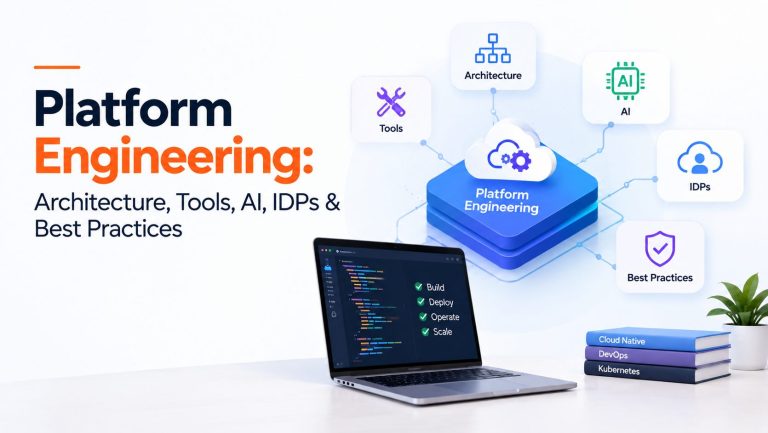
Platform engineering is the discipline of building and operating internal developer platforms (IDPs) that turn recurring infrastructure, delivery, security and observability work into reusable, self-service capabilities. It reduces developer cognitive load while preserving governance, and in 2026-27 it increasingly extends to serve AI agents alongside human developers.
Modern development teams are expected to ship faster while dealing with Kubernetes, multi-cloud infrastructure, CI/CD pipelines, security policies, secrets, networking, compliance and, increasingly, AI-generated code and autonomous agents. Asking every application team to independently master all of this creates duplicated effort, inconsistent security postures and slower delivery.
Platform engineering addresses this by turning recurring infrastructure and operational tasks into reusable, self-service capabilities delivered through an internal developer platform. Rather than each team reinventing provisioning, pipelines and observability, a dedicated platform team builds paved roads that other teams consume. In 2026-27, that scope is expanding again: platforms are being redesigned to serve AI coding assistants and autonomous agents as platform consumers, not just human engineers.
What Is Platform Engineering?
Platform engineering is the practice of designing, building and operating internal developer platforms that give development teams self-service access to infrastructure, delivery pipelines, security controls and observability, without requiring every team to become infrastructure specialists.
The discipline grew out of the DevOps movement. DevOps established the cultural principle that teams building software should also be responsible for running it. In practice, that responsibility often became a heavy burden: every product team had to learn Kubernetes, cloud networking, secrets management and pipeline configuration on top of their actual product work. Platform engineering responds to that burden by centralizing the repeated, non-differentiating parts of infrastructure and operations into a platform, built and operated with product discipline.
Microsoft’s platform engineering guidance frames this around developer experience, self-service, security and compliance, and time-to-business-value, treating the platform as a product built for internal customers rather than a set of scripts maintained by an operations team. CNCF describes platform engineering similarly, as the discipline of building developer self-service capabilities around infrastructure and software delivery workflows on top of cloud native technologies.
Platform engineering is not simply DevOps renamed. DevOps is a set of practices and cultural principles for collaboration between development and operations. Platform engineering is a concrete engineering discipline and product that implements many DevOps principles through a purpose-built internal platform, golden paths and a dedicated platform team.
Why Platform Engineering Matters in 2026-27
Several forces are pushing organizations toward platform engineering at the same time. Cloud environments have grown more complex, with multi-cloud and hybrid deployments becoming common. Microservices and distributed systems multiply the number of services each team must deploy, secure and observe. Security and compliance requirements have become non-negotiable, not optional add-ons. And AI-generated code, along with AI coding agents, is increasing the volume of changes flowing toward production, without a corresponding increase in the number of humans available to review infrastructure and security implications.
The underlying problem platform engineering solves is cognitive load. A developer should not need to become a Kubernetes networking expert, a Terraform module author and a compliance officer just to deploy a production service safely. Platform engineering absorbs that complexity into reusable capabilities so developers can focus on application logic while the platform enforces secure, observable, compliant defaults.
Platform Engineering vs DevOps
Quick Answer: Platform Engineering vs DevOps
DevOps is a set of cultural practices for shared responsibility between development and operations. Platform engineering is a concrete discipline that implements many of those practices through a purpose-built internal developer platform, golden paths, self-service tooling and a dedicated platform team that treats developers as customers.
DevOps and platform engineering are complementary, not competing, models. Platform engineering is often described as a way to operationalize DevOps principles at scale, especially once an organization has too many teams for informal collaboration alone to keep infrastructure consistent and secure.
| Area | DevOps | Platform Engineering |
| Primary focus | Collaboration and delivery culture | Internal developer platform (IDP) |
| Main users | Dev and Ops teams | Developers and engineering teams |
| Approach | Practices and culture | Product plus engineering discipline |
| Self-service | Often implemented through ad hoc tooling | Core design principle |
| Golden paths | Optional | Core platform capability |
| Developer portal | Not required | Common |
| Platform product ownership | Not central | Central |
| Governance | Shared responsibility | Embedded into the platform |
| Developer experience | Important | Explicit product goal |
| Automation | Core | Core |
| Infrastructure abstraction | Varies by team | Major objective |
What Is an Internal Developer Platform (IDP)?
Quick Answer: What Is an IDP?
An internal developer platform (IDP) is the collection of internal services, workflows, interfaces and automation that lets developers build, deploy and operate software through standardized self-service experiences, covering provisioning, CI/CD, secrets, environments, observability, security controls and documentation.
An IDP typically includes a service catalog, application and infrastructure templates, automated provisioning, CI/CD integration, secrets management, environment management, observability hooks, security and policy controls, and documentation, all exposed through consistent interfaces such as a portal, a CLI or platform APIs.
IDP vs developer portal: a developer portal, such as Backstage or Port, is typically the interface layer, the place where developers discover services, launch templates and view documentation. The IDP is the broader underlying platform: the provisioning logic, policy engines, pipelines and infrastructure the portal exposes. A portal without real self-service automation behind it is a directory, not a platform.
Platform as a Product
Treating the platform as a product means the platform team treats developers as internal customers, not ticket submitters. Microsoft’s guidance explicitly recommends this product mindset: understanding developer needs, prioritizing a roadmap, measuring adoption and iterating based on feedback, rather than building infrastructure in isolation and hoping teams adopt it.
Platform-as-a-Product Loop (editorial framework)
This is an editorial framework created for this article, not an industry standard.
- Discover: interview developers, review support tickets and identify recurring infrastructure pain points.
- Design: define the golden path, the interface and the guardrails before building anything.
- Build: implement the smallest capability that solves the real problem, not the most complete one.
- Launch: release to a pilot team with documentation and a feedback channel.
- Measure: track adoption, time saved and failure rate, not just usage counts.
- Improve: fold feedback into the next iteration and retire capabilities nobody uses.
Golden Paths and Self-Service
Quick Answer: What Is a Golden Path?
A golden path, sometimes called a paved road, is an opinionated, supported and automated way to accomplish a common engineering task, such as standing up a new service. It gives developers a fast, secure default path while still allowing documented exceptions for legitimate edge cases.
A practical example: a developer selects ‘Create production-ready Node.js service’ in the developer portal. The platform automatically provisions the repository from a template, wires up a CI/CD pipeline, creates the cloud environment, integrates secrets, configures monitoring and applies the organization’s deployment and security defaults. What would otherwise take days of manual configuration across several teams becomes a self-service action measured in minutes.
Good golden paths are discoverable through the portal or catalog, genuinely automated rather than documentation with manual steps, secure by default, and flexible enough to allow legitimate exceptions without forcing every team through an identical workflow.
Platform Engineering Architecture
The following layered model is an editorial framework created for this article to describe how platform capabilities typically stack, from the developer-facing interface down to infrastructure, governance and, increasingly, AI and agentic capabilities.
| Layer | Capabilities |
| 1. Developer Experience | Developer portal, CLI, templates, documentation, service catalog |
| 2. Platform APIs and Orchestration | Platform APIs, workflow orchestration, provisioning, policy engines |
| 3. Delivery | CI/CD, GitOps, deployment automation, release management |
| 4. Infrastructure | Kubernetes, containers, cloud, networking, storage, compute |
| 5. Security and Governance | Identity, secrets, policy as code, compliance, vulnerability management |
| 6. Observability | Logs, metrics, traces, alerts, SLOs |
| 7. AI and Agentic Capabilities | AI assistants, coding agents, agent runtimes, model access, agent identity and permissions |
Each layer depends on the ones beneath it. A golden path in the developer experience layer is only as good as the provisioning logic in the orchestration layer, which in turn depends on secure, well-modeled infrastructure and governance beneath it. The AI and agentic layer sits alongside the others rather than replacing them: it consumes the same orchestration, security and observability layers that human developers use, through interfaces appropriate to software agents.
Platform Engineering Tools
Platform engineering tools are best understood by the function they serve rather than as an undifferentiated list. The table below maps common platform functions to representative tool categories.
| Platform Function | Common Tools | Purpose |
| Developer Portal | Backstage, Port | Discoverability and self-service |
| Containers | Docker | Application packaging |
| Orchestration | Kubernetes | Workload management |
| Infrastructure as Code | Terraform, Pulumi, Crossplane | Infrastructure provisioning |
| CI/CD | GitHub Actions, GitLab CI/CD | Build and release automation |
| GitOps | Argo CD | Declarative, Git-driven deployment |
| Secrets | HashiCorp Vault, cloud secret managers | Secrets management |
| Observability | Prometheus, Grafana, OpenTelemetry | Logs, metrics and traces |
| Policy | Open Policy Agent, Kyverno | Policy as code and governance |
| Cloud | AWS, Azure, Google Cloud | Underlying infrastructure |
No single tool is ‘platform engineering’ on its own. The discipline is in how these categories are integrated behind a self-service interface, with sensible defaults and governance built in, rather than left as separate tools each team must wire together manually.
Kubernetes and Platform Engineering
Quick Answer: Does Platform Engineering Require Kubernetes?
No. Kubernetes is a common foundation for many platform engineering initiatives because it standardizes container orchestration, scaling and operator-based automation, but platform engineering as a discipline is broader than any single infrastructure technology and can be built on other compute models.
Where Kubernetes is used, platform teams typically abstract namespaces, deployments, services, ingress, autoscaling and operators behind templates, so application developers interact with a simplified interface rather than raw Kubernetes manifests. Helm charts and operators are commonly used to package and standardize these patterns.
Infrastructure as Code in Platform Engineering
Infrastructure as Code tools such as Terraform, Pulumi and Crossplane let platform teams define infrastructure as reusable, version-controlled modules rather than manual console changes. In a mature platform, IaC becomes the engine behind self-service provisioning: a developer’s golden-path request triggers a module that creates a database, a namespace or an environment with policy checks already applied, instead of every developer authoring and running Terraform themselves.
CI/CD, GitOps and Platform Engineering
Platform teams standardize CI/CD and GitOps workflows so pipelines, environment promotion, automated testing and rollback behavior are consistent across teams, without forcing every application into an identical pipeline. GitOps tools like Argo CD keep the desired state of infrastructure and applications in Git, so deployments are declarative, auditable and reversible. Progressive delivery patterns and policy checks are typically embedded into these pipelines rather than bolted on afterward.
Security and Governance in Platform Engineering
Security in platform engineering goes beyond generic DevSecOps checklists. It covers identity and RBAC, secrets management, policy as code, software supply-chain security, vulnerability scanning, compliance evidence, audit trails, network policies and least-privilege defaults, all embedded into the platform rather than left to each team to implement independently.
The guiding principle is that the platform should make the secure path the easiest path. If following security policy requires more effort than bypassing it, teams under delivery pressure will bypass it. A well-designed golden path applies secure defaults automatically, so compliance is a side effect of using the platform rather than a separate task.
Observability and Platform Operations
Observability in platform engineering spans logs, metrics and traces, commonly implemented with Prometheus, Grafana and OpenTelemetry, along with alerting and SLO tracking. Platform engineering does not end once infrastructure is provisioned. The platform itself is a production system and must be operated: platform availability, provisioning failure rates, incident response and developer-facing visibility into platform health are all part of platform operations, distinct from the applications running on top of the platform.
AI in Platform Engineering
AI is increasingly used inside the platform itself, not only as an external coding assistant. Common applications include AI-assisted troubleshooting and incident response, AI-generated documentation, AI-assisted configuration and policy analysis, and AI-powered recommendations inside developer portals. PlatformEngineering.org describes AI platform engineering as a sub-discipline focused on using AI within internal developer platforms to improve developer productivity, automation and standardization.
Agentic Platform Engineering in 2026-27
Traditional platforms follow a simple model: a human developer uses the platform to provision and operate infrastructure. The emerging model adds a second kind of consumer: human developer plus AI agent, both using the platform to provision infrastructure and AI workloads.
Traditional model: Human developer -> Platform -> Infrastructure.
Emerging model: Human developer + AI agent -> Platform -> Infrastructure + AI workloads.
CNCF’s 2026 research on platform engineering for the agentic enterprise describes this directly. AI agents are increasingly becoming consumers of the platform alongside human engineers, provisioning infrastructure, deploying applications, investigating incidents, analyzing telemetry and invoking operational workflows. Rather than serving only developers, the platform must serve both humans and intelligent software through interfaces appropriate to each, operating under the same governance model. Applications, infrastructure resources and AI agents themselves become the three categories of object a platform manages.
For agents to operate safely as platform consumers, they generally need their own identity, scoped authentication and authorization, resource limits, auditability, environment isolation, controlled tool access, managed secrets, automated validation, policy enforcement and cost controls, the same categories of control applied to human users, but designed for machine-speed, high-volume interaction.
The distinction worth holding onto: AI-assisted platform engineering uses AI to help humans operate the platform faster. Agentic platform engineering treats AI agents as platform consumers in their own right, with their own identity and governance, not merely as a tool a human happens to be using.
How AI Changes the Internal Developer Platform
| Traditional IDP | AI-Enabled IDP |
| Human developers only | Humans plus AI agents |
| Manual discovery | AI-assisted discovery |
| Static templates | Context-aware recommendations |
| Human troubleshooting | AI-assisted troubleshooting |
| Manual documentation | AI-generated documentation |
| Human workflow execution | Agent-assisted workflows |
| Fixed policies | Policy-aware agent execution |
AI does not eliminate governance in this model. It makes governance more important, because agents can take action at a speed and volume no human review process was designed for.
Platform Engineering Architecture for AI-Native Applications
Supporting AI-native workloads typically extends the platform to cover model access and AI gateways, GPU-backed inference, vector databases and data pipelines, agent runtimes and sandboxing, evaluation and guardrails, and cost controls specific to inference spend. CNCF’s 2026 material on evolving platform engineering for AI-native workloads discusses these as new platform requirements, distinct from the traditional application-focused IDP, and highlights that resources such as databases, messaging, AI models and identity providers increasingly need to be managed as first-class objects with their own lifecycle and ownership, alongside applications and agents.
Platform Engineering Maturity Model
The following is an editorial framework created for this article. It is not an official industry standard.
| Level | Description | Typical Bottleneck |
| 1. Tooling | Teams use disconnected scripts and tools with no shared platform. | Duplicated effort across teams |
| 2. Standardization | Common templates and workflows begin to emerge. | Inconsistent adoption |
| 3. Self-Service | Developers provision infrastructure through reusable workflows. | Platform team becomes a bottleneck without automation |
| 4. Platform as a Product | Platform has product ownership, a roadmap, feedback loops and adoption metrics. | Proving ROI to leadership |
| 5. Intelligent / Agentic Platform | AI and agents participate in provisioning, operations and optimization under governed controls. | Agent identity, permissions and audit at scale |
How to Build an Internal Developer Platform
Microsoft’s platform engineering guidance recommends an incremental approach rather than a big-bang rollout, starting with a thinnest viable platform that grows based on real user needs. A practical roadmap:
- Identify developer pain points through interviews and support ticket analysis.
- Define who the platform’s customers actually are.
- Establish the minimum viable platform, not the complete vision.
- Select the technology foundation, matched to existing team skills.
- Build the first golden path around the highest-friction workflow.
- Add self-service provisioning behind that golden path.
- Integrate security and policy as code from the start, not as an afterthought.
- Add observability so both the platform team and developers can see platform health.
- Measure adoption, not just capability count.
- Expand based on feedback from real usage.
- Introduce AI capabilities once the platform foundation is stable.
- Prepare identity, permissions and audit controls for agentic workflows.
Platform Engineering Metrics and KPIs
Developer Experience
- Developer satisfaction
- Time to first deployment
- Time to environment creation
Delivery
- Deployment frequency
- Lead time for changes
- Change failure rate
- Deployment recovery time
Platform
- Golden path adoption
- Self-service completion rate
- Platform availability
- Failed provisioning rate
Business
- Engineering time saved
- Cost per deployment
- Reduced operational toil
AI
- Agent task completion rate
- Validation success rate
- Human intervention rate
- AI infrastructure cost
These categories are an editorial framework for what to track. Organizations should set their own baselines rather than adopt external benchmark figures as targets, since methodology and team size vary widely between reports.
Platform Engineering Benefits
Well-executed platform engineering can reduce developer cognitive load, speed up onboarding, improve consistency of security and compliance, and reduce repetitive operational toil. These outcomes depend heavily on platform adoption, design quality and ongoing product management. A platform that is built but not adopted delivers none of these benefits, which is why adoption metrics matter as much as capability count.
Challenges and Risks of Platform Engineering
- Building a platform nobody actually uses
- Over-engineering before validating a real need
- Tool sprawl without an integrated self-service layer
- The platform team turning into a ticket desk
- Excessive standardization that blocks legitimate exceptions
- Ambiguous ownership between platform and application teams
- High upfront investment before value is visible
- Kubernetes and infrastructure complexity leaking through the abstraction
- New AI governance and agent-permission challenges
Common Platform Engineering Mistakes
- Treating platform engineering as a rebrand of DevOps.
- Starting with tool selection instead of the underlying problem.
- Building every capability internally instead of reusing proven tools.
- Creating a portal without real self-service automation behind it.
- Ignoring developer experience in favor of infrastructure completeness.
- Skipping product ownership and a feedback loop.
- Never defining adoption metrics.
- Over-standardizing and removing legitimate flexibility.
- Deprioritizing security until after launch.
- Deprioritizing observability of the platform itself.
- Building broad platform coverage before testing adoption on one golden path.
- Adding AI capabilities before the platform foundation is stable.
- Granting AI agents excessive, unscoped permissions.
- Ignoring platform operations once the initial build is done.
Build vs Buy vs Adopt Open Source
| Approach | Advantages | Risks | Best Fit |
| Build | Maximum customization | High engineering effort | Unique requirements |
| Buy | Faster implementation | Vendor dependency | Organizations prioritizing speed |
| Open Source | Flexibility | Integration and maintenance effort | Teams with strong platform expertise |
| Hybrid | Balance of speed and control | Architecture complexity | Most enterprise environments |
Most organizations end up combining these approaches: buying or adopting open source for commodity capabilities like observability and secrets management, while building custom golden paths and integrations specific to their own stack.
Platform Engineering Services
Organizations that do not want to build every capability internally typically look for services covering platform strategy, IDP architecture, cloud and Kubernetes platform development, developer portal implementation, Infrastructure as Code automation, CI/CD and GitOps setup, DevSecOps integration, observability, platform migration and modernization, AI platform engineering, and ongoing platform operations and support.
HireDeveloper.dev works with businesses that need platform engineers, cloud and DevOps engineers, or dedicated engineering teams to build and operate these capabilities, sourcing pre-vetted talent across stacks including Golang, Node.js, Laravel and ASP.NET for teams in the US, UK and Europe.
What Does a Platform Engineer Do?
Quick Answer: What Does a Platform Engineer Do?
A platform engineer builds and operates the internal developer platform: automating infrastructure provisioning, creating golden paths, maintaining Kubernetes and cloud environments, implementing CI/CD, integrating security and observability, and improving platform adoption based on developer feedback.
Day to day, a platform engineer builds internal platforms and tooling, automates infrastructure through IaC, creates and maintains golden paths, develops and supports developer-facing tooling, maintains Kubernetes or cloud environments, implements and evolves CI/CD pipelines, integrates security and compliance controls, implements observability, manages platform reliability, gathers developer feedback and increasingly implements AI platform capabilities.
Platform Engineer Skills
Infrastructure
- Linux, networking, cloud platforms, containers, Kubernetes
Automation
- Terraform, Pulumi, scripting, APIs, CI/CD tooling
Platform
- Backstage, Port, service catalogs, internal APIs
Security
- IAM, secrets management, RBAC, policy as code
Observability
- Prometheus, Grafana, OpenTelemetry
Modern Skills
- AI infrastructure, AI agent security, AI observability, platform product thinking
Platform Engineer Salary in 2026
Platform engineer compensation varies significantly by geography, seniority and whether the role is a direct hire or a contractor, because the role blends cloud, infrastructure, software engineering, automation and operational skills. Reliable, current salary benchmarks should be checked against live sources such as Levels.fyi, Glassdoor or a regional salary survey at the time of hiring, since figures shift throughout the year and vary widely by market. This article does not publish specific figures to avoid presenting stale or unverified numbers as current fact.
How to Choose a Platform Engineering Partner
For organizations evaluating an external partner, a practical checklist covers demonstrated cloud and Kubernetes expertise, IaC and CI/CD experience, GitOps familiarity, a track record on security and observability, experience with developer portals and IDP architecture, evidence of product thinking rather than pure ticket-based delivery, AI platform experience, documentation quality, support model and the ability to scale the engagement as needs grow.
Why Platform Engineering Is Becoming More Important for AI
AI increases software development throughput: more code shipped, more deployments, more environments, more security events to review, more testing surface, more observability data and more AI workloads to operate. platformengineering.org’s State of Platform Engineering Volume 4 report, based on a January 2026 survey of 518 engineers, found that 94 percent of respondents see AI as critical to the future of platform engineering, while nearly 30 percent of platform teams still do not measure their own success, a gap the report treats as the discipline’s biggest weakness. Treat these as that survey’s findings, not universal facts.
Because AI-driven development increases throughput without automatically increasing governance capacity, platform engineering becomes the control and enablement layer that keeps that throughput safe, observable and compliant.
Platform Engineering Trends for 2027
- Agentic platform engineering is likely to expand beyond pilots into production governance.
- AI-native IDPs are increasingly being designed to manage AI resources, not only applications.
- AI agents as platform users are expected to require standardized identity and permission models.
- Developer experience engineering is emerging as its own discipline inside platform teams.
- Platform product management roles are increasingly being formalized.
- Security platform engineering is expected to converge more tightly with platform teams.
- Data platform engineering is likely to be treated as a peer discipline to application platforms.
- Observability platforms are being explored as shared infrastructure across apps and agents.
- Multi-cloud platform abstraction remains an active area of tooling investment.
- Policy-as-code adoption is expected to keep growing alongside agent governance needs.
- Platform FinOps is increasingly being applied to AI inference and agent spend.
- Internal AI gateways are emerging as a standard platform component.
- Self-service AI infrastructure is being explored as the next golden path category.
- Platform engineering is increasingly converging with SRE and DevSecOps functions.
Key Takeaways
- Platform engineering is broader than DevOps tooling: it is a product discipline built around an internal developer platform.
- The IDP is the core delivery mechanism for developer self-service, and a developer portal is only its interface layer.
- Platform-as-a-product thinking is critical for adoption; an unused platform delivers no benefit regardless of its technical quality.
- Golden paths reduce repetitive engineering work by making the secure, standard path the easiest path.
- Kubernetes, IaC, CI/CD, GitOps, security and observability remain the common building blocks, though Kubernetes itself is not mandatory.
- AI is changing platform requirements, both as an assistive capability inside the platform and as a new category of platform consumer.
- AI agents introduce new identity, permission and audit requirements that platform teams need to design for deliberately.
- The next generation of platforms will increasingly serve both human developers and software agents under a unified governance model.
Need Platform Engineers or a DevOps Team?
HireDeveloper.dev connects businesses in the US, UK and Europe with pre-vetted platform, cloud and DevOps engineers across Golang, Node.js, Laravel and ASP.NET, for dedicated teams or staff augmentation. Get in touch to discuss your platform engineering needs.
Sources and References
Microsoft Learn: What Is Platform Engineering?
Microsoft Learn: Platform Engineering Documentation
CNCF: What Is Platform Engineering?
CNCF: Platform Engineering for the Agentic Enterprise
CNCF: Evolving Platform Engineering for AI-Native Workloads
PlatformEngineering.org: AI Platform Engineering
PlatformEngineering.org: State of AI in Platform Engineering 2026