






Introduction
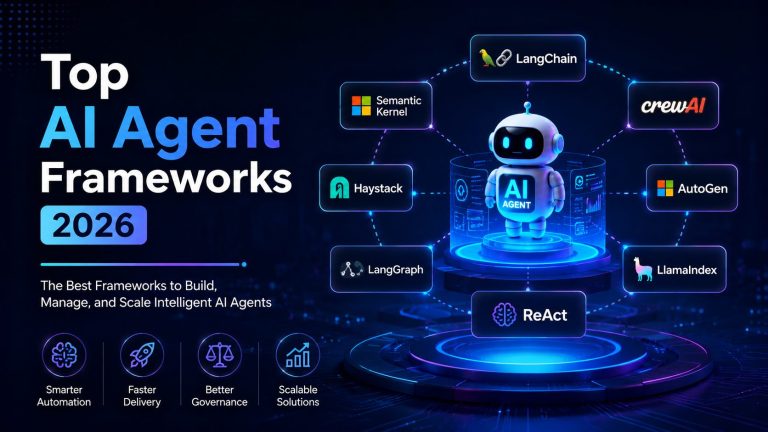
AI agent frameworks have become the missing layer between “an LLM that can call a function” and “an application that can reliably finish multi-step work without a human watching every turn.” Through 2025 and into 2026, most engineering teams stopped asking whether to build agents and started asking which framework to build them on: LangGraph, CrewAI, the OpenAI Agents SDK, Google’s Agent Development Kit, the Claude Agent SDK, Microsoft Agent Framework, LlamaIndex Workflows, or Pydantic AI. Each solves a similar problem, letting a model reason, call tools, keep state, and hand off work, but they differ in control, model portability, and how much effort it takes to move from a demo to a system you can operate. This guide compares the leading AI agent frameworks in 2026 by architecture, features, and production trade-offs, and offers a repeatable way to evaluate any framework rather than a popularity ranking.
What Is an AI Agent Framework?
An AI agent framework is a software layer that gives developers reusable building blocks for applications in which a language model can reason about a task, call external tools, retain state across steps, and carry out multi-step workflows toward a goal, rather than returning a single one-shot response.
A few terms are worth defining precisely:
- Agent: a system built around an LLM that decides, on its own, which tool to call and when to stop.
- Agent framework: the SDK providing the loop, tool interfaces, memory, and orchestration so teams do not build them from scratch.
- LLM: the underlying model doing the reasoning, on top of which the framework sits.
- Tools: functions, APIs, or systems the agent can call to act or retrieve information.
- Memory: short-term context plus longer-term storage the agent reads and writes across sessions.
- Planning: how an agent breaks a goal into steps, explicitly or through iterative reasoning.
- Orchestration: the logic deciding what runs next and how control passes between agents.
- Environment: everything external to the model that the agent can observe or affect.
The Core Agent Loop
User Goal → Agent → Reasoning/Planning → Tools → Observation → Next Action → Result
How Do AI Agent Frameworks Work?
Most agent frameworks implement a variation of the same cycle: input, model reasoning, tool selection, tool execution, state and memory updates, observation, iteration, and a final response or action. The model interprets a goal, chooses a tool, the framework executes it, and the result flows back into context so the model can decide whether the goal is met or another step is needed.
Four related terms are often used loosely:
- An LLM application sends a prompt and returns a response, with no autonomous tool use.
- An AI workflow chains predetermined steps in a fixed order set in advance.
- An AI agent decides its own path through that sequence, choosing tools through reasoning.
- A multi-agent system coordinates several agents, each with its own role, that hand off tasks.
A support bot that always follows “look up order, check policy, draft reply” is a workflow. The same bot deciding, case by case, whether to check inventory or escalate is an agent. Splitting that into a triage agent, a policy agent, and a drafting agent is a multi-agent system.
What Are the Key Components of an AI Agent Framework?
A mature agent framework typically provides:
- Model integration: a consistent interface for calling LLM providers without rewriting logic when swapping models.
- Prompt management: structured ways to version, template, and test system prompts.
- Tool calling: a defined schema for describing functions and executing them safely on request.
- Agent memory: short-term context plus optional long-term memory backed by a database or vector store.
- State management: tracking where an agent is in a task across long-running workflows.
- Workflow orchestration: control flow for sequencing, branching, looping, and retrying steps.
- Planning: breaking a goal into sub-tasks, explicitly or through iterative reasoning.
- Multi-agent coordination: patterns for how agents communicate, hand off, or supervise one another.
- Retrieval and RAG: connectors for pulling relevant context from documents or vector databases.
- Human approval: checkpoints where a person authorizes an action before execution.
- Observability: tracing and logging of every reasoning step and tool call.
- Evaluation: tooling to test agent behavior against expected outcomes.
- Security: authentication, authorization, and boundaries on what tools an agent can invoke.
AI Agent Frameworks vs Traditional AI Frameworks
| Dimension | Traditional AI/ML Framework | AI Agent Framework |
| Primary purpose | Train, fine-tune, and serve models | Orchestrate reasoning and actions of an existing model |
| Model interaction | Tensor operations and training loops | API calls to a hosted or local LLM |
| Tool use | Not applicable | Native tool and function calling |
| Memory | Model weights and training data | Runtime conversational and persisted memory |
| Workflow control | Data pipelines and training schedules | Agent loops, graphs, or conversational turns |
| Autonomy | None; output is deterministic given weights | Model decides next action within guardrails |
| Multi-agent support | Not applicable | Native or supported coordination patterns |
| Evaluation | Accuracy, loss, and benchmark metrics | Task completion and behavioral evaluation |
| Deployment | Model servers and inference endpoints | Agent runtimes that call inference endpoints |
Frameworks like PyTorch or TensorFlow answer how to train and run a model. AI agent frameworks answer how to get an already-trained model to reliably plan, act, and complete tasks.
Top AI Agent Frameworks in 2026
Ranking frameworks by GitHub stars or search volume is a poor proxy for production fit. The comparison below weighs flexibility, developer experience, orchestration model, tool integration, memory and state handling, multi-agent capability, observability, evaluation, production readiness, security, ecosystem maturity, and maintenance complexity. The frameworks below have active maintenance and documented production use.
LangGraph
LangGraph, built by the LangChain team, models agent logic as a directed graph rather than a linear chain, making branching and long-running workflows inspectable.
Key Features: conditional-edge graph orchestration; built-in checkpointing with resume and replay; human-in-the-loop interrupts; broad LangChain integrations.
Best For: complex, stateful workflows needing explicit control over branching processes.
Pros: fine-grained execution control; strong state persistence; a large integration ecosystem.
Cons: steeper learning curve; graphs can grow complex; more upfront design work.
Production Considerations
the explicit node structure makes token usage and execution paths easier to audit, helping with cost control and compliance review.
CrewAI
CrewAI organizes agents into role-based “crews” with defined tasks, and offers a managed platform, AMP, for teams that want observability without running their own stack.
Key Features: role, goal, and task abstractions; sequential and hierarchical process types; pluggable memory backends; a managed platform with tracing.
Best For: teams that want to prototype and ship role-based multi-agent workflows quickly.
Pros: fast to learn; readable agent definitions; growing enterprise adoption.
Cons: less granular control than graph frameworks; hierarchical crews are harder to predict at scale; AMP pricing sits on top of LLM costs.
Production Considerations
sequential crews are predictable; hierarchical mode adds autonomy and needs closer monitoring of tool calls and cost.
OpenAI Agents SDK
The OpenAI Agents SDK replaced Swarm with a small set of primitives, agents, tools, guardrails, and handoffs, leaning on standard code over new abstractions.
Key Features: explicit handoffs with carried context; input and output guardrails; built-in session management and tracing; sandboxed execution and filesystem tools.
Best For: teams on OpenAI models wanting a lightweight SDK with strong voice and realtime support.
Pros: minimal abstraction overhead; strong tracing tooling; solid realtime and voice support.
Cons: tightly coupled to OpenAI models for full functionality; fewer built-in multi-agent patterns; state is ephemeral by default.
Production Considerations
explicit, code-level handoffs keep cost and behavior predictable, but teams should plan their own persistence layer for longer-lived state.
Google Agent Development Kit (ADK)
ADK is an open-source, code-first framework from Google, available in Python, TypeScript, Java, and Go, treating agents like conventional software.
Key Features: sequential, parallel, loop, and hierarchical multi-agent composition; a built-in evaluation framework with evalsets; a local dev UI; one-command deployment to Vertex AI, Cloud Run, or GKE.
Best For: teams on Google Cloud, or organizations needing consistent multi-language support.
Pros: genuine feature parity across four languages; strong native evaluation tooling; a clear managed deployment path.
Cons: deepest benefits realized on Google Cloud specifically; optimized for Gemini; a newer tutorial ecosystem than LangChain.
Production Considerations
the built-in evaluation framework and dev UI shrink the gap between prototype and production for teams needing auditable evalsets before going live.
Claude Agent SDK
The Claude Agent SDK, renamed from the Claude Code SDK in 2026, extends the “give the agent a computer” pattern into a framework with deep tool and file system access.
Key Features: hierarchical sub-agent spawning; deep file system and code execution access; fallback model chains; tool integration through the Model Context Protocol.
Best For: developer-facing agents, coding assistants, and workflows operating on a file system or codebase.
Pros: strong fit for coding and developer-tooling agents; MCP simplifies external connections; sub-agent hierarchy suits decomposable tasks.
Cons: tied to Claude models for full functionality; deep system access needs careful sandboxing; a younger production track record.
Production Considerations
because this pattern grants broad file and execution access, sandboxing, permission scoping, and audit logging are prerequisites, not optional extras.
Microsoft Agent Framework
Microsoft folded AutoGen’s orchestration and Semantic Kernel’s enterprise integration into a single successor. AutoGen is now in maintenance mode, fixes only, no new features.
Key Features: CodeAct-style execution where agents write and run code; native .NET, Java, and Python SDK consistency; conversational multi-agent orchestration; Azure identity and monitoring integration.
Best For: enterprises standardized on Microsoft or Azure infrastructure, particularly .NET-heavy teams.
Pros: strong enterprise identity and governance integration; consolidates two frameworks into one path; a good fit for regulated Azure environments.
Cons: migration overhead for legacy AutoGen or Semantic Kernel code; most mature within Microsoft’s ecosystem; some patterns still stabilizing.
Production Considerations
teams running AutoGen in production should treat it as a maintenance-mode dependency and plan a migration path rather than new investment.
LlamaIndex Workflows
LlamaIndex, originally built for data indexing and retrieval, added Workflows, an event-driven orchestration layer for agents grounded in retrieval over private data.
Key Features: event-driven steps that compose with retrieval pipelines; deep vector database and document indexing integration; native RAG tooling; pairing support with other frameworks, including CrewAI.
Best For: retrieval-augmented generation products where the agent’s core job is reasoning over private data.
Pros: best-in-class indexing and retrieval tooling; pairs naturally with RAG pipelines; combinable with other frameworks for hybrid builds.
Cons: orchestration features are less mature than agent-first frameworks; best suited to retrieval-centric use cases; a smaller multi-agent surface than LangGraph.
Production Considerations
for RAG-heavy products the integration reduces glue code, but broader multi-agent systems may still need a dedicated orchestration layer.
Pydantic AI
Pydantic AI, from the team behind Pydantic, takes a type-safe, harness-first approach to agent development in Python.
Key Features: strongly typed agent outputs validated through Pydantic models; model-agnostic provider support; dependency injection for tools and context; a harness-first design for testable behavior.
Best For: Python teams that prioritize type safety, structured outputs, and testability.
Pros: strong type safety reduces runtime errors in output parsing; familiar to teams already using Pydantic; encourages testable, deterministic design.
Cons: a smaller multi-agent ecosystem than LangGraph, CrewAI, or ADK; a younger production track record; fewer managed deployment options.
Production Considerations
typed, validated outputs suit teams burned by unpredictable agent output formats, though richer multi-agent orchestration may need additional tooling.
AI Agent Framework Comparison Table
| Framework | Open Source | Best For | Multi-Agent | Tool Calling | Memory/State | Learning Curve |
| LangGraph | Yes | Complex stateful workflows | Yes | Yes | Built-in checkpointing | Moderate to high |
| CrewAI | Yes | Fast role-based prototyping | Yes | Yes | Pluggable backends | Low |
| OpenAI Agents SDK | Yes | Lightweight OpenAI-native agents | Yes (handoffs) | Yes | Session-based | Low |
| Google ADK | Yes | Multi-language, Google Cloud teams | Yes | Yes | Session state, pluggable | Moderate |
| Claude Agent SDK | Yes | Coding and file-system agents | Yes (sub-agents) | Yes (MCP) | Via MCP servers | Moderate |
| Microsoft Agent Framework | Yes | Enterprise Microsoft/.NET stacks | Yes | Yes | Azure-integrated | Moderate |
| LlamaIndex Workflows | Yes | RAG-grounded agents | Limited | Yes | Vector store-backed | Low to moderate |
| Pydantic AI | Yes | Type-safe Python agents | Limited | Yes | Developer-managed | Low to moderate |
Open-Source AI Agent Frameworks vs Managed Platforms
Open-source AI agent frameworks give teams full control over how agents run and where data goes, at the cost of operating that infrastructure themselves. Managed platforms and vendor SDKs trade some of that control for faster time to production and less operational burden.
- Control and customization matter for unusual requirements or strict data residency rules, since open source allows modifying orchestration logic and self-hosting.
- Infrastructure and maintenance shift to whoever runs and patches the runtime; managed platforms absorb that for a fee.
- Vendor lock-in is a real risk with SDKs tied to one model provider, smoother to use but costlier to leave.
- Cost shifts rather than disappears: open source avoids platform fees but adds engineering time; managed platforms add a predictable line item.
- Security and compliance often favor self-hosted deployments, giving security teams full visibility into data flow.
Small teams validating an idea often benefit from a managed layer instead of building observability and deployment tooling from scratch. Larger organizations with dedicated platform teams or strict compliance needs tend toward self-hosted stacks they can fully audit.
How to Choose the Best AI Agent Framework in 2026
There is no single best AI agent framework; the right choice depends on the shape of the problem. Work through these factors before committing:
- Project and workflow complexity: a single-tool agent needs far less than a branching, multi-step workflow, which favors graph orchestration.
- Number of tools: more tools means more need for structured schemas and guardrails.
- Model requirements: avoid frameworks tightly coupled to one provider if flexibility matters.
- Memory needs: transient agents need far less than agents recalling context across weeks.
- Multi-agent needs: add coordination only when one agent genuinely cannot handle the task.
- Existing infrastructure: current cloud commitments often make the matching vendor framework a smoother fit.
- Team expertise: match the framework’s language and abstractions to what the team knows.
- Security, observability, and budget: weigh access risk, audit needs, and both API and platform fees.
- Long-term maintenance: prefer frameworks with active development over ones already in maintenance mode.
As a starting point: simple agents suit a lightweight SDK such as the OpenAI Agents SDK or Pydantic AI. Complex, stateful workflows suit a graph-oriented framework such as LangGraph or Google ADK. Genuine multi-agent systems call for explicit coordination primitives, such as CrewAI or Microsoft Agent Framework. Enterprise deployments should weight governance and security above developer convenience alone.
What Makes an AI Agent Framework Production-Ready?
A framework that produces an impressive demo is not the same as one you can operate safely at scale. Production readiness depends on capabilities that rarely show up in a five-minute quickstart:
- Reliability and error handling: for failed tool calls and malformed output, not just the clean path.
- Retries and timeouts: so one stuck step cannot stall a workflow.
- Observability:, meaning full tracing of every reasoning step, tool call, and model response.
- Evaluation: run automatically against representative tasks to catch regressions.
- Security and authorization: that scope agents to only the systems and data they need.
- Human-in-the-loop controls: with approval gates before high-stakes actions.
- Versioning: of prompts, tools, and configurations so changes are reviewable.
- Testing: that treats agent behavior the way application code is tested.
- Cost monitoring: for token usage and tool-call volume.
- Scalability and governance:, handling concurrent sessions with clear ownership and audit trails.
The Real Test
A demo only needs to work once, with a developer watching. A production agent needs to work correctly, or fail safely, across thousands of unpredictable inputs with no one watching. That gap is where framework choices are actually tested.
Common Mistakes When Choosing an AI Agent Framework
Teams repeatedly run into a similar set of avoidable mistakes:
- Choosing a framework based on popularity or GitHub stars rather than fit for the workload and team.
- Ignoring maintenance status, such as building new systems on a framework already in maintenance mode.
- Overusing autonomous agents for tasks a deterministic workflow would handle more predictably and cheaply.
- Delaying observability until something breaks instead of instrumenting tracing from the first prototype.
- Underestimating tool failure handling and assuming external APIs will always succeed.
- Deferring security until deployment instead of designing permission boundaries alongside agent logic.
- Building multi-agent systems where a single well-scoped agent would do.
- Skipping model compatibility checks before committing to a tightly coupled framework.
- Ignoring vendor lock-in with SDKs that are convenient early but costly to migrate away from.
- Failing to evaluate total cost, counting only API pricing while missing platform fees and engineering time.
What Is the Future of AI Agent Frameworks?
pilots toward the agentic enterprise, coordinated fleets of agents across departments, which raises the bar for governance and identity management. Standardized tool interfaces, including the Model Context Protocol and agent-to-agent communication standards, are cutting the custom integration code between frameworks and tools. Observability and evaluation, once an afterthought, are becoming first-class features across nearly every major framework. Governance (permissioning, audit trails, and approval workflows) is increasingly built into the framework rather than bolted on separately. Model portability is improving as frameworks support multiple providers natively, reducing the cost of switching as pricing shifts. Long-running agents benefit from maturing durable state and checkpointing, and human-agent collaboration is being formalized, with clearer definitions of where humans stay in the loop.
None of this points to a single framework winning outright. It points to convergence on a common set of capabilities, orchestration, tool standards, observability, and governance, implemented differently across a still-competitive field.
Conclusion
The frameworks compared here solve the same core problem, letting a model reason, act, and complete multi-step work, but they make different trade-offs around control, model portability, and operational overhead. LangGraph and Google ADK favor explicit, auditable control over complex workflows. CrewAI favors speed of prototyping for role-based teams of agents. Provider SDKs like the OpenAI Agents SDK and Claude Agent SDK favor a tight fit within one model ecosystem. Microsoft Agent Framework and LlamaIndex Workflows serve more specific enterprise and retrieval-heavy niches. None of that adds up to a single winner; it adds up to tools built for different use cases and production requirements.
The best AI agent framework for a given project depends on workflow complexity, the team’s expertise, the model ecosystem already in use, and how much governance and production hardening the use case demands. Once that decision is clear, the harder work begins: implementing the architecture, wiring up tools and permissions, building evaluation pipelines, and hardening the system for production. Teams that need additional engineering capacity for that phase can find experienced AI developers through HireDeveloper.dev.
Sources & Further Reading
- Towards AI, “Top AI Agent Frameworks in 2026: A Production-Ready Comparison” (pub.towardsai.net)
- LangChain, “AI Agent Frameworks” resource hub (langchain.com)
- JetBrains PyCharm Blog, “Top Agentic Frameworks for Building Applications 2026” (blog.jetbrains.com)
- AgentMail, “The 9 Best AI Agent Frameworks in 2026” (agentmail.to)
- Braintrust, “Best AI Agent Frameworks (2026): How to Choose One and Add Evals” (braintrust.dev)
- Workflow Builder, “Best AI Agent Frameworks in 2026: A Comparison for Production Teams” (workflowbuilder.io)
- Our Code World, “AI Agent Frameworks Developers Should Know” (ourcodeworld.com)
- Salesforce, “AI Agent Frameworks: A Practical Guide” (salesforce.com)