






Introduction
A hospital operations team spends three extra hours a week reconciling patient records between two systems that were never designed to talk to each other. A telehealth startup loses signups because its booking flow does not match how patients actually search for care. A medical device company cannot get an investor meeting until its companion app can demonstrate a real security architecture, not a slide. These are not software problems in the abstract. They are healthcare software development problems, and they show up the moment an organization tries to scale beyond spreadsheets, generic SaaS tools, or a patchwork of vendor systems.
Healthcare software development is the process of designing, building, and maintaining applications and platforms tailored to clinical workflows, patient engagement, regulatory requirements, and healthcare data exchange. Unlike general business software, it has to account for sensitive patient data, interoperability standards, and long-term maintainability inside a highly regulated industry.
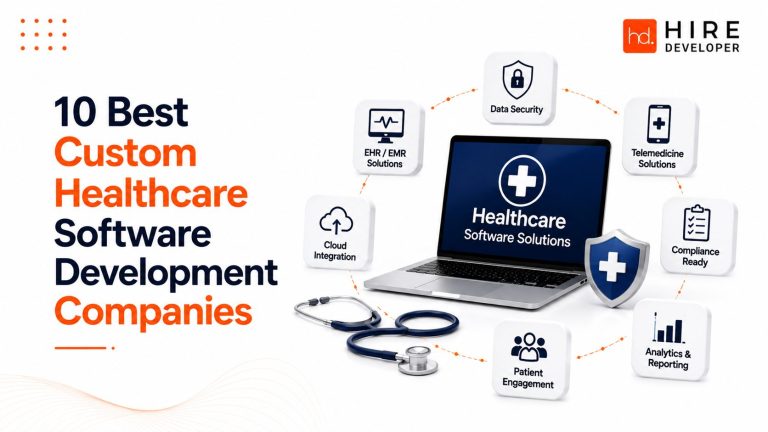
This guide walks through what healthcare software development actually involves before recommending anyone. You will find the main categories of healthcare software, the technologies and architecture patterns behind them, security and compliance considerations, realistic cost ranges, a framework for evaluating vendors, and finally ten custom healthcare software development companies worth researching in 2026. The goal is to leave you better equipped to make a build decision, not just a shortlist.
What Is Healthcare Software Development?
Healthcare software development is the design, engineering, and maintenance of digital applications used by healthcare providers, payers, patients, and medical device makers, ranging from patient portals and EHR-connected tools to telemedicine platforms and clinical analytics systems, built to handle sensitive health data securely and reliably.
In practice, this covers a wide range of work. A custom healthcare software development company might build a patient-facing mobile app, a clinician-facing dashboard, a backend system that talks to an electronic health record, or a data pipeline that feeds analytics and reporting. Some projects are patient portals or telemedicine platforms. Others are hospital systems, healthcare SaaS products, clinical applications used inside a single department, or software embedded inside a medical device.
What ties these projects together is not the interface, it is the constraints. Healthcare software has to work inside real clinical workflows, exchange data with other healthcare systems, protect patient information under regulations like HIPAA, and remain usable for people who are often working under time pressure. Medical software development that ignores any of these constraints tends to get built once and abandoned.
What Types of Healthcare Software Can You Build?
Custom healthcare software development spans several recurring categories. Each one solves a different operational or patient-facing problem, and most healthcare organizations end up needing more than one.
- Telemedicine platforms: video consultations, virtual waiting rooms, e-prescriptions, and remote intake for providers who need to see patients outside a physical office.
- Patient portals: secure logins for patients to view records, message providers, book appointments, and pay bills, usually connected to an EHR or practice management system.
- Hospital management systems: bed management, staff scheduling, department coordination, and administrative workflows across a facility.
- EHR and EMR solutions: systems for capturing, storing, and sharing clinical records, either as standalone products or custom modules built around an existing EHR.
- Medical billing software: claims processing, coding support, and revenue cycle management built around payer and regulatory rules.
- Appointment scheduling systems: booking, reminders, waitlists, and calendar sync for clinics, hospitals, and multi-provider practices.
- Healthcare CRM: tools for managing patient relationships, outreach campaigns, and referral tracking across a care organization.
- Remote patient monitoring: software that ingests data from wearables or connected medical devices and flags changes for clinical review.
- Healthcare analytics platforms: dashboards and reporting tools that turn clinical and operational data into decisions.
- Pharmacy management software: inventory, dispensing, and prescription workflow tools for pharmacies and pharmacy benefit programs.
- Medical device applications: companion software and firmware-adjacent applications that support a physical medical device.
- Healthcare mobile applications: patient-facing or clinician-facing apps for scheduling, monitoring, education, or communication.
- Healthcare SaaS platforms: multi-tenant products sold to multiple healthcare organizations, often combining several of the categories above.
Why Choose Custom Healthcare Software Development?
Off-the-shelf healthcare software is often the right starting point, and plenty of organizations should stay there. Custom healthcare software development becomes worth considering when an organization’s workflows, integrations, or growth plans outgrow what a generic platform can support.
- Workflow customization: software built around how your clinicians and staff actually work, instead of forcing them into a vendor’s generic process.
- Integration flexibility: the ability to connect cleanly with existing EHR, billing, and lab systems rather than working around a closed platform.
- Scalability: architecture that can grow with patient volume, new locations, or new service lines without a full replatform.
- Data ownership: clearer control over where patient data lives, how it is structured, and who can access it.
- User experience: interfaces designed for a specific patient population or clinical role, rather than a one-size-fits-all screen.
- Automation: workflow logic built around your specific rules for intake, triage, billing, or follow-up.
- Business differentiation: for HealthTech and MedTech companies, the software itself is often the product, so a generic platform is not an option.
- Long-term maintainability: a system your team can extend for years, instead of being locked into a vendor’s roadmap.
Custom development is not always the right call. Early-stage practices with simple, standard workflows are often better served by an established off-the-shelf tool, at least until specific limitations start to cost real time or money. The comparison later in this guide walks through that trade-off in more detail.
Key Features of Modern Healthcare Software
Most healthcare software, regardless of category, shares a common core of features. What differs is which of these are central to the product and which are supporting functions.
- Patient management and records, covering demographics, history, and care episodes.
- Appointment scheduling with calendar sync and automated reminders.
- Electronic records access, either native or integrated with an existing EHR.
- Billing and claims workflows, often tied to payer rules and coding standards.
- Prescription management, including e-prescribing where applicable.
- Notifications for patients and staff across email, SMS, or in-app channels.
- Dashboards for clinical, operational, or administrative users.
- Reporting and analytics for quality, utilization, or business metrics.
- Authentication and role-based access control for different user types.
- Audit trails that log who accessed or changed what data, and when.
- API integrations that connect the software to the rest of the healthcare ecosystem.
Technologies Used in Healthcare Software Development
Technology choice should follow project requirements, not popularity. That said, most custom healthcare software development companies work within a fairly consistent set of technology categories.
- Frontend: React, Angular, and Vue are the most common choices for web-based clinical and patient interfaces.
- Backend: Node.js, Java, Python, .NET, and PHP each show up frequently, chosen based on team expertise, performance needs, and existing systems.
- Mobile: Flutter and React Native support cross-platform patient apps, while native Android and native iOS development is common for performance-sensitive or device-integrated apps.
- Cloud: AWS, Microsoft Azure, and Google Cloud all offer healthcare-specific compliance tooling and are widely used for hosting healthcare workloads.
- Databases: PostgreSQL, MySQL, and MongoDB are common depending on whether the data is highly relational or better suited to a flexible document model.
Beyond the stack itself, interoperability is what makes healthcare software genuinely useful. HL7 and FHIR are the data exchange standards that let a custom application talk to an EHR, a lab system, or a health information exchange without a fragile, one-off integration. In plain terms, FHIR defines a common structure for healthcare data such as patients, medications, and observations, so different systems can request and share that data through a standard API rather than a custom file format. EHR and EMR integration built on these standards is usually what separates a healthcare application that fits into real clinical workflows from one that creates extra work for staff.
Security, Privacy and Compliance in Healthcare Software
Healthcare software carries protected health information, or PHI, which makes security a design requirement from day one rather than a checklist applied before launch. This is often called security-by-design: encryption, access control, and monitoring are built into the architecture from the first sprint, not bolted on before a compliance audit.
- Encryption for data at rest and in transit, so patient data is protected even if a system is compromised.
- Role-based access control, so users only see the data relevant to their job function.
- Strong authentication and authorization, including multi-factor authentication for sensitive roles.
- Audit logs that record data access and changes for accountability and investigation.
- Secure API design, since most healthcare integrations happen through APIs that can otherwise become a weak point.
- Regular vulnerability testing and code review throughout development, not only before launch.
- Reliable backup and disaster recovery strategies for clinical and patient data.
- Ongoing monitoring to detect unusual access patterns or potential breaches early.
HIPAA is the primary US regulation governing PHI, and it applies to how software handles, stores, and transmits patient data. It is important to be precise here: HIPAA compliance describes how a specific software system, its hosting environment, and an organization’s operational practices meet the law’s requirements. It is not a certification that a development company itself holds, and no development company can make its client’s software HIPAA compliant on its own, since compliance also depends on the client’s own policies, business associate agreements, and how the software is actually deployed and used. A development partner can build with HIPAA requirements in mind, follow secure development practices, and support a compliance program, but the actual regulatory obligations depend on the specific product, its users, the data involved, and where and how it operates. This guide does not offer legal advice, and any organization building healthcare software should confirm its compliance approach with qualified legal and compliance counsel.
What Does the Healthcare Software Development Process Look Like?
A healthcare software project typically moves through the following stages, though the exact sequence varies by team and methodology.
- Discovery: understanding the clinical or business problem, the users involved, and the constraints around data and compliance.
- Requirements analysis: turning that discovery into concrete functional and technical requirements.
- Healthcare workflow mapping: documenting how care teams or patients actually move through the process the software will support.
- Architecture planning: choosing the technology stack, data model, and integration approach.
- UI or UX design: designing interfaces for the specific users involved, whether clinicians, administrators, or patients.
- MVP development: building a first working version focused on the core workflow.
- API and integration development: connecting to EHR systems, labs, payment processors, or other healthcare software.
- Testing: functional, usability, and performance testing across the application.
- Security validation: penetration testing and vulnerability assessment before launch.
- Deployment: releasing the software into a production environment, often in phases.
- Monitoring: tracking performance, errors, and security signals after launch.
- Maintenance: ongoing updates, bug fixes, and feature development as needs evolve.
How Much Does Custom Healthcare Software Development Cost?
There is no single number that applies to every healthcare software project. Cost depends on product complexity, the number of platforms involved, integrations with EHR or billing systems, compliance and security requirements, team size and seniority, development location, UI or UX complexity, third-party APIs, and the scope of testing and ongoing maintenance.
| Project Type | Relative Complexity | Typical Cost Drivers |
| Simple healthcare app | Low | Basic UI, authentication, a small set of APIs |
| Patient portal | Medium | Records access, EHR integration, security controls |
| Telemedicine platform | High | Video infrastructure, scheduling, payments, patient data |
| Hospital management platform | Very High | Multiple departments, workflows, and system integrations |
| Healthcare SaaS product | High | Multi-tenancy, security, and scalability for many clients |
These categories are approximate market patterns rather than fixed price points, and any numerical estimate a vendor gives you should be treated as a starting range that can move based on the specifics of your project, the maturity of your requirements, and how much integration work is involved. Getting a reliable estimate usually requires a discovery phase with a specific development partner.
How to Choose a Healthcare Software Development Company
Selecting a custom healthcare software development company is as much about domain fit as technical skill. The following factors are worth evaluating for any shortlist.
- Healthcare experience: has the team actually shipped software for healthcare workflows, not just generic business apps.
- Technical expertise: depth across the frontend, backend, mobile, and cloud technologies your project needs.
- Security practices: whether security is treated as a design principle or an afterthought.
- Integration experience: prior work connecting to EHR, lab, billing, or scheduling systems.
- Compliance knowledge: familiarity with HIPAA and related requirements, without overstating what they can guarantee.
- Portfolio: evidence of relevant healthcare projects, ideally with specifics rather than vague claims.
- Development methodology: a clear, communicated process for how work gets planned, built, and reviewed.
- QA capabilities: dedicated testing practices, not just developer self-testing.
- Cloud expertise: comfort with the cloud platform your organization already uses or plans to use.
- Post-launch support: a defined plan for maintenance, monitoring, and future development.
- Communication: responsiveness and clarity, especially across time zones for offshore or nearshore teams.
- Scalability: the ability to grow the engineering team as the project grows.
Custom Healthcare Software vs Off-the-Shelf Software
Both approaches are valid. The right choice depends on how specific your workflows are and how much runway you have.
| Factor | Custom Healthcare Software | Off-the-Shelf Software |
| Customization | Built around your exact workflow | Limited to vendor’s configuration options |
| Integration | Designed to fit your existing systems | May require workarounds or middleware |
| Scalability | Can be architected for your growth path | Depends on the vendor’s own roadmap |
| Initial investment | Higher upfront cost | Lower upfront cost, often subscription based |
| Ownership | You typically own the codebase | You license access, not the software itself |
| Time to launch | Longer, depends on scope | Faster, since the product already exists |
| Long-term flexibility | High, extend as needs change | Bound by vendor’s feature set |
Off-the-shelf software tends to make sense for standard, well-understood workflows where speed and lower upfront cost matter more than a perfect fit. Custom healthcare software development tends to make sense once specific integrations, patient volume, or unique workflows start creating real friction inside a generic tool, or when the software itself is the core product.
Build vs Buy vs Outsource
There are effectively four paths to getting healthcare software built, and most organizations end up combining more than one over time.
- Build internally: full control and in-house domain knowledge, but it requires hiring, managing, and retaining a healthcare-aware engineering team, which is slow and expensive to stand up from scratch.
- Buy existing software: fastest path to a working solution, best for standard workflows, but limited customization and integration flexibility.
- Work with a development company: access to an established team and process without building one from scratch, useful for defined projects with clear scope.
- Use dedicated healthcare developers: engage individual developers or a small dedicated team that works as an extension of your own product organization, useful when you want ongoing capacity without a full outsourced project structure.
Many healthcare organizations mix these approaches: buying off-the-shelf software for standard operations, hiring a development company or dedicated developers for a differentiated product, and building specific components internally once the team and budget exist to support it.
10 Best Custom Healthcare Software Development Companies in 2026
The following companies were selected based on demonstrated healthcare domain expertise, technical breadth across custom software development, evidence of relevant healthcare integrations and projects, the range of engagement models offered, and general market visibility in the healthcare software development space. This list does not represent independent client reviews, verified certifications, or guaranteed outcomes. Always confirm current capabilities, compliance posture, and references directly with each company before making a decision.
| 1. HireDeveloper.dev | |
| Company Overview | HireDeveloper.dev is a developer placement and staffing platform connecting healthcare and HealthTech organizations in the US, UK, and Europe with pre-vetted software developers, with a strong offshore hiring angle centered on India-based talent. |
| Healthcare Software Capabilities | Custom software development support, dedicated developer placement, and staff augmentation for healthcare and HealthTech product teams across common web and mobile stacks used in patient portals, telemedicine tools, and healthcare SaaS products. |
| Services | Custom software development, dedicated developers, remote developer staffing, staff augmentation, and offshore development team building. |
| Technology Strengths | Golang, Node.js, Laravel, ASP.NET, React, and related modern web and mobile stacks, matched to project requirements rather than a single fixed technology. |
| Best For | Healthcare startups, HealthTech companies, and product teams that want to add vetted developers or a dedicated offshore team to an existing product roadmap, rather than outsourcing an entire project end to end. |
| Engagement Options | Dedicated developers, staff augmentation, and offshore team builds, structured around the client’s existing product and engineering process. |
| Key Considerations | Best suited to organizations that already have internal product direction and want to extend engineering capacity. Healthcare compliance requirements and data handling responsibilities should be discussed and defined directly with the team for each specific project. |
| Website | https://hiredeveloper.dev/ |
| 2. ScienceSoft | |
| Company Overview | ScienceSoft is a global IT consulting and software development company with a dedicated healthcare IT practice, offering end-to-end services from consulting through development and long-term support. |
| Healthcare Software Capabilities | Custom EHR development, patient portals, medical device and SaMD software, healthcare analytics, and healthcare web and mobile applications. |
| Services | Healthcare IT consulting, custom software development, modernization of legacy healthcare systems, and ongoing support. |
| Technology Strengths | Broad healthcare data standard expertise including HL7 and FHIR, alongside common cloud and enterprise development stacks. |
| Best For | Larger healthcare organizations and medical device or SaMD companies that need deep regulatory and interoperability experience across a long-term engagement. |
| Engagement Options | Project-based development, dedicated teams, and IT consulting engagements. |
| Key Considerations | As a larger consulting firm, project structures and timelines may suit mid-size to enterprise organizations more than very early-stage startups. |
| Website | https://www.scnsoft.com/healthcare |
| 3. Itransition | |
| Company Overview | Itransition is a software engineering company with over two decades of experience delivering healthcare solutions for hospitals, diagnostic centers, pharmaceutical companies, and medical device manufacturers. |
| Healthcare Software Capabilities | EHR systems, telemedicine platforms, and clinical analytics solutions, with experience supporting FDA device classification requirements. |
| Services | Custom healthcare software development, healthcare data analytics, and system modernization. |
| Technology Strengths | Large-scale healthcare data processing and analytics, alongside standard custom application development capabilities. |
| Best For | Organizations that need FDA-related medical device software experience or large-scale healthcare analytics and data platforms. |
| Engagement Options | Project-based delivery and dedicated development teams. |
| Key Considerations | Depth in analytics and medical device software makes this a strong fit for data-heavy or device-adjacent projects specifically; confirm current experience for narrower, product-specific use cases. |
| Website | https://www.itransition.com/ |
| 4. Leobit | |
| Company Overview | Leobit is a full-cycle custom software development company with a strong HealthTech focus, working with organizations that need to modernize legacy systems and add new capabilities securely. |
| Healthcare Software Capabilities | HealthTech product engineering, legacy system modernization, and secure application development for healthcare organizations. |
| Services | Custom software development, product engineering, and application modernization. |
| Technology Strengths | Modern web and cloud development stacks applied to healthcare-specific security and scaling requirements. |
| Best For | HealthTech companies looking to modernize an existing product or scale securely rather than start entirely from scratch. |
| Engagement Options | Dedicated teams and project-based engagements. |
| Key Considerations | A useful fit for modernization-focused projects; organizations should validate specific healthcare integration experience against their own requirements. |
| Website | https://leobit.com/ |
| 5. Jelvix | |
| Company Overview | Jelvix is a bespoke software development company known for complex system integrations, with healthcare as one of its core industry focus areas alongside enterprise and insurance software. |
| Healthcare Software Capabilities | Custom healthcare application development and system integration work connecting healthcare software to other business and clinical systems. |
| Services | Custom software development, system integration, and data management solutions. |
| Technology Strengths | Strong integration engineering, useful for healthcare projects that need to connect multiple systems such as EHR, billing, and scheduling platforms. |
| Best For | Healthcare organizations whose primary challenge is connecting several existing systems rather than building a single standalone application. |
| Engagement Options | Project-based development and dedicated engineering teams. |
| Key Considerations | Healthcare is one of several industry verticals served, so healthcare-specific domain depth should be confirmed for highly specialized clinical workflows. |
| Website | https://jelvix.com/ |
| 6. Arkenea | |
| Company Overview | Arkenea is a healthcare-focused software development company that has worked with organizations ranging from healthcare startups to established medical practices and larger health systems. |
| Healthcare Software Capabilities | Healthcare mobile application development, telemedicine applications, patient management systems, EHR software development, and healthcare analytics tools. |
| Services | Custom healthcare software development, mobile app development, and post-launch support. |
| Technology Strengths | Mobile-first healthcare application development alongside web-based patient and provider tools. |
| Best For | Healthcare startups and practices that need a mobile-first patient or provider application built with healthcare-specific workflows in mind. |
| Engagement Options | Project-based development with ongoing support options. |
| Key Considerations | Strong mobile focus; organizations needing complex enterprise-scale system integration should confirm experience at that scale specifically. |
| Website | https://arkenea.com/ |
| 7. Elinext | |
| Company Overview | Elinext is an international software development company with more than two decades of experience delivering solutions for global enterprises, including hospitals, medical device companies, and healthtech startups. |
| Healthcare Software Capabilities | Custom healthcare software including EHR and EMR systems, patient portals, telehealth platforms, and medical practice management software. |
| Services | Custom healthcare software development, healthcare integrations, and remote patient monitoring solutions. |
| Technology Strengths | Healthcare integration engineering across HL7, FHIR, PACS, billing systems, and other clinical tools. |
| Best For | Organizations that need broad integration coverage across multiple healthcare data standards and third-party clinical systems. |
| Engagement Options | Project-based delivery and dedicated development teams. |
| Key Considerations | Long operating history across multiple industries; confirm current healthcare team size and recent healthcare-specific project examples. |
| Website | https://www.elinext.com/ |
| 8. Belitsoft | |
| Company Overview | Belitsoft has been delivering healthcare technology solutions since 2015, focused on long-term partnerships with healthcare startups, medical ISVs, hospitals, and pharmacy organizations across the US, UK, Europe, and Israel. |
| Healthcare Software Capabilities | HIPAA-oriented cloud healthcare solutions, mHealth application development, healthcare data integration, and healthcare database architecture. |
| Services | Custom healthcare software development, cloud migration, healthcare IT consulting, and healthcare data integration services. |
| Technology Strengths | Cloud infrastructure, healthcare database design across relational and NoSQL systems, and healthcare data exchange using standards such as FHIR. |
| Best For | Healthcare organizations with data-heavy needs, such as migrating legacy systems to the cloud or integrating multiple clinical data sources. |
| Engagement Options | Long-term partnership engagements, project-based development, and healthcare IT consulting. |
| Key Considerations | Strong emphasis on data infrastructure and cloud work; confirm specific patient-facing application design experience if that is the primary need. |
| Website | https://belitsoft.com/ |
| 9. Intellectsoft | |
| Company Overview | Intellectsoft is an enterprise-oriented software development company with a healthcare vertical serving hospitals, insurance providers, and healthcare startups, combining UX design with healthcare engineering. |
| Healthcare Software Capabilities | Mobile healthcare applications, cloud-based healthcare platforms, hospital management systems, wearable health data platforms, and healthcare workflow automation. |
| Services | Custom software development, cloud modernization, and enterprise application development for healthcare organizations. |
| Technology Strengths | Secure API design, encrypted data pipelines, and enterprise-scale cloud architecture. |
| Best For | Larger healthcare organizations and enterprises that need enterprise-grade engineering combined with strong UX for patient-facing products. |
| Engagement Options | Project-based delivery and dedicated engineering teams. |
| Key Considerations | Enterprise focus may mean higher minimum engagement size; smaller organizations should confirm fit before committing to a full project. |
| Website | https://www.intellectsoft.net/ |
| 10. Andersen | |
| Company Overview | Andersen is a mid-to-large software outsourcing company with a growing healthcare vertical serving clients in the US and Europe, delivering enterprise-grade healthcare software solutions. |
| Healthcare Software Capabilities | Telehealth systems, healthcare CRM platforms, and patient management software integrated with existing healthcare technologies. |
| Services | Custom software development, staff augmentation, and dedicated development teams. |
| Technology Strengths | Broad general software engineering capability applied to healthcare workflows, with growing healthcare-specific domain experience. |
| Best For | Organizations that want the stability and scale of a larger outsourcing partner while still getting dedicated attention to healthcare workflows. |
| Engagement Options | Dedicated teams, staff augmentation, and project-based development. |
| Key Considerations | Healthcare is a growing rather than long-established vertical for the company, so healthcare-specific references are worth reviewing closely. |
| Website | https://andersenlab.com/ |
10 Healthcare Software Development Companies Compared
| Company | Best For | Healthcare Capabilities | Development Model | Geographic Focus |
| HireDeveloper.dev | Extending teams with vetted offshore developers | Custom development, dedicated developers | Staff augmentation, dedicated teams | US, UK, Europe (India-based delivery) |
| ScienceSoft | Enterprise and SaMD healthcare IT | EHR, medical device software, analytics | Consulting, project, dedicated teams | US, EU, Middle East |
| Itransition | FDA-related device software and analytics | EHR, telemedicine, clinical analytics | Project, dedicated teams | Global |
| Leobit | HealthTech modernization | Product engineering, legacy modernization | Dedicated teams, project | Europe, US |
| Jelvix | Complex system integration | Healthcare integrations, custom apps | Project, dedicated teams | US, Europe |
| Arkenea | Mobile-first healthcare apps | Mobile apps, patient portals, EHR | Project-based with support | US |
| Elinext | Multi-standard healthcare integration | EHR, EMR, telehealth, RPM | Project, dedicated teams | US, Europe |
| Belitsoft | Healthcare data and cloud migration | Cloud, data integration, mHealth | Long-term partnership, project | US, UK, Europe, Israel |
| Intellectsoft | Enterprise healthcare platforms | Mobile, cloud, hospital systems | Project, dedicated teams | US, Europe |
| Andersen | Stable outsourcing at scale | Telehealth, CRM, patient management | Dedicated teams, staff augmentation | US, Europe |
Custom Healthcare Software Development vs Healthcare SaaS
It is worth separating two things that sound similar: building custom healthcare software, and subscribing to a healthcare SaaS product built by someone else.
- Ownership: custom software is typically owned by your organization; SaaS is licensed, not owned.
- Customization: custom software fits your workflow exactly; SaaS fits within the configuration options the vendor provides.
- Deployment: custom software can be deployed on your preferred infrastructure; SaaS is deployed on the vendor’s infrastructure.
- Scalability: custom software scales according to your architecture decisions; SaaS scales according to the vendor’s plan tiers.
- Maintenance: custom software requires your own or a partner’s ongoing maintenance; SaaS maintenance is handled by the vendor.
- Integration: custom software can be built to integrate deeply with your other systems; SaaS integration depends on what APIs the vendor exposes.
- Cost structure: custom software usually means higher upfront investment and lower long-term licensing cost; SaaS usually means lower upfront cost and ongoing subscription fees.
Build an Internal Team or Hire a Healthcare Development Company?
| Factor | Internal Team | Development Company |
| Hiring speed | Slow, especially for specialized healthcare roles | Fast, existing team can start quickly |
| Talent access | Limited to your local or remote hiring pipeline | Broader access to specialized healthcare engineers |
| Initial overhead | High, recruiting, onboarding, tooling | Lower, overhead is absorbed by the partner |
| Healthcare expertise | Depends entirely on who you hire | Often already established across projects |
| Scalability | Requires ongoing hiring to grow capacity | Can typically scale the team up or down faster |
| Project management | Managed entirely in-house | Often includes established delivery processes |
| Long-term ownership | Full ownership and institutional knowledge | Ownership depends on contract terms |
An internal team tends to make sense when the software is a long-term, core part of your product and you have the budget to build and retain healthcare-aware engineering talent. A development company or dedicated developers tend to make sense when you need to move faster than an internal hiring process allows, or when the project does not yet justify a full in-house team.
Common Mistakes When Choosing a Healthcare Software Development Company
- Choosing based only on price, without weighing healthcare domain experience.
- Ignoring healthcare domain knowledge in favor of general software development skill alone.
- Failing to define data ownership and source code ownership before the contract is signed.
- Treating security as an afterthought instead of a design requirement from the start.
- Not checking a vendor’s actual integration experience with EHR, billing, or lab systems.
- Not discussing maintenance and long-term support before development even begins.
- Choosing a technology stack before requirements are clearly defined.
- Not validating whether the proposed architecture can actually scale with expected growth.
- Failing to define clear communication processes, especially across time zones.
- Selecting a vendor without any technical due diligence, such as a code review or reference check.
Conclusion
Healthcare software development is not a single decision, it is a series of decisions about workflow, data, security, and long-term ownership that compound over time. Getting the informational groundwork right, understanding what type of software you actually need, what compliance genuinely requires, and what a realistic budget looks like, matters as much as picking a name off a list.
Explore Healthcare Software Development Options
Planning a healthcare application or looking for additional software engineering capacity.
HireDeveloper.dev helps businesses explore dedicated development and remote engineering options based on their specific technical and product requirements.
Sources & References
Innowise: Healthcare Software Development
CoderRower: What Is Healthcare Software Development
Radixweb: Comprehensive Guide on Healthcare Software Development
Technobrains: Top Healthcare Software Development Companies
Cabot Solutions: Healthcare Software Development Companies
Algoscale: Top Healthcare Software Development Companies
Keragon: Healthcare Software Development Companies
First Page Sage: The Top Healthcare Software Development Companies