






Introduction
If you have ever watched a single failed deployment take down an entire product for a few painful hours, you already understand why Kubernetes orchestration exists. Running one container is easy. Running hundreds of containers across dozens of servers, while keeping everything healthy, scaled, and updated without downtime, is a different problem entirely. That problem is exactly what Kubernetes orchestration was built to solve, and in 2026 it has become the default operating model for almost every serious DevOps team building cloud native software.
This guide pulls together how Kubernetes orchestration works, why container orchestration became necessary in the first place, how Kubernetes compares to other orchestration approaches, when it is genuinely the right tool, and when it might be overkill for your team. We will also cover the architecture, the benefits enterprises care about, common tools in the ecosystem, and a practical path for teams that want to implement it correctly the first time.
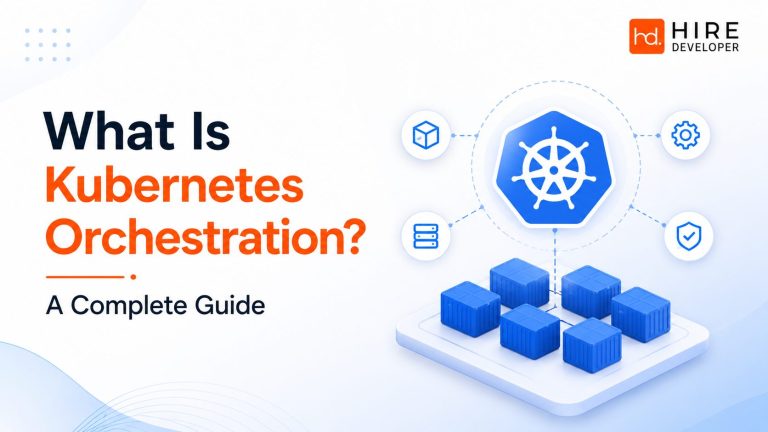
What Is Kubernetes Orchestration?
Kubernetes orchestration is the automated process of deploying, scaling, networking, and managing containerized applications across a cluster of machines, using Kubernetes as the control system. Think of it the way Mirantis frames it: like a conductor directing an orchestra, Kubernetes coordinates how every containerized service behaves, when it scales, how it talks to other services, and what happens the moment something goes wrong.
According to the official Kubernetes documentation, Kubernetes (often abbreviated K8s) is a portable, extensible, open source platform built for managing containerized workloads and services, supporting both declarative configuration and automation. It was open sourced by Google in 2014 and now sits under the Cloud Native Computing Foundation, drawing on more than 15 years of Google’s own experience running production workloads at massive scale.
In plain terms: Kubernetes orchestration is what is what is used used to make sure your containers run reliably in production without an engineer babysitting every single one of them manually.
Why Is Container Orchestration Necessary?
Modern applications are rarely a single program running on a single server anymore. They are built from many small, independently deployed microservices, each doing one job, and each depending on the others to function correctly. The moment you move past a handful of services, manual container management stops scaling.
Without orchestration, your team would have to manually handle:
- Configuring networking and service discovery between containers
- Scheduling containers onto the right available infrastructure
- Managing persistent storage for stateful workloads
- Handling failures and restarting crashed containers
- Scaling services up and down based on real demand
- Rolling out updates without taking the application offline
- Coordinating maintenance windows across underlying nodes
Now multiply that across dozens of nodes, hundreds of services, and thousands of container images. As Red Hat’s overview of container orchestration explains, this kind of management is what makes it possible to deploy software consistently across many different environments at scale, since container orchestration automates the deployment, management, scaling, and networking of containers throughout their entire lifecycle.
Trying to handle that with scripts and manual intervention is not just inefficient, it is genuinely risky. One missed health check or one forgotten scaling rule and you have an outage on your hands.
What Does Kubernetes Orchestration Actually Do?
Here is the direct answer for anyone scanning for a quick definition: Kubernetes orchestration lets you declare the desired state of your application, then continuously and automatically works to keep the real state of your infrastructure matching that desired state.
You are not telling Kubernetes how to perform each individual step. You are telling it what you want, and it figures out the rest. If a container crashes, Kubernetes restarts it. If a node fails, the workload gets rescheduled somewhere healthy. If demand spikes, replicas scale automatically.
This continuous reconciliation loop is powered by a few key mechanisms:
- Schedulers that place workloads onto the most appropriate available nodes
- Controllers that constantly reconcile your configuration with cluster reality
- Health checks and probes that detect failing containers before users notice
- Rolling update mechanisms that safely roll out new versions without downtime
This is the core difference between orchestration and basic automation. Orchestration is generalized, standardized, and configurable, meaning the same patterns apply whether you are running ten containers or ten thousand.
How Kubernetes Architecture Works Under the Hood
Understanding the architecture is genuinely useful here, not just academic. A Kubernetes cluster is made up of two main parts:
The Control Plane, which acts as the brain of the cluster. It includes the API server (the entry point for every operation), the scheduler (which decides where workloads run), the controller manager (which handles replication and self-healing), and etcd, a highly available key-value store that holds the cluster’s source of truth.
Worker Nodes, the machines, physical or virtual, that actually run your containerized applications. Each node runs a kubelet, which makes sure containers are running as defined, and kube-proxy, which manages networking and load balancing for pods.
The smallest deployable unit in Kubernetes is the Pod. A pod wraps one or more tightly coupled containers that share networking, storage, and an IP address. You do not deploy containers directly in Kubernetes, you deploy pods, and Kubernetes schedules them.
Because pods are ephemeral and their IP addresses can change at any time, Kubernetes introduces Services, which give a stable network identity and automatically load balance traffic across the pods behind them. On top of that sit Deployments for managing rolling updates, StatefulSets for applications that need stable identity and storage, and Ingress controllers for routing external traffic into the cluster.
It is a lot of moving parts, but each one solves a real production problem that teams used to handle manually with brittle scripts.
Kubernetes vs Other Container Orchestration Platforms
Kubernetes was not the first attempt at container orchestration, and it is worth understanding the landscape it grew out of.
Docker Compose works well for local development on a single host, but it was never designed for production scale orchestration across multiple machines.
Docker Swarm introduced clustering concepts and was easier to learn, but it lacked the extensibility and ecosystem maturity that large-scale production environments demanded.
Apache Mesos offered powerful resource scheduling across data centers, but its complexity and smaller ecosystem made it a harder sell compared to Kubernetes for most teams.
Kubernetes unified the best ideas from these earlier systems into a single, flexible, extensible platform, backed by what is now the largest open source ecosystem in cloud infrastructure. Today it is the default orchestration layer across data centers, public clouds, and increasingly, edge environments. That dominance is also why most container orchestration platforms on the market, including managed offerings from AWS, Google Cloud, and Azure, are built around Kubernetes rather than competing with it directly.
What Is Kubernetes Used For in Real Production Systems?
This is one of the most searched questions about the platform, so let’s answer it directly. Kubernetes is used to automate and manage:
- Provisioning and deployment of containerized applications
- Configuration and scheduling across available infrastructure
- Resource allocation between competing workloads
- Container availability and uptime
- Scaling or removing containers based on real-time load
- Load balancing and traffic routing between services
- Monitoring container health continuously
- Keeping interactions between containers secure
Beyond these core mechanics, Kubernetes is increasingly the foundation for GitOps workflows, platform engineering initiatives, and AI driven workloads, where repeatability and automation are not nice to have, they are required for the system to function at all.
Benefits and Advantages of Kubernetes Orchestration
The advantages of Kubernetes go well beyond simple container scheduling. Three benefits tend to matter most to engineering and business leaders alike.
Faster development cycles. Container orchestration enables continuous integration and continuous deployment pipelines, which speed up software delivery throughout the entire development lifecycle. This connects directly to a broader DevOps approach focused on shrinking the time between an idea and a working production feature.
Cost savings through efficient scaling. Kubernetes can automatically scale containers based on actual demand, which means you are not paying for idle infrastructure during quiet periods, and you are not scrambling for capacity during traffic spikes. This flexibility is particularly valuable for organizations running multicloud or hybrid environments.
Stronger security posture. Building software in containers helps teams catch and fix security issues at the build stage rather than patching a live, running application. Kubernetes also supports role based access control, letting organizations assign very specific permissions to users and service accounts, and apply governance policies at the pod or namespace level.
For enterprises specifically, these benefits compound. Consistent operations across environments reduce configuration drift, built-in self-healing improves uptime, and standardized deployment workflows mean new applications ship faster without reinventing the wheel each time.
Kubernetes Orchestration Tools You Should Know
The Kubernetes ecosystem in 2026 is enormous, but a handful of tool categories show up in almost every serious production setup.
kubectl remains the primary command line interface for interacting with any cluster, used to apply configuration files, inspect resources, and check logs.
Helm functions as a package manager for Kubernetes, letting teams template and version complex application deployments instead of hand writing YAML for every environment.
Operators, built on Custom Resource Definitions, extend Kubernetes to automate the management of complex, stateful applications like databases, acting almost like an automated site reliability engineer for that specific software.
Service meshes such as Istio and Linkerd add a dedicated infrastructure layer for service to service communication, handling traffic control, mutual TLS encryption, and deep observability without requiring changes to application code.
GitOps tools treat your Git repository as the single source of truth for both application and infrastructure state, automatically syncing the live cluster to match what is defined in version control. This approach has become close to standard practice for teams managing more than a handful of clusters.
Fleet and multi-cluster management platforms address a real pain point: managing dozens of clusters spread across multiple clouds and on-prem data centers individually does not scale any better than managing containers individually did in the first place. Centralized control planes let platform teams enforce consistent policy, security, and deployment standards across an entire fleet from one place.
When Kubernetes Orchestration Makes Sense (and When It Doesn't)
Here is the part most vendors will not tell you plainly: Kubernetes is not automatically the right answer for every team, and pretending otherwise sets engineering organizations up for unnecessary pain.
Kubernetes orchestration genuinely earns its complexity when:
- Your services experience high, variable load, where traffic might spike ten times during peak hours
- You are running twenty, fifty, or a hundred plus independently deployed microservices
- You need a consistent abstraction layer across multi-cloud or hybrid environments
- You operate under strict compliance or isolation requirements common in regulated industries
It is also worth being honest about the other side. The uncomfortable truth, echoed by backend platform teams who have lived through both extremes, is that a large share of teams running Kubernetes do not actually fall into any of those categories. They adopted it because it felt like the industry standard choice, not because their workload genuinely required it.
The real costs are concrete. Kubernetes requires dedicated expertise across YAML manifests, Helm charts, network policies, RBAC, and debugging across pods, services, and ingress layers. Managed offerings like EKS, GKE, and AKS reduce that burden, but they do not eliminate it. For a small team of three to fifteen engineers shipping a handful of backend services, time spent managing the orchestration layer is time not spent building the actual product.
If that sounds like your situation, it is worth weighing alternatives like managed container platforms (AWS Fargate, Google Cloud Run), Platform-as-a-Service offerings, or infrastructure-derived-from-code frameworks before committing to a full Kubernetes setup. None of this means Kubernetes is the wrong long term choice, it simply means the decision deserves an honest conversation rather than a default yes.
This is exactly the kind of decision where having experienced engineers in the room early saves months of rework later. Teams weighing whether to build on Kubernetes from day one, or to start simpler and migrate once scale actually demands it, often benefit from bringing in outside expertise rather than guessing.
HireDeveloper.dev connects companies with pre-vetted backend and DevOps engineers who have actually made this call before, in production, under real traffic.
How to Implement Kubernetes Container Orchestration the Right Way
If you have decided Kubernetes orchestration is the right move, implementation quality matters as much as the decision itself. A few practices consistently separate smooth rollouts from painful ones.
Define everything as code. Manage both applications and infrastructure with declarative configuration in YAML and tools like Terraform. This creates a version controlled, auditable system that eliminates configuration drift across environments.
Secure your clusters from day one, not as an afterthought. A default Kubernetes environment is not secure out of the box. Implement role based access control for least privilege access, network policies for workload isolation, and a real secrets management strategy, ideally with encryption at rest enabled for etcd.
Set resource requests and limits properly. One of the most common beginner mistakes is forgetting to set CPU and memory requests and limits on containers, which can lead directly to performance issues or unexpected node failures.
Choose a deployment strategy deliberately. Rolling updates work well as a default, but blue-green deployments and canary releases give you more control and lower risk for high stakes changes, depending on how much risk your team is willing to tolerate on any given release.
Build monitoring and observability in from the start. Prometheus and Grafana remain the standard tools here, but for teams running multiple clusters, a unified dashboard that links infrastructure health with application performance saves enormous troubleshooting time later.
Plan for multi-cluster management early, even if you are only running one cluster today. Treating clusters as a unified fleet from the beginning, rather than retrofitting that approach later, avoids a painful re-architecture down the line.
Getting all of this right on a first implementation is genuinely difficult without prior experience, which is why many growing companies choose not to do it entirely in-house.
If your team needs experienced Kubernetes and cloud infrastructure engineers to design, implement, or audit a container orchestration platform, HireDeveloper.dev helps you access vetted DevOps talent quickly, without the months long hiring cycle most companies budget for.
Kubernetes Orchestration for Enterprises
At enterprise scale, Kubernetes stops being a developer convenience and becomes core operational infrastructure. Large organizations typically run applications across multiple teams and environments simultaneously, spanning on-premises data centers, public cloud, and edge locations. Without a consistent orchestration layer, this naturally leads to operational fragmentation, inconsistent configurations, and elevated risk.
Enterprise-grade Kubernetes orchestration addresses this by enabling:
- Consistent operations across environments, reducing manual intervention and configuration drift
- Improved resilience and uptime through built-in self-healing
- Faster application delivery through standardized deployment workflows
- Elastic scaling that keeps infrastructure spend proportional to actual usage
- A solid foundation for GitOps, platform engineering, and AI-driven workloads, where repeatability is essential
This is also where governance and centralized identity management become non-negotiable. Enterprises typically integrate Kubernetes with an OpenID Connect provider for single sign-on, define RBAC policies once, and sync them across every cluster in the fleet to guarantee uniform access control. The goal is the same one that drives orchestration at any scale: turning what would otherwise be hundreds of manual, error-prone decisions into a consistent, automated, and auditable system.
Whether you are a startup standing up your first production cluster or an enterprise managing hundreds of them, the principle holds. Kubernetes orchestration is what turns containers into a real, dependable platform rather than a pile of individually managed processes that someone has to babysit by hand.
If your organization is scaling its container infrastructure and needs the right engineering talent to architect, secure, and operate it correctly, HireDeveloper.dev gives you direct access to experienced developers who have built and run Kubernetes orchestration platforms in production, helping you scale your DevOps capability without slowing down your roadmap.
Related Sources and Further Reading
- Mirantis — What Is Kubernetes Orchestration?
- Kubernetes Documentation — Concepts Overview
- Kubernetes — Official Project Site
- Red Hat — What Is Container Orchestration?