







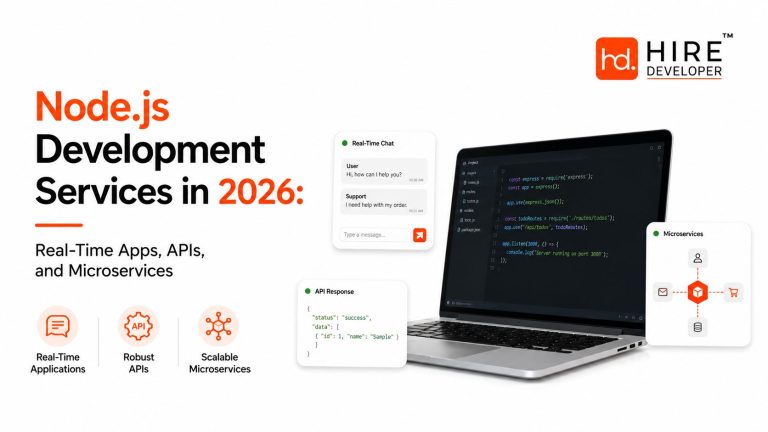
Use Cases That Are Actually Worth Hiring For
Node.js runs Netflix. It powers LinkedIn, PayPal, Uber, and Walmart. It processes over 1 billion npm package downloads every single week. And according to the 2024 Stack Overflow Developer Survey, it is the most used web framework among professional developers globally, at 40.8% adoption. It beat React. It beat every other framework on that list.
That is not a trend. That is infrastructure.
Yet the conversation around Node.js development services in 2026 is still foggy for a lot of engineering leaders and CTOs. Everyone claims to offer it. Few clearly explain what high-quality Node.js delivery actually looks like, which use cases genuinely need it, and how to separate experienced Node.js engineers from developers who passed a JavaScript tutorial six months ago.
This guide cuts through that noise. It covers the full spectrum of Node.js development services, the use cases worth investing in, real rate benchmarks, and what a professional Node.js development company or Node.js development agency actually delivers in a production-grade engagement.
If you are planning to hire Node.js developers in 2026, this is the decision framework you need before signing anything.
Why Node.js Is Still the Smartest Backend Choice in 2026
The engineering case for Node.js is well-documented. Non-blocking I/O handles high-concurrency workloads efficiently without the memory overhead of multi-threaded server models. JavaScript across both front end and back end reduces cognitive context-switching for developers and enables shared libraries and types through TypeScript.
But the real-world proof is more compelling than any benchmark:
70% reduction in startup time reported by Netflix after migrating to Node.js
20x performance improvement LinkedIn recorded moving from Ruby on Rails to Node.js
35% faster response times PayPal observed after rebuilding its account overview in Node.js
40.8% global developer adoption, making Node.js the most used web framework in production
These companies had the budget and engineering talent to choose anything. They chose Node.js for real-time workloads, high-concurrency APIs, and event-driven microservices architectures where the runtime characteristics genuinely matter.
In 2026, TypeScript has become the default for serious Node.js development. NestJS has replaced Express as the preferred enterprise framework. And cloud-native deployment via Docker and Kubernetes is table stakes for any production-grade Node.js project. The bar has moved. The teams delivering quality Node.js web development services in this environment look different from what was passing as Node.js delivery three years ago.
The Full Spectrum of Node.js Development Services
Node.js development services is not a single category. Before you engage a node js web development company or hire dedicated Node.js developers, it is worth mapping exactly what you need built against what service types actually exist.
|
Service Type |
Core Capability |
Ideal For |
Stack Depth Required |
| Real-Time App Development | WebSocket servers, live dashboards, event streaming | SaaS, fintech, collaboration tools | Senior |
| REST API Development | Endpoint design, auth layers, versioning, documentation | Mobile backends, platforms, marketplaces | Mid to Senior |
| GraphQL API Development | Schema design, resolvers, federation, subscriptions | Complex SaaS, data-heavy products | Senior |
| Microservices Architecture | Service decomposition, Docker, Kubernetes, message queues | Enterprise, high-scale SaaS | Senior to Architect |
| Full-Stack MERN Development | MongoDB, Express, React, Node.js end-to-end | Startups, MVPs, product teams | Mid to Senior |
| SaaS Backend Engineering | Auth, billing logic, multi-tenancy, cloud deployment | B2B SaaS, subscriptions, platforms | Senior |
| API Integration Services | Third-party connectors, payment gateways, webhooks | All product types | Mid-level |
Each service type demands a different seniority level and different technical depth. A node js developer for hire who excels at REST API design may not have the distributed systems background to architect a production microservices deployment. Understanding the distinction before you hire protects your budget and your timeline.
Need help identifying which Node.js service type fits your project?
HireDeveloper.dev matches startups and scaling companies with pre-vetted Node.js engineers matched to your specific use case. No sourcing overhead, no guesswork.
Visit: Hire Node.js Developer
Real-Time Application Development: Where Node.js Has No Equal
This is the use case Node.js was architecturally built for. Traditional multi-threaded servers create a new thread for each incoming request. At scale, that model exhausts memory quickly. Node.js runs a single-threaded event loop, pushing I/O operations to non-blocking callbacks and processing thousands of concurrent connections without proportional memory growth.
For any product where the user experience depends on data arriving the instant it changes, that architectural advantage is not theoretical. It is the difference between a product that feels alive and one that feels like it is refreshing on a timer.
Real-Time Use Cases Worth Investing In
- Live chat and customer messaging infrastructure
- Collaborative editing tools with multi-user synchronization
- Real-time financial dashboards and trading interfaces
- Sports score feeds and live betting platforms
- IoT data ingestion pipelines from sensor networks
- Multiplayer gaming backend systems
- Live notification and activity feed systems
When evaluating a node js app development company for real-time work, look specifically for production WebSocket experience using Socket.io or native WebSocket API, event loop profiling skills for identifying concurrency bottlenecks, and Redis or in-memory pub/sub architecture for horizontal scaling of real-time connections.
A developer who can build a REST API is not automatically qualified to build a real-time system. The architecture conversations matter as much as the code itself.
REST API and GraphQL Development Done Right
The vast majority of commercial Node.js web development services in production today involve API development. Node.js handles REST and GraphQL APIs efficiently because its lightweight runtime adds minimal per-request overhead and its ecosystem of Express.js, Fastify, and NestJS provides battle-tested patterns for rapid API delivery at scale.
According to Postman’s State of the API Report, REST APIs remain dominant at 89% usage across development teams, while GraphQL has grown to 28% adoption, particularly in mobile-first and SaaS products where flexible querying reduces over-fetching and under-fetching problems.
What Quality API Development Looks Like in 2026
- Clean versioning strategy with backward-compatible deprecation paths
- JWT or OAuth2 authentication with proper token refresh handling
- Rate limiting and throttling middleware baked into the architecture
- Input validation using libraries like Zod or Joi, not ad hoc checks
- OpenAPI or Swagger documentation generated from code, not maintained separately
- Error handling with consistent response structures across all endpoints
If you are evaluating a node.js web development services provider for API work, request a sample of their existing API documentation from previous projects. A well-documented API is a direct signal of how the team thinks about developer experience, maintainability, and the engineers who will consume their work two years from now.
Microservices Architecture with Node.js
Microservices is the area of Node.js development services where the experience gap matters most. Building a monolith is forgiving. Breaking a system into distributed services that communicate reliably, fail gracefully, and scale independently demands a different class of engineer entirely.
Node.js is well suited for microservices because individual services can run as lightweight processes with minimal memory footprint. Combined with Docker containers and Kubernetes orchestration, Node.js microservices deployments allow engineering teams to scale specific services based on demand rather than scaling the entire application.
A Production Microservices Stack Built on Node.js Typically Includes
- API gateway layer handling routing, rate limiting, and auth
- Individual Node.js services managing isolated business domains
- RabbitMQ or Kafka for asynchronous inter-service communication
- Distributed tracing with tools like Jaeger or Datadog APM
- Centralized logging aggregation via ELK stack or similar
- Kubernetes for container orchestration and auto-scaling
Companies engaging a node js development agency for microservices work should validate production experience before any contract is signed. Ask for architecture diagrams from past distributed systems projects, reference conversations with previous clients, and a specific proposal showing how the team would handle service discovery, circuit breaking, and failure isolation for your system.
The cheapest microservices engagement is rarely the cheapest long-term decision. A team charging $30/hr that delivers unstable inter-service communication typically costs more over 18 months than a $65/hr team that builds maintainable distributed systems from the start.
Full-Stack MERN Development: One Team, Faster Delivery
The MERN stack (MongoDB, Express.js, React, Node.js) remains one of the most deployed technology combinations in startup and SaaS product engineering in 2026. The primary advantage is a unified JavaScript runtime across the entire application: one language, shared types through TypeScript, shared utility libraries, and significantly reduced onboarding overhead for new engineers.
A full-stack Node.js and React team that owns both the front end and the back end makes better architectural decisions throughout the product. When the developer building the API is the same developer consuming it in the UI layer, the design choices reflect real usage patterns rather than abstract specifications.
Research by Revelry found that full-stack JavaScript teams ship features approximately 30% faster than teams splitting front end and back end across different language stacks. For early-stage SaaS companies where shipping speed compounds directly into competitive advantage, that delta is significant.
When hiring a node.js app development company for full-stack MERN work, confirm that their front-end and back-end capability sits within the same team rather than being split across separate sub-contractors. The communication overhead of cross-team coordination routinely adds two to three sprint cycles per quarter on complex product builds.
Enterprise SaaS Backend Engineering
Node.js has moved decisively into enterprise backend engineering over the last three years. Large-scale SaaS platforms use Node.js for API layers, integration middleware, and event-driven processing pipelines because it integrates cleanly with cloud infrastructure on AWS, GCP, and Azure and handles concurrency predictably under load.
NestJS is now the framework of choice for enterprise Node.js backend work. It introduces dependency injection, a modular architecture, decorators, and a structured approach to organizing code that scales well across large engineering teams. For any node js application development company working on enterprise projects, NestJS fluency should be a non-negotiable requirement in 2026.
The enterprise Node.js stack in production typically includes TypeScript for type safety, NestJS for application architecture, Prisma or TypeORM for database abstraction, Jest for testing infrastructure targeting 70% or higher coverage, Docker for containerization, and CI/CD pipelines via GitHub Actions or GitLab CI.
A node js web development company that cannot demonstrate competence across this full stack is not enterprise-grade, regardless of what their sales materials suggest.
Node.js Developer Rates by Region and Engagement Model in 2026
Rate data for Node.js developers varies significantly by geography, seniority, and engagement model. The following benchmarks are based on market data from Arc.dev, Glassdoor, and Index.dev for 2026 engagements:
|
Region |
Junior ($/hr) |
Mid-Level ($/hr) |
Senior ($/hr) |
Dedicated Monthly |
| United States / Canada | $60 – $80 | $90 – $130 | $130 – $175 | $12,000 – $18,000 |
| Western Europe | $45 – $65 | $70 – $100 | $100 – $140 | $9,000 – $14,000 |
| Eastern Europe | $20 – $35 | $35 – $55 | $55 – $85 | $4,500 – $8,000 |
| India (Offshore) | $12 – $22 | $22 – $40 | $35 – $55 | $2,800 – $5,500 |
| Latin America | $18 – $30 | $30 – $50 | $50 – $75 | $4,000 – $7,500 |
A NestJS or microservices premium of 20 to 30% above standard Node.js rates applies for engineers with proven distributed systems or enterprise framework experience. Budget accordingly if your project falls into those categories.
The offshore Node.js development services market in India offers the most competitive rates for dedicated engagements. Companies hiring a hire dedicated node js developer from India through a structured platform with vetting processes consistently report better delivery outcomes than unstructured Upwork-style engagements at similar price points.
Want transparent rate benchmarks for your specific project?
HireDeveloper.dev provides pre-vetted Node.js engineers from India at offshore rates with senior-level capability. Dedicated teams or individual developers ready in 48 to 72 hours.
Visit: Hire Node.js Developer
How to Evaluate a Node.js Development Company or Agency
The node js development services market is large and uneven in quality. Premium agencies charge $80 to $150 per hour. Offshore development centers in India run $20 to $55 per hour. The price range tells you almost nothing about delivery quality on its own.
These are the evaluation signals that actually matter:
Technical Depth
Ask for case studies specific to your use case, not generic portfolio pages. A node js development agency that has built real-time systems before will describe their WebSocket architecture choices, their scaling decisions, and their production incident history. Teams without real production experience give vague answers.
TypeScript as a Baseline
Any node.js development company still defaulting to plain JavaScript for new projects in 2026 is delivering below current industry standards. TypeScript adoption is a proxy for code quality culture. If the team does not use it, ask why. The answer is usually revealing.
The Handoff Deliverable
Professional node js web development services include architecture documentation, API documentation, test coverage reporting, CI/CD pipeline configuration, and a deployment runbook. Code without documentation is a liability that your internal team will spend quarters cleaning up. Ask what the handoff package includes before any statement of work is signed.
Communication Quality as a Signal
The quality of communication during the sales and scoping process is the best proxy available for how the team will communicate once the project starts. Vague answers to architecture questions, slow response times during evaluation, and inability to explain past technical decisions clearly are all disqualifying signals.
Dedicated vs Pooled Teams
Companies offering dedicated node js developers who are assigned exclusively to your project consistently outperform agencies using pooled talent models where developers split attention across three or four clients simultaneously. Ask directly whether your engineers will work exclusively on your project or whether they carry concurrent client commitments.
Stop Searching and Start Shipping with HireDeveloper.dev
You have seen the data. Node.js powers the backends of the most successful digital products on the planet. The use cases are proven: real-time systems, API infrastructure, microservices architectures, and full-stack SaaS platforms. The technology is not the constraint. The team is.
Finding Node.js developers who can actually ship production-grade backend systems, not just developers who list Node.js on a resume, is where most engineering hiring cycles break down. The sourcing takes weeks. The vetting takes more weeks. Trial engagements with the wrong vendor cost months. And a bad architectural decision made in month one compounds into a costly rebuild six months later.
That is exactly the problem HireDeveloper.dev was built to solve.
Why Engineering Teams Choose HireDeveloper.dev
Pre-Vetted, Production-Ready Talent
Every Node.js developer on the HireDeveloper.dev platform goes through a structured technical assessment before being listed. That means no guesswork on syntax familiarity, no surprises on production experience gaps, and no onboarding months wasted discovering the engineer cannot handle what your project actually requires. You review a detailed technical profile, have a scoped introductory call, and make a confident decision backed by real vetting data, not a sales pitch.
Dedicated Teams Ready in 48 to 72 Hours
Traditional hiring for a senior Node.js developer takes 6 to 10 weeks on average when you factor in sourcing, screening, technical interviews, and offer negotiation. HireDeveloper.dev compresses that to 48 to 72 hours. Whether you need a single hire dedicated Node.js developer to extend an existing team or a full dedicated squad to own a new product backend end to end, the matching and onboarding process is built for speed without sacrificing the quality bar.
Senior-Level Offshore Engineers at a Fraction of US Rates
The HireDeveloper.dev talent pool is built around offshore Node.js development services from India, delivering senior-level engineering capability at 60 to 70% below equivalent US or Western European rates. That is not a compromise on quality. It is a structural cost advantage that scaling startups and engineering-forward companies use to extend their runway, move faster, and build better products than competitors paying three times more for the same output.
Every Engagement Model You Need in One Place
HireDeveloper.dev supports dedicated developer models, IT staff augmentation for teams that need to extend existing engineering capacity, and offshore development center setups for companies building long-term distributed engineering operations. Whatever your current stage, the platform is built to match the right engagement model to your actual needs rather than upselling you into a structure that does not fit.
The companies that consistently ship great Node.js products in 2026 are not the ones who spent the most on engineering. They are the ones who hired the right engineers fast, gave them clear problems to solve, and did not waste months on sourcing cycles that drained budget before a single line of production code was written.
HireDeveloper.dev exists to give you that advantage. Pre-vetted Node.js engineers. Transparent profiles. Dedicated teams built around your specific use case. Onboarding in days, not months.
Ready to turn ideas into products?
Visit hiredeveloper.dev and match with your Node.js team today.