








The Node.js Talent Gap Is Real— And It Is Costing Companies Millions
Here is a number that should stop you in your tracks: the average cost of a bad engineering hire in a mid-size tech company is $50,000 or more, according to data from the U.S. Department of Labor. Now factor in that Node.js developer job postings on LinkedIn grew by 34% year-over-year in 2024, while the global pool of qualified backend JavaScript engineers has not kept pace. That is the talent gap. And if you are building anything that touches real-time data, APIs, or scalable web infrastructure in 2026, you are probably feeling it.
Node.js powers the backends of companies like Netflix, LinkedIn, Uber, PayPal, and Walmart. It processes over 1 billion npm package downloads every week. It is not a trend. It is infrastructure. And finding the right developer to build on top of it is one of the most consequential engineering decisions a growing company can make.
This guide is not a generic listicle. It is a decision-making playbook built for CTOs, engineering managers, and founders who need to hire Node.js developers, evaluate them rigorously, understand what they cost, and get them shipping fast. We cover everything from technical skills to pricing benchmarks to exactly why the dedicated developer model is outperforming traditional hiring in 2026.
Why Node.js Still Dominates Web and App Development in 2026
Every few years, someone predicts the end of Node.js. Every time, the data says otherwise. In the 2024 Stack Overflow Developer Survey, Node.js ranked as the most used non-language technology for the 12th consecutive year, with 40.8% of professional developers using it actively. That is not a legacy statistic. That is market dominance.
The reason Node.js continues to win comes down to architecture. Its non-blocking, event-driven I/O model is purpose-built for the applications that define modern software: real-time dashboards, streaming platforms, REST and GraphQL APIs, chat applications, and microservices. Where traditional server architectures struggle with concurrent connections, Node.js handles thousands simultaneously without breaking a sweat.

Is Node.js a Framework? Clearing Up the Confusion
This question comes up constantly, especially when hiring managers write job descriptions. Node.js is not a framework. It is a runtime environment built on Chrome’s V8 JavaScript engine that allows JavaScript to run server-side, outside the browser. Frameworks like Express.js, Fastify, NestJS, and Koa.js are built on top of Node.js. When you hire Node.js developers, you are hiring someone who understands the runtime layer, not just the framework sitting on top of it.
This distinction matters enormously in interviews. A developer who only knows Express.js but cannot explain the Node.js event loop, callback queue, or non-blocking I/O is a framework user, not a Node.js engineer. That difference is the gap between a developer who can maintain code and one who can architect a system.
JavaScript vs Node.js: What Hiring Managers Need to Know
JavaScript is a programming language. Node.js is a runtime that executes JavaScript outside the browser using Google’s V8 engine. A JavaScript developer writes code that runs in the browser. A Node.js developer writes code that runs on a server. The distinction sounds subtle, but in practice it means a Node.js engineer understands concepts that have nothing to do with frontend development: operating system I/O, file system operations, HTTP servers, TCP networking, environment variables, and process management.
When you are screening candidates to hire Node.js developers, verify they understand both worlds. The strongest engineers can explain what happens in the Node.js event loop during a non-blocking I/O operation, not just how to write an Express route.
Node.js and React.js: The Full-Stack Combination Leading Companies Choose
One of Node.js’s most powerful capabilities is how naturally it pairs with React.js on the frontend. The combination, often called the MERN stack (MongoDB, Express, React, Node), has become the dominant architecture for SaaS products. According to the State of JavaScript 2024 survey, over 73% of developers who use React also use Node.js as their backend runtime.
When companies hire Node.js developers for full-stack roles, they gain engineers who can own entire features from database query to rendered UI. This reduces coordination overhead, speeds up feature delivery, and creates cleaner codebases. For startups in particular, the cost savings of a single full-stack Node.js engineer over separate frontend and backend specialists can be significant.
Teams building Node.js and React applications can find experienced full-stack engineers through HireDeveloper.dev, where every developer is evaluated on both runtime knowledge and framework proficiency.
What to Look When You Hire Node.js Experts
Hiring the wrong developer is expensive in two ways: the direct cost of compensation and the indirect cost of rework, delayed releases, and technical debt. The companies that consistently hire great Node.js engineers have a structured evaluation framework. Here is what it looks like.
Non-Negotiable Technical Skills
Before any interview, define the minimum technical bar. For a mid-level to senior Node.js developer, that bar should include:

- Asynchronous programming mastery: Can they explain the difference between callbacks, Promises, and async/await? Do they understand the event loop deeply enough to diagnose race conditions and memory leaks? This is the single most important technical differentiator.
- REST and GraphQL API design: Have they designed APIs consumed by mobile apps, third-party services, or internal microservices? Do they understand rate limiting, versioning, and authentication patterns like JWT and OAuth2?
- Database integration: Proficiency with at least one NoSQL database (MongoDB, Redis) and one relational database (PostgreSQL, MySQL). Bonus for understanding when to use each.
- Express.js or NestJS: Express for flexibility, NestJS for structured enterprise patterns. A strong hire knows both and has opinions about when each is appropriate.
- Testing practices: Unit testing with Jest or Mocha, integration testing, and at minimum awareness of TDD. Code without tests is a liability, not an asset.
- Docker and CI/CD: Container knowledge is table stakes in 2026. Any Node.js developer working in a production environment should be able to write a Dockerfile and understand deployment pipelines.
- Performance optimization: Can they profile a slow Node.js application, identify bottlenecks using the built-in profiler or clinic.js, and fix them? Production experience with clustering and worker threads is a strong signal.
Soft Skills That Separate Good Hires from Great Ones
Technical skills get a developer through the door. Soft skills determine how much value they create on your team. For remote and nearshore hires especially, look for:
- Clear written communication, because async collaboration depends on it
- Ability to ask clarifying questions before building, not after
- Comfort with code reviews, both giving and receiving feedback
- Documentation habits, because a developer who does not document is creating future risk
- Timezone overlap of at least 4 hours with your core team for remote hires
Red Flags to Reject Immediately
Years of experience do not protect you from these warning signs:
- Cannot explain async/await vs callbacks: This is Node.js 101. If they cannot explain it clearly, they will write buggy concurrent code.
- No version control hygiene: Messy Git history, no branching strategy, commits like ‘fix stuff’ — these signal poor engineering discipline.
- Zero test coverage on portfolio projects: Code without tests is code you cannot safely change.
- Vague answers about production experience: Ask what the highest traffic their app ever handled was. Vague answers usually mean limited real-world exposure.
HireDeveloper.dev conducts multi-layer technical screening before any developer reaches your interview stage. Their vetting process tests async programming, system design, and production readiness, so you are evaluating talent, not filtering noise.
Hiring Models Explained: Freelancer, Agency, or Dedicated Node.js Developers?
Not all hiring decisions are the same. A startup building its first product has different needs than a Series B company scaling an existing platform. The three main models for sourcing Node.js talent each come with distinct tradeoffs.
| Model | Cost | Control | Speed to Hire | Best For |
| Freelancer | Medium | Low | Fast | Short projects |
| Agency | High | Medium | Slow (4-8 wks) | Enterprise, fixed scope |
| Dedicated Dev | Low-Medium | High | Fast (2-4 days) | Ongoing product work |
| In-House | Very High | Full | Very Slow (45+ days) | >Core team building |

Freelance Node.js Developers: Fast, But Fragile
Freelancers are useful for well-defined, time-boxed work. An API integration, a performance audit, a specific feature build. But for ongoing product development, they introduce risk: inconsistent availability, knowledge silos, and limited accountability for long-term code quality. Platforms like Toptal, Upwork, and Guru host thousands of Node.js freelancers, but vetting quality on these platforms requires significant engineering time.
Node.js Development Agency: Full Service, Full Price
Agencies provide project management, design, and development under one roof. They work well for companies with clear project scopes and healthy budgets. The tradeoff is cost and control. Agencies typically charge $75 to $250 per hour depending on geography, and you often have limited visibility into who is actually writing your code. For companies that need to move fast and iterate frequently, the agency model can feel rigid.
Dedicated Node.js Developers: The Model That Scales
This is the model that has grown fastest among scaling startups and mid-size product companies over the past three years. A dedicated developer integrates into your team, works in your tools, follows your processes, and is fully focused on your product. Unlike a freelancer, they are not juggling multiple clients. Unlike an agency, they are not adding overhead.
The dedicated model also offers the flexibility that agencies cannot: you can scale from one developer to a team of five as your product grows, without renegotiating contracts or losing institutional knowledge.
Why Companies Are Choosing to Hire Node.js Developers from India
India produces over 1.5 million engineering graduates annually. Its Node.js developer community is among the most active in the world, with significant contributions to major open-source packages. When companies hire Node.js developers from India through a quality partner, they typically save 50 to 70% compared to US or UK hiring, while accessing engineers with 5 to 10 years of production experience.
The key differentiator is the vetting layer. Platforms like HireDeveloper.dev screen for English proficiency, communication skills, and technical depth before any introduction, which solves the quality risk that has historically made offshore hiring unpredictable.
Companies that need dedicated Node.js developers without the sourcing overhead partner with HireDeveloper.dev for pre-vetted, timezone-aligned engineers available for immediate engagement. Learn more at hiredeveloper.dev.
Step-by-Step Process to Hire Node.js Experts
Most companies take 45 to 60 days to fill a senior Node.js developer role through traditional recruiting. That is 45 to 60 days of delayed features, overloaded existing engineers, and compounding technical debt. Here is a proven process that compresses that timeline significantly.
Step 1: Define Requirements Before You Post Anything
The most common hiring mistake is writing a job description before defining what the role actually needs to accomplish. Before you write a single line of the JD, answer these questions:
- What specific systems will this developer own or contribute to?
- What is the expected team size and collaboration structure?
- What does success look like in the first 90 days?
- What is the preferred stack: Express, NestJS, Fastify? PostgreSQL, MongoDB? AWS, GCP?
- Is this a product role, a platform role, or both?
A well-defined role attracts better candidates and makes evaluation 40% faster, according to research from LinkedIn Talent Solutions.
Step 2: Write a JD That Attracts Senior Engineers
Senior Node.js developers are not reading job descriptions hoping to be impressed by a list of technologies. They are scanning for signal: Is this a technically interesting problem? Is the team competent? Will I have ownership? Write your JD accordingly. Lead with the technical challenge, not the company benefits. Specify the stack concretely. Mention deployment infrastructure, testing philosophy, and code review culture.
Step 3: Technical Screening — What to Actually Test
A two-stage technical assessment works best. The first stage is a 30-minute async assessment covering:

- Event loop behavior and concurrency patterns
- Async/await error handling
- Database query optimization
- >One small system design question (design a rate limiter, design a webhook system)
The second stage is a 60-minute live code review or pair programming session. Avoid LeetCode-style algorithm puzzles — they are poor predictors of Node.js performance. Focus on production-relevant scenarios.
Step 4: Paid Trial Project (Optional but Powerful)
>A 5 to 10 hour paid trial project tells you more about a candidate than three rounds of interviews. Give them a real (but non-sensitive) engineering task: build a small REST API with authentication, write tests for an existing module, or refactor a specific piece of code for performance. Evaluate output quality, Git commit discipline, documentation, and communication during the process.
Step 5: Onboarding That Sets the Developer Up to Ship
The first two weeks determine long-term developer productivity. A strong onboarding process includes:
- Complete repository access and documented architecture overview
- Assigned first task that is meaningful but not critical-path
- Daily check-ins for the first 10 days
- Access to all communication tools and meeting cadences
- Clear 30-60-90 day expectations
Companies that follow structured onboarding see new developer productivity improve by 60% in the first month, compared to those that skip it.
HireDeveloper.dev streamlines the entire process above. Their dedicated Node.js developers come pre-screened through multiple technical stages and are ready to integrate into your team within 2 to 4 business days. Visit hiredeveloper.dev to see how.
Keeping Your Stack Current: How to Update and Upgrade Node.js
Outdated Node.js versions are a real security and performance risk. The Node.js release schedule publishes a new major version every October, with LTS (Long-Term Support) versions receiving active maintenance for 18 months and security updates for a further 12. Running a version that has reached end-of-life means your application is no longer receiving security patches, a fact that compliance teams and enterprise clients care about deeply.
How to Update Node.js Using NVM (Recommended Method)
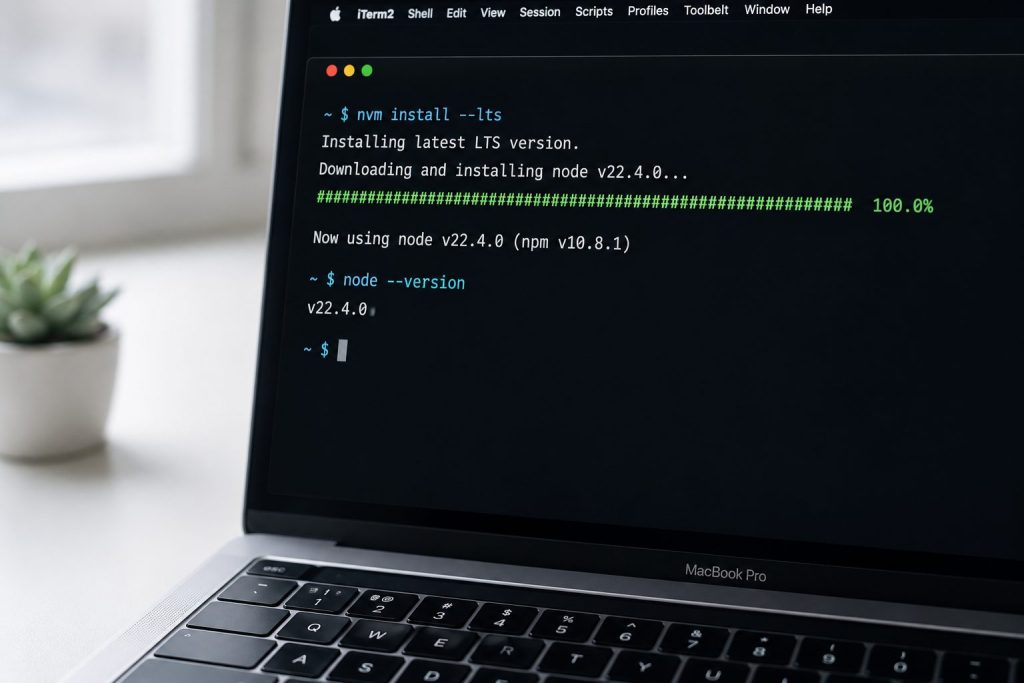
NVM, the Node Version Manager, is the standard tool for managing Node.js versions in development environments. Here is the update sequence:
- Install or confirm NVM is installed: run ‘nvm –version’ in your terminal
- List available versions: run ‘nvm ls-remote –lts’ to see all LTS releases
- Install the latest LTS: run ‘nvm install –lts’
- Switch to the new version: run ‘nvm use –lts’
- Set as default: run ‘nvm alias default node’
- Verify: run ‘node –version’ to confirm
How to Upgrade Node.js Version on macOS Using Homebrew
For teams on macOS who use Homebrew as their package manager, the process is:
- Update Homebrew: run ‘brew update’
- Upgrade Node.js: run ‘brew upgrade node’
- Verify: run ‘node –version’
How to Update Node.js to the Latest Version on Windows
On Windows, the simplest method is to download the latest LTS installer from nodejs.org and run it. The installer replaces the existing version. For teams using nvm-windows, run ‘nvm install latest’ followed by ‘nvm use [version]’.
LTS vs Current: Which Version Should Your Application Run?
For any production application, always run an LTS version. LTS versions receive 3 years of support including security patches. The ‘Current’ channel is for developers who want access to the latest features but is not appropriate for production workloads. As of 2026, Node.js 22 is in active LTS and Node.js 24 is in the Current channel.
Why Your Development Team Should Manage Version Updates Proactively
Falling behind on Node.js versions creates a compounding technical debt problem. Dependencies built for Node 18 often require workarounds when your application eventually moves to Node 22. A proactive update cadence, tested in a staging environment before production deployment, keeps the migration manageable. Any Node.js developer worth hiring in 2026 should be able to own this process without oversight.
When you hire Node.js developers through HireDeveloper.dev, you get engineers who actively manage version compatibility and keep your infrastructure current. No version debt, no scramble upgrades.
How Much Does It Cost to Hire Node.js Developers in 2026?
Cost is where most hiring decisions either gain clarity or fall apart. Here is the data, broken down by engagement model and geography, so you can make an informed decision rather than a hopeful one.
Node.js Developer Salary and Rates by Region
| Region | Annual Salary | Hourly Rate | Experience Level |
| United States | $120,000-$185,000 | $75-$130/hr | Mid-Senior |
| United Kingdom | $85,000-$130,000 | $55-$90/hr | Mid-Senior |
| Western Europe | $70,000-$110,000 | $45-$80/hr | Mid-Senior |
| Eastern Europe | $35,000-$65,000 | $30-$55/hr | Mid-Senior |
| India | $12,000-$28,000 | $12-$35/hr | Mid-Senior |
| Latin America | $30,000-$55,000 | $25-$45/hr | >Mid-Senior |
Source: Glassdoor, LinkedIn Salary Insights, Hired.com 2024 State of Software Engineers Report.
Hourly vs Monthly vs Project-Based: Which Pricing Model Wins?
For ongoing product development, monthly retainers on dedicated developers offer the best value. You get predictable costs, full-time focus, and the ability to build product velocity over time. Hourly contracts work for audits and short integrations. Project-based pricing works for agencies on fixed-scope work but adds risk for anything agile, because scope always changes.

The Real Cost Comparison: In-House vs Agency vs Dedicated Developer
- In-house hire (US-based): $185,000 salary + $45,000-$65,000 in benefits, payroll tax, equipment, and recruiting fees = total cost of $230,000-$250,000 annually. Time to hire: 45-90 days.
- Agency model: $85-$150 per hour for a team of two to three developers, typically $30,000-$60,000 per month for a mid-size project. Limited code ownership.
- Dedicated developer via HireDeveloper.dev: Access to senior Node.js engineers at $2,500-$5,500 per month depending on experience level, with full-time dedication and direct team integration. Time to hire: 2-4 business days.
Hidden Costs Most Companies Forget
The sticker cost of a developer is only part of the picture. Factor in:
- Recruiting agency fees: typically 15 to 25% of first-year salary
- Onboarding time: a new hire takes 3 to 6 months to reach full productivity
- Turnover risk: average tech employee tenure is 2.1 years, per LinkedIn data
- Benefits and equipment: adds 25 to 40% on top of base salary for US hires
- Management overhead: each additional in-house developer adds coordination cost
When you total these hidden costs, the dedicated developer model often delivers 40 to 60% savings compared to equivalent US in-house hiring, while providing comparable or superior output quality.
Get a transparent pricing breakdown for hiring dedicated Node.js developers at HireDeveloper.dev. No recruiting fees, no long-term lock-in, and engineers ready to start in under a week.
What Can You Build? Node.js Development Services and Use Cases
Before hiring, it is worth confirming that Node.js is the right choice for what you are building. The short answer: for almost everything involving APIs, real-time data, or high-concurrency web applications, Node.js is an excellent choice. Here is how leading companies use it.
Node.js Web Development Services
Node.js is the backbone of modern web development services. It handles server-side rendering with Next.js, powers RESTful and GraphQL API layers, manages authentication services, and serves as the middleware layer in microservices architectures. Companies like LinkedIn reduced their server count from 30 servers to 3 when they migrated to Node.js, while simultaneously handling double the traffic.
Node.js App Development
For mobile backends, Node.js is often the preferred choice because of its ability to handle thousands of concurrent connections with minimal memory overhead. A single Node.js server can handle up to 10,000 simultaneous connections with a memory footprint of around 50MB, compared to Apache’s multi-threaded model which allocates approximately 8MB per connection. That difference defines scalability economics.

API Development and Microservices
Node.js’s event-driven architecture makes it purpose-built for API development. Teams building microservices architectures use Node.js services for authentication, notification systems, webhook handlers, and integration layers. The npm ecosystem, with over 2 million packages, means your Node.js developers rarely build foundational tooling from scratch.
Real-Time Applications
Real-time functionality, live dashboards, collaborative tools, gaming backends, trading platforms, live chat, requires a non-blocking I/O model. Node.js with Socket.io is the standard implementation. Trello, Slack (original backend), and NASA’s Mars mission command dashboard all used Node.js for real-time data handling.
Node Bootcamp and Team Ramp-Up
For teams adding Node.js capabilities, a structured ramp-up plan matters. The best Node.js engineers are those who understand the runtime deeply, not just the surface API. When hiring through a partner like HireDeveloper.dev, developers come with production backgrounds that eliminate the lengthy learning curve of internal bootcamp programs.
Whether you need a single Node.js API developer or a full-stack team for a product build, HireDeveloper.dev can match you with the right engineers for your specific use case. Explore their Node.js development services at hiredeveloper.dev.
Why Leading Companies Choose HireDeveloper.dev to Hire Node.js Experts
<There is no shortage of platforms promising access to top developer talent. What separates HireDeveloper.dev from the noise is a vetting process built on technical depth, not platform mechanics.
The Vetting Process: What Gets Tested
Every Node.js developer in the HireDeveloper.dev network passes through a multi-stage evaluation before being made available to clients:
- Stage 1: Automated technical screening covering asynchronous patterns, event loop understanding, and API design
- Stage 2: Live coding session with a senior Node.js engineer evaluating production problem-solving
- Stage 3: System design assessment covering scalability, caching, database design, and deployment
- Stage 4: Communication and collaboration evaluation including written English, async responsiveness, and documentation ability
Less than 15% of applicants pass all four stages. The result is a curated pool of engineers who are ready to contribute from day one, not month three.
Engagement Models That Flex With Your Business
- Full-time dedicated developer: 40 hours per week, fully integrated into your team and tools
- Part-time dedicated developer: 20 hours per week, ideal for early-stage products or maintenance work
- Team augmentation: add two to five developers to an existing team for a specific sprint or release cycle
- Technical lead placement: a senior Node.js engineer who owns architecture decisions and leads junior developers
What Clients Say
Companies that have scaled their Node.js teams through HireDeveloper.dev consistently cite three outcomes: faster time to hire compared to traditional recruiting, lower total cost than agency or in-house models, and engineers who integrate into existing team culture without friction.
One SaaS company reduced their backend API response times by 60% within the first quarter of engagement after bringing in a dedicated Node.js developer from HireDeveloper.dev to refactor their data pipeline.
The Speed Advantage
The average time to hire a Node.js developer through traditional job boards is 47 days. Through staffing agencies, it is 21 to 35 days. Through HireDeveloper.dev, companies are interviewing matched candidates within 24 to 48 hours and have developers onboarded within 4 business days. In a competitive product environment, that difference compounds quickly.
Ready to hire Node.js Experts without the 45-day wait? HireDeveloper.dev has pre-vetted engineers ready for immediate engagement. Visit hiredeveloper.dev to get matched with your ideal developer in under 48 hours.
Your Node.js Hiring Decision Starts Here
Node.js is not going anywhere. With 40.8% of professional developers using it, a thriving npm ecosystem of over 2 million packages, and adoption by companies from Netflix to NASA, it remains the most reliable choice for scalable backend and API development in 2026.
But the quality of what you build with Node.js depends entirely on the quality of the engineers you hire to work with it. The difference between a developer who knows Express.js routes and one who can architect a production microservices system using Node.js is the difference between code that survives growth and code that collapses under it.
The hiring decision is commercial. It affects timelines, quality, and costs. The companies that get it right in 2026 are the ones that define requirements clearly, evaluate rigorously, choose the right engagement model for their stage, and move fast.
That last part, moving fast, is where most hiring processes break down. The traditional recruiting cycle is too slow for product teams operating on monthly release schedules. The solution is not to lower the bar. It is to find a partner who has already raised it on your behalf.
Start Hiring Node.js Developers the Smarter Way
HireDeveloper.dev has built a network of pre-vetted Node.js engineers who have passed rigorous multi-stage technical and communication assessments. Their dedicated developer model gives you full-time engineering capacity at 50 to 60% of the cost of equivalent US in-house hiring, with a time-to-hire measured in days, not months.
Whether you need a single API developer to accelerate a specific project, a full-stack Node.js and React team for a product build, or a technical lead to own your backend architecture, HireDeveloper.dev matches you with the right engineer for your exact requirement.
Ready to turn ideas into products?
Visit hiredeveloper.dev today. Tell them your stack, your timeline, and your goals. Get matched with a pre-vetted Node.js developer in under 48 hours and start shipping faster.
Related Sources
-
Hire a Dedicated Node.js Developer: Step-by-Step Process — https://hiredeveloper.dev/insights/hire-dedicated-node-js-developer-step-by-step-process/
-
Hire Node.js Developers in India from a Trusted Node.js Development Company (2026) — https://hiredeveloper.dev/insights/hire-node-js-developers-in-india-from-a-trusted-node-js-development-company-2026/
-
Hire Node.js Programmers in India: Cost and Pricing (2026) — https://hiredeveloper.dev/insights/hire-node-js-programmers-india-cost-pricing-2026/
-
Node.js Development Services for Real-Time Apps, APIs, and Microservices — https://hiredeveloper.dev/insights/node-js-development-services-real-time-apps-apis-microservices/
-
Top Skills for Node.js Developers — https://hiredeveloper.dev/insights/top-skills-for-node-js-developers/
-
The Latest Node.js Development Trends to Follow in 2025 — https://hiredeveloper.dev/insights/the-latest-node-js-development-trends-to-follow-in-2025/
Our Other Services
-
Hire React.js Developers — https://hiredeveloper.dev/hire/react-js-developers/
-
Hire Node.js Developers — https://hiredeveloper.dev/hire/nodejs-developers/
-
Hire .NET Developers — https://hiredeveloper.dev/hire/net-developers/
-
Hire Java Developers — https://hiredeveloper.dev/hire/java-developers/
-
Hire Python Developers — https://hiredeveloper.dev/hire/python-developers/
-
Hire AngularJS Developers — https://hiredeveloper.dev/hire/angularjs-developers/
-
Hire Laravel Developers — https://hiredeveloper.dev/hire/laravel-developers/
-
Hire PHP Developers — https://hiredeveloper.dev/hire/php-developers/
-
Hire Flutter Developers — https://hiredeveloper.dev/hire/flutter-developers/
-
Hire iOS Developers — https://hiredeveloper.dev/hire/ios-developers/