







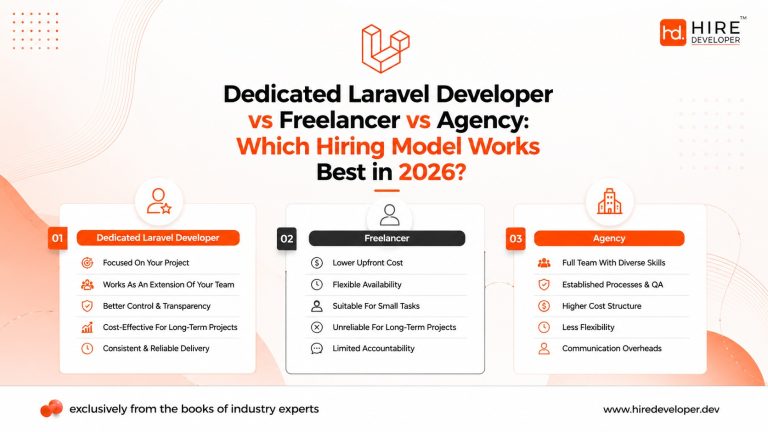
Introduction
The Laravel hiring landscape has shifted significantly in 2026. AI-assisted development tools have changed how fast engineers ship code. Remote work infrastructure has matured. And the cost gap between hiring locally versus offshore has widened further. Yet the core question SaaS founders and CTOs face remains exactly the same: should I hire a dedicated Laravel developer, work with a freelancer, or bring in a Laravel development agency?
The wrong answer still costs you months of delays, tens of thousands in rework, and a codebase that cannot scale when you need it most. This guide gives you the unfiltered, 2026-current breakdown of all three models so you can choose with full confidence.
Key Stats Before We Begin:
- 73% of SaaS startups report poor developer hiring as a top growth barrier (Clutch, 2024)
- $15,000 is the average cost per bad hire for mid-level developers (SHRM)
- 58% of freelance Laravel projects experience scope creep or delivery delays
- Dedicated teams deliver product 3x faster than project-based agency models
Laravel in 2026: Why It Still Leads Backend SaaS
A lot has changed in web development since 2024. AI code generation tools are now embedded in every serious engineering workflow. Cloud-native architectures have become the default expectation, not the premium option. And the bar for what a production-ready SaaS backend needs to do on day one has risen considerably.
Laravel has kept pace with every shift. Laravel 12, released in early 2026, introduced native concurrency support, improved first-party Inertia.js integration, and a rearchitected service container that reduces memory overhead by up to 22% under high-load scenarios. The framework now ships with built-in support for distributed job queues across multiple Redis clusters, making it significantly more capable for enterprise-grade SaaS workloads than even two years ago.
According to the JetBrains Developer Ecosystem Survey 2026, Laravel maintains its position as the dominant PHP framework with 67% adoption among professional PHP developers globally. More tellingly, 54% of new SaaS backend projects started in 2025 used Laravel as their primary framework, ahead of Node.js-based alternatives for teams prioritizing development speed and long-term maintainability.
The demand for skilled Laravel programmers for hire has not softened. If anything, the combination of a maturing framework, a growing SaaS market, and the increased complexity of modern product requirements has made genuinely skilled Laravel engineers harder to find and more expensive to retain in local markets. The average time to hire a mid-to-senior Laravel developer in the US currently sits at 52 to 68 days (LinkedIn Talent Insights, 2026), and total compensation for senior engineers in major tech hubs now regularly exceeds $145,000 annually.
That persistent talent squeeze is precisely why the hiring model decision matters more than ever in 2026.
The Three Hiring Models Explained
Before comparing costs and outcomes, it is worth being precise about what each model actually means. These are not just different price points on the same service. They represent fundamentally different working relationships with entirely different accountability structures, communication dynamics, and risk profiles.
Dedicated Laravel Developer: A full-time remote engineer assigned exclusively to your project, typically engaged through a staffing platform or offshore development company. They work your hours, attend your standups, write code under your repository, and are accountable to your product roadmap day to day.
Freelance Laravel Developer: An independent contractor hired for a specific deliverable or defined time period. They manage their own schedule, typically work across multiple clients simultaneously, and have limited contractual accountability beyond the agreed delivery scope.
Laravel Development Agency: A full-service development company that assigns a project team to your work. Pricing is typically project-based or retainer-based, with a dedicated project manager acting as your primary interface to the engineering team.
Key insight for 2026: The rise of AI coding assistants like GitHub Copilot and Cursor has not eliminated the model differences. It has amplified them. A dedicated developer using AI tools compounds their output daily because they understand your codebase deeply. A freelancer using the same tools on a shallow engagement produces faster but still context-poor code. The structural accountability gap between the three models has actually widened in the AI development era.
The Dedicated Laravel Developer Model
When companies choose to hire a dedicated Laravel developer in 2026, they are making a structural decision, not just a budget one. They are choosing to embed an engineer inside the product the same way a local hire would operate, without the overhead of office space, equipment, benefits administration, and employer payroll taxes.
What Makes This Model Different in 2026
A dedicated developer works 8 hours per day on your project alone. They participate in sprint planning, contribute to architectural decisions, join your team communication channels, and are expected to maintain responsiveness throughout your business hours. In 2026, with async-first tooling now standard across remote teams, dedicated developers integrate more seamlessly than ever before.
The combination of mature remote collaboration infrastructure and AI-assisted development tools means a well-matched dedicated Laravel developer can now deliver output that would have required a two-person team just three years ago. According to the Turing Developer Productivity Report 2026, dedicated remote engineers using AI-augmented workflows ship 41% more story points per sprint on average than developers working in fragmented, multi-client freelance arrangements.
Companies that hire remote Laravel developers through pre-vetted platforms consistently report higher first-sprint success rates. Toptal’s 2026 State of Remote Engineering report found that 89% of teams using dedicated remote developers rated their communication quality and delivery consistency as good or excellent, compared to 58% for project-based engagements.
The Offshore Advantage in 2026
The case for hiring offshore Laravel developers, particularly from India, has only strengthened in 2026. India now produces over 1.7 million software engineering graduates annually (NASSCOM Tech Talent Report, 2026), and Laravel expertise is deeply embedded in the country’s professional development ecosystem through both university curricula and industry certification programs.
Senior Laravel engineers in India increasingly bring experience with microservices architectures, Kubernetes deployments, multi-region AWS infrastructure, and event-driven backends built on Laravel Horizon and Reverb. This is not junior-level talent filling a cost gap. It is mid-to-senior engineers delivering enterprise-quality work at a cost structure that makes growth-stage SaaS economics viable.
When you hire Laravel developers in India through a properly structured dedicated engagement, hourly rates range from $18 to $45 depending on seniority and specialization. Full-time monthly costs typically fall between $1,800 and $4,500, representing a 65 to 78% cost reduction compared to equivalent US-based hires, with no meaningful compromise on technical output quality.
When you hire an offshore Laravel developer, you are also eliminating recruiter fees that typically run 18 to 25% of annual salary for local hires, plus benefits overhead that adds another 20 to 30% on top of base compensation in most Western markets. For a Series A SaaS company with a 12-month runway to next raise, that difference can extend the runway by a full quarter.
When to Use a Dedicated Developer
- You are building or scaling a SaaS product that requires continuous, ongoing backend development
- You want an engineer who integrates fully with your existing team processes, tools, and culture
- You need consistent code quality, shared architectural standards, and documented knowledge retention
- You are past MVP and need sustainable long-term development capacity that grows with the product
- You want full control over the engineering relationship without going through an agency intermediary
The Freelancer Hiring Model: Speed vs Reliability in 2026
Platforms like Upwork, Hiredeveloper.dev, Toptal, and Contra have made it faster than ever to find Laravel programmers for hire. The global freelance technology market surpassed $520 billion in 2025 (Statista), and the number of self-identified Laravel developers available for project work has grown substantially with the broader shift toward independent contracting post-pandemic.
But the volume of available talent is not the same thing as reliable delivery. The freelance model carries structural risks that have, if anything, become more pronounced as projects have grown more complex, and AI tool adoption has raised the expectations around delivery speed.
The Real Risks of Freelance Laravel Hiring in 2026
Multi-client availability: The average active freelancer on major platforms works across 4 to 7 simultaneous client engagements in 2026. Your feature priority competes directly with every other client’s feature priority, and there is no contractual mechanism that gives your work precedence.
Scope creep and delivery gaps: A 2025 analysis by Freelancer.com found that 61% of software development projects on their platform exceeded the original agreed timeline, and 47% exceeded budget. Ambiguous scope documents and evolving requirements hit freelance engagements disproportionately hard because there is no shared product context to anchor decisions.
Knowledge transfer fragility: When a freelancer completes their engagement and moves on, they carry with them the undocumented system understanding they built up over weeks or months. Without embedded team knowledge retention practices, that institutional knowledge simply disappears, creating technical debt that the next engineer has to excavate.
Inconsistent code standards: Without shared team code review processes and consistent architectural guidelines, freelancers default to their own patterns. A codebase touched by four different freelancers over 18 months is typically a refactoring project before it can be a scaling project.
No product investment: Freelancers are incentivized to close tickets and move to the next project. Your product’s long-term architectural health is genuinely not their primary concern, and no contract clause changes that underlying dynamic.
When Freelancers Still Make Sense
The freelance model is not without legitimate use cases. One-time, clearly bounded tasks with a defined deliverable and no requirement for ongoing knowledge retention are valid freelancer use cases. Building a standalone payment webhook handler, completing a specific database migration, auditing an existing Laravel codebase, or writing a one-off data export script are all tasks where a skilled freelancer can deliver efficiently without the risks of the broader model applying.
The consistent mistake is using freelancers for core product development. That is where the model’s structural weaknesses compound, and where founders discover too late that cheap hourly rates do not translate to low total cost
The Laravel Development Agency Model: Structured but Expensive in 2026
A Laravel development company or full-service agency brings a level of structural organization that neither freelancers nor individual dedicated developers can match out of the box. They offer packaged processes, in-house project management, quality assurance protocols, and an established track record of delivering complete product builds.
The global software development outsourcing market reached $583 billion in 2025 (Grand View Research) and is projected to grow further through 2026, driven primarily by enterprise and mid-market businesses that need complete team capacity without in-house headcount investment.
What Agencies Do Well in 2026
- Managing full product development cycles from discovery workshops through production deployment
- Coordinating multi-discipline teams covering UI/UX design, backend engineering, QA, and DevOps in a single engagement
- Providing a single point of contractual accountability for enterprise procurement processes
- Absorbing team scaling requirements across project phases without the client managing headcount
The Hidden Costs of Agencies in 2026
Laravel development services from established agencies in the US or UK now carry rate cards between $110 and $220 per hour for senior development resources. A 6-month SaaS product build has a typical agency cost range of $180,000 to $450,000, with project management, QA, and account coordination accounting for 30 to 45% of total billing in many engagements.
The structural issue for most growth-stage companies is not just cost. It is access. When you outsource Laravel development to a full agency, your direct relationship is with the account manager or project manager, not with the engineers writing your code. Developer assignment and rotation happen internally based on agency capacity, not based on your product needs. The engineer who spent 3 months learning your domain may be reassigned to another client account with no notice period.
The best Laravel development company relationships tend to work well for fixed-scope, milestone-driven projects where the full agency team model justifies its overhead. For ongoing SaaS products that require continuous iteration, the model’s communication layers and cost structure work against you over time.
Side-by-Side Comparison: All Three Models in 2026
| Factor | Dedicated Developer | Freelancer | Agency |
| Monthly Cost (USD) | $1,800 – $4,500 | $2,400 – $7,200 | $18,000 – $45,000+ |
| Full-Time Dedication | Yes | No | Partial |
| Team Integration | Deep | Minimal | Managed |
| Code Ownership | Full | Negotiable | Contract-based |
| Time to Hire | 3 – 7 days | 1 – 3 days | 2 – 6 weeks |
| Scalability | High | Low | Medium |
| Communication Quality | Direct | Variable | Via PM |
| IP and NDA Protection | Strong | Moderate | Strong |
| Long-term Product Fit | Excellent | Poor | Good for phases |
| Agile / Scrum Compatibility | Native | Possible | Agency-dependent |
| AI Tool Integration | Proactive | Inconsistent | Agency-policy dependent |
| Knowledge Retention | High | Low | Medium |
Real Cost Analysis: What You Actually Pay Per Model in 2026
The rate card is never the full story. In 2026, with inflation-adjusted developer salaries, higher freelancer platform fees, and agency overhead increasing alongside operational costs, the total cost gap between models has widened compared to 2024.
| Cost Element | Dedicated Developer (India) | US Freelancer | Agency (US/UK) |
| Hourly Rate | $18 – $45 | $70 – $135 | $110 – $220 |
| Monthly Cost (Full Time) | $1,800 – $4,500 | $11,200 – $21,600 | $18,000 – $35,000 |
| Recruitment Overhead | Low (pre-vetted) | Medium (screening) | High (contracts, SOW) |
| Rework and Bug Fix Cost | Low (team standards) | High (inconsistency) | Billed separately |
| Annual All-In Cost | ~$28,000 – $54,000 | ~$90,000 – $170,000 | ~$220,000 – $550,000 |
Real-world 2026 scenario: A SaaS company building a multi-tenant Laravel 12 application with REST API integrations, Stripe billing, role-based admin panels, and a React frontend can ship a production-ready v1 in 90 to 110 days with a dedicated Laravel developer team at approximately $20,000 to $40,000 total. The identical project scoped through a US-based agency in 2026 would realistically run $140,000 to $280,000 with a 6 to 10 month delivery timeline.
That gap is not theoretical. It is the lived reality of hundreds of SaaS companies that have made the switch to dedicated offshore Laravel teams in the past 18 months. When you hire a Laravel consultant or dedicated engineer through a structured vetting platform, you also eliminate recruiter fees now averaging 20 to 28% of annual salary for local hires, plus benefits and employment tax overhead that adds another 25 to 35% on top of base salary in most Western markets.
Which Model Is Right for Your Business in 2026?
The correct answer depends on your company stage, the nature of the development work, and how long you need consistent engineering capacity. Here is the decision framework that aligns with how most SaaS engineering leaders are approaching the choice in 2026.
| Your Situation | Recommended Model | Why |
| Pre-launch, capital-constrained, MVP focus | Dedicated Developer (offshore) | Full-time focus at startup-viable cost |
| One-time, clearly bounded feature or task | Freelancer | Clean scope with defined deliverable |
| Enterprise build, full cross-functional team needed | Agency | Turnkey team with PM, QA, and design included |
| Post-funding, scaling engineering headcount fast | Dedicated Developer Team | Add capacity without 60-day local hiring cycles |
| Ongoing SaaS with weekly or bi-weekly releases | Dedicated Developer | Continuous product integration and roadmap alignment |
| Scope unclear, need strategic input before building | Hire Laravel Consultant | Expert advisory before committing development budget |
| Global product with compliance requirements | Agency or Dedicated Team + Legal overlay | Structured accountability with IP protections |
For the overwhelming majority of SaaS companies operating in 2026, the dedicated model delivers the best combination of output quality, cost efficiency, speed of engagement, and long-term product fit. The critical factor is sourcing that talent through a platform that has already done the technical vetting, communication screening, and contractual structuring on your behalf.
Conclusion: The Dedicated Laravel Developer Model Wins in 2026
After evaluating cost, output quality, delivery speed, scalability, and long-term product fit across all three models, the verdict for 2026 is clear. The dedicated Laravel developer model consistently outperforms freelancers and agencies for companies building and scaling SaaS products. Freelancers carry too much structural delivery risk for core product work. Agencies deliver structure at a cost ceiling that growth-stage companies cannot sustain without enterprise budgets and enterprise timelines.
The dedicated model gives you a full-time, deeply integrated engineer at 65 to 78% of the cost of a local hire, with zero of the knowledge-transfer fragility that makes freelance engagements so expensive over time. Whether you are a pre-seed founder hiring your first backend engineer or a VP of Engineering scaling a distributed team after Series B, bringing in a dedicated Laravel developer through a properly structured platform is one of the highest-ROI decisions available to you in 2026.
The numbers make the case. The engineering outcomes confirm it. The only remaining variable is where you source the talent from and how well the engagement is structured from day one.
That is exactly what HireDeveloper.dev was built to solve.
HireDeveloper.dev is a specialist platform for hiring pre-vetted, full-time dedicated Laravel developers from India, purpose-built for SaaS companies and product teams that need genuine engineering accountability without the overhead of local hiring or the risk of agency abstraction. Every developer on the platform has passed rigorous technical assessments covering Laravel architecture, API development, database optimization, and cloud deployment, as well as communication and project-fit screening designed to ensure real team integration from week one. There are no agency markups, no freelancer unpredictability, and no months-long recruiting cycles. You get a dedicated Laravel developer matched to your stack, your timezone, and your product requirements within 3 to 7 business days, backed by transparent pricing and a trial period so you can verify fit before making a long-term commitment. Over 350 SaaS companies have already scaled their engineering capacity through HireDeveloper.dev without blowing their runway or compromising on code quality.
If 2026 is the year you stop losing velocity to the wrong hiring model, visit hiredeveloper.dev today and get matched with your dedicated Laravel developer. Your roadmap is waiting.