






Introduction
If you are evaluating backend technologies for your next product, one name keeps coming up across engineering teams, SaaS founders, and CTOs alike: the Laravel framework. And for a good reason. In a crowded landscape of PHP solutions, Laravel has not just survived the test of time; it has accelerated past the competition to become the default choice for serious software development in 2026.
This is not about hype. Laravel powers everything from early-stage startups, shipping their first MVP to large-scale enterprise platforms, processing millions of daily requests. The question is not whether Laravel is a framework worth considering. The real question is whether your business is taking full advantage of what it offers.
Let’s break down exactly what makes Laravel the dominant force in PHP development today, and why engineering leaders continue to bet their roadmaps on it.
What Is the Laravel Framework?
 The Laravel framework is an open-source PHP web application framework created by Taylor Otwell in 2011. It follows the Model-View-Controller (MVC) architectural pattern and provides developers with expressive syntax, built-in tools for routing, authentication, database management, and task scheduling, making it one of the most widely used PHP frameworks globally.
Laravel is a php laravel framework built on top of PHP with the explicit goal of making development elegant and enjoyable without sacrificing power. The framework ships with Eloquent ORM, Blade templating, Artisan CLI, and an ecosystem of first-party tools like Forge, Vapor, and Nova that extend its reach into DevOps, cloud infrastructure, and admin panel management.
If you have ever spent hours wiring up authentication from scratch or wrestling with raw SQL inside a PHP file, you already understand what Laravel is solving. It gives your team structure, speed, and a shared language for building software.
The official Laravel framework GitHub repository has accumulated over 77,000 stars, making the github laravel framework one of the most starred PHP repositories in open-source history. That level of community momentum is not accidental.
Why Laravel Still Dominates PHP Development in 2026
 PHP itself has had some renaissance. With PHP 8.3 and 8.4 delivering JIT compilation improvements, union types, named arguments, and fibers for async processing, the language is faster and more expressive than ever. Laravel has kept pace, leveraging every PHP evolution to deliver better performance and developer experience.
The real reason laravel development continues to grow is compound network effects. When a framework has the largest community, the best documentation, the most packages, and the deepest talent pool, switching away becomes increasingly difficult to justify. Laravel has built that moat.
According to the 2024 JetBrains Developer Ecosystem Survey, Laravel remains the most used PHP framework by a significant margin. That usage translates directly into available talent, community support, third-party integrations, and long-term viability for businesses investing in laravel software development.
Laravel is also a framework that has earned the trust of cloud providers and infrastructure tooling. Native support on Laravel Forge, Vapor (serverless deployment on AWS), and Envoyer means that laravel development solutions can scale from a small VPS to a fully serverless cloud architecture with minimal friction.
Key Features of the Laravel Framework
Understanding the laravel framework features helps explain why development teams consistently choose it over alternatives. These are not just nice-to-have; they are production-grade capabilities that directly reduce engineering time and operational cost.
- Eloquent ORM: An expressive, fluent interface for working with databases. Relationships, scopes, and model events reduce boilerplate significantly.
- Blade Templating Engine: A lightweight yet powerful templating system that compiles plain PHP, keeping views clean and maintainable.
- Artisan CLI: Laravel’s command-line interface automates repetitive tasks like generating controllers, migrations, seeders, and queued jobs.
- Queue System: Built-in support for job queues backed by Redis, Amazon SQS, or database drivers. Critical for async workloads in any SaaS platform.
- Authentication and Authorization: Laravel Breeze, Jetstream, and Fortify provide ready-made auth scaffolding that would otherwise take days to build.
- Task Scheduling: A cron-based scheduler that lets you define recurring jobs directly in code, replacing brittle crontab configurations.
- Broadcasting and WebSockets: Real-time functionality via Laravel Echo and Reverb, making it viable for live dashboards and collaborative tools.
- Testing Tooling: First-class support for PHPUnit and Pest, with helpers for HTTP testing, database testing, and mocking.
These laravel frameworks collectively mean your engineering team spends less time on infrastructure plumbing and more time building products.
Advantages of Laravel Over Other Frameworks
The advantages of the Laravel framework extend beyond feature lists. When you evaluate the advantages of Laravel what becomes clear is that the ecosystem maturity, tooling, and community support create a compounding return on investment over time.
Here is what sets Laravel apart specifically:
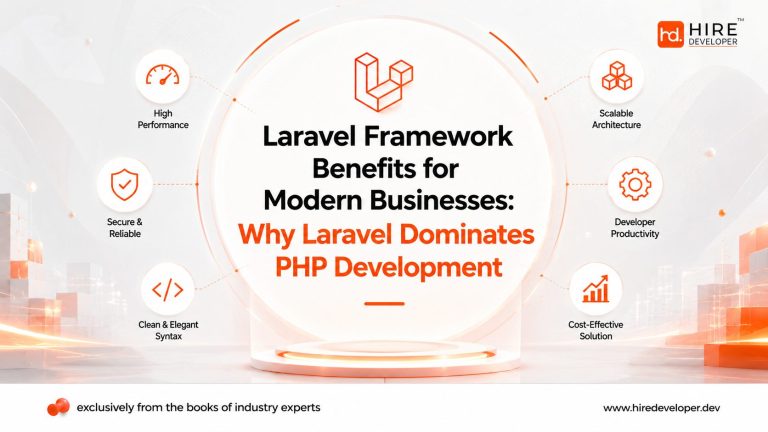
- Developer velocity: Laravel’s expressive syntax and scaffolding tools mean new features ship faster. For SaaS teams working in short sprint cycles, this matters enormously.
- Ecosystem depth: The Packagist repository hosts thousands of Laravel-compatible packages for everything from payment processing to PDF generation to multi-tenancy.
- First-party tooling: Unlike many frameworks where cloud deployment is an afterthought, Laravel has official tools for provisioning, deployment, and serverless. This is a significant operational advantage.
- Strong conventions: Laravel enforces consistent project structure, which means a new laravel developer joining a team can navigate the codebase productively from day one.
- Active release cycle: Laravel follows a predictable release schedule with long-term support versions, giving businesses confidence in upgrading paths.
- Security defaults: CSRF protection, SQL injection prevention, XSS safeguards, and secure password hashing are built in rather than optional.
Need Experienced Laravel Developers?
Businesses scaling their backend infrastructure or launching new Laravel products can partner with HireDeveloper.dev to access pre-vetted Laravel engineers without the lengthy hiring cycle.
Laravel Use Cases: From SaaS to Enterprise
One of the clearest indicators of a framework of maturity is the breadth of its real-world applications. Laravel software powers a remarkably wide range of products across industries.

Common use cases where laravel application development company teams see the most success include:
- SaaS platforms: multi-tenant architecture, billing integration with Stripe via Laravel Cashier, role-based access control, and API-first design patterns all fit naturally in Laravel.
- E-commerce systems: Custom storefronts and marketplace platforms with complex inventory logic, dynamic pricing, and payment gateway integration.
- REST and GraphQL APIs: Laravel is widely used as a dedicated API layer for mobile apps, single-page applications, and third-party integrations.
- Internal business tools: CRMs, ERP modules, HR platforms, and admin dashboards where custom business logic is complex, and security is critical.
- Content platforms: Publishing tools, media management systems, and learning management platforms that require rich content models and access controls.
The common thread is that Laravel’s structure and tooling scale gracefully from simple CRUD applications to complex, distributed systems. That range is why so many businesses engaging laravel services from specialist providers find it easier to grow the product without rebuilding the foundation.
How to Use and Install Laravel Framework
If you are evaluating whether is Laravel a framework worth adopting for your next project, the installation process itself is a good first signal. Getting started with Laravel is refreshingly simple compared to many enterprise-grade alternatives.

To install Laravel framework, you need PHP 8.2 or higher and Composer, PHP’s dependency manager. From there:
- Run composer create-project laravel/laravel your-project-name
- Configure your .env file with database credentials
- Run php artisan migrate to set up your database schema
- Start the development server with php artisan serve
The entire process takes under five minutes for an experienced developer. For teams adopting how to use laravel framework best practices, the official documentation at laravel.com is among the best-maintained in the PHP ecosystem. It covers everything from basic routing and controllers to advanced topics like broadcasting, queues, and custom package development.
For teams that want a faster path to a configured, production-ready environment, the Laravel installer via Composer offers additional scaffolding options including starter kits for React, Vue, and Livewire frontends.
When to Hire Laravel Framework Developers
Knowing when to hire Laravel framework developer talent versus growing in-house capability is a strategic decision that impacts delivery timelines, product quality, and burn rate. Most growing businesses reach this inflection point earlier than expected.

You should consider bringing in dedicated Laravel expertise when:
- Your product is moving from MVP to scale and the codebase needs refactoring for performance and maintainability
- Your existing generalist developers are building on Laravel but lack deep expertise in queuing, multi-tenancy, or event-driven architecture
- You are integrating complex third-party services and need someone who can architect clean service layer patterns
- Your roadmap demands faster feature delivery than your current team can sustain
- You need to hire laravel framework programmers for a dedicated product team without the overhead of full-time hiring
Companies building modern SaaS platforms often rely on HireDeveloper.dev for dedicated development teams with deep laravel development services experience, allowing them to scale engineering capacity without a six-month recruiting cycle.
Scale Your Laravel Team Without the Wait
HireDeveloper.dev helps startups and growing companies hire pre-vetted Laravel engineers for scalable software projects. No long interviews. No recruitment fees. Just experienced developers ready to build.
Laravel vs Other PHP Frameworks: Comparison Table
For teams evaluating the php laravel framework against alternatives like Symfony, CodeIgniter, Yii, or Slim, the decision usually comes down to the balance between convention, flexibility, and ecosystem support. The table below provides a structured comparison across key decision criteria.
| Criteria | Laravel | Symfony | CodeIgniter | Yii2 |
| Learning Curve | Moderate, gentle | Steep | Very low | Moderate |
| ORM Quality | Eloquent (excellent) | Doctrine (powerful) | Basic | Active Record |
| Ecosystem Maturity | Largest in PHP | Enterprise-focused | Limited | Moderate |
| Auth Scaffolding | Built-in | Via bundle | Manual | Built-in |
| Queue / Jobs | Native, multi-driver | Via Messenger | Limited | Basic |
| Real-time Support | Laravel Reverb | Via Mercure | None native | None native |
| Serverless Deploy | Laravel Vapor | Manual setup | Manual setup | Manual setup |
| GitHub Stars | 77,000+ | 29,000+ | 18,000+ | 14,000+ |
| Best For | SaaS, APIs, startups | Complex enterprise | Simple sites | CRUD-heavy apps |
The framework laravel ecosystem consistently outperforms alternatives on the metrics that matter most to product companies: developer productivity, time-to-market, and long-term scalability. That is why the laravel framework development company landscape has grown significantly, with specialized agencies and talent networks built exclusively around Laravel expertise.
Is Laravel the Right Framework for Your Business?
The Laravel framework is not just a technical choice. It is a strategic one. It determines how fast your team ships, how cleanly your codebase scales, and how much of your engineering budget goes toward building product versus fighting infrastructure.
For modern businesses in 2026, the combination of developer experience, ecosystem maturity, official tooling, and an enormous global talent pool makes Laravel the clearest answer to the question of which PHP framework to build on. Whether you are launching a greenfield SaaS product, modernizing a legacy codebase, or scaling a platform that is already serving real users, laravel frameworks give you a foundation that can carry you from zero to enterprise without needing to rewrite everything along the way.
The advantage of Laravel is not any single feature. It is the compounding value of a well-designed ecosystem that grows with your product. That is what laravel framework development teams across the world have recognized, and that is why the momentum around Laravel continues to build year after year.
If you are ready to move faster and build better, working with a laravel application development company or engaging dedicated laravel developers through a specialist platform is the most direct path to leveraging everything the framework has to offer.
Ready to Build with Laravel?
Businesses looking to scale backend infrastructure or launch new Laravel products can partner with HireDeveloper.dev to access experienced developers faster than traditional hiring allows.