






Introduction
The moment your SaaS product starts growing, really growing, is exactly when the backend decisions you made in the early days come back into the conversation.
The monolith that was fast to build starts becoming the reason you deploy take 40 minutes. The Python service that handled 100 concurrent requests fine starts struggling at 10,000. The infrastructure costs that seemed irrelevant at $5K/month become a real line item at $50K/month.
Cloud-native microservices architecture built in Go is how most serious startups answer that question in 2026. Not because it’s the trendiest stack of choice, but because Go’s design characteristics and the cloud-native ecosystem are genuinely, structurally aligned in a way that most other language and infrastructure combinations simply are not.
Golang cloud-native microservices are not just a technical preference. They are increasingly a business decision backed by measurable infrastructure cost reductions, faster deployment cycles, and backend systems that scale predictably under real production load.
This article explains exactly why that alignment exists, what it means for your backend architecture, and how to build the engineering team that can execute it properly.
What Makes Golang the Right Language for Cloud-Native Microservices?
Go was not designed to win popularity contests. It was designed at Google to solve a specific set of engineering problems at scale, and those problems map almost perfectly onto what cloud-native microservices demand in 2026.
Goroutines make concurrency genuinely lightweight.
A Go service handles tens of thousands of concurrent operations with goroutines that cost roughly 2KB of memory each. An equivalent thread-per-request model in Java or Python costs orders of magnitude more. For high-performance microservices handling concurrent API calls, event streams, and background jobs simultaneously, this is an architectural advantage, not a marginal one.
The standard library handles HTTP natively and efficiently.
Go’s built-in net/http package is production-grade without additional frameworks. You are not patching performance issues on top of a framework layer. The baseline is already fast.
Static typing catches distributed system bugs at compile time.
In any microservices architecture, services communicate across the network. Type mismatches, schema drift, and interface inconsistencies cause production incidents that are painful and expensive to debug. Go’s strict static typing, combined with protobuf schemas for golang for distributed systems service contracts, catches these issues before deployment rather than at 2am.
Single binary compilation removes runtime complexity entirely.
Every Go service compiles to a single static binary. No JVM tuning. No interpreter runtime. No package manager invocations at deployment time. The resulting containers are small, start in milliseconds, and carry zero runtime dependency surface area. For go language cloud applications running on Kubernetes, this simplicity compounds across every service in your architecture and makes DevOps lives significantly easier.
These are not theoretical advantages. They are the reason Uber, Cloudflare, Dropbox, and Twitch run significant Go backends in production at scale. According to the CNCF Annual Survey 2025, Go remains the most widely used language among cloud-native engineering teams for the third consecutive year. In 2026, that signal has fully filtered down to the growth-stage startup market.
How Golang Microservices Architecture Is Actually Structured in Production
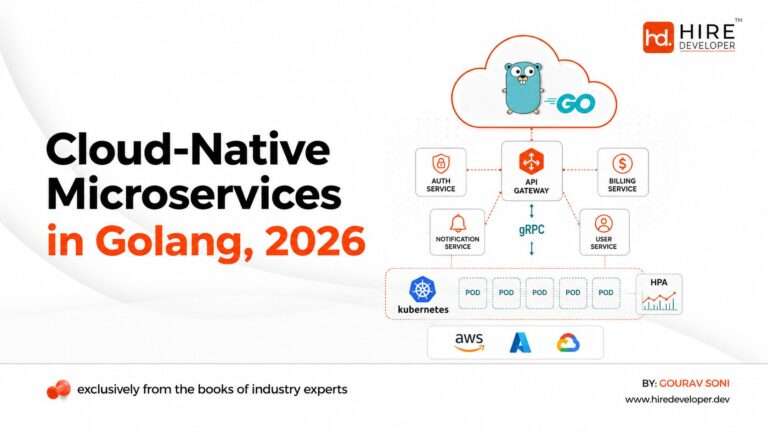
Understanding golang microservices architecture means understanding how Go services map to real product components. Here is how production Go microservices architectures are structured at growing startups that have successfully scaled their backends:
The API gateway layer.
A single Go service handles authentication, rate limiting, request routing, and response aggregation. Written in Go, it processes thousands of simultaneous requests without becoming a bottleneck, routing traffic to downstream services with minimal latency overhead.
Domain-specific services.
Each business domain (auth, billing, user management, notifications, search) owns its own Go service. Each compile independently, deploys independently, and scales independently based on its own load profile. A spike in notification volume does not affect your billing service’s response time.
gRPC for internal service communication.
Service-to-service calls use gRPC with protobuf schemas, which provides type-safe inter-service contracts, efficient binary serialization, built-in streaming support, and generated client and server code that keeps interfaces consistent as the architecture evolves. This is a core pattern in every serious scalable backend systems implementation built on Go.
Background workers and event consumers.
Go handles worker pool patterns and Kafka event consumers with native efficiency. Background services processing async jobs, sending transactional emails, generating reports, or consuming event streams run in Go with significantly lower memory overhead than equivalent implementations in Python or Java.
Observability designed from the start.
Go services integrate with Prometheus for metrics collection, OpenTelemetry for distributed tracing across services, and structured JSON logging. These are standard library or lightweight package additions, not expensive framework integrations. Observability in a production of microservices architecture is not an afterthought. It is a design requirement.
Golang and Kubernetes: Why This Pairing Dominates Cloud-Native Engineering
Kubernetes was written in Go. That is not a trivia fact. It shapes how deeply the two technologies align at every operational level.
Kubernetes Golang services benefit from a set of structural advantages that make cloud-native operations significantly more efficient:
Minimal container images reduce infrastructure overhead.
A Go service typically produces a container image of 10 to 30MB using a multi-stage Docker build. An equivalent Java service image routinely runs 200 to 500MB. Smaller images mean faster pulls, faster pod startup, lower container registry costs, and a meaningfully reduced attack surface across a fleet of microservices running on AWS, GCP, or Azure.
Sub-millisecond pod startup enables truly responsive autoscaling.
Go services start in milliseconds. Kubernetes Horizontal Pod Autoscalers can spin up new Go pods and have them serving production traffic within seconds of a demand spike. For SaaS products with variable traffic patterns, this responsiveness is the practical difference between graceful autoscaling and user-visible degradation during peak load.
Custom Kubernetes controllers and operators are Go-native.
Teams building advanced Kubernetes automation, including custom resource definitions, operators for stateful workloads, and admission webhooks, write them in Go because the official Kubernetes client libraries are Go-native. This is not a workaround. It is the intended and supported model.
Infrastructure cost reduction is measurable and consistent.
Go’s resource efficiency translates directly into lower cloud bills. Fewer pods are needed to serve the same request volume. Pod resource requests are smaller. Node counts drop. Startups running on major cloud providers consistently report infrastructure savings in the 30 to 50 percent range on workloads migrated from heavier-runtime languages to Go.
The Real Performance Gains: What Startups Report After Going Cloud-Native with Go
The business case for cloud-native Golang development is not theoretical. Here is what the numbers consistently look like from engineering teams who have completed the transition:
Infrastructure cost reduction of 30 to 60 percent.
Teams migrating compute-intensive services from Python or Node.js to Go report compute cost reductions of 30 to 60 percent on equivalent workload volumes. At $20K per month in cloud spend, that is a six-figure annual saving. At $100K per month, it funds additional product engineering headcounts.
CI/CD pipeline simplification that compounds over time.
Go’s single-binary compilation cuts build steps from 8 to 12 minutes down to 2 to 4 minutes. Container image sizes shrink dramatically. Rollback procedures become straightforward. DevOps teams managing dozens of microservices report meaningful reductions in deployment-related incidents following Go migrations, with less engineering toil spent managing deployment infrastructure.
P99 latency improvements of 40 to 70 percent on API-heavy services.
Go’s efficient garbage collector, low-overhead concurrency model, and fast HTTP handling produce better tail latency, specifically the p99 and p99.9 metrics that matter most for user-perceived application performance. Engineering teams consistently report p99 improvements of 40 to 70 percent on API-heavy services after migrating to Go.
Faster engineering onboarding into Go codebases.
Go’s explicit, readable code style means new engineers navigate a Go microservices codebase meaningfully within days rather than weeks. Teams report faster ramp-up than equivalent Node.js or Java codebases, where framework magic and implicit patterns significantly slow new engineer productivity.
When Cloud-Native Golang Development Makes Sense for Your Stage
Not every startup needs to be built on golang backend architecture from day one. Here is an honest stage-by-stage assessment:
Early-stage (pre-PMF):
Go microservices are likely overkill. A well-structured monolith in any language ships faster and requires less engineering coordination overhead. If your team already has strong Go expertise, starting in Go positions you well for later service decomposition. Otherwise, focus on product discovery first.
Growth stage (post-PMF, scaling real load):
This is the inflection point. If you are hitting performance ceilings, if infrastructure costs are outpacing revenue growth, or if deployment pipelines are becoming the rate limiter on your engineering velocity, Go microservices architecture is worth the investment. This is where the 30 to 60 percent infrastructure cost savings and p99 latency improvements translate directly into product and business outcomes.
Scale stage:
The question at this point is not whether to use Go. The question becomes how quickly you can migrate your highest-impact services. Companies running significant production traffic on Python or Node backends consistently find that migrating their three or four most-trafficked services to Go captures 80 percent of the infrastructure cost benefit.
The most common mistake is waiting until a performance crisis forces the conversation. Teams migrating under time pressure from an active production incident do so with reduced engineering care, which compounds the architectural complexity of the transition.
How to Build Your Golang Backend Architecture Team Without Starting from Scratch
The bottleneck for most startups is not the decision to adopt cloud-native microservices in Go. It is finding engineers who can execute it properly.
Go engineers with real production microservices experience, including goroutine management, gRPC service design, Kubernetes operator development, distributed tracing with Open Telemetry, and Prometheus instrumentation, are consistently among the harder backend specialists to hire locally. The talent pool is smaller than for Python or Node.js, the competition from larger tech companies is direct and well-funded, and the timeline for hiring senior Go engineers locally typically runs 3 to 6 months.
Most growth-stage startups in the US and UK solve this through one of three models:
Dedicated offshore Go teams embedded directly in your sprint cycle. Pre-vetted engineers who understand Go microservices architecture and integrate with your existing team from day one. This model has become the standard for US and UK startups that need to move quickly without competing against FAANG compensation packages for Go talent. Teams using this model report meaningful contribution within the first sprint rather than the first quarter.
Staff augmentation involves adding one or two senior Go engineers to provide architecture leadership while your broader backend generalists execute under their guidance. This works well when your team has strong backend fundamentals and can learn Go rapidly with experienced technical leadership setting the standard.
Full team outsourcing for a defined service or platform component. Engaging a specialist Go team to build, test, and hand off a specific backend service while your in-house team remains focused on core product development.
HireDeveloper.dev is built specifically for startups that need to hire Golang developers without the 3 to 6 month local recruiting timeline. Based in Indore and embedded in India’s Tier-2 tech ecosystem, the platform pre-vets Go engineers against production microservices standards including goroutine design, gRPC architecture, Kubernetes deployment patterns, and distributed system architecture. Whether you need to hire dedicated Golang developers for long-term team integration or hire remote Golang developers for a specific service build, HireDeveloper.dev connects you with Go engineers who can contribute meaningfully from sprint one.
Hire Golang Developers at HireDeveloper.dev
Cloud-Native Microservices Are a Strategy, Not Just a Stack Choice
Cloud-native microservices built in Go represent a deliberate engineering strategy. One that trades early build complexity for long-term scalability, infrastructure efficiency, and deployment simplicity that compounds in value as your product grows.
The startups making this investment in 2026 are not doing it because it sounds sophisticated on a conference talk. They are doing it because their infrastructure costs needed to come down by 30 to 60 percent, their p99 latency needed to stop being a product issue, and their deployment pipelines needed to stop being the rate limiter on their engineering velocity.
Go is the right language for this architectural pattern because it was designed for exactly these constraints. Not adapted. Not patched to fit. Designed for them from the ground up at Google, tested at Uber, Cloudflare, and Dropbox, and proven by thousands of production deployments in the CNCF ecosystem.
If this decision is on your engineering roadmap, the talent question is usually what comes next. HireDeveloper.dev places pre-vetted Go developers and dedicated Go backend teams offering Golang development services built for startups that need to ship cloud-native systems at scale without spending 6 months on local hiring.
→ Find your Golang backend engineering team at HireDeveloper.dev