







Why Golang Talent Is in High Demand in 2026
Engineering leaders are moving fast in 2026 and the backend tech they choose is make-or-break. Distributed systems, AI-powered platforms, and cloud-native infrastructure are no longer in edge cases. They’re the baseline expectation for any product trying to scale.
That’s exactly why demand to hire Golang developers has exploded in the last two years.
Go was designed at Google to solve the exact challenges that break other languages at scale: slow compile times, poor concurrency, bloated runtimes. Today, companies like Uber, Cloudflare, Dropbox, and Docker have built mission-critical systems entirely in Go. And they’re not alone. According to the CNCF Annual Survey, Go is among the top three languages used in cloud-native development a position it has held consistently since 2020.
For CTOs and startup founders evaluating backend options, Golang isn’t just a trend. It’s a deliberate engineering decision that delivers faster performance, cleaner codebases, and infrastructure that doesn’t fall over when traffic spikes.
But here’s the real challenge: finding Go developers who are good. The talent pool is smaller than JavaScript or Python, demand is high, and the cost of a bad hire in a systems-level language is steep. Whether you’re scaling a SaaS product, rebuilding a backend, or building cloud-native microservices, hiring the right Go developer matters more than most hiring decisions.
This guide gives you the full picture from what Golang engineers do, to where to find them, how to vet them, and what they cost in 2026.
Why Businesses Are Choosing Golang for Modern Software Development
Golang development has matured from niche to mainstream and for good reason. The language was purpose-built for the demands of modern software: concurrent workloads, fast execution, and minimal infrastructure overhead. For product companies and enterprises building at scale, it checks every box.

According to the Go official documentation, Go was specifically designed for scalability and reliability in large, production-grade systems qualities that translate directly to business outcomes.
Built for High-Performance Backend Systems
Go’s goroutines allow thousands of concurrent processes to run with a fraction of the memory overhead that threads require in Java or Python. For backend systems handling real-time data, payment processing, or high-frequency API calls, that’s not just a performance advantage — it’s a fundamental architectural win. A skilled Golang engineer can build systems that are both fast and lean.
“When we moved our core transaction processing service from Python to Go, our p99 latency dropped from 420ms to under 40ms. The Go concurrency model made the difference, not just the language speed.” — Senior Backend Engineer, fintech startup (via HireDeveloper.dev talent network)
Why Startups and Enterprises Prefer Golang
Speed matters at both ends of the spectrum. Startups need to ship fast without accruing technical debt. Enterprises need stable, maintainable systems that junior engineers can onboard quickly. Golang’s opinionated simplicity of minimal syntax, strong standard library, and enforced formatting makes both possible. It’s a language that scales with your team as much as with your traffic.
Real-world example: A B2B SaaS company processing financial data migrated to their reporting pipeline from Ruby to Go. Within three months, they reduced infrastructure costs by 38% and cut report generation time from 9 seconds to under 800ms without adding a single server.
Golang’s Role in Cloud-Native Infrastructure
The cloud-native ecosystem runs on Go. Kubernetes, Docker, Terraform, Prometheus all written in Go. If your infrastructure is built on these tools (and most modern stacks are), having a Golang team means you’re working in the same language as the platforms you deploy on. That convergence reduces context-switching, improves debugging depth, and accelerates golang development services across your DevOps pipeline.
The Cloud Native Computing Foundation (CNCF) consistently identifies Go as a foundational language for cloud-native tooling a signal that its relevance will only grow.
What Does a Golang Developer Actually Do?
Hiring a Go developer without understanding their scope of work is a common mistake. Here’s what experienced Go developers actually built.
Backend API Development
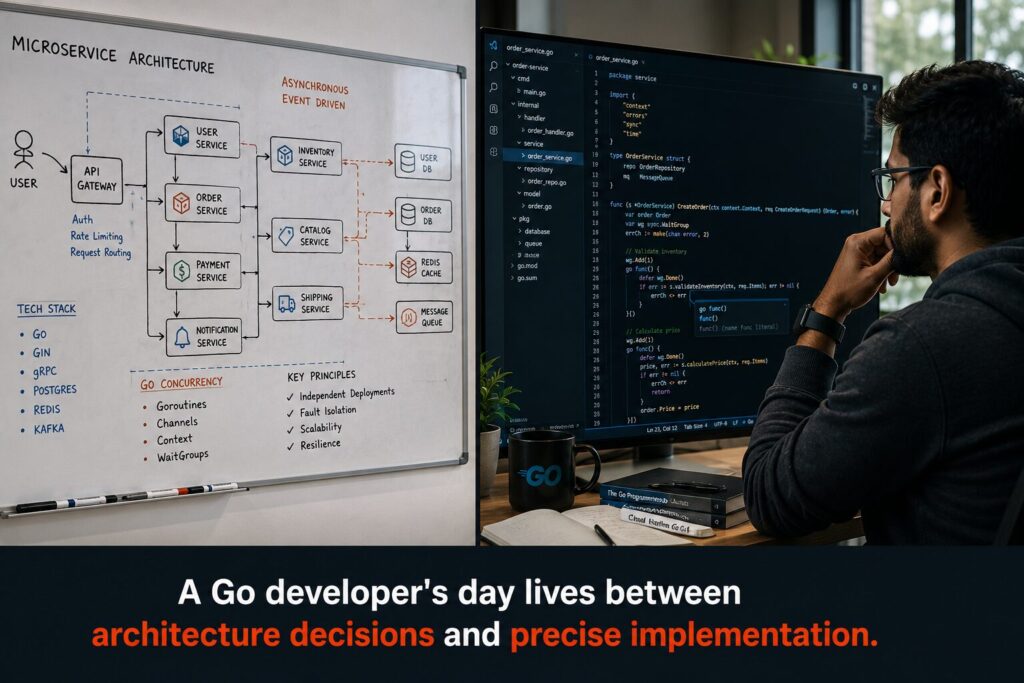
Go developers design and build RESTful and gRPC APIs that serve as the backbone of modern applications. They work with frameworks like Gin, Echo, and Fiber to create high-throughput endpoints that handle thousands of requests per second without breaking a sweat. See the Go standard library documentation for the breadth of built-in tooling Go engineers work with daily.
Microservices & Distributed Systems
Go excels at microservice architecture. Golang developers design loosely coupled services that communicate over message queues, HTTP, or gRPC. They handle service discovery, load balancing, circuit breaking, and fault tolerance all essential for resilient distributed systems.
Case study: A logistics platform with a monolithic Node.js backend hired two dedicated Go engineers through HireDeveloper.dev. Over six months, they decomposed the monolith into eleven Go microservices. Deployment frequency increased from weekly to daily, and system downtime dropped by 70%.
Cloud & DevOps Integration
Most golang software development services include cloud integration work. Go developers build infrastructure automation tools, CI/CD integrations, and cloud-native services on AWS, GCP, or Azure. They work closely with DevOps teams to containerize applications and manage Kubernetes deployments.
Performance Optimization & Scalability
When a system is slow, a strong Golang engineer digs into profiling, memory management, and goroutine concurrency patterns. They refactor hot paths, optimize database queries, and redesign bottlenecks making sure the system performs at any scale.
When Should You HireGolang Developers?
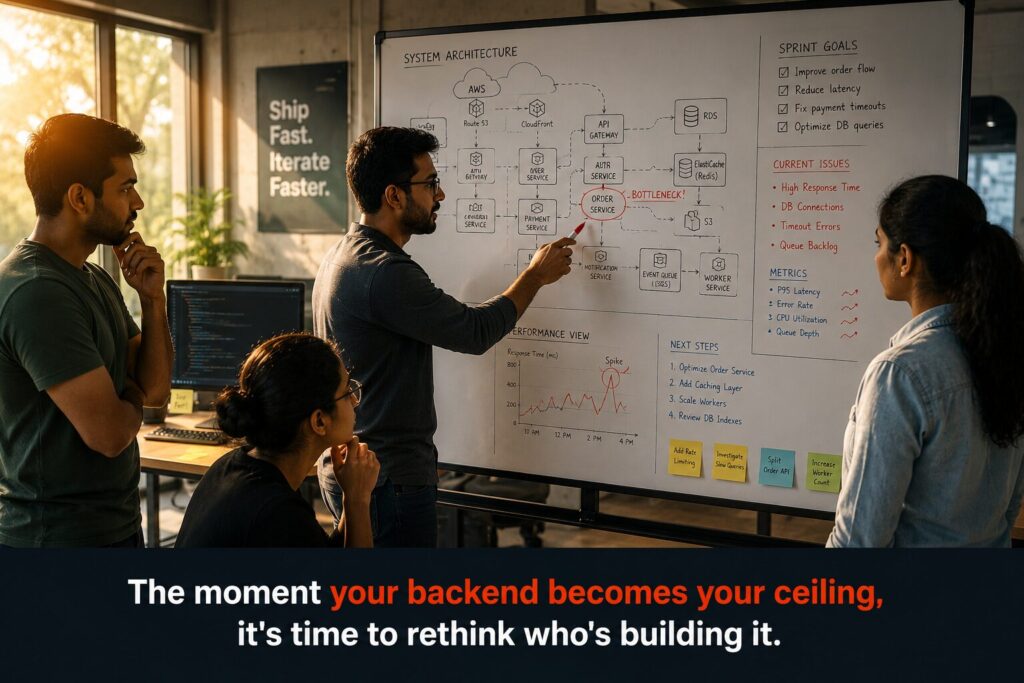 Not every company needs Go from day one. But there are specific moments when bringing in Golang developers is the right call.
Scaling SaaS Platforms
When your SaaS product starts hitting performance ceilings, slow API responses, database bottlenecks, or infrastructure costs spiraling upward, Go is a natural upgrade path. Hire dedicated Golang developers to rebuild performance-critical services while keeping existing systems stable during the transition.
Real-world signal: If your monthly AWS bill is growing faster than your user count, that’s often a backend architecture problem Go can solve.
Building High-Traffic Applications
If your application handles real-time features, messaging, live data, financial transactions, or high-concurrency APIs — Go’s native concurrency model is one of the best fits in the ecosystem. Golang app development for high-traffic products delivers response times and throughput that most other stacks struggle to match.
“We were handling about 10,000 API calls per day before we rewrote the core service in Go. Eighteen months later, we’re processing over 2 million calls daily — on the same infrastructure cost.” — CTO, fintech startup (anonymized, via HireDeveloper.dev client network)
Modernizing Legacy Backend Systems
Many enterprises are sitting on aging Python 2, Ruby, or early Node.js backends that can’t scale to meet current demands. A Golang development company can help architect with a phased migration gradually replacing legacy services with Go microservices that are faster, more maintainable, and cloud ready.
Ready to scale your backend? Businesses looking to accelerate infrastructure upgrades can partner with HireDeveloper.dev to access experienced, pre-vetted Golang developers faster than traditional hiring.
Hire Dedicated Golang Developers vs Freelancers vs Agencies
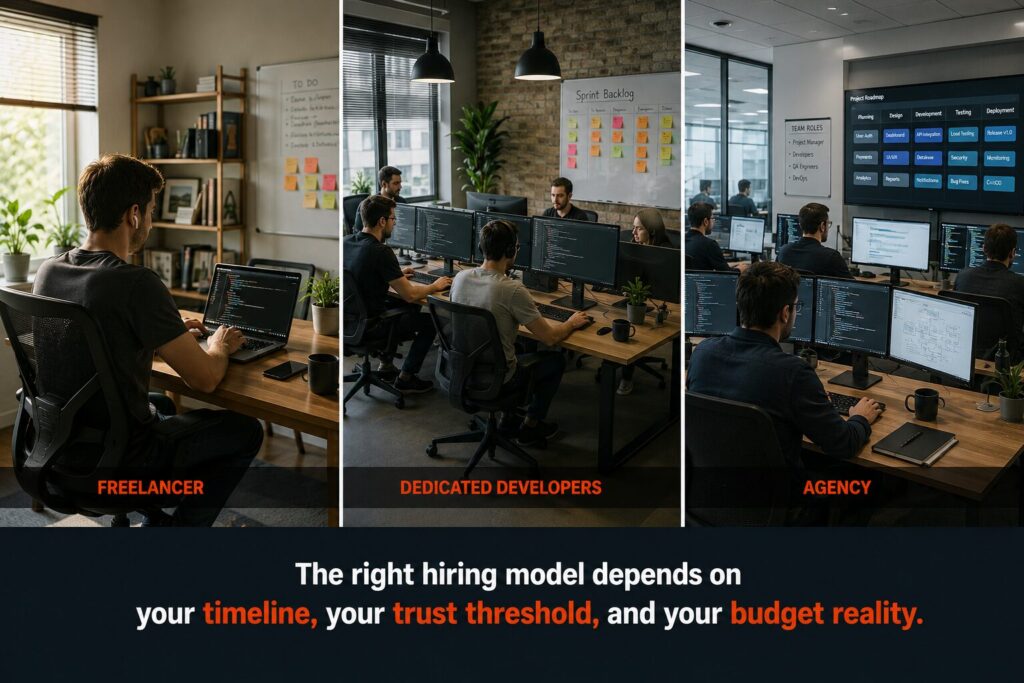
Choosing the right hiring model is as important as choosing the right developer. Each option has trade-offs that matter depending on your project scope, timeline, and budget.
Dedicated Developers
Hiring dedicated Golang developers means bringing a developer (or team) on board full-time through a staffing partner or development firm. They work exclusively on your product, follow your processes, and integrate into your team. This model works best for ongoing product development, long-term infrastructure projects, and teams that need consistent output.
The key advantage: you get continuity, institutional knowledge, and a developer who understands your codebase deeply over time. Hire dedicated Golang developers in India through platforms like HireDeveloper.dev to get this model at significantly lower cost than US-based hiring.
Freelance Golang Developers
Freelancers offer speed and flexibility. You can find Golang developers to hire on platforms like Upwork, Toptal, or Gun.io for short-term tasks, proof-of-concept builds, or specific feature development. The downside is inconsistency quality varies widely, availability can shift mid-project, and knowledge transfer is a recurring cost.
For non-critical, bounded tasks with clear deliverables, freelancers work well. For anything mission-critical or long-term, the risks often outweigh the savings.
Golang Development Agencies
Golang development agencies provide a full delivery team: developers, tech leads, QA, and project managers. They’re ideal when you need to build an entire product or platform from scratch, or when you lack internal engineering leadership to manage a team. The trade-off is cost and communication overhead you’re paying for process, not just code.
Which Hiring Model Is Best in 2026?
| Model | Best For | Cost | Risk |
| Dedicated Developers | Ongoing product work | Medium | Low |
| Freelancers | Short-term, bounded tasks | Low–Medium | Medium–High |
| Agencies | Full product builds | High | Low–Medium |
For most product companies and SaaS founders in 2026, dedicated developers offer the best balance of cost, continuity, and quality especially when hired through a vetted platform that handles sourcing and screening upfront.
Hire Remote Golang Developers or Build an In-House Team
If you’re seriously evaluating how to hire remote Golang developers, the comparison with in-house teams deserves an honest look. Remote hiring has matured significantly, and, in most cases, it wins.
Cost Efficiency
Building a fully in-house Go team in the US means salaries starting at $130,000 per year per developer, plus benefits, office space, and recruiting costs. Hiring remote Golang developers, especially from India or Eastern Europe delivers comparable skill at 40–60% of that cost. The savings compound across a team of five or ten engineers.

“We ran the numbers on in-house vs. remote hiring. For a team of four senior Go engineers, remote saved us over $400,000 annually — and the quality of work was indistinguishable.” — Engineering Manager, SaaS startup (anonymized, via HireDeveloper.dev)
Access to Global Talent
Go is still a relatively niche language. Limiting your search to a single city or country significantly shrinks your talent pool. Going remote opens access to the strongest Golang engineers across India, Eastern Europe, Southeast Asia, and Latin America — regions with deep technical talent and growing Go communities. The Go GitHub repository itself has contributors from over 80 countries.
Faster Team Scaling
Remote hiring timelines are shorter. With the right partner, you can have a vetted Golang team onboarded in two to four weeks versus two to four months for in-house recruiting. When you’re scaling a product and every sprint matters, that speed advantage is significant.
Operational Flexibility
Remote Golang teams offer contract flexibility that in-house teams don’t. You can scale up during a major product push and scale down post-launch without the overhead of hiring and layoffs. For startups and growth-stage companies managing runways, flexibility is often the deciding factor.
HireDeveloper.dev helps startups and enterprises hire dedicated Golang developers for scalable backend systems, with fast onboarding, flexible contracts, and no recruiting overhead.
Why Companies Hire Golang Developers in India
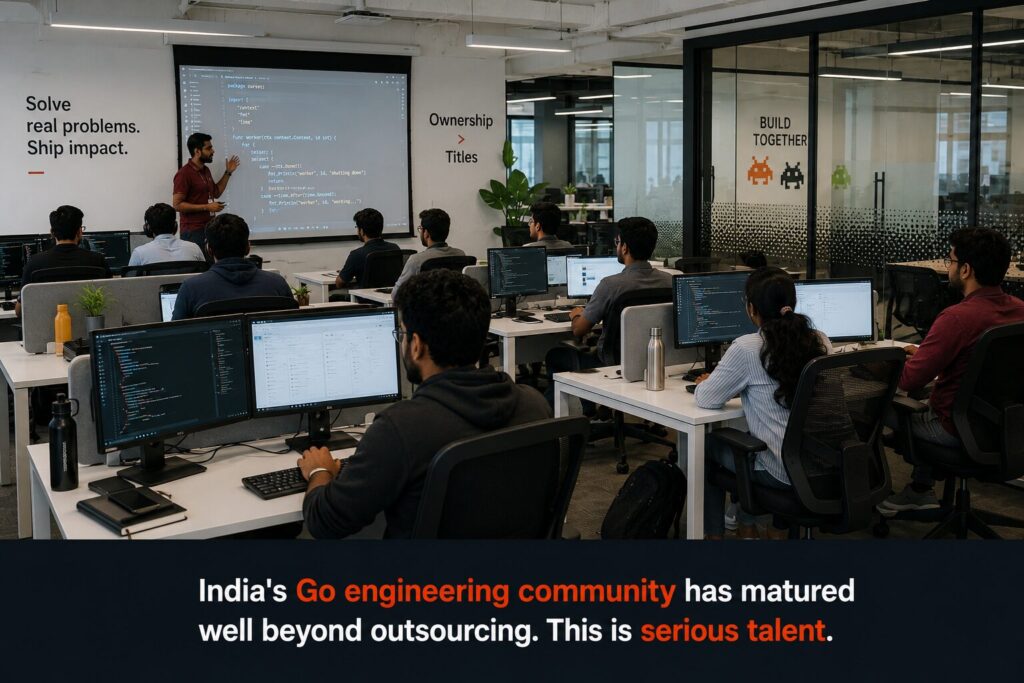
India has become one of the most strategically important destinations for Go engineering talent and it’s not just about cost. The quality of backend engineers coming out of India’s top technology centers has improved dramatically.
Lower Development Costs
The cost to hire Golang developers in India is typically 50–70% lower than equivalent US talent. A senior Go developer in India commands $25,000–$45,000 annually versus $130,000–$160,000 in the US. For companies building or scaling engineering teams, that margin allows you to hire two or three senior Indian engineers for the cost of one US-based hire.
Strong Engineering Talent Pool
India produces over 1.5 million engineering graduates annually, with a growing concentration of backend and systems developers who specialize in Go. Cities like Bangalore, Hyderabad, Pune, and Chennai have mature Go communities’ meetups, open-source contributors, and developers with experience across fintech, cloud infrastructure, and enterprise SaaS.
“The Go engineers we hired through HireDeveloper.dev in Bangalore came in with stronger distributed systems fundamentals than several candidates we’d interviewed locally in London. It was a genuine surprise.” — CTO, enterprise software company (anonymized)
Offshore Development Advantages
Golang outsourcing to India gives companies access to dedicated teams who operate on long-term engagements. Unlike freelancing, offshore development relationships allow for knowledge of accumulation, team continuity, and ongoing product ownership, without the cost and compliance overhead of international employment.
Faster Hiring & Scaling
Hiring pipelines in India move quickly when you work with the right partner. Pre-vetted Go engineer pools mean you can move from requirement to onboarded developer in under three weeks. For companies that need to hire Go engineers at scale building out a backend team of five, ten, or twenty developers. India offers the throughput no other market can currently match.
Skills to Look for Before You Hirea Golang Developer
Screening Go developers effectively requires knowing what separates strong candidates from average ones. Here’s what to assess before making any hiring decision.
API & Backend Architecture Skills
Strong Golang engineers understand RESTful and gRPC API design beyond basic routing. Look for experience with API versioning, rate limiting, authentication flows (OAuth 2.0, JWT), and middleware composition. Golang web development expertise means understanding how backend decisions cascade to frontend performance and reliability. Reference the gRPC official documentation to understand what deep gRPC knowledge looks like in a candidate.

Kubernetes & Docker Experience
Modern Go development is inseparable from container orchestration. Any strong Golang development services candidate should demonstrate hands-on experience with Docker containerization and Kubernetes deployments. Ask about how they’ve handled rolling updates, health checks, resource limits, and pod autoscaling in production environments. Strong candidates can speak to real production incidents, not just documentation.
Database & Cloud Knowledge
Go developers don’t work in isolation. They interact with databases (PostgreSQL, MongoDB, Redis), message queues (Kafka, RabbitMQ), and cloud services (AWS Lambda, GCP Cloud Run). A strong Go language developer knows when to use a relational model versus NoSQL, how to manage connection pooling, and how to instrument queries for performance.
Scalability & Concurrency Expertise
This is Go’s core strength and where many self-proclaimed Go developers fall short. Strong Golang engineers understand goroutines, channels, sync primitives, and common concurrency patterns like worker pools and fan-out/fan-in. They know how to avoid race conditions, deadlocks, and memory leaks in concurrent code. Test this rigorously in technical interviews.
“Any developer can copy goroutine code from a tutorial. The real test is whether they can explain why a channel blocks, when to use a mutex instead, and how to profile a goroutine leak. That’s the line between a Go user and a Go engineer.” — Gourav Soni, Founder, HireDeveloper.dev
Building a Go team from scratch? Companies building cloud-native platforms often choose HireDeveloper.dev for pre-vetted Go engineering talent with demonstrated skills in concurrency, cloud, and microservices architecture.
How to Vet and Interview Golang Developers Properly
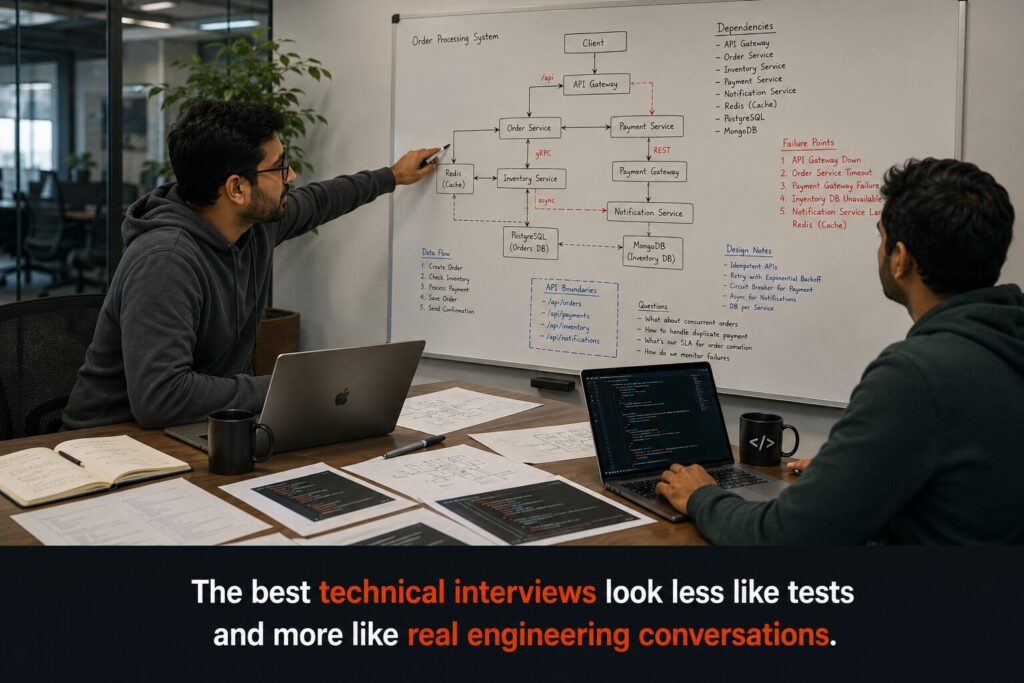
Hiring the wrong Golang developer is expensive, both in time and in technical debt. A structured evaluation process protects you.
Technical Evaluation Process
Start with a practical coding exercise using Go idioms, not generic algorithm puzzles. Give candidates real-world scenarios: write a concurrent file processor, design a rate-limited API wrapper, or fix a race condition in provided code. This reveals how they think in Go, not just whether they can code.
Review their GitHub or open-source contributions if available. A developer with real Go projects in the wild shows you how they structure code when no one is watching. The Go GitHub repository and ecosystem projects are good benchmarks for what high-quality Go code looks like.
System Design Interviews
For senior Golang backend development roles, system design interviews are non-negotiable. Present a realistic problem — design a URL shortener that handles 10 million requests/day, or architect for a real-time notification service for a SaaS platform. Strong candidates naturally reach Go’s concurrency model, talk about horizontal scaling, and think in terms of failure modes and observability.
Case study: One of HireDeveloper.dev’s enterprise clients — an e-commerce platform in the UK — ran system design interviews for five Go candidates. The two who progressed to hire both independently proposed event-driven architectures using Kafka and Go consumers. Pattern recognition in strong candidates is consistent and tells you more than any resume.
Communication & Collaboration Skills
For remote Golang teams, communication is a force multiplier. Evaluate how clearly candidates explain technical trade-offs, how they handle ambiguity, and how they respond to code review feedback. A developer who communicates well with product and design teams is worth more than one who codes perfectly but operates in isolation.
Golang Developer Salary in 2026
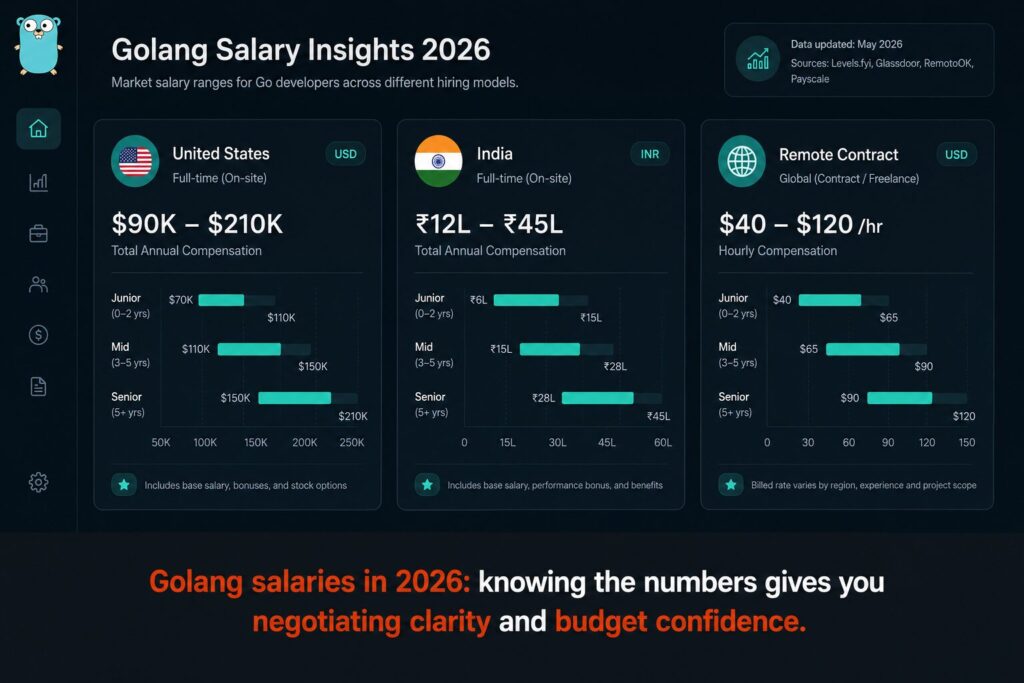
Understanding go developer salary benchmarks helps you budget accurately and negotiate competitively.
US Hiring Costs
In the United States, Golang developers command some of the highest backend engineering salaries in the market. Junior Go developers start around $90,000–$110,000 per year. Mid-level engineers earn $120,000–$145,000, and senior Go engineers or tech leads with distributed systems experience can exceed $160,000–$200,000 annually, especially in San Francisco or New York.
India Hiring Costs
To hire Golang developers in India, expect significantly different ranges. Junior developers start at $8,000–$15,000 per year. Mid-level engineers with two to five years of Go experience earn $18,000–$30,000. Senior engineers with cloud-native and microservices experience earn $30,000–$50,000, a fraction of US market rates for comparable skill levels.
Remote Developer Rates
For contract and remote Golang developers working on hourly or project-based engagements, rates vary by region and seniority. Eastern European Go developers typically bill $50–$90/hour. Indian Go developers range from $25–$55/hour. US-based remote contractors often charge $100–$150/hour or more. Long-term dedicated arrangements typically offer better rates than short-term contracts.
| Region | Junior (Annual) | Senior (Annual) | Contract Rate/hr |
| United States | $90K–$110K | $160K–$200K | $100–$150 |
| India | $8K–$15K | $30K–$50K | $25–$55 |
| Eastern Europe | $25K–$45K | $70K–$100K | $50–$90 |
Common Mistakes Companies Make When Hiring Golang Developers
 Even experienced engineering leaders make preventable mistakes when hiring Go talent. Here’s what to avoid.
Hiring Based Only on Cost
The cheapest Golang developer is rarely the best value. Low-cost developers without proper Go experience often write Python-style code in Go, ignoring concurrency patterns, misusing goroutines, and creating performance problems that cost far more to fix than the savings on salary. Golang outsourcing requires quality screening, not just cost comparison.
“We once onboarded a developer who listed Go as a primary skill but had only used it for a side project. It took three months to discover the concurrency issues embedded in the code he wrote. The refactor cost us more than his entire contract.” — Engineering Manager, (anonymized, via HireDeveloper.dev)
Ignoring Scalability Experience
Go’s main value proposition is scale. Hiring a Go engineer without testing their understanding of concurrency, distributed systems, and performance optimization defeats the purpose. Always assess scalability thinking in technical interviews, not just syntax knowledge.
Weak Technical Screening
A brief phone call and a resume review is not a hiring process for backend engineers. Developers who list Go on their resume but have minimal hands-on experience are common. Require a practical coding task, a system design discussion, and ideally a reference or portfolio review before making any offer to hire Go engineers.
How the Right Golang Team Helps Businesses Scale Faster
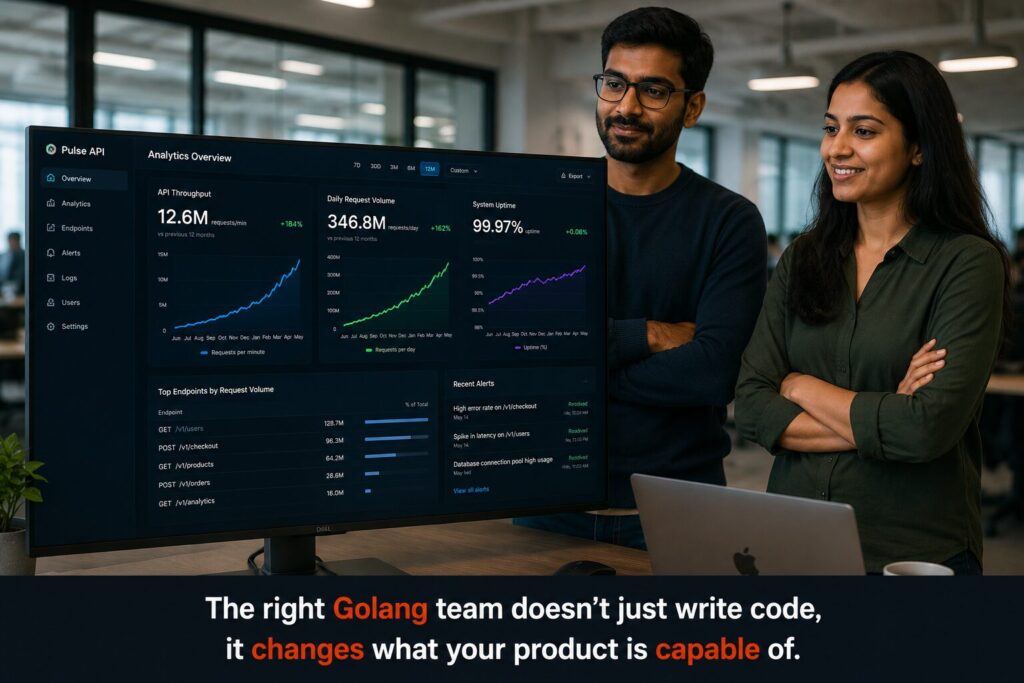 The right Golang team doesn’t just write code, it changes the trajectory of your product.
Faster Product Development
Go’s simplicity and strong standard library reduce the decision of fatigue that comes with more complex language ecosystems. Golang teams spend less time debating frameworks and more time shipping. For startups especially, that velocity advantage compounds quickly across a product roadmap.
Real example: A healthcare data startup replaced their Python-based ETL pipeline with a Go implementation built by a two-person dedicated team. Development time for new data connectors dropped from two weeks to three days, a 5x velocity improvement on a critical path feature.
Better Infrastructure Performance
Backend systems built in Go handle more load with less compute. That translates directly to lower cloud infrastructure costs and better user experience. Golang backend systems consistently outperform equivalent Python or Ruby implementations in throughput and latency benchmarks often by a factor of five to ten, as documented in the Go performance FAQ.
Long-Term Cost Efficiency
Go’s readable, opinionated codebase makes it easier for new engineers to onboard, contribute, and maintain existing systems. Golang development outsourcing relationships tend to stay productive over longer periods because the codebase doesn’t accumulate complexity the way unmanaged JavaScript or Python backends often do. The maintenance cost advantage compounds over years.
Why Partner with a Golang Development Company Instead of Hiring Alone
Solo hiring for Golang roles is time-intensive, expensive, and error-prone especially when your team doesn’t have deep Go expertise to evaluate candidates effectively.

Faster Access to Pre-Vetted Developers
A specialized Golang development company maintains a bench of developers who have already been screened for technical skills, communication quality, and professional reliability. Instead of sourcing, interviewing, and vetting for weeks, you access qualified candidates in days. That time savings matter when your engineering roadmap isn’t waiting.
Flexible Scaling Models
The right partner lets you start with one dedicated Go developer and scale to a full team as your product grows without renegotiating contracts or rebuilding hiring pipelines. Golang development services built around flexibility mean you can respond to product opportunities without being constrained by headcount decisions made months earlier.
Reduced Hiring Risks
Bad hires in engineering are costly in severance, in lost velocity, and in technical debt. Golang developers hire through a structured platform to come with quality guarantees, trial periods, and replacement options that solo hiring can’t offer. That risk reduction has real financial value, especially for companies without internal Go expertise to evaluate performance.
“The difference between hiring alone and working with a specialized partner is about six weeks and several poor conversations with candidates who shouldn’t have been in the pipeline at all.” — Gourav Soni, Founder, HireDeveloper.dev
HireDeveloper.dev - Choose the Right Golang Developers in 2026
Finding the right Golang developer isn’t about posting a job listing and hoping. It’s about working with a partner that understands what good Go engineering looks like and has already done the hard work of finding it.
HireDeveloper.dev Specializes in connecting CTOs, startup founders, and engineering leaders with pre-vetted Golang developers and teams. Whether you need one senior Go engineer to lead a backend refactor, or a full Golang team to build out your cloud-native infrastructure, HireDeveloper.dev gives you a faster path to the right talent.
Every developer on the platform has been evaluated for Go-specific technical skills concurrency patterns, microservices architecture, cloud integration, and system design. No guesswork, no resume gambling, no three-month hiring cycles.
What you get with HireDeveloper.dev:
- Pre-vetted Go engineers with demonstrated backend and cloud experience
- Flexible hiring models: dedicated, part-time, or full teams
- Fast onboarding — most engagements start within two to three weeks
- Transparent pricing with no hidden recruiting fees
- Ongoing support and developer replacement guarantee
If you’re serious about building scalable backend systems in 2026, the smartest move is to stop searching alone and start working with a team that’s already found what you’re looking for.
Talk to HireDeveloper.dev today →
Explore Our Other Services
- Hire Dedicated Developers
- IT Staff Augmentation — High-intent alternative service. Hire Developer
- Offshore Development — Strong commercial/offshore hiring intent. Hire Developer
- Hire React Developers — Technology-specific hiring page. Hire Developer
- Hire Node.js Developers — Technology-specific hiring page
Related Sources
- Hire Remote Golang Developers: Scale Without In-House Teams
- Hire Golang Developers in India
- Startups: Hire Dedicated Golang Developers for Scalable Backend Systems
- Cost to Hire Golang Developers in 2026
- Skills to Evaluate When Hiring Golang Developers in 2026
- Golang Developers: Skills to Look For
- Golang Development Outsourcing: Offshore Go Teams in 2026
- Golang Development Company vs. Freelancers: Why Choose a Company in 2026
- Golang Development Services for SaaS Business Growth in 2026
- Golang Developers: Integrate Seamlessly With Your Team
- Cloud-Native Microservices with Golang
- Golang Development Trends in 2026