








Introduction
Your API response times just crossed 800ms. Your cloud bill doubled last quarter. Your senior engineer is in a Slack thread at 2am explaining why the database connection pool is exhausted again. You’ve got users, you’ve got traction, and your backend is quietly becoming the thing that kills the company.
The startups that don’t end up in that situation usually made one deliberate call earlier than the rest: they decided to hire dedicated Golang developers, people who actually understand Go at a systems level, not just people who can read the syntax. This article explains exactly why that decision matters, what it looks like in practice, and what separates a smart Go hire from an expensive mistake. If you want the full hiring guide, our hire golang developers guide covers everything from vetting to salaries to team structures.
What is Backend Development and Why the Language Choice Is Make-or-Break
Most founders understand backend development at a surface level, it’s the server-side layer that processes requests, talks to databases, and serves APIs. What they often miss is that this invisible layer becomes the single point of failure the moment your user base scales. When you outsource backend development services early on, you’re making a bet that the language and architecture underneath can grow with you. Most of the time, that bet is wrong.
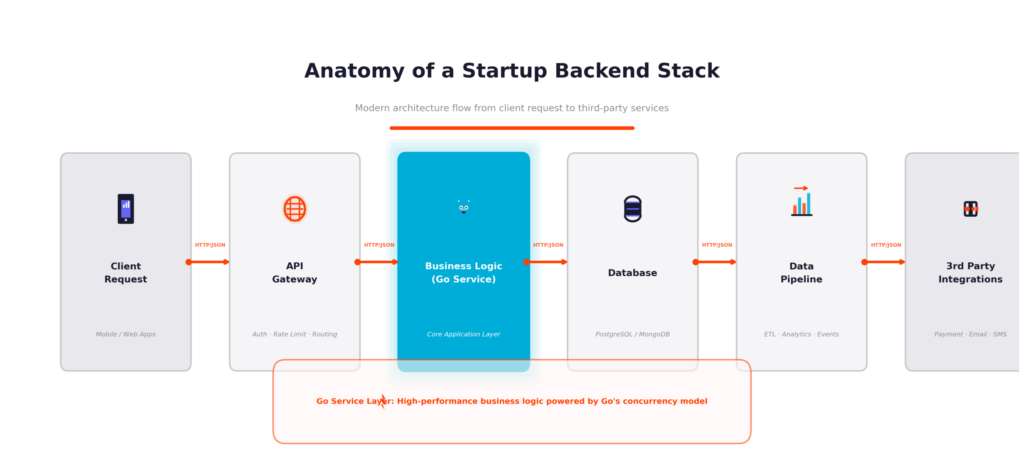
The server-side work nobody talks about until it breaks
Backend development is everything the user never sees: the server logic that processes requests, the APIs connecting your frontend to your database, the authentication layer, the data pipelines that keep your product functioning between user actions. When people ask about backend development, they’re talking about the part of the stack that either holds everything together or becomes the single point of failure at 50,000 concurrent users.
Most startups outsource their backend development services to agencies or hire generalist developers early on. That works fine for a while. The backend stays invisible, which is exactly what it’s supposed to do. The problem is that invisibility doesn’t last, it just delays the reckoning.
Why the language you build on sets your scalability ceiling
Python and Node.js are genuinely excellent for getting to a working product fast. Python has the ecosystem depth; Node.js has the event-driven model. Both hit a wall at scale that’s baked into the language design, not something you patch your way out of.
Python’s GIL the (Global Interpreter Lock) means only one thread executes Python bytecode at a time. Under heavy concurrent load, your CPU cores sit largely idle while requests queue up. Node.js handles concurrency through a single event loop, which breaks down the moment you introduce CPU-bound work. Java handles concurrency better than both, but each thread carries significant memory overhead, and deployment is slow enough to be genuinely painful at startup iteration speeds.
Go was designed at Google specifically because the engineers there were tired of exactly these trade-offs. Performance comparable to C; deployment simplicity closer to Python, concurrency that actually works at scale. That’s the foundation the rest of this article sits on.
Why Go Wins for Scalable Backend Systems: The Technical Case
Go’s advantage isn’t marketing. It’s math. The goroutine starts at 2KB. An OS thread needs 1–2MB. At 50,000 concurrent connections, that’s the difference between running on your existing hardware and tripling your infrastructure budget. The decision to hire dedicated Golang developers is a technical one, and it deserves specifics, not surface-level lists, but the actual mechanics of why Go outperform when backends are under real load.
Goroutines, channels, and why concurrency matters
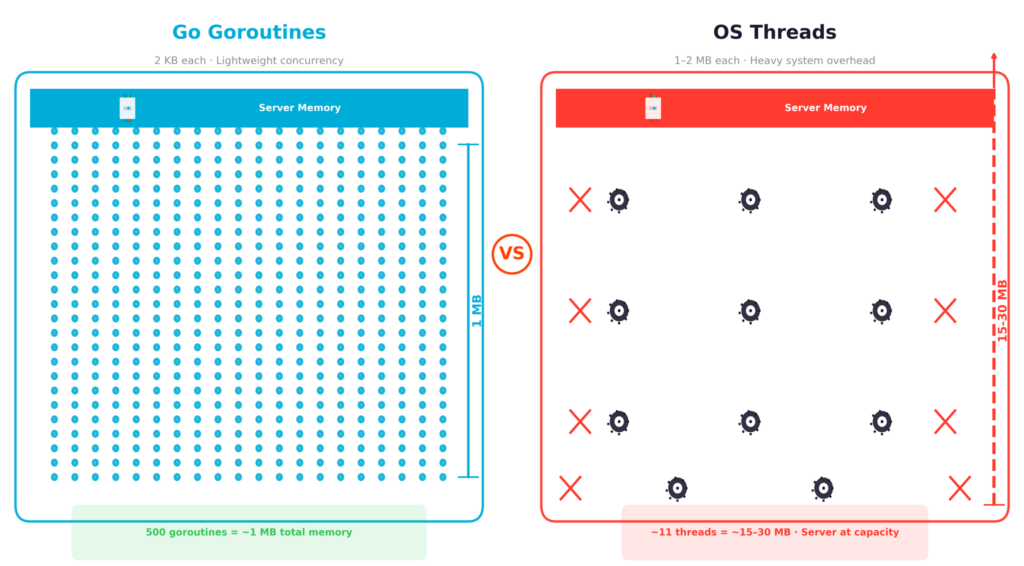
A goroutine starts with roughly 2KB of stack space. An OS thread typically requires 1–2MB. That sounds like a footnote until you’re running a payment gateway processing 50,000 simultaneous transactions. At that scale, the difference isn’t marginal; it’s the difference between your system handling the load on the hardware you have and needing to triple your infrastructure to spend.
Golang backend development is built around the CSP model, Communicating Sequential Processes. Where goroutines pass messages through channels rather than fighting over shared memory. In practice, this means fewer race conditions, cleaner code, and failures that are easier to reason for. If you’ve ever spent three days tracking down a concurrency bug in a Java application because two threads were mutating the same state simultaneously, you’ll understand why Go engineers genuinely prefer this approach.
Compiled, not interpreted – what that means for your API speed
Go compiles directly to native machine code. There’s no JIT warmup like the JVM needs, and no GIL throttling execution like Python. The binary of your Golang development team ships runs at close to the speed of C, from the first request.
A fintech startup in the HireDeveloper.dev talent network migrated to their core transaction processing service from Python to Go. Their p99 latency, the response time for the slowest 1% of requests and dropped from 420ms to under 40ms. That’s not a 10% improvement. It’s an order-of-magnitude change. Golang application development at this level doesn’t just make your product faster; it changes what your product can credibly promise enterprise customers on SLAs.
Built for the cloud stack you’re already running
Kubernetes, Docker, Prometheus, terraform, these aren’t just written in Go by coincidence. They were written in Go because Go produces small, statically compiled binaries that deploy cleanly, start instantly, and carry none of the runtime baggage that makes Java containers so heavy. A skilled golang engineer building your services inside this ecosystem is working with the grain of the tools, not against it. The standard net/http package handles high-throughput API workloads without an external framework. As Go’s official documentation describes, the language was explicitly designed for large-scale, production-grade systems where reliability and performance are non-negotiable.
Go vs. the alternatives — a direct comparison
| Language | Concurrency model | Memory per connection | Deployment size | Cloud-native fit |
| Go | Goroutines + channels (CSP) | ~2KB per goroutine | Small static binary (5–15MB) | Excellent — K8s, Docker, Terraform all in Go |
| Node.js | Single-threaded event loop | ~1MB per connection | Medium (node_modules bloat) | Good — but CPU-bound tasks stall the loop |
| Python | GIL limits true parallelism | ~8MB per thread | Large (virtual env + deps) | Fair — strong tooling, poor raw throughput |
| Java | OS threads (heavy) | ~1–2MB per thread | Large JVM + JAR (100MB+) | Fair — needs JVM tuning, slow cold starts |
Real-World Use Cases: Where Startups Deploy Golang Backends
Uber, Dropbox, and Twitch didn’t adopt Go because it was trendy. They adopted it because their existing stacks broke under the load their businesses required. For a startup CTO evaluating whether to hire Golang developers, these aren’t case studies from a textbook; they’re proof that the same patterns you’re facing have already been solved at scale.
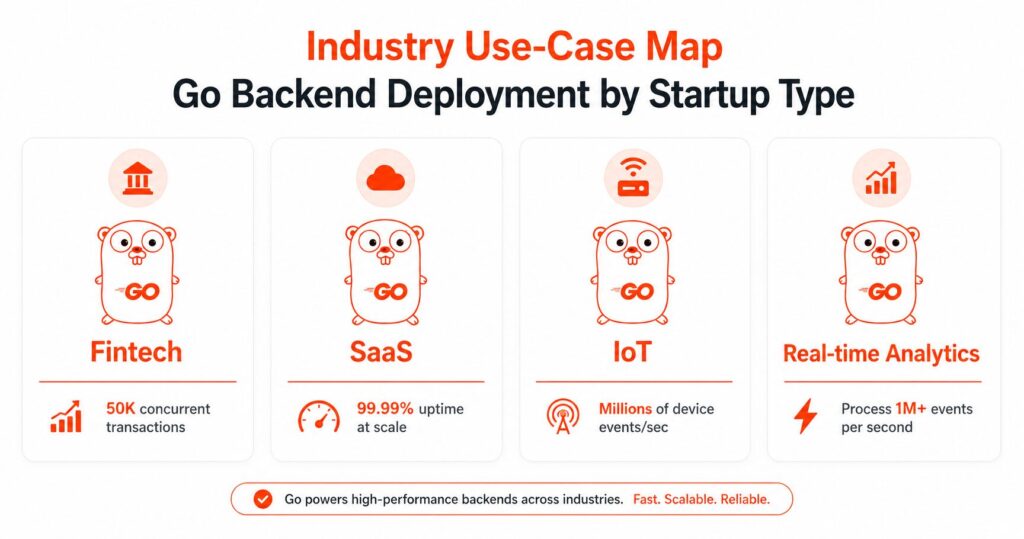
What the big companies proved first
Uber built their geofencing microservice in Go, a system matching millions of drivers and riders in real time, calculating location intersections across enormous geographic datasets with sub-second latency requirements. These weren’t experiments. They were production decisions made because the alternatives couldn’t handle the load. Dropbox migrated their storage backend from Python to Go because the Python implementation couldn’t keep pace with their data volumes; the Go rewrite cut infrastructure costs significantly and dramatically improved throughput. Twitch rebuilt their entire chat system in Go to handle millions of simultaneous persistent connections, the kind of workload that breaks event-loop-based languages in predictable and ugly ways. When you hire golang developers at this level, you’re accessing engineers who understand why those companies made those calls.
The startup patterns that keep recurring
Fintech payment APIs are probably the most common Go success story in the startup world. Low latency, high concurrency, regulatory requirements around error handling and auditability, Go’s type system and explicit error handling make compliance easier to enforce. Multi-tenant SaaS architectures benefit from Go’s memory efficiency; you’re not paying cloud costs proportional to your tenant count. IoT data ingestion pipelines are a natural fit because Go handles millions of device events per second without the memory overhead that makes Python or Node.js solutions expensive to operate at that volume. Real-time analytics dashboards use Go’s streaming capabilities to aggregate data on the fly rather than relying on caching layers that introduce staleness.
One example worth citing: a B2B SaaS company migrated their reporting pipeline from Ruby to Go over three months. Their infrastructure costs dropped by 38%, and report generation time fell from nine seconds to under 800 milliseconds — without adding a single server. That’s the kind of outcome backend development in Go regularly produces when the system is actually under load. Go is increasingly the default choice for teams serious about scaling their backend development.
Dedicated Golang Developers vs. Generalist Hires: Why Specialization Pays Off
The gap between knowing Go syntax and writing production-grade Go is wider than most hiring managers realize. A developer who lists Go on their CV after a few months of tutorials will produce code that compiles but doesn’t scale goroutine leaks, over-engineered abstractions, and race conditions that only surface under production load. That’s why startups who get this right don’t just hire the language. They hire for the idioms.
What a generalist hires costs you
Here’s what happens more often than anyone admits: a developer applies for a Go role, lists Go on their CV and genuinely believes they know the language because they’ve spent three months reading tutorials and rewriting a side project. You hire them. Six months later, your codebase is full of deeply nested interface hierarchies that serve no purpose in Go’s type system, goroutines that were started and never properly managed — leaking memory quietly across every request — and a complete absence of go vet in the CI pipeline because they didn’t know it existed.
This isn’t hypothetical. It’s the single most common reason for companies who decide to hire dedicated golang developers to end up re-hiring six months after the first attempt. The cost isn’t just the salary. It’s the technical debt that takes the next team six months to unwind.
What a dedicated golang engineer brings
A real golang engineer doesn’t look up goroutine lifecycle patterns, they know instinctively where a goroutine needs a done channel, where context.WithCancel is the right tool, and were launching a goroutine at all is the wrong call. They understand Go’s error handling philosophy: errors are values, not exceptions, and propagating them explicitly through the call stack is a feature, not a limitation. When you hire go engineers at this level, you’re also frequently getting someone who can set up your CI/CD pipelines, write your Terraform modules, and make sensible infrastructure decisions, capabilities that would otherwise require a separate DevOps hire.
There’s a reason experienced engineering teams specifically seek Golang developers for hire rather than training existing Java or Python engineers. The patterns are different enough that retraining takes longer than the salary delta suggests.
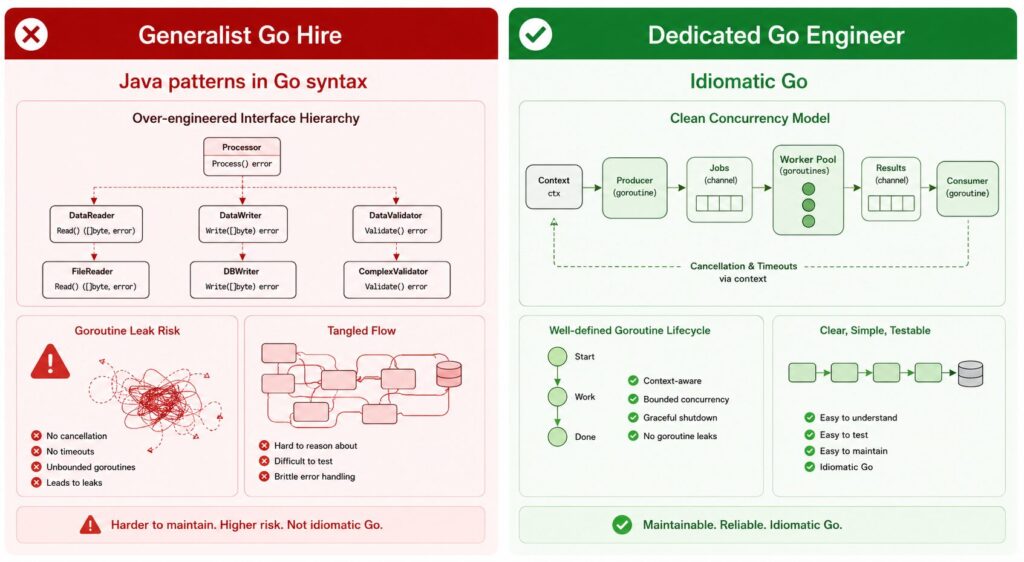
How to structure your Golang team at early scale
For a Series A startup where backend performance is already a concern, a practical structure is one Go architect who owns the system design and concurrency patterns, plus two to three mid-level Go engineers who can execute within that design. That team can build and maintain a production-grade microservices architecture without accumulating debt that slows you down in year two.
If budget is the constraint, and it usually building an India-based golang team extension through a vetted partner gives you 60–70% cost savings without a quality trade-off. Go’s opinionated simplicity enforced formatting via go fmt, and strong standard library mean that strong engineer’s ramp quickly regardless of geography. The key word is “vetted.” Sourcing golang developers for hire through a platform with a genuine technical screening process is categorically different from posting on a job board and hoping. Many startups also supplement with managed backend development services rather than building entirely in-house, especially in the early months. If you’re also evaluating when to hire backend developers more broadly versus building a specialized Go team, the decision usually comes down to how central concurrency and throughput are to your core product.
Red flags in a Golang hiring process
Three signals that the person you’re interviewing hasn’t actually internalised Go: they over-engineer with OOP abstractions that Go doesn’t need, they can’t walk you through detecting a race condition with go race, and they’ve never written a table-driven test. Any one of these suggests someone who learned the syntax without understanding the idioms. All three and you have a problem.
Why Startups Hire Dedicated Golang Developers in India: Cost, Quality & Timezone
Series A and B startups face a specific pressure: stretch runway without dropping technical quality. India has become a genuine source for Go talent — not because it’s cheap, but because the engineering depth is there and the cost structure makes sense for companies that need to hire dedicated golang developers india without compromising on vetting standards.
Cost efficiency without quality compromise
A US-based senior Go engineer commands $130,000–$180,000 annually. An India-based Go engineer through a vetted partner typically runs $35,000–$65,000 equivalent — roughly 60–70% savings. That isn’t a reflection of skill; it’s a reflection of market rates. Go’s simplicity means India-based engineers ramp faster than they would on complex Java or Scala systems, and CNCF data shows India among the top three contributors to Go-based open-source cloud-native projects. The quality is demonstrable, not theoretical.
What to verify before hiring
Don’t hire based on a CV that says, “Knows Go.” Look for a portfolio of shipped concurrent systems. Check for contributions to CNCF or Go open-source repos — that’s a quality marker you can verify in five minutes. Confirm timezone overlap: most India-based Golang teams offer 4–6 hours overlap with US and EU business hours, which is enough for daily standups and real-time collaboration. At HireDeveloper.dev, every Golang engineer in India goes through a multi-stage vetting process that includes live coding, system design, and concurrency-specific problem solving. See how we vet.
When Golang Is Not the Right Choice (Honest Trade-offs)
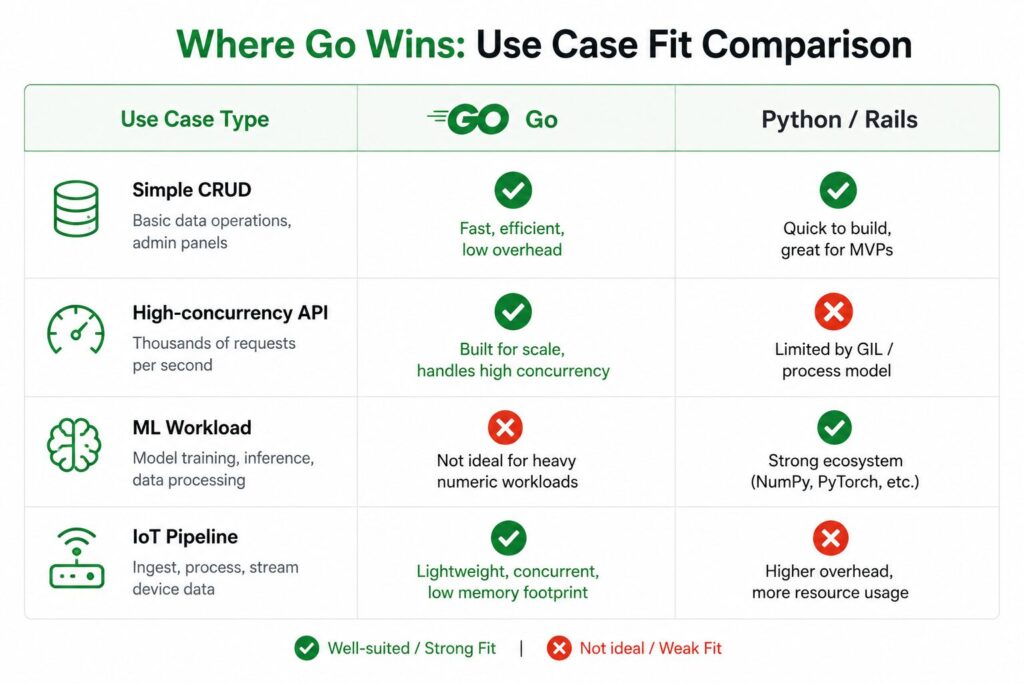
Go is not the right tool for every backend problem. Articles that pretend otherwise are marketing, not advice. Knowing where Go breaks, simple CRUD apps, ML workloads, rapid MVPs, is what makes the decision to hire dedicated golang developers an informed one rather than a trend-following mistake.
When Go is genuinely overkill
Go is the wrong tool for a simple CRUD application where the most complex operation is reading from a database and returning JSON. Rails, Laravel, or Django will get you to a working, maintainable product in half the time with a far larger pool of available developers. If you’re in the MVP stage and your primary concern is iteration speed rather than throughput, Go adds complexity both in the language and in hiring that you don’t need yet.
For ML and AI workloads, Go’s ecosystem is genuinely thin compared to Python’s. If your backends’ primary job is serving machine learning models, coordinating training pipelines, or processing data for LLM applications, the Go choice makes your life harder, not easier. Python wins that domain, and pretending otherwise costs you time. When companies hire backend developers for pure ML infrastructure, Python is almost always the right call.
The learning curve is real
CSP concurrency isn’t a natural extension of how most developers already think. Developers coming from Java or Python have spent years building instincts around thread-based or event-loop-based models. Shifting to channels and goroutines requires a genuine mental model change, and the bugs that appear when someone applies thread-based thinking to Go concurrency are exactly the kind that are hard to reproduce and expensive to debug.
Go’s standard library is excellent, but its ecosystem for niche enterprise integrations complex ORMs, legacy ERP system connectors, certain financial data format parsers is thinner than Java’s. These are real tradeoffs. For most startup backend systems, none of these limitations will surface. But they’re worth knowing about going in.
The CNCF Annual Survey consistently ranks Go among the top three languages in cloud-native development. The CNCF Annual Survey data makes clear this isn’t hype — it’s the ecosystem voting with production deployments.
Future-Proofing Your Backend: Why Go's Trajectory Matters for Startups
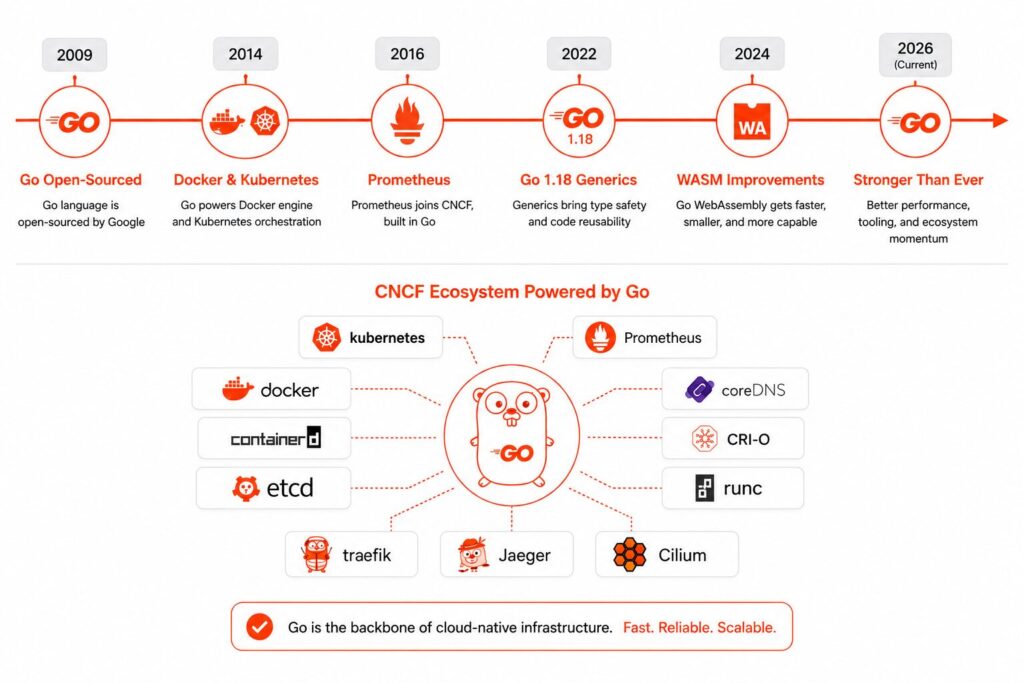
Startups make technology bets that need to last three to five years. Betting on a language that’s peaking and fading is a risk you can’t afford. Go’s trajectory isn’t speculative, it’s anchored in the infrastructure that already runs the internet, from Kubernetes to Prometheus to Terraform.
Generics, WASM, and the CNCF lock-in that protects you
Go 1.18 introduced generics, which removed the last credible objection from engineers who’d been holding back from Go for enterprise codebases. The standard library now supports type-safe generic operations without the verbosity that made earlier workarounds painful. It doesn’t change what Go is — it removes an excuse not to use it.
Go’s WASM support is earlier-stage but genuinely significant for startups building edge computing products or serverless workloads that need near-native speed at the network edge. The more durable point is the CNCF infrastructure: Kubernetes, Prometheus, etc., Helm, Terraform. The global cloud infrastructure layer is written in Go. That means the worldwide developer community maintaining these tools is permanently invested in Go’s ecosystem, tooling, and language evolution. This isn’t a trend you’re betting on. It’s an infrastructure that already runs most of the internet. When companies commit to golang development at the infrastructure layer, they’re building a foundation that isn’t going anywhere.
Start Building Your Golang Team with HireDeveloper.Dev
Golang backend development wins at scale because it was designed for exactly the problems that kill startup backends — concurrent load, cloud infrastructure complexity, and the need to do more with less hardware. But the language is only half the equation. The other half is the engineer writing it.
At HireDeveloper.Dev, we don’t send you CVs. We send you engineers who have already passed a multi-stage technical vetting process — live coding assessments, system design interviews, and concurrency-specific problem solving. Every golang engineer in our network has shipped production Go code, not just completed tutorials. Whether you need a single Go architect to set your patterns or a full golang team including India-based extension engineers at 60–70% cost savings, we match you to pre-screened talent in days, not months.
The decision to hire dedicated golang developers is worth making carefully. We help you make it confidently. See our complete guide on how to hire golang developers — covering vetting criteria, salary benchmarks, India versus local hiring, and what your interview process should look like for Go-specific roles.
Ready to build your Go backend team?
Every Golang engineer in the HireDeveloper.Dev network goes through a multi-stage technical vetting process — concurrency patterns, code review, and system design. You get pre-screened engineers, not job board applicants.
Talk to a Golang expert Read the full hiring guide