







What Builder.ai Promised and Why It Was Tempting
For founders and product heads under pressure, Builder.ai seemed perfect:
- No hiring delays.
- No need to manage engineers.
- No dev experience required.
- Faster MVP delivery.
But the fine print? Most clients didn’t even know who was writing their code, where it was stored, or how to migrate out.
What Went Wrong: The Hidden Costs of “No Developers Needed”
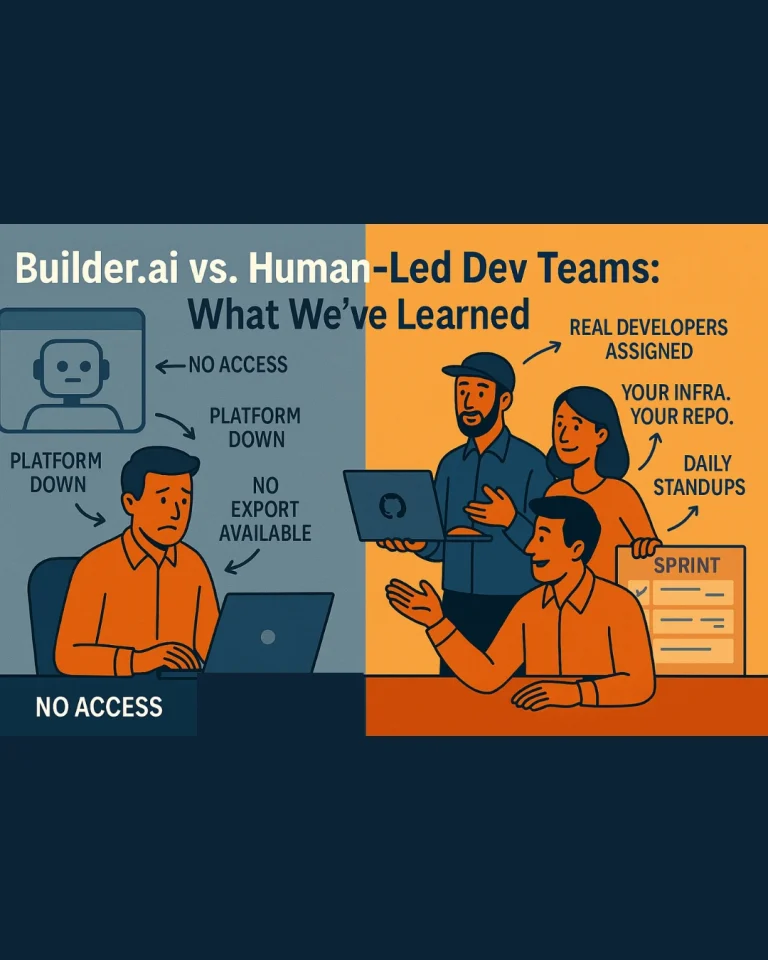
- Lack of Developer Visibility: Clients couldn’t speak to the devs behind their product, which meant no iteration, no real strategy, and no course correction.
- Rigid, Non-Responsive Workflows: Builder.ai operated like a vending machine. Submit a scope of work. No fluid feedback loops.
- Locked Infrastructure: Clients didn’t control repos, environments, or builds. When the platform collapsed, so did access.
- Zero Contextual Ownership: Product strategy evolved. Builder.ai didn’t. Teams couldn’t align their evolving vision with a static platform process.
The Human-Led Advantage (What We Do Differently)
Let’s get clear about the benefits of developer-embedded, human-led models like HireDeveloper.dev:
- You know who’s building your product: Developers are introduced by name. You can meet, manage, and collaborate directly.
- You control the code, infra, and delivery: Everything lives in your GitHub, on your cloud, with no strings attached.
- We adapt to your sprint, not force you into ours: Real agile. Daily updates. Slack, Zoom, Trello, your flow, our execution.
- You get stability without lock-ins: If you scale up, we support. If you pause, we exit cleanly. No black-box IP entrapment.
Real Example: What Human-Led Recovery Looks Like
One SaaS founder came to us after Builder.ai folded.
They had:
- No code access.
- No way to launch.
- No idea who had built what.
We assigned two senior developers in 72 hours. They reverse-engineered the logic from the staging link, rebuilt critical flows, and launched a stable MVP in 3 weeks.
That’s not just development, that’s rebuilding momentum with people who care.
Why Human Still Wins in 2025
Even with all the AI tools and automation out there, one thing remains true:
- Great products are conversations.
- Between idea and architecture.
- Between user needs and technical trade-offs.
Platforms can’t have those conversations. People can, and when you’re trying to move fast, fix what broke, and own your future, you don’t need another system. You need a team.
What You Avoid by Going Human-First
- You won’t get locked into one process.
- You won’t lose access to your product.
- You won’t wonder who’s responsible for quality.
- You won’t wake up to a shutdown notice ever.
- You’ll get real people, building real code, on your terms.
Platforms Make Promises, HireDeveloper.Dev Makes Progress!
At HireDeveloper.Dev, we specialise in smooth, secure project migrations with minimal downtime. Our expert developers don’t just fill roles, they integrate with your existing workflow, ensuring continuity and real results. With proven experience in Builder.AI transitions, we help you reclaim control of your product roadmap and move forward with confidence.
Start your migration journey today. Book a free consultation with HireDeveloper.Dev.
Related Resources:
- What Happened to Builder.ai? A Breakdown for Startup Founders
- How Builder.AI’s Collapse Shook the Startup World?
- How to React When Your Development Partner Fails Overnight?
- The 5 Stages of Vendor Grief and How to Get Unstuck
- Builder.ai’s Fall: Lessons for Product Owners and CTOs
- Builder.ai Migration Checklist: Save Your Code, Your Time, Your Product
- You Don’t Need to Start Over How to Transfer Your Project Safely
- From Panic to Progress, Real Strategies to Move on from Builder.ai
- Why Moving Fast Now After Builder.ai’s Collapse Will Save You Months Later
- How HireDeveloper.Dev Helps Builder.ai Clients Rebuild with Confidence
- No More Black Boxes: The Power of Developer Transparency
- AI Was the Hype: Human Execution Is the Reality
- In Crisis, Founders Need More Than Just Tech: They Need Trust
- Why Owning Your Codebase Is Non-Negotiable in 2025
- Avoiding the Next Builder.ai: Red Flags Every Buyer Should Watch For
- From Locked to Liberated: How We Helped Former Builder.ai Clients Reclaim Control
- The Myth of One-Click Apps: Why Custom Always Wins in the Long Run
- What Every Investor Wants to Know: Technical Due Diligence After Builder.ai
- From Recovery to Resilience: A Blueprint for Building Post-Builder.ai