Introduction
Ask five developers which React.js framework is best and you will get six answers. That is not because anyone is wrong. It is because the question hides a bigger one: what are you actually building?
React on its own draws components. Routing, server rendering, data loading and deployment come from somewhere else, and that is where React frameworks earn their keep. Your choice shapes SEO, hosting costs, hiring and how painful the next upgrade feels.
This guide compares ten React.js frameworks and tools using what changed through 2026, including React 19.3, Next.js 16.4 and TanStack Start 1.0. Some are full-stack frameworks, others are build tools or mobile platforms. We say which is which, share the trade-offs, and finish with a quick way to choose.
QUICK ANSWER
For most SEO-led products and SaaS, start with Next.js. Prefer a lighter, more explicit model? Try React Router or TanStack Start. Pick Astro for content sites, Vite + React for logged-in apps, Expo for mobile and Docusaurus for docs.
What Is a React Framework?
SHORT DEFINITION
A React framework is a toolkit built on top of React that adds what React leaves out: routing, rendering strategies, data loading, server code and build tooling. You ship a complete application instead of assembling one.
If you are still asking what is React JS, here is the one-line version: a React JavaScript library for building interfaces out of components. It decides how a screen looks as data changes. It does not decide how URLs map to pages, where data comes from, or whether HTML is built in the browser or on a server.
That gap is why the official React docs point new apps toward a framework or a build tool, and why Create React App was retired in 2025. A framework bundles sensible answers to those questions. You trade a little freedom for speed, conventions and fewer decisions.
Want to learn React framework concepts without drowning? Go in this order: components and Hooks first, then routing, then rendering. Even the component lifecycle React JS developers once memorised now maps to Hooks like useEffect, and interview questions in React JS still start there, so the basics pay off twice.
React vs React Framework: Understanding the Difference
Think of React as the engine and a framework as the whole car. You can build a perfectly good vehicle from parts, but most teams would rather start with the wheels attached.
| Area | React on its own | With a React framework |
| Core role | Renders UI components | Same React, plus an application structure |
| Routing | Add a router yourself | Built in, often file-based |
| Rendering | Client-side by default | SSR, static pages or Server Components |
| Data fetching | Your choice of library | Loaders, server functions or cached fetches |
| Server code | None | API routes and server functions |
| Build and deploy | You configure the bundler | Preconfigured, with deployment adapters |
| Typical use | SPAs, dashboards, widgets | SEO sites, SaaS, stores, full-stack apps |
NEXT.JS VS REACT
This is not a fair fight, because Next.js is React. Every Next.js app is a React app, but not every React app needs Next.js. The real question is whether you need server rendering, built-in routing and server code, or whether a lean single-page app will do.
10 Best React.js Frameworks to Use in 2026-27
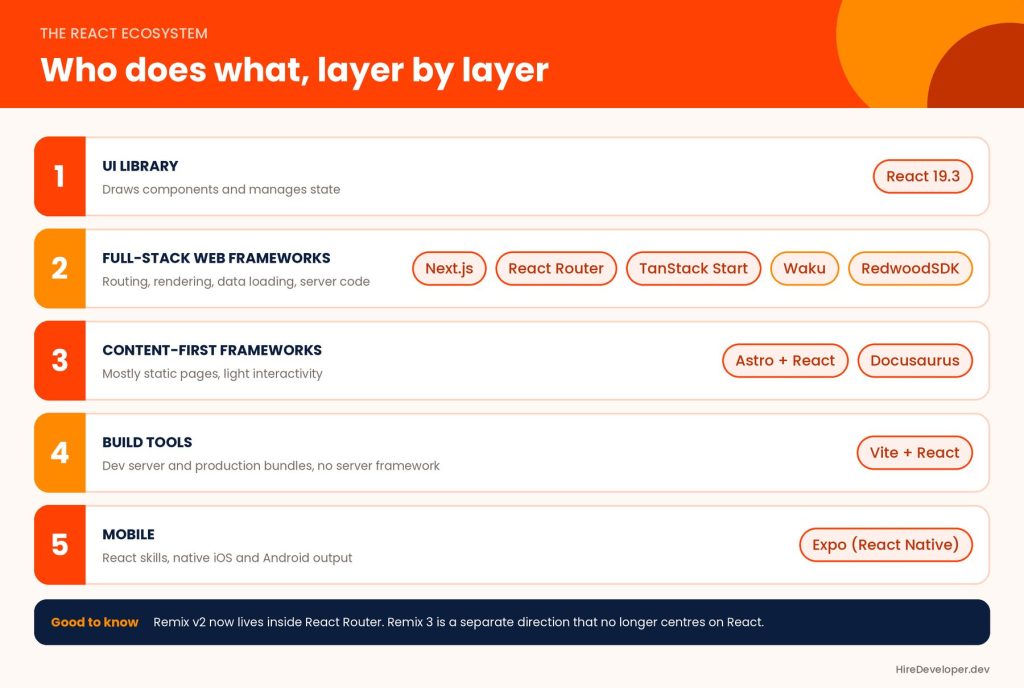
Quick note before the list: these ten are not like-for-like rivals. Some are full-stack web frameworks, one is a build tool, one is a mobile platform and one is for documentation, so each entry opens with a label. Gatsby, a regular on older lists, is missing on purpose. It is in maintenance mode, with no core release since early 2026 as of this writing, so we would not start a new project on it. Maintaining a Gatsby site today? Plan a migration path.
01 Next.js
FULL-STACK FRAMEWORK · VERSION 16.4
Next.js is still the default full-stack React framework, and the 16.4 release in October 2026 made its direction clearer. Cache Components, built on the ‘use cache’ directive, are now recommended for every app and become the default in Next.js 17. Around that sit the App Router, nested layouts, Server and Client Components, streaming, static generation, image optimisation and built-in server code through Route Handlers and Server Actions. Pages arrive as ready HTML, which is why SEO teams like it.
The trade-offs are real. Caching rules take time to learn, the release pace is fast, and it feels most at home on Vercel. Pick it for SaaS, e-commerce, enterprise portals and content-heavy products where hiring depth and ecosystem breadth matter.
| Best for | SEO-led sites, SaaS, e-commerce, enterprise apps |
| Trade-off | Steeper caching model and a fast release pace |
02 React Router
ROUTER AND FULL FRAMEWORK · VERSION 8
React Router stopped being “just a router” a while ago. It now works in three modes: declarative routing for simple single-page apps, data mode with loaders and actions, and framework mode, which adds route modules, server rendering, code splitting and type-safe route types. Version 8 arrived in mid-2026, and the 8.x releases keep adding framework features, including an API-only mode that is still marked unstable.
Because loaders and actions follow web standards, it suits dashboards, form-heavy products and teams deploying to many hosts. Server-driven react js pagination fits naturally into URL parameters and loaders. The cost is a thinner batteries-included story than Next.js.
| Best for | Data-heavy apps, forms, existing React Router codebases |
| Trade-off | You assemble more of the stack yourself |
03 Remix and Its Evolution into React Router
FRAMEWORK LINEAGE
This one confuses people, so here is the short version. Remix pioneered loaders, actions, nested routes and progressive enhancement. The team then folded those ideas into React Router, and what was planned as Remix v3 shipped as React Router v7. Remix v2 has since reached end of life, and the React-based Remix lineage continues as React Router framework mode.
The Remix name now belongs to something different. Remix 3 is a new direction with its own component model that no longer treats React as a core dependency, and it reached release-candidate stage in August 2026. Starting a React project today? Use React Router. Running a Remix v2 app? Follow the React Router upgrade path. Curious about Remix 3? Evaluate it as a new framework, not a React one.
| Best for | Teams with Remix v2 apps planning a migration |
| Trade-off | Naming confusion; Remix 3 is not a React framework |
04 TanStack Start
FULL-STACK FRAMEWORK · 1.0 STABLE
TanStack Start 1.0 went stable on 13 October 2026 after a long release-candidate period. It sits on TanStack Router, so routes, path params and search params are typed end to end, and it adds server rendering, streaming and server functions. It pairs naturally with TanStack Query, which suits dashboards and data-intensive SaaS.
Stable does not mean every feature is stable. React Server Components support is still experimental, so read the docs before depending on it, and keep packages patched, since an XSS advisory landed in late September 2026. Choose Start when your team loves TypeScript and wants control without a heavy convention layer.
| Best for | Dashboards, SaaS products, type-safe complex apps |
| Trade-off | Younger ecosystem; Server Components still experimental |
05 Docusaurus
REACT-BASED STATIC SITE GENERATOR · VERSION 3.10
Docusaurus takes the slot Gatsby used to hold, because it is a React-based static site generator that Meta’s open-source team still actively maintains. Version 3.10 landed in April 2026, and its Rspack-powered “Faster” build option is now stable. You get versioned docs, MDX, a blog, internationalisation and Algolia DocSearch, including its Ask AI option, without wiring anything yourself.
It is not for application development. Think documentation sites, developer portals, changelogs and knowledge bases. Choose it when writers should work in Markdown and React should only add interactive touches.
| Best for | Docs, developer portals, knowledge bases |
| Trade-off | Not designed for dynamic, app-like products |
06 RedwoodSDK
SERVER-FIRST FRAMEWORK · FORMERLY REDWOODJS
RedwoodSDK is what the original RedwoodJS project became. Version 1.0 arrived on 11 March 2026, and the direction shifted from a broad, GraphQL-heavy toolkit to a lean, server-first React framework for Cloudflare. It starts as a Vite plugin and adds server rendering, React Server Components, server functions and realtime features, with Workers, D1 and R2 as first-class building blocks.
The upside is a simple, edge-native stack. The downside is tight coupling to Cloudflare, so weigh lock-in early. Older RedwoodJS tutorials describe a different architecture, so do not mix them up. Choose it for full-stack apps already living on Cloudflare.
| Best for | Edge-native apps that want Server Components |
| Trade-off | Cloudflare coupling; newer ecosystem |
07 Expo (React Native Framework)
MOBILE FRAMEWORK, NOT A WEB FRAMEWORK
Expo is a React Native framework for mobile apps, and it is the clearest answer to the react js vs react native question. React.js renders to the browser DOM. React Native renders real native views on iOS and Android. They share components and Hooks, but not UI elements.
Expo SDK 56 (May 2026) shipped with React Native 0.85 and React 19.2, made Expo UI production-ready and sped up native builds. Expo Router adds file-based navigation, and web output exists if you need it. Choose Expo when your team has React skills and wants iOS and Android from one codebase. Skip it for a content website.
| Best for | Mobile apps built by React teams |
| Trade-off | Not a web framework; native modules need care |
08 Astro with React
MULTI-FRAMEWORK WEB FRAMEWORK · VERSION 6
Astro is a web framework for content-driven sites that supports React alongside other UI libraries, so it is not React-only. Its islands architecture renders pages as static HTML and hydrates only the interactive components, which keeps JavaScript small. Astro 6 went stable in March 2026, and Cloudflare, which acquired the Astro team in January 2026, has said the project stays open source.
Use it for marketing sites, blogs, documentation and content hubs with a few React widgets. It is a weaker fit for apps with heavy client state on every page.
| Best for | Marketing sites, blogs, content platforms |
| Trade-off | Less suited to highly interactive apps |
09 Vite + React
BUILD TOOL AND DEV SERVER · VITE 8
Vite is a build tool, not a full-stack framework. You get instant dev feedback, hot module replacement, TypeScript support and optimised production builds. Vite 8 (March 2026) made the Rust-based Rolldown its single bundler, which the Vite team says speeds up builds considerably. You add routing, data fetching and a backend yourself.
That freedom suits single-page apps, admin dashboards, internal tools and front ends that talk to a separate API, such as one from our Node.js development specialists. Prefer it when SEO does not matter, pages sit behind a login, or you want full control. Reach for a framework when you need server rendering.
| Best for | SPAs, dashboards, internal business tools |
| Trade-off | No built-in routing, SSR or server layer |
10 Waku
MINIMAL SERVER COMPONENTS FRAMEWORK · 1.0 RELEASE CANDIDATE
Waku is a minimal framework designed around React Server Components from day one, built on Vite and Hono. The 1.0 release candidate landed in August 2026 with public APIs fixed and unstable ones clearly marked, so treat it as promising rather than proven. It handles mostly static sites with some dynamic routes well: marketing sites, blogs, docs and light e-commerce.
It is a good way to learn Server Components without the surface area of Next.js. Its ecosystem, hosting options and hiring pool are small, so we would not bet a large enterprise product on it yet.
| Best for | Small sites, RSC learning, lean full-stack apps |
| Trade-off | Young ecosystem; confirm stability before launch |
React Frameworks Comparison: Features, Performance and Use Cases
| Framework / Tool | Category | Rendering / Architecture | Best for | Main strength |
| Next.js | Full-stack framework | SSR, SSG, Server Components, streaming | SEO-led SaaS, stores, enterprise | Broadest ecosystem |
| React Router | Router and framework | SPA, SSR, optional pre-rendering | Data-heavy apps, forms | Web-standard data flow |
| Remix | Framework lineage | v2 moved into React Router; Remix 3 is not React-based | Existing Remix v2 apps | Proven loader and action model |
| TanStack Start | Full-stack framework | SSR, streaming, server functions, typed routes | Dashboards, typed SaaS | End-to-end type safety |
| Docusaurus | Static site generator | SSG with MDX and versioned docs | Docs, developer portals | Docs features built in |
| RedwoodSDK | Full-stack framework | SSR and Server Components on Cloudflare | Edge-native apps | Simple Cloudflare-native stack |
| Expo | Mobile framework | Native iOS and Android via React Native | Mobile apps | One codebase, two stores |
| Astro with React | Multi-framework web framework | Static first, islands, optional SSR | Content sites | Minimal JavaScript |
| Vite + React | Build tool | Client-side SPA | Dashboards, internal tools | Fast dev loop, full control |
| Waku | Minimal framework | Server Components, static and dynamic routes | Small sites, RSC learning | Lean Server Components model |
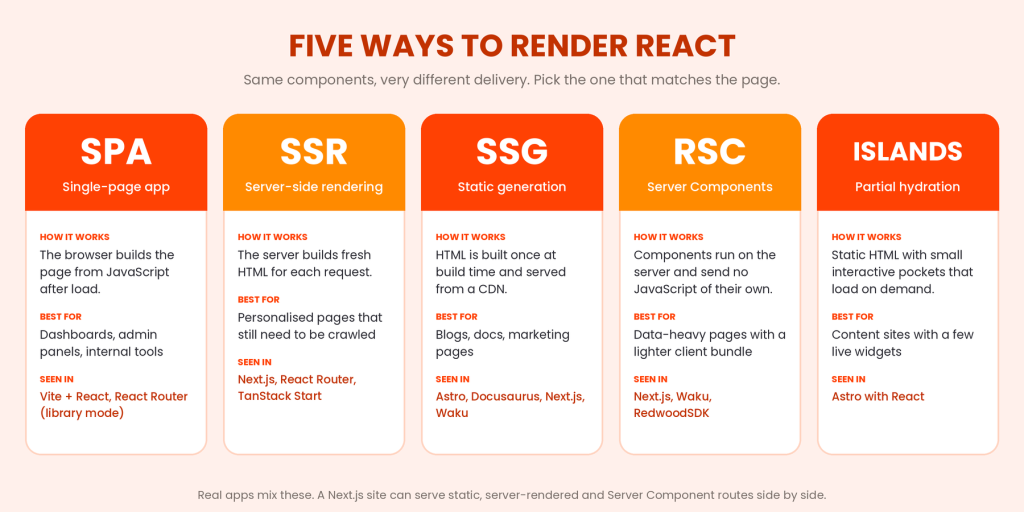
How to read this table. SSR builds HTML on the server per request. SSG builds it once, ahead of time. An SPA lets the browser build the page. Server Components run on the server and send results, not component code, to the browser. We left out performance scores on purpose: real speed depends on your code, caching, hosting and data.
Best Framework for React JS Based on Project Requirements
There is no single best framework for React JS. There is a best fit for each job.
Best React Framework for SEO and SSR
Next.js leads here because pages ship as ready HTML with strong metadata, sitemap and streaming support. React Router framework mode and TanStack Start can match it for server rendering with less convention. Astro wins when a page is mostly content. For React JS websites that must rank, good headings, internal links and clean URLs still do more than the framework logo.
Best React Framework for Enterprise Applications
Enterprise teams care about security, maintainability, integrations, long-term support and hiring. Next.js is the safest default on those counts. React Router suits teams that want portability across hosts, TanStack Start fits type-safe internal platforms, and a Vite-based setup works when the backend is separate and SEO is irrelevant.
Best React Framework for Startups
Startups need speed now and room to grow later. Next.js offers the fastest path to a product with auth, payments and SEO. Vite + React is simpler to host for pure app products. Avoid exotic stacks you cannot hire for.
Best React Framework for AI-Powered Applications
No React framework is an AI framework by itself. If you are hunting for the best AI framework for React hooks and Next.js support, you are really choosing two things: an SDK and a framework. A common setup uses Next.js, React Router or TanStack Start for server routes and auth, a JavaScript AI library such as the Vercel AI SDK for streaming and its useChat hook, and a model provider behind your server so keys never reach the browser. Hooks manage input, loading and streaming state. Need help building it? Talk to our AI application development experts.
Best React Framework for Frontend Development
For a pure react front end, match the tool to how interactive the product is. Vite + React suits SPAs, Next.js suits SEO-led products, React Router suits data-driven flows and Astro with React suits content with a few live widgets.
Best React Framework for Mobile Applications
Expo. It builds React Native apps, so compare it with other mobile options, not with Next.js.
SECURITY NOTE
In December 2025 the React team disclosed CVE-2025-55182, nicknamed React2Shell, a critical remote code execution flaw in React Server Components. It affected packages used by Next.js, React Router, Waku, RedwoodSDK and others, and was fixed in React 19.0.1, 19.1.2 and 19.2.1. Next.js moved to regular security releases in July 2026. The lesson on any React JS vulnerability: if your React JS server runs Server Components, build a patching routine.
React JS UI Frameworks vs React CSS Frameworks
These tools work alongside your framework, not instead of it. A react js UI framework gives you ready-made components, while a react js CSS framework gives you styling rules.
| Tool | Type | Best for | Watch out for |
| MUI | Component library (Material Design) | Enterprise apps, data grids | Heavier runtime, strong visual identity |
| Ant Design | Component library | Admin tools, data-heavy dashboards | Hard to restyle away from its look |
| Chakra UI | Component library | Fast prototyping, accessible defaults | v3 changed its API from v2 |
| Mantine | Component library with hooks | Productive, full-featured apps | Smaller community than MUI |
| shadcn/ui | Copy-paste components with Tailwind | Full control over component code | You maintain the code you copy |
| Tailwind CSS | Utility CSS framework | Custom designs, quick iteration | Verbose markup |
| Bootstrap | CSS framework | Familiar grids and components | Looks generic without work |
| CSS Modules | Scoped CSS files | Simple, zero-runtime styling | No design system included |
In short: choose MUI or Ant Design when you need lots of ready-made components, and Tailwind when you want custom design control. Check accessibility, bundle size and Server Component compatibility, since many interactive components need ‘use client’ in the Next.js App Router.
React JS Testing Frameworks Developers Should Know
Not every tool here is a framework, and mixing them up leads to messy test setups. Here is who does what.
| Tool | Role | Use it for |
| Vitest | Test runner | Unit and integration tests in Vite projects; version 5 shipped in September 2026 |
| Jest | Test runner | Established unit testing and large existing codebases |
| React Testing Library | Testing utility | Component tests that behave like a user, with Vitest or Jest |
| Playwright | Browser automation | Cross-browser end-to-end flows |
| Cypress | End-to-end and component testing | Browser tests with an interactive runner |
A healthy setup pairs Vitest or Jest for unit and integration tests, React Testing Library for components, and Playwright or Cypress for end-to-end journeys. Keep most tests small and fast, and save browser tests for the paths that make money. These react js testing frameworks are worth learning first.
How to Choose the Right React Frontend Framework
Run your project through these ten questions before you commit to a React frontend framework:
- Project type and complexity: app, content site or both?
- SEO and rendering: do crawlers need ready HTML?
- Performance: what must load fast, and where?
- Server-side needs: APIs, auth, forms, database access
- Team expertise: what can your engineers debug today?
- Ecosystem maturity: libraries, docs and hiring pool.
- Integrations: CMS, payments, analytics, auth.
- Hosting and deployment: where will it run, and at what cost?
- Security and maintenance: who patches, and how fast?
- Scalability: what happens at ten times the traffic and team?
Team expertise is the factor founders underestimate. If it is missing in-house, HireDeveloper.dev (Talent Wing of Rightbyte Technologies Pvt Ltd) can place dedicated React.js developers to fill the gap.
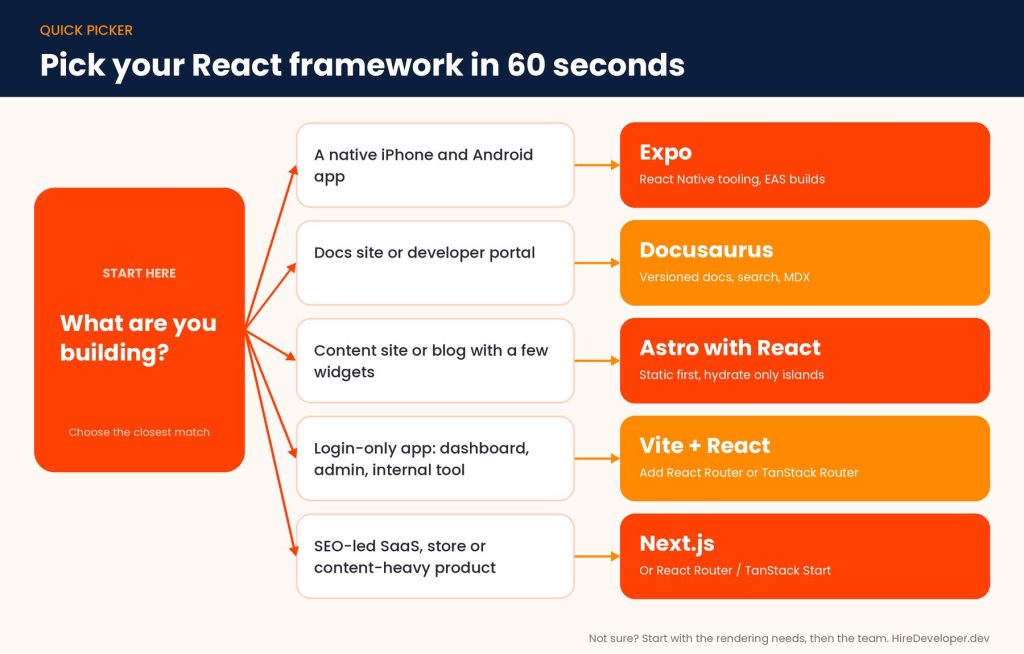
| If your project is… | Strong fit |
| SEO-led SaaS or online store | Next.js, React Router or TanStack Start |
| Content or marketing site | Astro with React |
| Documentation site | Docusaurus |
| Logged-in dashboard | Vite + React or TanStack Start |
| Type-safe, complex product | TanStack Start |
| Cloudflare-first full-stack app | RedwoodSDK |
| Mobile app | Expo |
| Small Server Components experiment | Waku |
Future of React Frameworks in 2027
The React JS latest version at the time of writing is 19.3, released on 9 September 2026. It made <ViewTransition> and Fragment refs stable, and no React 20 has been announced. Check react.dev for newer patches before you upgrade. Here is what looks settled and what is still moving.
| Already established | Still evolving |
| Server rendering and streaming | Server Components outside Next.js |
| Type-safe routing and data loading | Cache Components becoming the Next.js default |
| Vite-based tooling | AI-assisted development, such as version-matched docs for coding agents |
| Edge and serverless deployment | AI-powered chat and agent interfaces |
| Component-driven development | Built-in view transitions in everyday apps |
Treat the right-hand column as direction, not promise.
Conclusion
The React.js frameworks landscape in 2026-27 is wider and healthier than older listicles suggest. Next.js remains the safe default for SEO-led and enterprise products. React Router and TanStack Start offer lighter, more explicit routes to full-stack React. Astro, Docusaurus and Vite cover content, docs and app-only needs, while Expo owns mobile. Whichever JS React framework you choose, plan for patching and upgrades from day one.
NEED A HAND?
If you want experienced engineers, HireDeveloper.dev (Talent Wing of Rightbyte Technologies Pvt Ltd) can help you hire React.js developers or set up dedicated development teams for custom React.js development services.