






Introduction
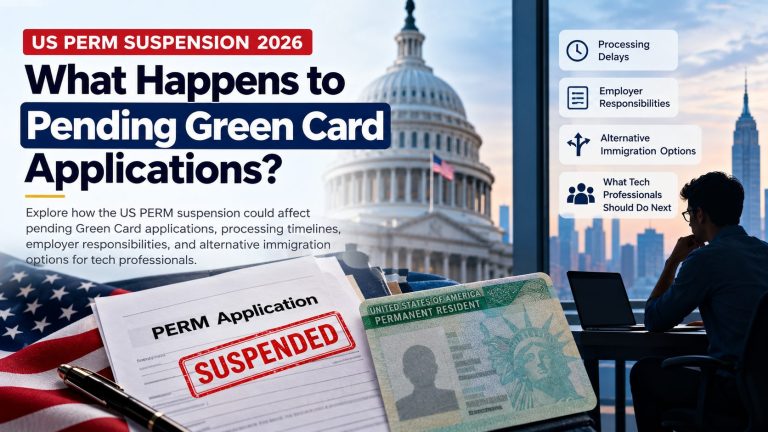
The US PERM suspension in 2026 has raised serious concerns among foreign professionals pursuing employment-based Green Cards. Reports of restrictions affecting major technology companies, including TCS, Infosys, Wipro, Microsoft, and Adobe, have created uncertainty around pending applications and employer-sponsored permanent residency.
For thousands of international IT professionals, particularly Indian workers, the Permanent Labor Certification (PERM) process is a crucial step toward building a long-term career in the United States.
But what happens when an employer faces PERM restrictions? Will pending Green Card applications be rejected, or will processing simply be delayed?
Understanding the implications is essential for employees and employers navigating US immigration requirements.
Why Has the US Suspended the PERM Program for Major IT Companies?
On October 8, 2026, US officials announced restrictions affecting eight technology companies: Microsoft, Adobe, Cognizant, Infosys, Tata Consultancy Services, Wipro, HCL Technologies, and Capgemini.
The Department of Labor cited ongoing investigations into alleged misuse of employment-based immigration programs. Officials expressed concerns about hiring practices, wage protection, and employment opportunities for American workers.
However, allegations do not establish wrongdoing, and detailed findings for individual companies have not been publicly established.
According to the Financial Times, the restrictions temporarily prevent affected companies from sponsoring workers through the PERM process.
What Happens to Pending PERM Applications?
The biggest concern for affected employees is whether their existing Green Card applications will continue moving forward.
Under the announced restrictions, the Department of Labor will not process pending PERM applications submitted by suspended employers while the suspension remains active.
However, a suspended application is not necessarily a rejected application.
The impact depends on the employee’s immigration stage.
-
Pending PERM Applications: Processing is paused until further action or clarification.
-
Approved PERM Certifications: Employees should verify their certification validity and subsequent filing deadlines.
-
Pending I-140 Petitions: These are handled by USCIS, and their status should be reviewed separately.
-
Approved Green Cards: Existing permanent resident status is not automatically cancelled.
For additional context, read Hindustan Times’ PERM suspension explainer
How Could the Suspension Affect Green Card Processing Times?
Employment-based Green Card applications already involve multiple stages, including labor certification, immigrant petitions, and visa availability.
The PERM suspension introduces another potential delay.
Employees may face uncertainty around certification approvals, application progress, and long-term immigration planning.
For Indian professionals, these challenges can be particularly significant because employment-based Green Card backlogs may already extend waiting periods.
Applicants should regularly review the Department of Labor’s official PERM processing times and consult their immigration representatives for case-specific updates.
Does the PERM Suspension Affect H-1B Visa Holders?
The PERM restrictions do not automatically invalidate existing H-1B visas or authorized employment.
However, some H-1B professionals rely on employment-based Green Card filings to qualify for extensions beyond the standard six-year period.
Delays in initiating or completing PERM applications could therefore create additional challenges for employees approaching important immigration deadlines.
Workers should verify their eligibility for extensions and avoid assuming that a pending Green Card process automatically guarantees continued work authorization.
What Are the Alternative Green Card Options?
Although PERM is a common route for employment-based permanent residency, certain immigration categories do not require traditional employer-sponsored labor certification.
Potential alternatives include:
-
EB-1: For qualifying individuals with extraordinary ability, outstanding researchers, or certain multinational executives and managers.
-
EB-2 National Interest Waiver: For eligible professionals whose proposed work meets national-interest requirements.
-
Sponsorship Through Another Employer: A potential option when a different employer can independently satisfy applicable immigration requirements.
Eligibility varies, and changing employers may affect filing timelines and immigration benefits.
Explore official requirements through USCIS Employment-Based Immigration Guidance
What Should Employers and IT Professionals Do Next?
Employers should assess pending sponsorship cases, review immigration compliance procedures, and communicate clearly with affected employees.
Meanwhile, professionals should confirm their application stage, monitor H-1B expiration dates, maintain immigration documentation, and consult qualified immigration attorneys before making employment decisions.
Businesses may also need to reconsider their workforce planning strategies while balancing regulatory compliance and access to specialized technical expertise.
For companies exploring flexible technology workforce solutions, HireDeveloper provides access to software development talent and technology hiring services.
For more background on the broader implications for Indian professionals, read US Green Card Restrictions: What Indian IT Professionals Need to Know in 2026.
Conclusion
The US PERM suspension in 2026 has introduced significant uncertainty for foreign professionals pursuing employer-sponsored permanent residency.While pending PERM applications at affected companies face processing restrictions, existing H-1B visas and approved Green Cards are not automatically cancelled.
For employees, understanding their application status and immigration options is essential. For employers, the situation highlights the importance of compliance, transparent communication, and adaptable workforce strategies.
As investigations continue, following official updates will remain critical for everyone navigating the US Green Card process.
Related Sources
1. https://www.axios.com/2026/10/08/h1b-vs-perm-vance-tech-worker-ban
2. https://www.axios.com/2026/10/09/trump-microsoft-immigration-tech
5. https://news.bloomberglaw.com/ip-law/us-suspends-visa-program-for-tech-firms-including-microsoft-2
6. https://www.ft.com/content/5cfecbba-69ed-42d0-98fd-3ae019144692
8. https://www.wired.com/story/trump-administration-crackdown-microsoft-adobe-immigration/