






Introduction
In February 2025, Andrej Karpathy posted a casual observation that changed how millions of people think about software: describe what you want, let the AI write the code, and just go with the vibes. Fourteen months later, Collins English Dictionary named vibe coding its Word of the Year for 2025, and the practice went from niche experiment to the dominant way software gets built.
By 2026, the numbers make the shift impossible to ignore. A full 92% of US developers use AI coding tools every day. Forty-one percent of all code written globally is now AI-generated. The vibe coding market hit an estimated 4.7 billion dollars this year and is projected to reach 12.3 billion by 2027. This is no longer a trend to watch. It is the current state of software development.
This guide gives you a clear vibe coding definition, the latest 2026 data, a practical breakdown of the best vibe coding tools available right now, and an honest look at where this approach works well and where it still needs human backup.
What Is Vibe Coding? Definition and Meaning in 2026
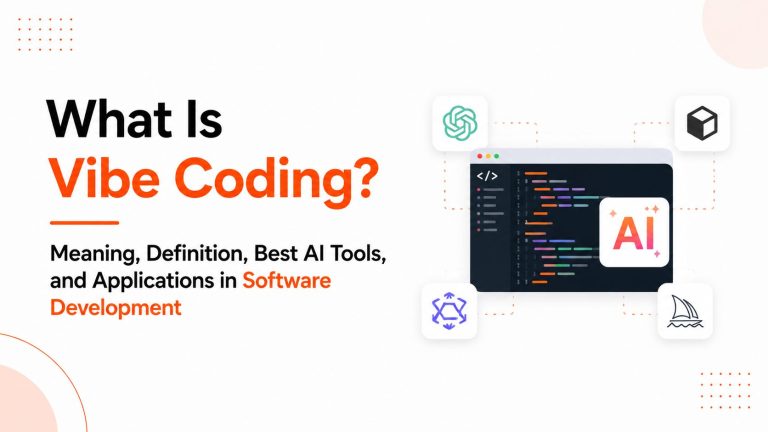
Vibe coding is a method of software development where you describe what you want to build in natural language and a large language model (LLM) generates the working code. The developer focuses on intent, direction, and refinement rather than writing syntax line by line.
The vibe coding definition that Collins Dictionary officially adopted in 2025: the use of artificial intelligence prompted by natural language to write computer code. Simple, but the implications are enormous.
In practical terms, vibe coding means staying at the ideas layer. You tell the AI what you need. It produces the code. You review the output, refine through conversation, test, and ship. The process compresses what used to take days into hours and what took hours into minutes.
Vibe Coding vs Traditional Coding
Traditional software development requires engineers to write, debug, and maintain every single line of code. It demands deep knowledge of languages, frameworks, architecture patterns, and system design. The skill floor is high and the ramp-up time is long.
Vibe coding removes that barrier without eliminating the need for judgment. You still need to understand what the AI is producing, especially in production environments where security, performance, and reliability actually matter. What changes is the mode of interaction. You are directing an AI that never sleeps and never makes syntax errors, rather than typing every character yourself.
The most important shift is who can participate. In 2026, 63% of vibe coding users identify as non-developers. Founders, product managers, designers, and domain experts are shipping working applications without writing a single line of code manually.
Building a product with an AI-first workflow? HireDeveloper.dev helps SaaS teams and startups hire pre-vetted engineers who understand modern vibe coding workflows and know when to take over from AI-generated output. Explore talent at hiredeveloper.dev
Vibe Coding in 2026: Key Statistics and Market Data
The numbers from 2026 paint a clear picture of just how quickly vibe coding moved from concept to standard practice.
- 92% of US developers now use AI coding tools every single day (Taskade, 2026)
- 41% of all code written globally is AI-generated, representing 256 billion lines in 2024 alone
- The vibe coding market reached an estimated 4.7 billion dollars in 2026 with a 38% compound annual growth rate
- 74% of developers report increased productivity when using vibe coding approaches
- 87% of Fortune 500 companies have adopted at least one vibe coding platform
- 51% faster task completion is reported by teams that have implemented vibe coding methodologies
- Lovable reported 100,000 new projects created on its platform every single day, with nearly 8 million users as of late 2025
- 25% of Y Combinator startups now rely heavily on AI-generated code for their core systems
- Gartner forecasts that 40% of new enterprise production software will be created using vibe coding techniques by 2028
The flip side of these adoption numbers is a growing quality and security concern. A 2026 security audit found that 45% of AI-generated code contains high-risk security flaws. CodeRabbit analysis of open-source pull requests found AI co-authored code contains 1.7x more major issues than human-written code. Developer trust in AI output has dropped from 77% in 2023 to 60% in 2026, even as usage keeps climbing. The industry is leaning into vibe coding while simultaneously learning its limits.
Best AI Vibe Coding Tools in 2026
The vibe coding tools landscape has matured significantly. The market now splits clearly into two categories: AI code editors for developers and AI app builders for non-technical users. Choosing the wrong category wastes time. Here is the full breakdown.
| Tool | Best For in 2026 |
| Cursor | Professional developers needing deep codebase-aware AI editing with multi-file refactoring |
| Claude Code | Terminal-first developers working on large codebases with complex multi-step refactors |
| GitHub Copilot | Enterprise teams in GitHub-heavy workflows needing compliant, widely supported AI assistance |
| Lovable | Non-technical founders building full-stack web apps from conversational prompts |
| Replit | Beginners, students, and teams needing collaborative browser-based coding with one-click deploy |
| Windsurf | Developers wanting an agent-first IDE experience with automatic large codebase indexing |
| Bolt.new | Rapid frontend prototyping with live preview and a generous free token quota |
| DeepSeek Coder | Cost-conscious teams running open-weight AI code generation on their own infrastructure |
Cursor Vibe Coding
Cursor is the most widely adopted AI-native code editor among professional developers in 2026. Built on a VS Code fork with deep codebase understanding layered on top, its Composer and Agent modes let you describe features and watch Cursor implement them across multiple files simultaneously. It averages 4.9 out of 5 in user ratings and has been shown to reduce PR review comments by 70% when teams use structured cursor rules. Pricing starts free with a Pro plan at 20 dollars per month.
Claude Code Vibe Coding
Claude Code emerged as a top pick in 2026 for developers who prefer a terminal-first workflow. It handles codebases over 50,000 lines of code successfully about 75% of the time and excels at multi-step refactors that require reasoning across an entire project. It is particularly well suited for complex, long-term projects where context depth matters more than UI polish. Available through Anthropic Claude Pro at approximately 20 dollars per month.
GitHub Copilot for Vibe Coding
GitHub Copilot holds roughly 42% of the AI coding assistant market in 2026 and remains the easiest entry point for enterprise developers and GitHub-heavy teams. Its free tier now includes 2,000 completions per month, making it the most affordable serious option at 10 dollars per month for the paid plan. It integrates into VS Code, JetBrains, Neovim, and more without requiring a workflow change, which is why IT departments trust it in regulated environments.
Lovable Vibe Coding
Lovable is the clear leader in the AI app builder category for non-technical users. With nearly 8 million users and 100,000 new projects created daily, it has become the go-to platform for founders and product managers who want a working application without writing code. You describe your app, Lovable builds the UI, connects Supabase for backend and auth, and delivers a deployable full-stack product. The majority of its users have no software engineering background at all.
Replit Vibe Coding
Replit remains the best option for collaborative browser-based development and education in 2026. Its AI Agent scaffolds full applications from a description, handles all package installation, and deploys to a live URL in minutes. It is particularly strong for beginners and for teams that need shared development environments without local setup complexity.
DeepSeek Vibe Coding
DeepSeek-Coder continues to be the practical choice for cost-conscious teams in 2026. Its open-weight models perform competitively with GPT-4 class models on coding benchmarks at a fraction of the API cost. For teams that want to run AI code generation on their own cloud infrastructure without paying per-token fees to a third-party API, DeepSeek remains one of the strongest open options available.
Scaling a vibe-coded product into production? You need experienced engineers to review architecture, handle edge cases, and own critical systems. HireDeveloper.dev connects you with senior developers ready to work inside AI-forward teams. Visit hiredeveloper.dev
Vibe Coding Applications in Software Development
Vibe coding is being applied across the full software development lifecycle in 2026, not just in prototype phases. Here is where it is making the biggest impact.
MVP and Startup Product Development
Early-stage startups are the clearest beneficiaries. A solo founder can describe a SaaS idea on Monday morning and have a deployed MVP with auth, a database, and a working UI by Monday afternoon. The entire validation cycle has compressed. According to recent data, 25% of Y Combinator startups now have codebases that are more than 90% AI-generated. That number was near zero two years ago.
Internal Tools and Enterprise Dashboards
IBM reported that internal tools built with vibe coding techniques reduced development time by 60% for enterprise applications. Engineering teams at large organizations are using Cursor and GitHub Copilot to build admin panels, analytics dashboards, and data pipelines in hours rather than days. The ROI on internal tooling, which was historically deprioritized, has become much easier to justify.
Vibe Coding in Java and Statically Typed Languages
A common question in enterprise engineering circles is whether vibe coding works reliably in statically typed languages like Java. The answer in 2026 is a qualified yes. Models including Claude 3.7 Sonnet, GPT-4o, and DeepSeek-Coder generate solid Java for REST APIs, Spring Boot services, and CRUD applications. However, a 2026 security audit specifically flagged that AI-generated Java code has a 72% security failure rate, the highest of any major language. Human expert review is not optional for Java in production.
Frontend UI Generation
Frontend development has seen some of the most dramatic acceleration from vibe coding. Tools like Lovable, Bolt.new, and v0 by Vercel generate complete React and Vue components from design descriptions. Nearly 44% of all vibe-coded projects focus on the frontend, including forms, layouts, and interactive components. Product designers can now ship their own component implementations without waiting for an engineering sprint.
Test Generation and Technical Documentation
Developers are consistently using vibe coding AI to handle the most time-consuming unglamorous work: writing unit tests and technical documentation. Cursor and GitHub Copilot generate comprehensive test suites from existing code and produce documentation in minutes. This is one of the highest-value applications because the ROI is immediate and the risk of AI errors in documentation is lower than in production logic.
Citizen Developer Applications
Perhaps the most structurally significant vibe coding application in 2026 is the rise of the citizen developer. With 63% of users being non-developers, product managers are prototyping features themselves instead of writing specifications. Designers are generating their own component libraries. Domain experts in finance, healthcare, and logistics are building the tools their teams actually need without waiting months for an engineering backlog to clear. 67% of design teams have adopted AI tools as of early 2026, and that adoption curve is still climbing.
Vibe Coding Jobs: How the Market Is Shifting in 2026
The concern that vibe coding would eliminate developer jobs has not materialized. The reality is more nuanced and, for skilled engineers, more interesting.
GitHub data shows developers using AI tools complete tasks 51% faster, which typically results in teams taking on more ambitious work, not headcount reductions. What is changing is the skill profile that commands premium rates. Developers who understand how to direct AI tools effectively, review generated code for security and architecture issues, and stitch AI outputs into coherent production systems are in significant demand.
A new category of role is emerging: AI workflow engineers, sometimes called vibe coders, who specialize in designing prompting systems, maintaining context architecture across large codebases, and governing what AI-generated code makes it into production. With 22% of job postings now mentioning AI coding tools as a requirement and Gartner predicting 90% of enterprise software engineers will use AI code assistants by 2028, this is no longer a niche specialization. It is becoming the baseline expectation.
Limitations and Real Risks of Vibe Coding in 2026
The adoption numbers are impressive, but the honest picture includes a serious set of unresolved challenges that any team using vibe coding in production needs to understand.
- Security vulnerabilities: 45% of AI-generated code contains high-risk security flaws according to 2026 audit data; AI-generated Java code has a 72% security failure rate
- Reduced developer trust: only 33% of developers trust AI code accuracy in 2026, down from 43% in 2024, even as usage keeps climbing
- Code quality degradation: code churn is up 41% and code duplication has increased 4x in teams relying heavily on AI generation without review protocols
- Debugging overhead: 63% of developers have spent more time debugging AI-generated code than writing the equivalent code manually would have taken
- Context limits: even the best tools struggle to reason coherently about very large codebases in a single prompt session
- Governance gap: Gartner warns that prompt-to-app approaches without proper governance will increase software defects by 2,500% by 2028
The organizations getting the best results from vibe coding in 2026 are those that treat it as a powerful first draft tool with mandatory human review, not a replacement for engineering judgment. The AI writes fast. The engineer thinks critically. Both are necessary.
Need engineers who can take AI-generated code from prototype to production safely? HireDeveloper.dev places experienced backend and full-stack developers with teams building modern AI-integrated software. Start hiring at hiredeveloper.dev
Conclusion: What Vibe Coding Means for Software Development in 2026
Vibe coding is no longer a concept to evaluate. It is the current state of software development. With 92% of US developers using AI coding tools daily, a 4.7 billion dollar market, and Collins Dictionary making it Word of the Year, the definition has settled and the adoption curve is behind us.
The practical vibe coding meaning in 2026: describe what you want, let the AI build it, apply expert judgment to what comes back, and ship. The best vibe coding tools span two lanes. For developers, Cursor, Claude Code, and GitHub Copilot provide deep codebase-aware assistance inside familiar workflows. For non-technical builders, Lovable, Replit, and Bolt.new make it possible to go from idea to deployed application without writing a line of code.
The companies winning in 2026 are those combining AI speed with engineering judgment. Vibe coding builds the product fast. Experienced developers make sure it holds up under real-world pressure. If you are scaling a product that started with AI-generated code, the moment to bring in senior engineering talent is before the cracks appear, not after.