








Introduction
Most SaaS companies hit the same wall at some point. The product is growing, the customer base is expanding, and the backend built fast in the early days starts showing the strain. Response times creep up. Deployment complexity increases. Infrastructure costs start climbing faster than revenue.
The engineering team knows that something needs to be changed. The architecture review happens. And increasingly in 2026, the conversation ends in the same place: Go.
Golang development services have moved from niche preference to mainstream SaaS strategy over the last few years, and the companies making that investment aren’t doing it because Go is trendy. They’re doing it because the performance and operational characteristics of Go-based systems solve the specific scaling problems that growing SaaS products run into.
This article breaks down exactly why that investment is accelerating, what Golang development services actually cover, and how to evaluate whether it’s the right move for your product.
What Are Golang Development Services — And Why Do They Matter Now?
Golang development services refer to the full range of software engineering work delivered using Go from backend API development and microservices architecture to cloud infrastructure tooling, data pipelines, and real-time systems.
What makes Go-specific services distinct from general software development is the specialization required to do them well. Go isn’t a language you can pick up and write production-quality systems over a weekend. Its concurrency model built on goroutines, and channels behave differently from threading models in other languages. Its error handling is explicit by design. Its performance characteristics come from how you structure the code, not just the language itself.

Golang software development services, at their best, bring engineers who’ve shipped real production Go systems: teams that understand the operational nuances of running Go at scale, know the ecosystem deeply (gRPC, protobuf, go modules, the CNCF toolchain), and can make sound architecture decisions rather than just executing tickets.
For SaaS businesses, the value shows up in three consistent ways: systems that handle load without architectural rewrites, deployment pipelines that are simpler and faster than JVM or interpreted language equivalents, and backend services that hold up under the compounding complexity of feature growth.
Why Go Has Become the Preferred Backend Language for SaaS in 2026
Go wasn’t designed to be a popular language. It was designed at Google to solve specific engineering problems high throughput, low latency, simple deployment, and predictable performance under load. Those happen to be exactly the problems SaaS companies face as they scale.
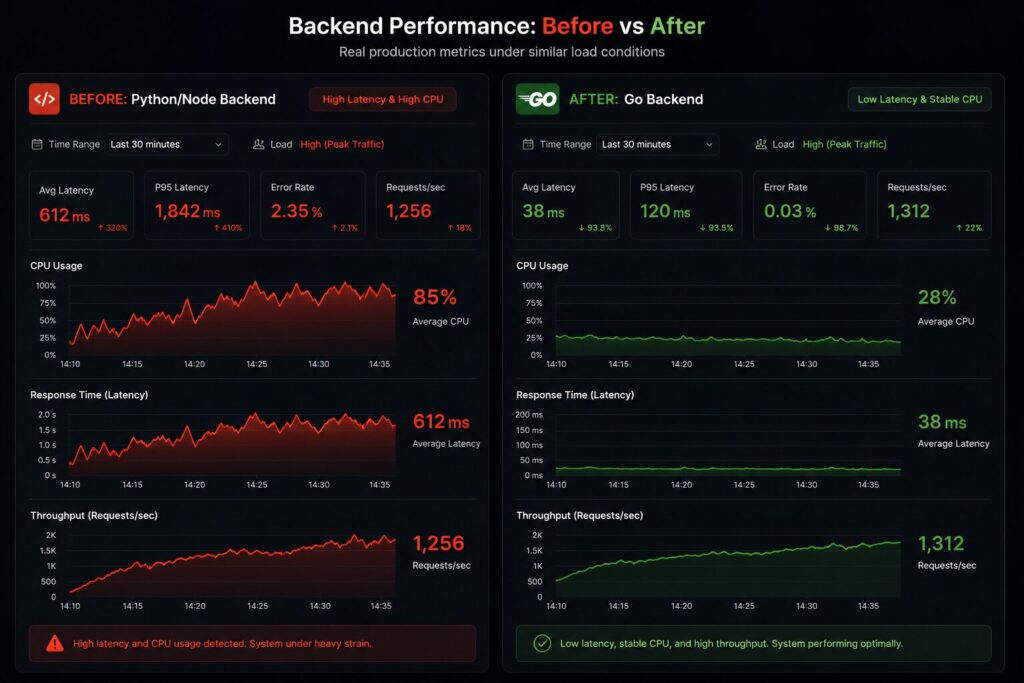
A few reasons Go has become the backend standard in 2026:
Concurrency without complexity.
Go’s goroutine model lets you handle thousands of concurrent connections with genuinely minimal overhead — far less than thread-per-request models. For SaaS products handling concurrent API calls, event streams, or real-time features, that matters at the infrastructure level.
Compilation to a single binary.
No runtime, no virtual machine, no dependency management at deployment time. A Go service compiles to a single static binary that runs anywhere. DevOps teams working with containerized SaaS deployments — Docker, Kubernetes — genuinely appreciate how simpler this makes the build and deploy pipeline.
Predictable performance under load.
Python and Node.js services often perform well under light load and degrade in non-linear ways as traffic grows. Go services tend to degrade more linearly — which means capacity planning is more reliable, and performance problems are easier to diagnose.
Native fit with the cloud-native ecosystem.
Kubernetes, Docker, Terraform, Prometheus — the tools most SaaS teams run their infrastructure on are either written in Go or deeply Go-native. That alignment reduces friction across the entire DevOps stack.
Uber, Cloudflare, Dropbox, and Twitch have all migrated significant backend systems to Go specifically for these reasons. In 2026, that enterprise signal filtered down to the growth-stage SaaS market.
Core Golang Development Services That Drive SaaS Growth
When businesses invest in golang development services, they’re typically accessing one or more of these core service types:
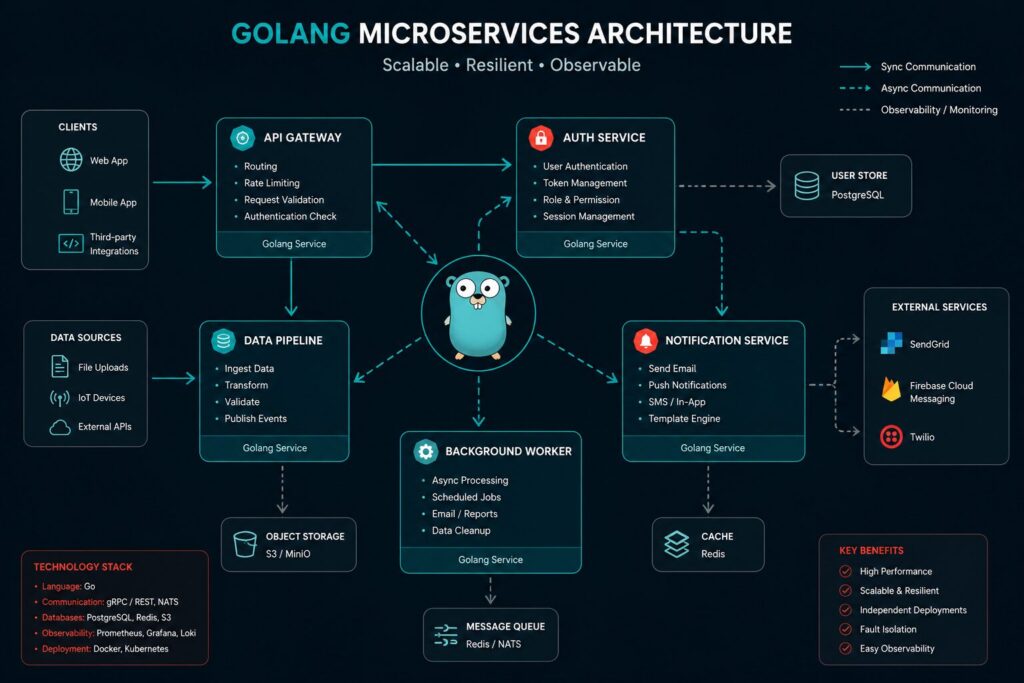
Microservices development.
Breaking a monolithic backend into discrete, independently deployable services is a standard SaaS scaling pattern — and Go is particularly well-suited for it. Each service compiles independently, deploys as a single binary, and handles its own concurrency cleanly. A Go microservices architecture scales horizontally without the overhead that heavier runtimes introduce.
REST and gRPC API development.
Go’s standard library HTTP handling is fast and reliable. For SaaS products with high API traffic — internal service-to-service calls, third-party integrations, or mobile/web frontend APIs — Go-based API layers deliver better throughput and more consistent latency than most alternatives. gRPC APIs built in Go are particularly efficient for service mesh communication.
Cloud-native infrastructure tooling.
CLI tools, Kubernetes operators, Terraform providers, internal developer platforms, deployment automation — this is where Go’s ecosystem depth becomes a genuine advantage. Many SaaS companies use golang development not just for user-facing services, but for the internal engineering tooling that makes their platform operable at scale.
Real-time systems and event-driven backends.
WebSocket servers, event streaming systems with Kafka integration, real-time notification services — Go’s concurrency model handles these workloads with less complexity and better resource efficiency than most alternatives.
Data pipeline engineering.
High-throughput ETL pipelines, log processing, analytics backends — Go’s performance at the tail makes it well-suited for data-intensive work that needs to be both fast and cost-efficient at scale.
Golang Backend Development: The Engine Behind High-Performance SaaS
When SaaS companies talk about golang backend development, they’re usually referring to the layer that handles the most load, the most complexity, and the most risk the services that process business logic, manage state, handle authentication, and serve data to end users.
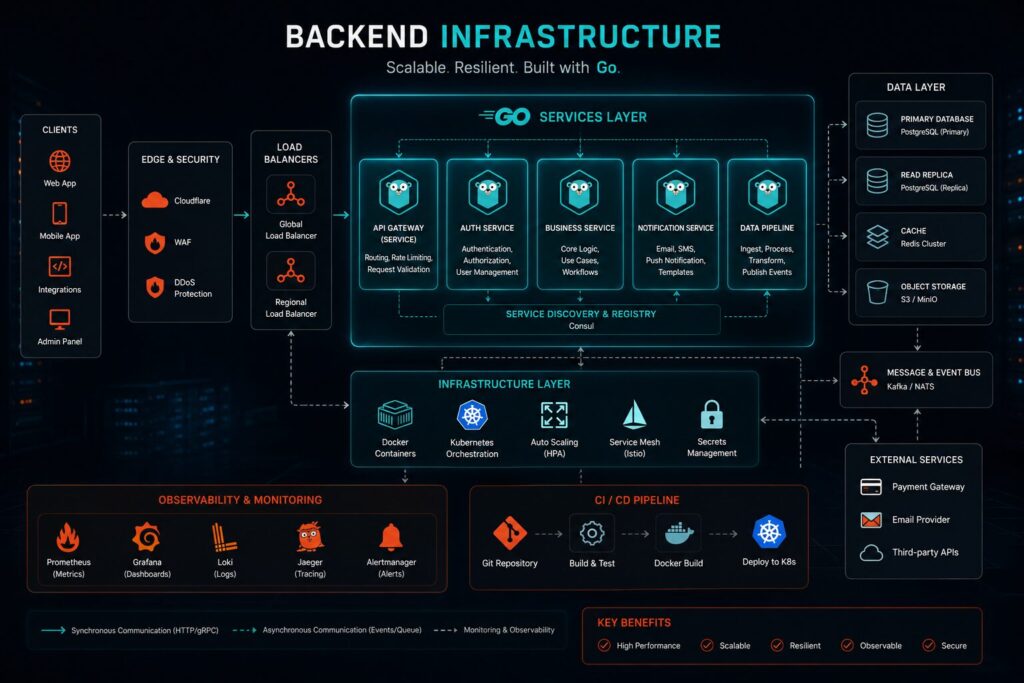
Go excels here for a specific set of reasons that aren’t always obvious until you’ve built and operated production systems in multiple languages:
Explicit error handling builds operational resilience.
Go’s error-as-a-value model forces engineers to handle errors at the point where they occur. This pattern creates backend systems where failure modes are predictable and observable — not hidden behind exception stacks that surface only in production. For SaaS products where uptime is a business metric, that operational predictability matters.
Low memory overhead at high concurrency.
A Go service handling 10,000 concurrent goroutines uses significantly less memory than an equivalent Java or Python service. For SaaS products where infrastructure cost is a real budget line, this translates to fewer instances, smaller container footprints, and lower cloud spend.
Fast startup time.
Go services start in milliseconds. In Kubernetes environments where pods scale up and down rapidly based on load, fast startup time reduces cold-start latency and makes auto-scaling more responsive. This is a real operational advantage for SaaS products with variable traffic patterns.
Readable, maintainable codebases.
Go’s deliberately constrained design — minimal language features, explicit patterns, no magic — produces codebases that are easier to onboard new engineers into and easier to maintain over time. For SaaS companies where engineering team continuity is a real challenge, that maintainability has compounding value.
Golang Web Development and App Development: What Businesses Are Building
Golang web development is sometimes misunderstood as a niche capability — Go as a backend language powering a web-facing application rather than building the frontend itself. That’s an important clarification: Go is a server-side language. It powers the APIs, services, and infrastructure that web and mobile applications consume, rather than the frontend rendering layer.

That context matters because it defines exactly where golang app development creates value for SaaS businesses:
Server-side rendered web applications.
Go’s net/http package and templating system support building web applications directly — useful for internal tools, admin dashboards, and content-heavy SaaS features where server-side rendering is preferred over a heavy SPA framework.
API backends for web and mobile applications.
The most common use case. A SaaS product’s React or Vue frontend consumes a Go-powered REST or gRPC API. The Go layer handles business logic, database interactions, caching, and external integrations — and does so at higher throughput and lower latency than most alternatives.
Webhook processing and integration layers.
SaaS products that integrate with external platforms — payment processors, CRMs, communication tools — often need high-reliability webhook processing. Go’s concurrency model and fast HTTP handling make it well-suited for processing high volumes of incoming webhooks without queue bottlenecks.
Background processing and job queues.
Scheduled tasks, async processing, email delivery, report generation Go handles background worker patterns cleanly and efficiently, with lower resource overhead than frameworks in heavier languages.
The common thread across all of these is that golang application development gives SaaS teams a backend that grows with the product without requiring architectural rewrites every time traffic doubles.
How Golang Application Development Solves Real SaaS Scaling Problems
Scaling problems in SaaS don’t usually announce themselves dramatically. They show up gradually: a p99 latency that keeps drifting up, a database connection pool that keeps filling under moderate load, infrastructure costs that are growing faster than the customer base.
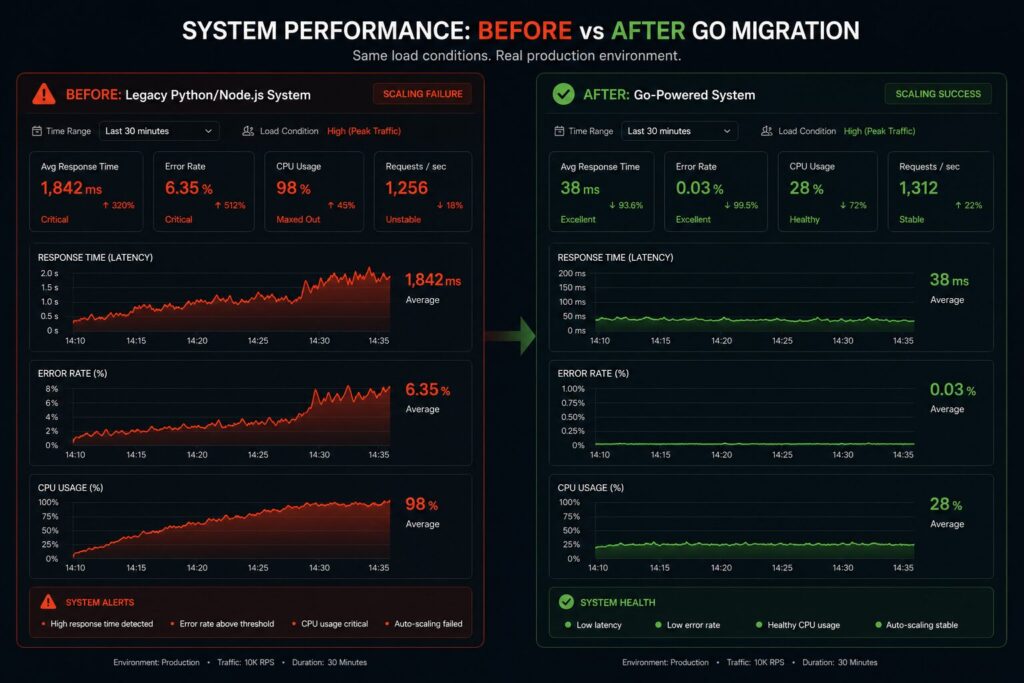
Golang application development addresses these problems at the architecture level rather than through operational patches:
The connection pooling problem.
Many SaaS backends struggle with database connection saturation as concurrency grows. Go’s lightweight goroutines allow more concurrent requests to be handled with significantly fewer open connections — reducing pressure on the database layer and the expensive connection pooling infrastructure around it.
The infrastructure cost problem.
A Go service typically runs on a fraction of the compute resources required by an equivalent Python or Java service. For SaaS businesses with multi-region deployments or spiky traffic patterns, that resource efficiency translates directly to cloud cost reductions. Teams consistently report 30–50% infrastructure cost reductions after migrating compute-intensive services to Go.
The deployment complexity problem.
Containerized SaaS deployments in Go are simpler. No runtime to manage, no class loader configuration, no heap tuning. A Go Dockerfile is typically a two-stage build that produces a minimal final image. This simplicity reduces both the surface area for deployment failures and the cognitive overhead on DevOps teams.
The cold-start problem.
SaaS products that use serverless or frequently scale-to-zero deployments suffer from cold-start latency in heavy-runtime languages. Go services start in milliseconds — eliminating cold-start penalties and making aggressive auto-scaling strategies more practical.
The onboarding problem.
Go’s explicit, readable code style means new engineers can be productive in a Go codebase faster than in codebases with heavy use of implicit framework magic. For SaaS teams that are growing their engineering org, this has real operational value.
What to Look When You Hire a Golang Web Developer or Development Team
When you hire a Golang web developer or engage in a Go development team, the screening process matters more than it does for most other technologies. Go is easy to write passably and difficult to write well. The gap between a developer who’s completed a few Go tutorials and one who’s shipped production-grade Go systems is significant — and it shows up in code that’s hard to maintain, debug, and extend.
Here’s what to screen for:
Go-specific code review.
Give candidates a piece of real Go code — something that has subtle issues: improper goroutine cleanup, context propagation gaps, error swallowing. Ask them to review it and explain what they’d change and why. Engineers with production Go experience find issues and explain the reasoning fluently.
Concurrency design understanding.
Ask candidates to design a solution to a real concurrency problem — a rate limiter, a worker pool, a circuit breaker. The approach they take reveals whether they think in Go’s concurrency model or are mentally translating from another language’s threading patterns.
Understanding of the Go ecosystem.
Go module versioning, standard library HTTP handling, testing patterns, linting with golangci-lint, profiling with pprof — a senior Go engineer should be fluent in these tools without needing to look them up.
Deployment and operational context.
Ask how they’ve deployed Go services in the past — containerization, binary compilation, CI/CD pipeline design. Go’s operational simplicity is one of its advantages, but capturing that advantage requires engineers who understand the deployment model.
Production incident experience.
Ask about a production issue they’ve debugged in a Go service. How they trace through goroutine leaks, diagnose memory pressure, or isolate latency issues in a distributed system is more revealing than any algorithm puzzle.
For companies that don’t want to run this evaluation process themselves, platforms that specialize in pre-vetted Go talent — like HireDeveloper.dev — handle the technical screening and surface engineers who meet production-grade standards without the weeks of candidate pipeline management.
The Cost Advantage: Why Golang Development Is a Smart Business Investment
The business case for golang software development services isn’t just technical — it’s financial. Here’s where the numbers typically land:
Infrastructure cost reduction.
Go services are significantly more resource-efficient than equivalent Python, Ruby, or Java services. For SaaS companies with meaningful compute costs, switching compute-intensive services to Go typically reduces infrastructure spend by 30–60% on those workloads. At scale, that’s a real budget line item.
Engineering velocity over time.
Go’s explicit, readable codebase style means less time debugging implicit framework behavior and more time building features. SaaS teams consistently report that well-structured Go codebases are faster to extend and easier to onboard new engineers into compared to their Python or JavaScript equivalents.
Reduced operational overhead.
Go’s simple deployment model — single binary, minimal container configuration, fast startup — reduces the time DevOps teams spend managing deployment infrastructure. Fewer deployment failures, simpler rollback procedures, and lower container image maintenance overhead all reduce engineering toil.
Lower hiring risk.
Hiring a Go generalist who claims Go experience and delivers mediocre code is expensive — in rework time, technical debt, and the cost of rehiring. Engaging a specialist golang development company or using a vetted platform removes much of that risk upfront.
Faster time-to-value.
Specialized Go teams and platforms that have done this before can onboard and contribute to a production codebase significantly faster than a generalist developer ramping up on Go for the first time. For SaaS companies where engineering velocity directly affects competitive position, that speed-to-contribution matters.
Why HireDeveloper.dev Is the Right Golang Partner for Your SaaS
The shift toward golang development services in SaaS isn’t a technology trend that will reverse. It’s a response to a real engineering reality: the language solves the specific scaling problems that growing SaaS products run into, and it does so in a way that reduces — rather than increases — long-term operational complexity.
The companies making this investment in 2026 aren’t doing it because a conference talk convinced them. They’re doing it because their infrastructure costs needed to come down, their deployment pipelines needed to get simpler, and their backends needed to stop being the limiting factor on their product roadmap.
The decision of how to actually access Go expertise — hiring in-house, engaging a firm, or using a specialist platform — comes down to your timeline, your budget, and how much recruitment overhead you want to take on internally.
Most growing SaaS companies find that a specialist platform or dedicated Go team gives them the fastest path to production-quality Go systems without the 3–6 month local hiring timeline or the risk of screening Go candidates without Go-specific evaluation expertise.
HireDeveloper.dev is built exactly for this. Based in Indore — embedded in India’s Tier-2 tech ecosystem, close to the actual talent market — the platform was purpose-built to solve the Go hiring problem: finding engineers who don’t just write Go, but understand goroutine management, gRPC architecture, cloud-native deployment, and the operational patterns that make Go services maintainable in production.
Every engineer placed through HireDeveloper.dev has been assessed against real production Go standards. Not keyword-matched. Not algorithm-filtered. Actually evaluated on the technical criteria that separate Go engineers who can ship production systems from those who’ve completed a few tutorials.
Whether you need a single senior Go engineer to join an existing SaaS team, or a dedicated backend team to own a new service from architecture to deployment — HireDeveloper.dev connects you with pre-vetted Go talent faster than traditional hiring allows.
Built in Indore. Trusted by SaaS engineering teams across the US and UK.
→ Find your Golang engineer or development team at HireDeveloper.dev