






Why There Isn't One Clean Answer to This Question
When a CTO or founder asks, “how much does it cost to hire Golang developers?” What they usually want is a single number they can put in a budget spreadsheet.
The honest answer is that the range is enormous and not in a vague, hand-wavy way. A junior Go developer on a freelance contract might cost $18 per hour. A senior Go engineer hired in-house in San Francisco might cost $230,000 fully loaded per year. Both are real numbers in the 2026 market. The gap between them reflects five different variables: seniority, location, hiring model, engagement length, and whether you’re sourcing directly or through a partner.
Getting this wrong has real consequences. Companies that budget for a single mid-level US hire and then discover they need a team of three often end up either stalling the roadmap or rushing an offshore hire without proper vetting, both of which cost more in the long run than getting the cost picture right up front.
This guide lays out the actual numbers for the current market, explains why they vary, compares what different hiring models really cost when your account for all the factors, and gives you a framework for figuring out what the right structure looks like for your specific situation.
Why Golang Developer Costs Vary More Than Most Languages
Before you can budget accurately, you need to understand why Go developer pricing is more variable than most backend languages. It’s not random, but there are specific structural reasons for it.

Go Is a Niche Language with a Smaller Talent Pool
JavaScript has millions of developers. Python has millions more. Go has far fewer and the ones with genuine production experience are even scarcer. According to the CNCF Annual Survey 2023, 64% of cloud-native developers use Go, but the total Go developer population is still a fraction of mainstream language ecosystems.
That supply constraint drives prices up in Western markets and creates significant arbitrage opportunities in markets like India, where Go has grown substantially but hasn’t yet priced itself to match US levels.
When you decide to hire Golang developers, you’re working in a smaller, more competitive market. That context matters for every number you’ll see in this guide.
Seniority and Production Experience Drive Price More Than Location
Here’s something most salary guides underemphasize within any given location; the gap between a junior and senior Go developer is larger than the gap between markets. A junior developer in the US might earn $90,000. A senior engineer in India with deep distributed systems experience might cost $48,000. The difference between those two isn’t just location, it’s years of debugging production failures, designing concurrent systems under real load, and making architecture decisions that don’t create expensive problems later.
When you look at golang developers for hire, seniority is actually the more important variable. Cheap junior developers in any market have a higher failure rate in production Go work for reasons we’ll cover later.
Hiring Model Changes the Number Completely
The same developer can cost dramatically different amounts depending on whether you hire them through a staffing partner, directly on a freelance platform, as a full-time employee, or through a golang development company. A $40,000-per-year developer via a dedicated offshore partner might cost $65,000 all-in. That same developer hired directly as a freelancer might cost $55,000 but with more risk and no replacement guarantee.
Understanding the model is as important as understanding the base rate. We’ll break down each model with full numbers in Section 4.
Go Developer Salary Benchmarks — What the Market Looks Like in 2026 What the Market Looks Like in 2026
These figures are based on current market data. Not survey results from two years ago.
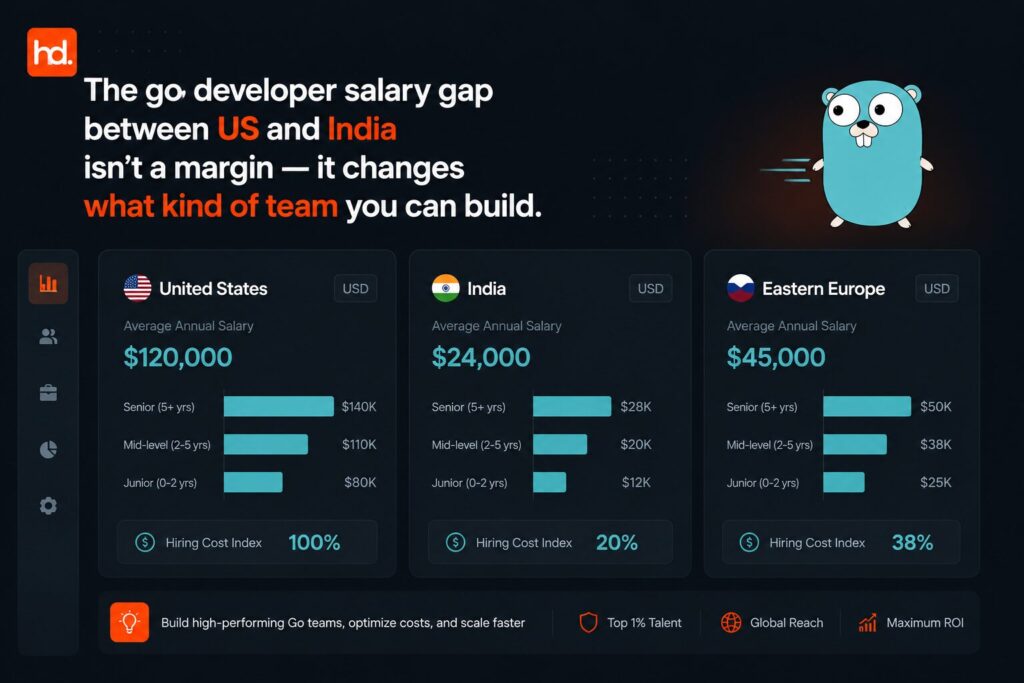
Table 1: Annual Salary — Golang Developers by Region and Seniority
| Region | Junior (0–2 yrs) | Mid-Level (2–5 yrs) | Senior (5+ yrs) |
| United States | $85,000–$110,000 | $120,000–$145,000 | $160,000–$200,000 |
| United Kingdom | £45,000–£60,000 | £65,000–£85,000 | £90,000–£120,000 |
| Canada | CAD $70,000–$90,000 | CAD $95,000–$120,000 | CAD $130,000–$165,000 |
| Eastern Europe | $20,000–$35,000 | $45,000–$65,000 | $70,000–$100,000 |
| India — Metro (Bangalore, Hyderabad) | $8,000–$14,000 | $18,000–$28,000 | $30,000–$48,000 |
| India — Tier-2 (Indore, Pune, Jaipur) | $6,000–$12,000 | $15,000–$24,000 | $26,000–$42,000 |
| Southeast Asia | $12,000–$20,000 | $22,000–$35,000 | $40,000–$60,000 |
| Latin America | $15,000–$25,000 | $28,000–$42,000 | $48,000–$72,000 |
Table 2: Hourly Contract Rates – Remote Golang Developers
When you hire remote Golang developers on a contract basis, here’s what the market looks like by region and seniority:
| Region | Junior | Mid-Level | Senior |
| United States | $60–$80/hr | $85–$110/hr | $120–$160/hr |
| United Kingdom | £35–£50/hr | £55–£75/hr | £85–£120/hr |
| Eastern Europe | $30–$45/hr | $50–$70/hr | $75–$100/hr |
| India — Metro | $18–$28/hr | $30–$45/hr | $48–$65/hr |
| India — Tier-2 | $15–$24/hr | $25–$38/hr | $40–$55/hr |
| Latin America | $25–$38/hr | $40–$58/hr | $65–$90/hr |
Table 3: True Fully Loaded Annual Cost Comparison
This is the table for most salary guides skip. The base salary number doesn’t capture what companies actually spend.
| Hiring Model | What’s Included | Estimated Annual Cost (Senior Engineer) |
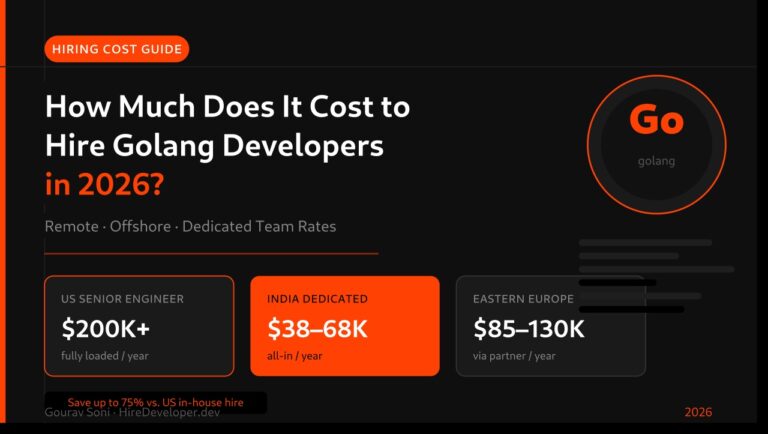
| US in-house hire | Salary + benefits + payroll tax + recruiting fee + equipment | $225,000–$275,000 |
| UK in-house hire | Salary + NI + pension + recruiting | £135,000–£170,000 |
| Remote US contractor | Rate × hours, no benefits, no recruiting overhead | $180,000–$240,000 |
| Dedicated India engineer via partner | All-in placement + support | $38,000–$68,000 |
| India direct freelance | Rate × hours, high variance, no continuity | $25,000–$55,000 |
| Eastern Europe via partner | All-in placement + support | $85,000–$130,000 |
| Golang dev company (agency) | Team fee including PM overhead | $120,000–$200,000+ |
The operational implication: For the annual cost of one senior US in-house Go engineer, you can hire three to four dedicated senior engineers from India, with proper vetting, onboarding support, and a replacement guarantee. That’s not a rounding difference. That’s the difference between a two-person backend team and a six-person backend team on the same budget.
If these numbers shift how you’re thinking about team structure, the next question is finding engineers who are worth those rates. HireDeveloper.dev pre-screens Go engineers from India’s strongest engineering communities, including our base in Indore, so you’re comparing vetted talent — not just market averages.
Remote vs. Offshore vs. Dedicated — Which Hiring Model Costs What
The numbers above are only useful if you understand which model you’re comparing. Here’s an honest breakdown of each one.
Hiring Remote Golang Developers — What “Remote” Actually Costs US Companies
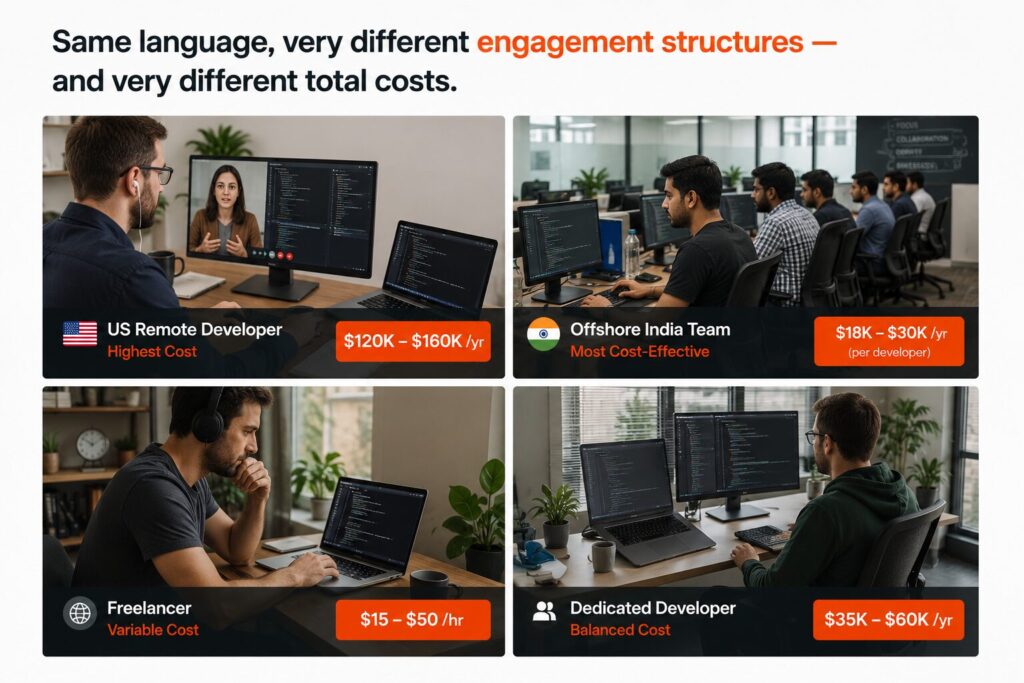
“Remote” in the US context usually means a US-based or US-adjacent developer working outside an office. You still pay US market rates for the go developer salary. You save on office space, that’s it.
Hiring remote Golang developers this way gets you US time zone coverage and no relocation complexity. The cost is still $160,000–$200,000+ for a senior engineer. For companies that need US time zone overlap for legal, compliance, or communication reasons, this might be the right call. For companies that primarily need strong Go engineering output, the cost premium is hard to justify.
Remote doesn’t automatically mean cheaper. It depends entirely on where the developer is.
Hiring Dedicated Golang Developers — The Model That Delivers Best Long-Term Value
A dedicated hire, whether onshore or offshore — works exclusively on your product. They join your team rhythm, learn your codebase over months, and accumulate institutional knowledge that freelancers and rotating contractors never do.
When you hire dedicated Golang developers from India through a vetted partner, the cost lands in the $38,000–$68,000 all-in range for a senior engineer. That’s 70–75% less than an equivalent US in-house hire. And because they’re dedicated, not splitting attention across multiple clients, the output quality matches what you’d expect from a full-time team member.
This is the model for most of our clients at HireDeveloper.dev use for ongoing backend product work.
Golang Outsourcing — When Offshore Makes Financial and Strategic Sense
Golang outsourcing to India or Eastern Europe makes the most sense when you need to build or scale a backend team quickly, can’t compete for US/UK talent at market rates, and have (or can establish) async-first workflows.
The strategic case is often as strong as the financial one. The Go engineering talent in cities like Bangalore, Hyderabad, and Indore has matured significantly, engineers from Indian product companies like Razor pay, CRED, and Zepto are solving the same distributed systems problems as their counterparts in San Francisco.
A second round of Golang outsourcing, where the first attempt was poorly structured, is expensive and demoralizing. The setup matters as much as the rate. We cover what that setup looks like in Section 5.
Freelance Go Developers for Hire — Low Entry Cost, High Hidden Cost
Golang developers hire on platforms like Upwork and Toptal have the lowest entry point. Junior Go developers start at $15–$18/hour. Even senior freelancers can be found for $45–$55/hour.
The hidden cost is everything that happens around the rate: onboarding overhead every time someone rotates out, knowledge that leaves with the developer, no codebase continuity, and quality variance that’s hard to predict from a profile and a portfolio.
Freelance hire go engineers for a scoped, time-bound task — a specific API, proof of concept, performance investigation. Don’t use them as a substitute for ongoing backend development unless you’re prepared for the ongoing integration cost.
The Hidden Costs Most Companies Miss When They Hire Golang Developers
Most budget conversations about Go development start and end with the salary number. That’s how companies end up surprised six months in.

Recruiting Time Is a Real Cost
The average time to fill a senior Go engineer role in the US is 90–120 days. During those months, your product roadmap is running at reduced capacity. If your account for the opportunity cost of delayed features, even conservatively — a 90-day vacancy for a senior Go engineer can cost more than the annual salary of the role you’re filling.
This is one of the genuine arguments for a partner-based model when you need to hire go engineers at scale. A pre-vetted bench gets you from “we have a requirement” to “developers are onboarded” in two to three weeks, not four months.
The Ramp Period Nobody Budgets For
A new Go developer, regardless of how strong they are, isn’t fully productive in week one. Most engineers reach meaningful sprint velocity in four to six weeks, and full architectural confidence in the codebase takes three to four months. During that period, you’re paying a full salary for partial output.
For a golang team built on dedicated long-term hires, this ramp cost is a one-time investment. For a team built on rotating freelancers or short-term contracts, you’re paying for it repeatedly.
The Wrong Hire Is the Most Expensive Line Item
We’ve said this before and it’s worth saying again here: bad concurrent Go code doesn’t fail loudly. A developer who lists Go as a primary skill but hasn’t worked through real production concurrency issues can spend three months writing code that looks fine until it doesn’t. The cleanup cost regularly exceeds the total compensation paid to the original developer.
The technical screen you run before the hire isn’t overhead. It’s the cheapest cost in the entire hiring process.
How to Build a Golang Team That Fits Your Budget Without Cutting Corners
Knowing the market rates is useful. Knowing what team structure actually makes sense for your stage is more useful.

What a Lean Golang Team Structure Looks Like for a Startup
Most early-to-stage startups don’t need a large Golang team immediately. What they need is:
- One senior Go engineer who can make architectural decisions, establish code standards, and build the core services
- One mid-level Go engineer who can execute on those decisions reliably
- Optionally, a DevOps or infrastructure engineer who understands Go deployment in Kubernetes environments
A lean team built this way, with dedicated offshore engineers from India can run at $70,000–$120,000 per year all-in. The equivalent team built in-house in the US would cost $450,000–$600,000 in fully-loaded salaries.
When to Scale from One Developer to a Full Golang Team
The right time to scale is when the work consistently outpaces capacity, not when you feel understaffed, but when features are genuinely slipping because your Go engineers are at ceiling. That’s a different signal, and it’s worth waiting for it before adding headcount.
The wrong time to scale is right after a funding round when everything feels urgent. Hiring fast without a proper technical screen builds a golang team that creates more problems than it solves.
Why Hiring Golang Developers in India Is the Most Cost-Effective Path in 2026
The financial case is straightforward. But the strategic case is equally compelling: India’s Go engineering ecosystem has matured to the point where companies aren’t tolerating offshore as a trade-off, they’re choosing it as a primary strategy.
Hire Golang developers in India through a structured partner and you get access to engineers who’ve built high-scale distributed systems at Indian fintech companies, cloud platforms, and product companies. Cities like Bangalore, Hyderabad, and Tier-2 hubs like Indore are producing engineers who compete directly on technical quality at 60–70% lower cost than equivalent US talent.
Golang outsourcing done right with proper vetting, onboarding structure, and continuity doesn’t feel like outsourcing. It feels like having a strong backend team. The difference between good and bad offshore experiences is almost entirely in how the engagement is set up, not in the talent.
HireDeveloper.dev — Hire Golang Developers Without the Overhead
Most of the cost problems described in this guide — long recruiting timelines, bad hires, ramp periods that stretch to four months, rotating freelancers — are structural problems with how the hiring process is set up, not fundamental problems with Go hiring itself.

HireDeveloper.dev was built to solve those structural problems.
We’re based in Indore, India — embedded directly in one of the country’s strongest Tier-2 tech ecosystems and we specialize in placing Go engineers with global product teams. Every developer we recommend has been through a Go-specific technical evaluation: concurrency patterns, API architecture, system design for realistic backend scenarios, cloud integration depth. Not generic screening. A Go-specific one.
Here’s what working with us looks like when you decide to hire Golang developers:
- Fast placement: Most clients receive qualified candidates within five to seven business days. Engagements typically start within two to three weeks.
- Flexible models: One dedicated Go engineer, a small team of three, or a full offshore squad — the structure matches your actual need.
- No recruiting overhead: You skip sourcing, screening, and the 90-day hiring timeline. The evaluation work is done before you meet the candidate.
- Replacement guarantee: If a placement isn’t working within the first 60 days, we replace them. The risk is ours, not yours.
- Transparent pricing: No hidden fees. What you’re quoted is what you pay and it’s significantly below what you’d pay building the same team in-house.
Whether you want to hire go engineers for a single backend project, build out a golang team to own a microservices architecture, or scale to a full offshore engineering function the cost structure we offer makes it achievable at budgets that in-house US hiring simply can’t match.