







Introduction
There’s a breaking point that most engineering-led companies hit somewhere between Series A and their first major scaling push.
Your backend is getting complex. Microservices are multiplying. The architecture needs engineers who actually understand distributed systems, not just engineers who’ve heard of them. Your current team is maxed out. And the Golang developer you’ve been trying to hire locally? Still hasn’t shown up. Three months in, you’ve interviewed twelve candidates, extended two offers, and converted zero.
This is exactly why the smartest CTOs and founders in 2026 are choosing to hire remote Golang developers, not as a compromise, but as a deliberate strategic decision.
Remote Go engineering isn’t a fallback. It’s a faster, leaner, often higher-quality path to the backend talent your company actually needs. This guide breaks down how to do it right: the models, the costs, the vetting process, the pitfalls, and why companies that get it right are shipping faster than the ones still waiting on local hiring cycles.
Why Engineering Leaders Are Rethinking the In-House Hiring Model
The in-house model for technical hiring worked well when talent was geographically concentrated, and engineering teams were physically co-located. That world doesn’t exist anymore, at least not in a way that makes financial or operational sense for most growing companies.
 Here’s what the data actually looks like for Golang specifically.
Go is one of the fastest-growing backend languages on the planet. It powers infrastructure at Google, Cloudflare, Uber, Docker, and Kubernetes. But the pool of experienced golang developers in any given city is genuinely thin. Senior Go engineers with distributed systems experience, gRPC fluency, and Kubernetes operational knowledge don’t grow trees and in major tech hubs, they’re expensive, hard to find, and extremely likely to receive competing offers before you close.
The median time-to-hire for a senior backend engineer in markets like San Francisco, London, or Toronto is now 12–16 weeks when your account for sourcing, screening, interviews, offers, and notice periods. For Golang specifically, it runs longer because the candidate pool is narrower.
Meanwhile, the golang remote work market has exploded. Golang remote jobs now represent the majority of new Go postings on major job platforms, and the engineers filling those roles are coming from India, Eastern Europe, LATAM, and Southeast Asia markets with strong technical education systems, deep Go communities, and a significant cost advantage.
The shift isn’t about cutting corners. It’s about accessing the right talent at the right time for the right cost. Those three variables rarely align in local hiring markets anymore.
For companies that need to scale backend infrastructure without a 12-week hiring runway, the remote model isn’t just faster, it’s structurally superior.
What Does It Actually Mean to Hire Remote Golang Developers?
Before diving into cost comparisons and hiring processes, it’s worth being precise about what “remote Golang hiring” actually means — because the term gets used to describe wildly different things.
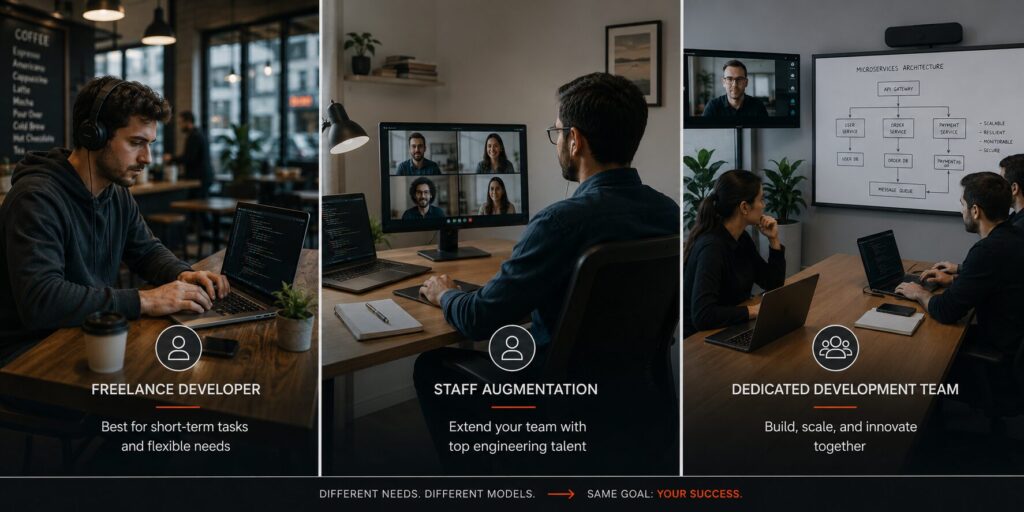
There are three distinct models. They serve different needs, carry different risks, and require different management approaches.
Model 1: Freelance Go Developer
A freelance go developer is an independent contractor who takes on defined, time-bound work. They typically manage their own tools, often work across multiple clients simultaneously, and operate outside your organizational structure. This model works well for discrete projects with clear deliverables a specific API, a migration script, and a performance optimization.
What it doesn’t work for: ongoing product development, architectural ownership, code review responsibility, or anything that requires consistent team integration.
Model 2: Staff Augmentation (Golang Remote Hire)
Staff augmentation means you’re adding a golang engineer to your existing team under your direction, but without the employment overhead. They work your hours, use your tools, join your standups, and integrate into your workflows. You direct the work; the staffing partner handles payroll, compliance, and HR.
This is the most common model for companies that have a working engineering culture but need to add capacity quickly. The engineer functions like an employee without the legal and administrative complexity of international employment.
Model 3: Dedicated Remote Golang Team
A dedicated team means you’re building a self-contained engineering unit typically a combination of golang developers, a tech lead, and sometimes a QA engineer that operates as an extension of your product team. This model suits companies with significant, sustained development needs: greenfield builds, major product expansions, or infrastructure modernization projects.
Which model is right for you?
| Model | Best For | Time to Start | Control Level | Cost Range |
| Freelance Go Developer | Defined, short-scope tasks | 1–3 days | Low | Low–Mid |
| Staff Augmentation | Capacity gaps, sprint needs | 5–10 days | High | Mid |
| Dedicated Remote Team | Ongoing product ownership | 7–14 days | Full | Mid–High |
The right answer depends on how much ownership the role requires, how long you need coverage, and whether you’re filling a gap or building a function.
The Real Cost Comparison: In-House Golang Engineer vs. Remote Go Developer
This is the section most companies wish they’d read before their third failed local hire.
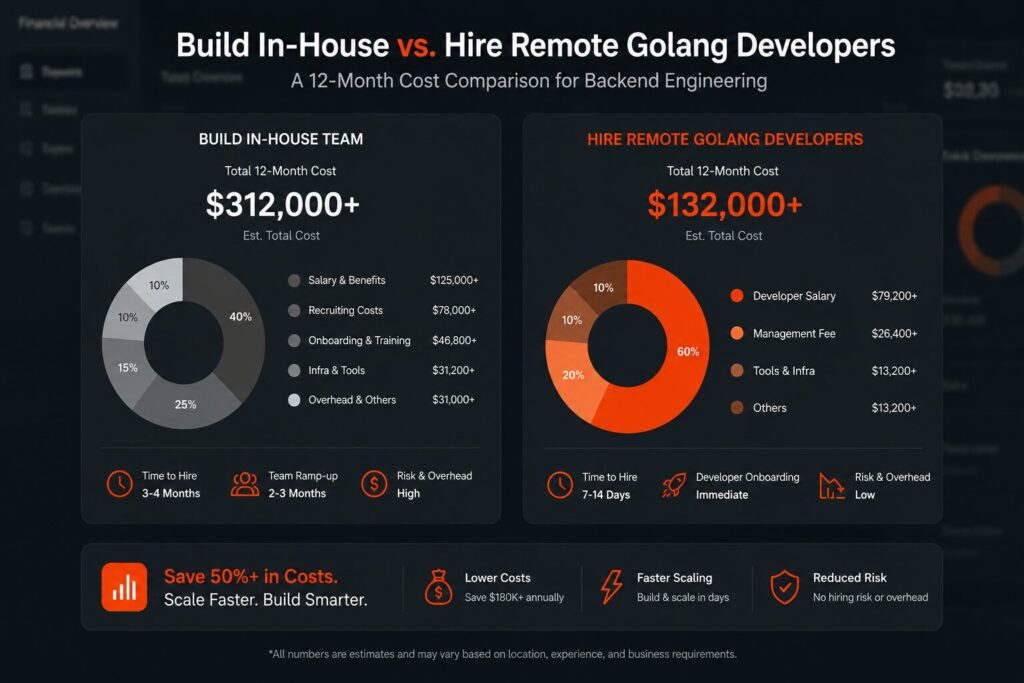
Let’s talk about what it actually costs to bring a senior golang engineer in-house in a major English-speaking market.
In-House Senior Golang Developer Cost (United States)
- Base salary: $155,000 – $195,000
- Payroll taxes and benefits: $25,000 – $45,000
- Recruitment fees (agency): $30,000 – $50,000 (one-time, typically 20–25% of salary)
- Equity dilution: Variable, but real
- Onboarding and tooling: $5,000 – $10,000
- Office space / infrastructure per seat: $8,000 – $18,000/year
Total first-year cost: $220,000 – $320,000+
And that’s before accounting for the 12–16 weeks of lost productivity while the role is unfilled, or the 6-month runway before a new hire is operating at full capacity.
Remote Golang Developer Cost (Managed Partner)
- India (mid-level golang developer): $2,800 – $4,500/month all-in
- India (senior golang engineer): $4,500 – $6,500/month all-in
- Eastern Europe (mid-level): $5,000 – $7,500/month all-in
- Eastern Europe (senior): $7,500 – $11,000/month all-in
- No recruitment fee. No benefits overhead. No equity. No office cost.
Golang Developer Salary Benchmark by Region
| Region | Junior Go Dev | Mid-Level Golang Engineer | Senior Golang Developer |
| USA (in-house) | $85K–$115K/yr | $120K–$155K/yr | $155K–$195K/yr |
| Western Europe (in-house) | £55K–£75K/yr | £80K–£110K/yr | £115K–£145K/yr |
| India (remote, managed) | $18K–$28K/yr | $28K–$45K/yr | $45K–$65K/yr |
| Eastern Europe (remote, managed) | $30K–$45K/yr | $50K–$75K/yr | $80K–$110K/yr |
The math is unavoidable. When your account for total employment cost, salary, benefits, recruitment, onboarding, and overhead remote Go developers through a managed partner typically cost 40–60% less than equivalent in-house hires.
At HireDeveloper.dev, the average total cost saving our clients see in year one, after switching from local to remote golang developer hiring, is 52%. That figure accounts for all employment costs on both sides.
The goal isn’t to pay the cheapest rate. The goal is to access the best value experienced golang developers who deliver senior-level output at a cost structure that doesn’t require a Series B to sustain.
If the cost comparison has you doing the math, HireDeveloper.dev makes it easy to get exact numbers for your specific role, seniority level, and timezone requirement — without a sales call. Get a cost estimate →
Five Signs Your Company Is Ready to Hire Remote Golang Developers
Not every company is at the same point in this decision. These five signals tell you that the window has opened.

Signal 1: Your in-house team is at capacity, but your roadmap keeps growing.
If your golang team is hitting sprint velocity limits and the backlog isn’t shrinking, you have a capacity problem, not a planning problem. Hiring remote go developers expands throughput without restructuring the org or rewriting the budget.
Signal 2: Your local golang jobs remote search keeps returning the same thin pool.
If you’ve been sourcing for 6+ weeks and you’re seeing the same 8–12 candidates cycle through referrals, your local market is genuinely depleted for this skill set. That’s when remote hiring stops being a preference and starts being the only logical path.
Signal 3: You’re building a distributed, cloud-native, or gRPC-heavy architecture.
The more sophisticated your backend stack, the more valuable Go’s concurrency model becomes and the more critical it is to hire golang engineers who’ve worked in those environments. That specific experience is far more available in remote talent markets than local ones.
Signal 4: Your golang developer salary budget is below local market rate.
You don’t need to pay US market rates to access US-quality talent. If your compensation ceiling is under $130K/year for a senior role, you’re fighting a losing battle in most major cities. The remote model lets you access genuinely senior engineers at compensation bands that fit your actual budget.
Signal 5: You need engineers in weeks, not months.
If the sprint can’t wait and the product timeline is real, you don’t have 16 weeks to run a hiring process. Remote golang remote work engagements through a qualified partner can have a vetted engineer in your Slack, pushing to your repo, within 5–14 business days.
How to Hire Remote Golang Developers Without Making Expensive Mistakes
The failure mode in remote Golang hiring almost never happens because the engineer wasn’t technically skilled. It happened because the process was wrong. Here’s the five-step process that actually works.

Step 1: Write a Specific Brief, not a Generic Job Description
Don’t post “hire golang programmer, backend experience required.” That’s a signal to good candidates that you don’t know what you need. A strong brief specifies: the architecture context (microservices, monolith migration, event-driven), the concurrency patterns the role touches (goroutines, channels, worker pools), the infrastructure stack (Kubernetes, Docker, GCP/AWS), and the communication rhythm (async-first, daily standup, sprint cadence).
Specificity attracts the right engineers and filters the wrong ones before you spend a minute interviewing.
Step 2: Choose the Right Sourcing Model Before You Start
If you’re sourcing yourself through golang remote jobs boards, you’ll need your own vetting infrastructure technical screeners, live coding frameworks, architecture review panels. Most companies don’t have that and building it for a single hire is expensive and slow.
If speed and quality assurance matter (they usually do), working with a managed partner that maintains a pre-vetted bench of remote golang developers is structurally faster and lower risk. You trade control for significant reduction in time and uncertainty.
Step 3: Run a Real Technical Screen Not Just Take-home
Take-home projects have their place, but they’re insufficient as a sole vetting mechanism. The best golang engineer assessments include:
- Goroutine lifecycle management under load
- Channel design and deadlock avoidance
- Memory profiling and escape analysis
- Architecture decision-making in a live system design session
- Code review of a deliberately flawed Go codebase
This kind of assessment reveals how an engineer actually thinks — not just whether they can pass a leetcode test.
Step 4: Evaluate Remote Readiness as Seriously as Technical Skill
A technically brilliant go developer who can’t communicate asynchronously, doesn’t document decisions, and disappears for 6 hours without signaling blockers is going to cost you more than a slightly weaker engineer who communicates clearly and proactively.
Remote readiness isn’t a soft skill — it’s a professional discipline. Look for: evidence of async-first communication, a track record of working across timezones, documented architectural decision records, and the ability to ask good questions independently.
Step 5: Start With a Structured Onboarding Sprint
Even the best remote golang developers need a deliberate start. Design a 2–4 week onboarding sprint with clear deliverables, daily check-ins, and specific success criteria. Don’t just give someone access to the repo and wish them luck. This sprint period lets you validate velocity, code quality, team integration, and communication style before you’re deeply dependent on the relationship.
HireDeveloper.dev runs every golang developer candidate through a 4-stage technical vetting process — so you don’t have to build this infrastructure yourself. See how we vet →
Where to Find Golang Remote Talent in 2026 (Honest Channel Breakdown)
There’s no shortage of places to look. The question is which channels actually produce qualified golang developers efficiently.
Golang-Specific Job Boards
Golang.cafe, Remote OK, and We Work. Remotely all surface active golang remote jobs and remote golang work postings. These platforms reach engineers who are specifically looking for remote Go work a meaningful filter in itself. The downside: you still need your own vetting capability, and competition for strong candidates is real.

General Freelance Platforms
Upwork and Toptal are the most common options. Upwork skews toward volume with variable quality; the platform’s incentives don’t always align with your need for genuinely senior talent. Toptal is more rigorously vetted but comes with higher rates and less flexibility for long-term, embedded engagement models.
Developer Communities
The Gophers Slack workspace, GolangBridge, the Go subreddit, and regional Go meetup communities are where many of the best go developers spend time that isn’t their job search. Community sourcing reaches engineers who aren’t actively applying — often the most experienced and in-demand segment. It takes longer and requires genuine community presence, but the quality ceiling is high.
Managed Staffing Partners (Recommended for Scale)
A qualified managed partner like HireDeveloper.dev handles sourcing, technical vetting, timezone matching, legal employment, IP protection, and ongoing developer retention. You receive a pre-vetted golang engineer who is ready to integrate, along with a structured process for resolving any fit issues quickly.
For companies that need to move fast without compromising quality, a managed partner eliminates every major friction point in the hire remote golang developer process. It’s not the cheapest option on paper but it’s almost always the cheapest option when your account for the cost of a slow or failed hire.
What Remote Golang Engineers Actually Build Day-to-Day
If you’re making a hiring decision, you should understand exactly what you’re hiring for. Golang engineers in remote production environments typically own:

API and service development:
REST and gRPC APIs, with Go’s performance characteristics making it particularly suited to high-throughput, low-latency endpoints. A strong go developer will design these services with observability, graceful degradation, and horizontal scalability built in from the start.
Microservices architecture:
Decomposing monolithic systems into independently deployable services, managing inter-service communication, and designing fault-tolerant patterns using Go’s native concurrency primitives.
Infrastructure and DevOps tooling:
Go’s compilation speed and binary portability make it the language of choice for CLI tools, Kubernetes operators, deployment scripts, and infrastructure automation. Many of the tools your team already uses — Docker, Kubernetes, Terraform providers, Prometheus exporters — are written in Go.
Data pipelines:
High-throughput data ingestion, transformation, and streaming systems where Go’s goroutine model handles concurrent workloads efficiently without the overhead of thread-per-request architectures.
Cloud-native applications:
Services deployed on AWS, GCP, or Azure using container orchestration, managed databases, and event-driven messaging systems — all areas where experienced golang developers bring significant architectural judgment.
This is not generic backend work. It’s specialized, high-leverage engineering that directly affects system reliability, performance, and scalability at scale
Common Mistakes Companies Make When Hiring Golang Remote Developers
These are the failure modes worth knowing before you start because they’re all avoidable.
Treating remote as purely a cost-reduction play.
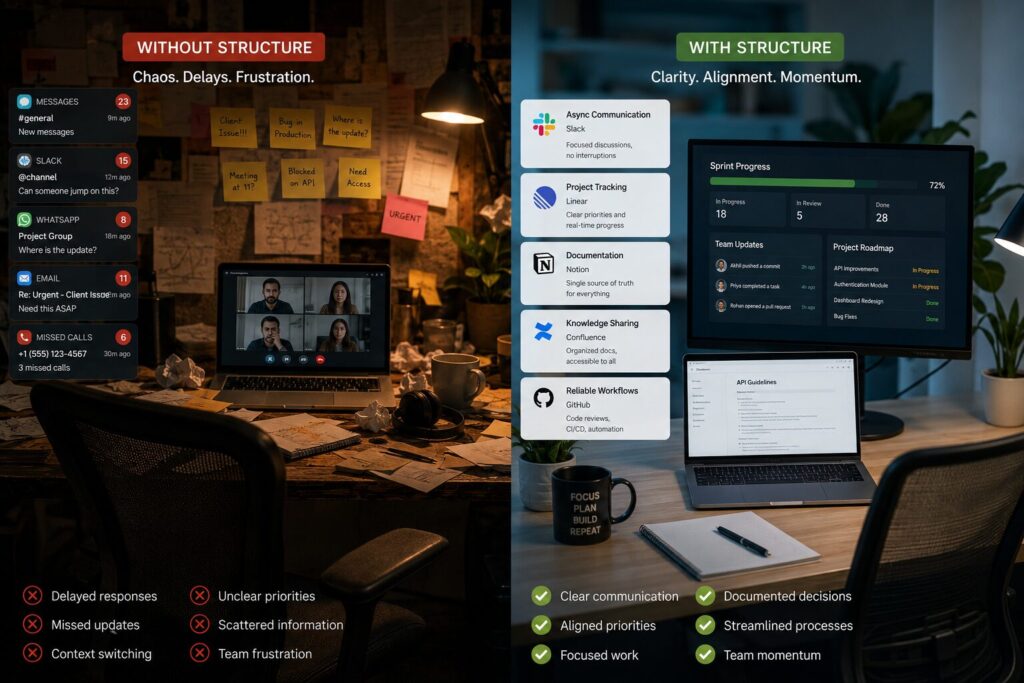
Companies that hire remote golang developers primarily to reduce the golang developer salary line on their P&L often under-invest in the tooling, async communication infrastructure, and documentation culture that makes remote engineering actually work. You can’t run a remote team with in-office habits. Invest in Notion, Linear, Loom, and a documentation-first culture, or the cost savings evaporate in coordination friction.
Skipping the architecture fit assessment.
A golang engineer with a background in CLI tooling and DevOps automation is a different hire than one with deep experience in high-throughput API services or distributed data pipelines. Both are legitimate Go expertise — but they’re not interchangeable for your specific use case. Match technical profiles to architectural requirements before you make an offer.
Using a freelance model for a role that needs ownership.
Golang remote jobs posted as short-term freelance work attract transient talent. If the role involves ongoing feature ownership, architectural decision-making, or code review responsibility and most meaningful backend roles do — hire a dedicated remote golang developer, not a project contractor.
Ignoring timezone overlap as an afterthought.
A golang engineer who is 10+ time zones ahead with zero daily overlap with your core team creates a silent productivity blocker that compounds over time. Code reviews get delayed. Blockers don’t get resolved. Sprint velocity suffers. Successful golang remote work requires a minimum of 3–4 hours of daily synchronous overlap for collaborative functions to work properly.
Skipping the structured trial period.
Hiring is never zero-risk. Even the best vetting process can miss a fit issue that only emerges in production context. A structured 2–4 week trial sprint with clear deliverables protects both sides and surfaces against any integration issues early — before you’re architecturally dependent on the relationship.
Why HireDeveloper.dev Is the Fastest Way to Hire Remote Golang Developers
Most of the friction in remote golang hiring comes from one source: having to build an entirely new capability — sourcing, vetting, legal compliance, timezone matching, developer retention — just to hire one engineer. HireDeveloper.dev exists to remove that friction entirely.
Here’s what the process actually looks like.
Pre-vetted talent bench. HireDeveloper.dev maintains an active, continuously screened pool of golang developers across India, Eastern Europe, and LATAM. These aren’t resumes pulled from a database — they’re engineers who have completed a 4-stage vetting process covering technical depth, architecture reasoning, communication assessment, and remote-work readiness.
4-stage vetting process:
- Technical depth screen (goroutines, channels, concurrency patterns, standard library)
- Live coding and system design session
- Architecture review — real-world problem, not a toy problem
- Async communication and documentation assessment
Timezone-matched placement. We don’t send you a golang engineer who can’t overlap with your team. Every placement is matched to your core working hours, ensuring meaningful daily synchronous time without requiring the engineer to work unsustainable hours.
Transparent pricing. No recruitment fees. No surprise invoices. All-in monthly pricing that accounts for the engineer’s compensation, HR management, and ongoing support — so your golang developer salary cost is exactly what you budget for.
Replacement guarantee. If a placement doesn’t work out — for any reason — HireDeveloper.dev replaces the remote golang developer within 5 business days. No hunting, no restarts, no gap in delivery.
Full compliance and IP protection. ISO 27001 certified, GDPR compliant, NDA-protected from day one. Your codebase, architecture, and product IP are protected under a structured legal framework — not just a handshake agreement.
Companies that partner with HireDeveloper.dev to hire remote golang developers report an average of 11 weeks saved versus running an in-house hiring process, and 52% lower total engineering cost in year one.
If you’re trying to scale backend capacity without the overhead, delay, and risk of local hiring, this is the most direct path.
Talk to an expert at HireDeveloper.dev →
Scale Your Backend Without Scaling Your Headcount
Here’s the honest truth about remote golang hiring in 2026.
The engineers who power the world’s fastest APIs, distributed systems, and cloud-native infrastructure aren’t all sitting in your city waiting to take your offer. They’re distributed globally, working for teams that figured out how to access them without a geographic constraint.
The companies that are shipping the fastest right now — the ones adding backend services in weeks rather than quarters; the ones whose infrastructure actually holds under load didn’t all get lucky with local hiring. Many of them made a deliberate decision to hire remote golang developers and built the processes to make it work.
The model works when three things are true: the vetting is rigorous, the communication infrastructure is right, and the partnership is structured properly. When those conditions exist, remote golang engineers deliver the same quality of work as in-house engineers at a cost structure and time-to-start that in-house hiring can’t match.
Whether you need one golang programmer for a targeted feature sprint, a mid-level go developer to own a critical service, or a full remote golang team to build out a new product layer the path exists. And it doesn’t require expanding your headcount, your real estate footprint, or your benefits overhead.
HireDeveloper.dev helps you find pre-vetted remote Golang developers — in days, not months. Start the conversation here →