






Introduction
On June 23, 2026, Anthropic launched Claude Tag, a product that fundamentally changes the unit of AI collaboration — shifting it from the private, one-on-one conversation to the shared team channel. Instead of every person carrying their own private Claude session, a single Claude now joins a Slack workspace as a shared team member, with its own identity, its own memory, and access to whichever tools and data an administrator chooses to grant it. This guide draws together Anthropic’s own announcement, official documentation, AWS’s enterprise rollout, and independent reviews to give engineering teams a complete picture of what shipped, how it works, and how to roll it out responsibly.
What Is Claude Tag?
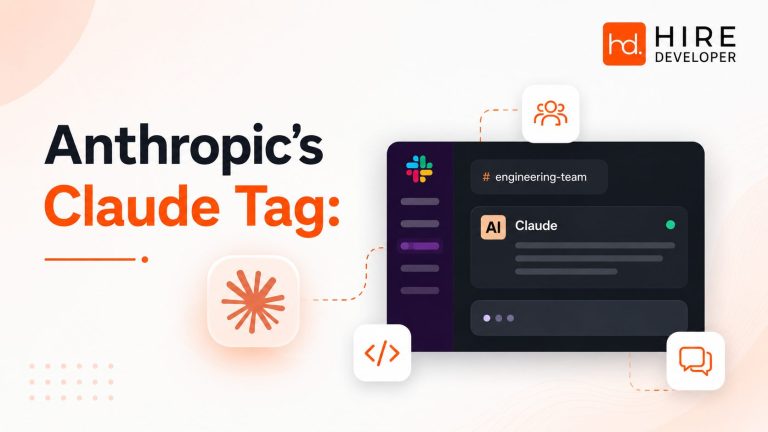
Claude Tag is Anthropic’s new always-on way of working with Claude inside Slack. An administrator adds Claude to selected channels and connects it to whichever tools, data sources, and even codebases the team chooses. From that point on, anyone in the channel can tag @Claude in and delegate a task while they focus on other work. Claude builds context by remembering relevant information from the channels it’s in, and it can plan out future tasks rather than only reacting to whatever it’s asked in the moment.
It launched in beta for Claude Enterprise and Claude Team plan customers, with Slack as the first supported surface. Anthropic has framed it as the beginning of an evolution of Claude Code — a way of making the model more proactive and better suited to working with a full team rather than a single user. Notably, Anthropic has said that the majority of its own product team’s code is now generated through an internal version of Claude Tag, and that the same pattern has spread well beyond engineering into chasing down product metrics, working through support tickets, and helping find the root cause of tricky bugs.
The Four Behaviors That Define Claude Tag
Independent reviews of the launch converge on four core properties that, together, set Claude Tag apart from any previous Slack bot or AI integration.
It’s multiplayer. Within a given Slack channel, there is one Claude that interacts with everyone — not a private session per user. Anyone can see what it’s working on and pick up the conversation from where the last person left off. This makes Claude Tag fundamentally different from working in a single chat with a single task: it behaves more like collaborating with a teammate than operating a tool.
It learns over time. As Claude follows along with a channel, it builds increasing context about the work happening there, so users don’t have to re-explain things from scratch in every conversation. With permission, it can also automatically learn from other Slack channels and data sources across the organization — though it does not report from private channels it hasn’t been explicitly granted access to.
It takes initiative. When “ambient” behavior is enabled, Claude proactively keeps the team updated on whatever it judges relevant, flags information from across the channels and tools it’s connected to, and follows up on threads or tasks that have gone quiet without being resolved.
It works asynchronously. A task can be assigned to Claude, and the team can move on to other priorities while it works. Claude can schedule its own follow-up steps and pursue a project over hours or days, which is part of why Anthropic describes its own internal teams as now spending much more time delegating work to multiple Claude instances in parallel.
How a Task Actually Flows Through a Channel
Anthropic’s documentation walks through a representative example: a teammate notices checkout traffic feels slow, tags @Claude, and asks it to compare current latency against the morning’s deploy. Claude responds directly in the thread and posts a running checklist as it works — pulling p99 latency figures, diffing the relevant deploy, reproducing the slow query locally, and ultimately opening a pull request with a fix. The entire exchange remains visible to everyone in the channel, so any teammate can jump in, redirect the work, or pick up where it left off.
This stage-by-stage execution model is consistent across use cases. When given a task, Claude Tag breaks it into stages, works through them using whichever tools it has access to, and reports back into the thread once it’s finished — rather than simply returning a single conversational reply.
The Agent-Identity Model: Why This Is More Than a New Chat Surface
The most consequential change in Claude Tag isn’t the Slack interface — it’s the identity model underneath it. In the earlier Claude in Slack integration, tagging Claude meant it acted under your own personal permissions, used your own connected accounts, and billed usage to your individual account. Every session started fresh.
Claude Tag replaces that with a shared, organization-level identity. The tools, data sources, codebases, and channels a given Claude instance can reach are defined in advance by an administrator — effectively creating a distinct Claude identity for each use case, scoped to the channels and connections an admin has authorized. A Claude instance configured for sales work doesn’t pass its memories to one configured for engineering, and it doesn’t give engineers access to sales data or tools. Usage is billed to the organization as a whole, and the context Claude accumulates in a channel belongs to that channel and everyone in it, not to whichever individual happened to start the conversation.
This solves a problem that has limited enterprise AI adoption for years: fragmentation. When every employee has their own private AI setup, their own context, and their own prompting habits, there’s no clean way to transfer institutional knowledge between people. A shared, channel-scoped identity means the context an engineer built with Claude on Monday is still available to a product manager who enters the same channel on Wednesday — and the isolation between sensitive contexts (HR, legal, engineering) is enforced structurally by admin configuration, not by hoping the model chooses not to cross a boundary.
For private or sensitive conversations, users can still DM Claude directly. In a DM, Claude responds using the individual’s own personal tools and connectors rather than the channel’s shared identity, keeping that exchange private.
Ambient Mode: Reactive by Default, Proactive on Request
Claude Tag is reactive out of the box — it only acts when someone tags it. Ambient mode is the optional layer that lets it participate without being summoned: surfacing relevant updates, flagging information from connected tools, and following up on stalled threads or unresolved tasks on its own initiative.
Ambient mode does not access private channels Claude hasn’t been explicitly granted permission to read, and the boundary of what it can see is set by an administrator at configuration time, not something that shifts on its own. For most teams, a sensible approach is to start with Claude purely reactive, build trust in the quality and judgment of its output, and only switch on ambient behavior in channels where proactive nudges genuinely add value — an active incident channel, for instance — rather than enabling it everywhere from day one.
Governance, Security, and Admin Controls
Anthropic built channel-level governance into Claude Tag from the outset, and the granularity of these controls is central to how the product is positioned for enterprise use:
- Channel-scoped identities. Each channel’s Claude instance only has the tools, data sources, and codebases an administrator has explicitly connected to it. A legal-team Claude cannot reach engineering’s tools or memory, and vice versa.
- Spend controls. Administrators can set token-spend limits both at the level of the whole organization and for individual channels, addressing one of the more common enterprise concerns about AI cost predictability.
- Audit visibility. Admins can view a log of everything Claude Tag has done in a workspace, along with who requested each task — giving security and compliance teams a clear record to review.
- DM privacy. Direct messages to Claude run under a user’s personal identity and connectors rather than the channel’s shared context, so individuals can still use Claude privately when needed.
- Standard enterprise data handling. Anthropic’s existing enterprise data-handling policies apply to Claude Tag, including options like zero data retention on eligible plans.
For organizations evaluating this rollout, a few practical habits matter just as much as the platform controls themselves: scope access per channel rather than granting broad permissions up front, treat any channel history containing sensitive data with caution before adding an agent identity, keep a human in the loop for any irreversible action (deployments, deletions, customer-facing communication), and be aware that since Claude reads whatever is posted in a channel, untrusted or adversarial content posted by any member is a real consideration when designing access scopes.
Claude Tag vs. the Old Claude in Slack App
The earlier Claude in Slack integration let users DM Claude or mention it for one-off help, and Claude Code in Slack already routed coding requests from channel mentions into full coding sessions on the web. Claude Tag consolidates these into one identity model with persistent memory, shared context, and admin-defined access — rather than a private, stateless session restarted with every interaction.
Anthropic is retiring the original Claude in Slack app on August 3, 2026. Administrators have a 30-day migration window from launch to opt in to Claude Tag and reconfigure channel access, tool connections, and memory scope before that date. Anthropic is also issuing introductory launch credits to eligible Enterprise and Team organizations so teams can evaluate Claude Tag before fully committing.
Availability and Enterprise Access via AWS
Claude Tag is available today in beta exclusively to Claude Enterprise and Claude Team plan customers, and currently works only with Slack — though Anthropic has stated its intention to expand the capability to other platforms over time.
Enterprises running Claude through AWS Marketplace also have access. AWS’s own announcement confirms that the experience for Claude Enterprise customers on AWS Marketplace is identical to first-party Claude Enterprise, with the same setup, capabilities, and controls, and that consumption-based pricing tracks usage rather than headcount — with an admin provisioning the agent identity in roughly an hour and scoping it per channel. For security and governance teams, AWS highlights that Claude Tag operates under its own identity, scoped per channel, with spend controls and ambient mode switched off by default.
What Engineering Teams Should Actually Delegate
Drawing on real workflows reported around the launch, the clearest early wins for engineering organizations include:
- Bug triage and fixes — comparing latency or error data against recent deploys, reproducing issues, and opening pull requests directly from a channel discussion.
- PR and incident summarization — condensing long, scattered threads into a clear, shared record everyone in the channel can reference.
- Cross-team handoffs — picking up a task mid-stream without losing context a colleague already built, since the memory lives with the channel rather than one person.
- Documentation from decisions — turning a back-and-forth discussion into a structured doc or spec.
- Data and metrics requests — fielding ad hoc product-metrics questions that would otherwise pull an analyst off other work.
- Support and bug-root-cause work — particularly suited to ambient mode, where Claude can flag recurring patterns across tickets and follow up on items that have gone unresolved.
A Practical Rollout Approach
- Pilot in one channel. Choose a team that already lives in Slack and has clear, repetitive work worth delegating.
- Scope access narrowly. Connect only the tools, data, and codebases that specific channel actually needs.
- Start reactive. Keep ambient mode off until the team has built confidence in Claude’s judgment and output quality.
- Define guardrails for high-impact actions. Require explicit human confirmation for anything irreversible, before it happens rather than after.
- Set spend limits early. Configure channel- and organization-level token budgets rather than leaving usage uncapped.
- Review, then expand. After a few weeks, assess what worked and what needed correction, then deliberately add channels or enable ambient mode where it clearly helps.
- Plan around the August 3, 2026 cutover if your organization currently relies on the legacy Claude in Slack integration.
Why This Launch Matters Beyond the Feature Itself
Claude Tag isn’t an isolated product update — it’s a deliberate extension of the same agentic approach that made Claude Code central to many engineering workflows, applied now to the broader set of tasks that move through team chat. The underlying bet is that the richest organizational context doesn’t live in a data warehouse or knowledge base — it lives in the channels where decisions actually get made and work actually happens. By giving Claude a persistent, governed presence inside those channels, Anthropic is positioning Claude Tag as infrastructure that accumulates institutional knowledge over time, rather than a tool that starts from zero with every new conversation.
For engineering leaders, the practical opportunity isn’t just faster individual task completion — it’s reducing the repeated context-switching and re-explanation that slows teams down whenever work moves between people, tools, and channels.
Need Help Rolling This Out the Right Way?
Adopting an AI teammate like Claude Tag well takes more than flipping a switch in the admin console — it takes the right access architecture, sensible guardrails, and engineers who understand how to wire agentic tools into real production systems safely. If your team is planning a Claude Tag rollout, building custom Slack-based workflows around it, or simply needs experienced engineers who can move quickly on AI-driven projects, Hire Developer can connect you with vetted developers who specialize in exactly this kind of work.
Get started with Hire Developer and build your next AI-powered engineering workflow with the right talent on your side.
Sources and References:
- Anthropic — Introducing Claude Tag
- Claude Docs — Claude Tag Overview
- AWS — Claude Tag now available via AWS Marketplace
- The Verge — Anthropic introduced Claude Tag, a new AI agent Slack integration
- Build Fast with AI — Anthropic Claude Tag Slack Review
- Lushbinary — Claude Tag: Anthropic’s Slack AI Teammate Guide