






Introduction
If you search “ASP.NET vs ASP.NET Core” today, most of what comes up was written years ago. Some of it still references .NET Core 3.1 as current. Some of it calls .NET 6 the latest LTS release. That was accurate once. It is not accurate now, and if you are making a real hiring or architecture decision in 2026, working from stale version numbers can quietly cost you months of avoidable migration work later.
This guide is rebuilt for where things actually stand in mid-2026: .NET 10 is the current long-term support release, both .NET 8 and .NET 9 reach end of support in November 2026, and ASP.NET Core has picked up real capability since the last time most comparison articles were updated. We will walk through what each framework actually is, where they genuinely differ, what changed recently, and how to decide which one fits your project, your team, and your budget.
What Is ASP.NET?
ASP.NET is Microsoft’s original web development framework, first released in 2002 and built on top of the full .NET Framework. It gave developers a structured way to build dynamic web pages, web services, and enterprise applications using C# or VB.NET, and it introduced three development styles that are still recognizable today: Web Forms, ASP.NET MVC, and Web Pages.
For nearly two decades, ASP.NET was the default choice for Windows-centric enterprise development. It integrates tightly with Internet Information Services (IIS), Windows Communication Foundation, and other Microsoft tooling, which made it a natural fit for organizations already standardized on Windows Server. That tight coupling to Windows is also its main limitation: ASP.NET runs primarily on IIS, and cross-platform support was never a core design goal.
ASP.NET now runs on the .NET Framework 4.8, which is in maintenance mode. It still receives security patches, but Microsoft’s active feature development has moved entirely to ASP.NET Core.
What Is ASP.NET Core?
ASP.NET Core, introduced in 2016, is not an upgraded version of ASP.NET so much as a ground-up rebuild. Microsoft rewrote the framework to be modular, open source, and genuinely cross-platform, meaning it runs natively on Windows, macOS, and Linux, and it can be deployed in containers, on Kestrel, behind Nginx, or on IIS.
The redesign unified what used to be separate frameworks. MVC and Web API, which required different setups in classic ASP.NET, now share a single programming model in ASP.NET Core. It also shipped with built-in dependency injection, a flexible configuration system that reads from JSON files and environment variables, and Razor Pages as a lighter alternative to full MVC. Later releases added Blazor, Microsoft’s framework for building interactive web UIs in C# instead of JavaScript.
Because ASP.NET Core is where Microsoft puts its engineering investment now, it is also where the performance work happens. Independent benchmarking (notably the TechEmpower framework benchmarks that Microsoft’s own team has cited) has repeatedly shown ASP.NET Core among the fastest mainstream web frameworks, a gap that has only widened with recent runtime work in .NET 8, 9, and 10.
ASP.NET vs ASP.NET Core: Key Differences
Here is the side-by-side breakdown that actually matters for a 2026 decision:
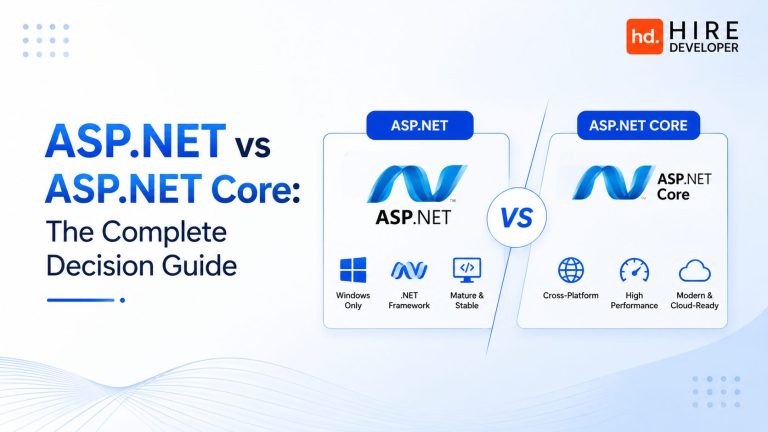
| Factor | ASP.NET | ASP.NET Core |
|---|---|---|
| Platform support | Windows only (IIS-based) | Windows, macOS, Linux, containers |
| Architecture | Monolithic, built-in libraries loaded by default | Modular, include only what you need via NuGet |
| Programming models | Separate: Web Forms, MVC, Web API | Unified: MVC, Web API, Razor Pages, minimal APIs, Blazor |
| Dependency injection | Not built in, needs third-party libraries | Built in from the ground up |
| Configuration | web.config (XML) | appsettings.json, environment variables, IConfiguration |
| Hosting | IIS on Windows Server | Kestrel, IIS, Nginx, Apache, Docker, Kubernetes |
| Open source | Partially, added later | Fully open source from day one |
| Active development | Maintenance mode, security patches only | Active, new major version every November |
| Best fit | Existing legacy Windows apps | All new development |
This table lines up with what you will find on Telerik’s own ASP.NET Core comparison and in ScholarHat’s side-by-side breakdown, both of which point to the same core distinction: ASP.NET Core is a cross-platform, modular rebuild, not an incremental update.
Weighing this decision for a live project? Teams building new platforms often bring in specialists through HireDeveloper.dev to get pre-vetted ASP.NET Core engineers who have already made this call dozens of times.
Performance and Scalability
Raw performance is where the gap between the two frameworks is hardest to argue with. ASP.NET Core’s Kestrel web server, its minimal request pipeline, and years of JIT and garbage collection improvements in the .NET runtime give it a consistent throughput advantage over classic ASP.NET, particularly under high concurrency.
That advantage compounds with .NET 10. The .NET 10 runtime introduces improvements in JIT inlining, method devirtualization, and stack allocation, along with better code generation for struct arguments. None of that is theoretical: it shows up directly in requests-per-second and memory footprint for typical ASP.NET Core APIs, which matters if you are running at cloud scale and paying for compute by the hour.
Scalability follows the same pattern. ASP.NET Core’s modular design means you deploy a smaller footprint, which containerizes cleanly and scales horizontally in Kubernetes or Azure Container Apps without the baggage of a full IIS-bound deployment.
What's New in 2026: .NET 10 LTS and the November Deadline
This is the section most existing comparison articles get wrong, because they were written before it happened. Several widely cited guides, including older breakdowns on jelvix.com and resolutesoftware.com, still describe .NET Framework 4.8 as the latest classic release and reference .NET 6 as the current long-term support version. Both of those were true for a while. They are outdated now, and building a 2026 hiring or migration plan on them will point you at the wrong target.
Here is what is actually current as of mid-2026:
- .NET 10 is the current long-term support (LTS) release, generally available since November 2025, and it is supported until November 10, 2028.
- .NET 8, the previous LTS release, and .NET 9, a standard-term support release, both reach end of support on the same date: November 10, 2026. Microsoft extended standard-term support from 18 to 24 months, which is why two different release tracks now converge on one deadline.
- ASP.NET Core 10 shipped alongside .NET 10 with Blazor WebAssembly preloading, automatic memory pool eviction, enhanced form validation, better diagnostics, and passkey support for ASP.NET Core Identity.
- C# 14 shipped with .NET 10, adding field-backed properties and expanded generic support in nameof expressions, among other developer-productivity features.
- EF Core 10 added named query filters and deeper vector search support for teams building AI-assisted features directly into their data layer.
The practical takeaway: if your team is still on .NET 8 or .NET 9, you have a hard deadline in November 2026 to move to .NET 10, or you will be running an unsupported framework in production. If you are starting a new ASP.NET Core project today, target .NET 10 directly rather than building on a version that is about to age out.
Migration: Should You Move an Existing ASP.NET App?
If you already have a working ASP.NET application, migration is not automatic, and it is not always the right call immediately. A few things worth checking before you commit a roadmap to it:
- Web Forms dependency. Web Forms has no direct equivalent in ASP.NET Core. If your app leans heavily on it, migration means a genuine rewrite of those views, not a straight port.
- Third-party library compatibility. Some older libraries built for the full .NET Framework have no ASP.NET Core-compatible replacement yet. Audit your dependency tree before estimating timelines.
- Static content and configuration. ASP.NET Core moves static files into a dedicated wwwroot folder and replaces web.config with appsettings.json, so both need to be restructured, not just copied over.
- Team readiness. Migration is also a skills shift. Developers comfortable with web.config and Web Forms need ramp-up time on dependency injection patterns and the ASP.NET Core middleware pipeline.
For most teams, a phased migration, starting with new features built in ASP.NET Core alongside the existing app, is lower risk than a single big-bang rewrite.
Which Should You Choose?
The honest, direct answer for 2026: if you are starting anything new, choose ASP.NET Core, and target .NET 10. There is no scenario in active development where classic ASP.NET offers an advantage that outweighs losing cross-platform support, active feature development, and the performance gains built into the current runtime.
Classic ASP.NET only remains the right call when you have an existing, working application with deep Web Forms or legacy library dependencies that make migration genuinely uneconomical right now. Even then, treat it as a holding position, not a destination, since Microsoft’s investment is entirely in ASP.NET Core going forward.
Hiring the Right Developers for Either Path
Whichever direction you’re heading, the bottleneck is rarely the framework itself. It’s finding developers who have actually shipped production ASP.NET Core systems on current .NET versions, not just tutorials from a few years back. Companies scaling backend infrastructure often work with HireDeveloper.dev to access pre-vetted ASP.NET and ASP.NET Core engineers who can start contributing without a long ramp-up period, whether the project is a new .NET 10 build or a phased migration off legacy Web Forms.
Planning an ASP.NET Core build or a migration off legacy Web Forms?
HireDeveloper.dev connects you with pre-vetted ASP.NET and ASP.NET Core developers who can start fast. Explore HireDeveloper.dev →
Sources and Further Reading
This guide draws on the following industry references. Where their version details were outdated, we’ve noted it and replaced those figures with the current 2026 above.
- Resolute Software: ASP.NET vs. ASP.NET Core (published 2023; useful for migration context, but its framework and support-schedule references predate .NET 10 and are now outdated)
- https://hiredeveloper.dev/insights/what-is-asp-net-development-benefits-use-cases-services/
- DEV Community: Differences Between ASP.NET and ASP.NET Core (solid feature-by-feature breakdown, version-agnostic)
- ScholarHat: Difference Between ASP.NET and ASP.NET Core (updated Sept 2025; strong architectural detail, though its “latest version” references still cite .NET Core 8.0 rather than the current .NET 10 LTS)
- Telerik: ASP.NET vs ASP.NET Core Key Differences (concise FAQ-style comparison from Progress/Telerik)
- Jelvix: ASP.NET vs ASP.NET Core (originally published 2020, updated Dec 2024; still references .NET Framework 4.8 as “latest” and predates the .NET 10 LTS release, so treat its version claims as outdated)