






Introduction
If you have ever used an enterprise web portal, a real-time trading dashboard, or a high-traffic SaaS product built by a company with serious engineering standards, there is a strong chance ASP.NET development was powering the server side.
ASP.NET is one of the most battle-hardened web development frameworks in existence. It is also one of the most misunderstood. Some developers still associate it with bulky Windows-only enterprise software from the early 2000s. That version is long gone.
Today, ASP.NET Core is a cross-platform, open-source, cloud-native framework consistently ranked among the fastest in global benchmarks. And in 2026, with enterprise teams doubling down on reliability, security, and performance, it is having something of a renaissance.
This guide covers everything: what ASP.NET development is, how it works, where it excels, how it compares to alternatives, and how to hire ASP.NET developers who actually know the stack in depth.
What Is ASP.NET Development?
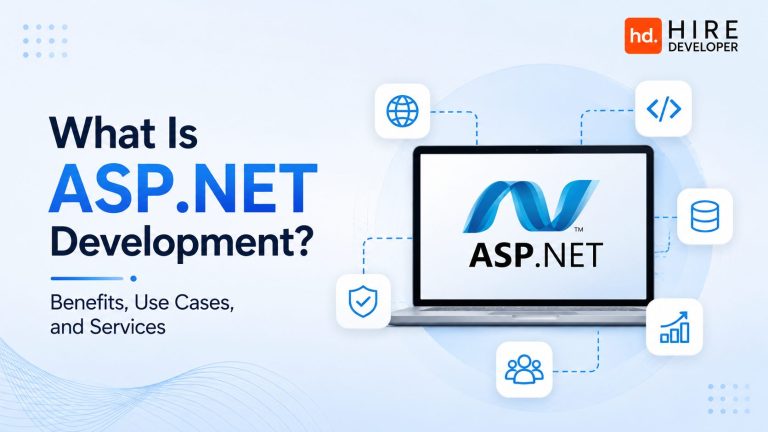
ASP.NET development refers to the practice of building server-side web applications, APIs, and enterprise systems using Microsoft’s ASP.NET framework and the C# programming language. The modern version, ASP.NET Core, is open-source, cross-platform, and runs on Windows, Linux, and macOS.
ASP.NET stands for Active Server Pages .NET. It is an open-source server-side web framework developed and maintained by Microsoft as part of the broader .NET ecosystem. Developers use it to build web applications, RESTful APIs, real-time systems, and enterprise-grade software using primarily C# or F# as the programming language.
ASP.NET handles the server-side layer of application architecture. That means business logic, database interactions, authentication, session management, routing, and API communication. The frontend, whether it is React, Angular, Vue, or Razor, sits on top of the backend that ASP.NET powers.
When someone refers to ASP.NET development services or an ASP.NET development company in 2026, they almost certainly mean ASP.NET Core. The original legacy ASP.NET framework is still maintained for existing systems but is no longer used for new projects.
According to the Stack Overflow Developer Survey 2024, ASP.NET Core is used by approximately 17.5% of professional developers globally, placing it among the top backend frameworks alongside Node.js and Django. JetBrains reports that roughly 70% of all .NET applications rely on ASP.NET in some form.
A Brief History: From Classic ASP to ASP.NET Core
Understanding where ASP.NET came from helps clarify why it is built the way it is and why teams trust it for long-horizon projects.
Classic ASP (1996-2002)
Microsoft’s original Active Server Pages was a server-side scripting environment. It worked, but it mixed business logic directly into HTML files and had no real separation of concerns. As web applications grew in complexity, classic ASP hit its limits.
ASP.NET 1.0-4.x (2002-2015)
Microsoft released ASP.NET in 2002 as part of the .NET Framework. This was a major leap: compiled code instead of interpreted scripts, proper object-oriented structure, and Web Forms for building UI components. Over the next decade, the MVC (Model-View-Controller) pattern was introduced in 2008, bringing the separation of concerns that modern development requires.
The limitation of this era was tight coupling to Windows and IIS (Internet Information Services). Deploying to Linux was not an option. This constrained adoption in cloud-native and open-source ecosystems.
ASP.NET Core (2016-Present)
In 2016, Microsoft released ASP.NET Core as a complete ground-up redesign. The goals were explicit: cross-platform support, modular architecture, cloud-first deployment, and dramatically improved performance. ASP.NET Core runs on Windows, Linux, and macOS. It uses Kestrel as its built-in high-performance web server and supports Docker containers natively.
The framework has continued to evolve rapidly. .NET 6 (2021) was the first unified LTS release merging .NET Core and the classic .NET Framework under one platform. .NET 8 (2023) and .NET 9 (2024) have further extended performance capabilities, with .NET 9 delivering significant throughput improvements in TechEmpower Plain Text benchmark results.
ASP.NET vs ASP.NET Core: Key Differences Explained
ASP.NET is the original Windows-only web framework released in 2002. ASP.NET Core is its modern, open-source, cross-platform successor released in 2016. All new ASP.NET development projects in 2026 use ASP.NET Core.
| Feature | ASP.NET (Legacy) | ASP.NET Core (Modern) |
| Platform Support | Windows only | Windows, Linux, macOS |
| Performance | Moderate | Very High (Kestrel, async-first) |
| Open Source | No | Yes (MIT License, GitHub) |
| Deployment | IIS required | Docker, cloud, serverless, IIS |
| Dependency Injection | Optional, third-party | Built-in, first-class support |
| Configuration | web.config (XML) | JSON, environment variables, cloud config |
| Modular Middleware | Limited | Fully modular pipeline |
| Long-Term Support | Maintenance mode only | Active development, LTS releases |
| Recommended Use | Legacy system maintenance | All new development |
The practical implication: if you are hiring an ASP.NET development company or looking to hire ASP.NET developers for a new project, verify that the team works in ASP.NET Core, not the legacy Web Forms or early MVC versions.
Core Components and Architecture of ASP.NET
Understanding the architecture of ASP.NET development helps both engineering leads evaluating the framework and businesses assessing what their development team is building.
ASP.NET Core MVC
The Model-View-Controller pattern separates application logic into three distinct layers. The Model handles data and business logic, the View handles the user interface, and the Controller handles input and coordinates between the two. MVC is the standard choice for server-rendered web applications.
ASP.NET Core Web API
The most widely used approach for modern ASP.NET development services. Web API builds RESTful HTTP services that serve data to frontend applications, mobile apps, third-party integrations, and microservices. It is lightweight, fast, and designed for JSON by default.
Razor Pages
A page-centric alternative to MVC for simpler web UI scenarios. Each Razor Page encapsulates its own logic and view, reducing the overhead of the full MVC pattern for pages that do not need complex routing.
Blazor
A newer addition to the ASP.NET ecosystem that allows developers to build interactive web UIs using C# instead of JavaScript. Blazor can run on the server (Blazor Server) or in the browser using WebAssembly (Blazor WASM). It is particularly powerful for teams that want full-stack C# without switching context to a JavaScript framework.
SignalR
ASP.NET’s real-time communication library. SignalR manages WebSocket connections and falls back gracefully to other transport methods when WebSockets are unavailable. It powers live dashboards, chat systems, notifications, and multiplayer game backends.
The Middleware Pipeline
Every request in an ASP.NET Core application passes through a configurable middleware pipeline. Each middleware component can inspect, transform, or short-circuit the request before passing it along. Authentication, logging, rate limiting, CORS, and caching are all implemented as middleware.
Key Benefits of ASP.NET Development
Industry-Leading Performance
ASP.NET Core consistently ranks among the fastest web frameworks in TechEmpower Round 22 benchmarks. In the Plain Text benchmark, ASP.NET Core handles over 7 million requests per second on commodity hardware. For SaaS products and APIs expecting traffic spikes, this performance ceiling matters significantly.
Enterprise-Grade Security by Default
Security in ASP.NET is not bolted on. It is built in. The framework ships with support for JWT bearer tokens, OAuth 2.0, OpenID Connect, ASP.NET Core Identity for user management, data protection APIs for encryption, HTTPS enforcement middleware, anti-forgery tokens for CSRF protection, and rate limiting middleware (introduced natively in .NET 7). For applications in regulated industries like financial services and healthcare, this default security posture is a significant advantage.
True Cross-Platform and Cloud-Native
ASP.NET Core applications containerize cleanly with Docker. Microsoft publishes official .NET container images optimized for size and security. Applications deploy natively to Azure App Service, Azure Container Apps, AWS Elastic Beanstalk, Google Cloud Run, and Kubernetes clusters. CI/CD pipelines with GitHub Actions and Azure DevOps have first-class .NET support.
C# as a Development Language
C# is a statically typed, object-oriented language with modern features including nullable reference types, pattern matching, record types, and async/await. Strong typing catches categories of bugs at compile time that dynamically typed languages surface only at runtime. For large teams and complex codebases, this translates to fewer production incidents.
Long-Term Vendor Support and Stability
Microsoft releases LTS versions of .NET every two years with three years of support. This is critical for enterprise teams that cannot afford to continuously chase framework upgrades. The stability of Microsoft’s support commitments is a primary reason enterprises in financial services, government, and healthcare prefer ASP.NET development.
Rich Ecosystem with NuGet
NuGet, the .NET package manager, hosts over 350,000 packages. Integrations for every major database, message broker, cloud provider, and third-party API are available as maintained packages. Entity Framework Core handles ORM. Serilog handles structured logging. MassTransit handles message bus integration. Polly handles resilience and retry patterns.
Teams building on ASP.NET often struggle to find developers who genuinely know the stack beyond tutorials. HireDeveloper.dev connects you with pre-vetted ASP.NET developers who have proven production experience.
Find pre-vetted ASP.NET developers at HireDeveloper.dev and start building faster.
Top Real-World Use Cases for ASP.NET in 2026
ASP.NET development services are applied across a wide and growing range of product categories. Here are the highest-value use cases in 2026:
Enterprise Web Applications and Portals
Large organizations build internal portals, HR systems, supply chain management tools, and ERP interfaces on ASP.NET. The framework’s role-based access control, audit logging, and enterprise identity integration (Active Directory, Azure AD) make it the natural choice for internal tooling at scale.
RESTful and GraphQL API Backends
ASP.NET Core Web API is the most common approach for building API backends that serve React, Angular, Vue, or mobile frontends. Its minimal API model (introduced in .NET 6) allows teams to build lean, high-performance API endpoints with minimal boilerplate.
Mobile App Backend Development
ASP.NET Core is widely used for mobile app backend development. Whether the mobile client is built in Swift, Kotlin, React Native, or Flutter, the backend API is frequently ASP.NET Core. The combination of strong performance, built-in JWT authentication, and robust ORM support makes it a reliable API backend for mobile products.
Real-Time Applications
SignalR makes ASP.NET the go-to for applications requiring real-time bidirectional communication. Trading dashboards, live sports scores, collaborative editing tools, customer support chat, and IoT monitoring platforms are all strong SignalR use cases.
SaaS Platform Backends
Multi-tenant SaaS products built on ASP.NET benefit from its built-in dependency injection (which naturally supports multi-tenancy patterns), strong connection pooling with Entity Framework Core, and seamless Azure integration for managed services like Azure Service Bus, Azure Blob Storage, and Azure Redis Cache.
Healthcare and Financial Technology Systems
In regulated industries, ASP.NET’s default security posture, auditability, and Microsoft’s compliance certifications (HIPAA-eligible Azure services, SOC 2, PCI DSS) make it a preferred backend for custom backend development services targeting fintech and health tech.
Microservices Architectures
ASP.NET Core applications containerize efficiently with small Docker image sizes. The framework’s support for gRPC (in addition to REST), message-based communication via MassTransit or NServiceBus, and distributed tracing integration makes it well-suited for microservices decomposition.
ASP.NET Development Services: What Companies Offer
When you engage an ASP.NET development company or ASP.NET development service provider, these are the core service categories you should understand:
- Custom ASP.NET web application development: Building greenfield web applications from requirements through deployment, using ASP.NET Core MVC or Minimal APIs.
- ASP.NET Core Web API development: Designing and implementing RESTful or GraphQL API backends for web, mobile, and third-party integration needs.
- ASP.NET migration services: Migrating legacy ASP.NET WebForms or ASP.NET MVC 4/5 applications to ASP.NET Core, often combined with .NET platform version upgrades.
- ASP.NET MVC application development: Building server-rendered web applications with full MVC architecture, Razor views, and database integration.
- Real-time application development: Implementing SignalR-based real-time features into existing or new ASP.NET applications.
- ASP.NET consulting and architecture review: Technical advisory engagements where senior ASP.NET architects evaluate existing codebases and recommend structural improvements.
- Dedicated ASP.NET development teams: Staffing dedicated development teams for ongoing product development, typically used by companies that want to outsource ASP.NET development without losing engineering control.
ASP.NET vs Other Backend Frameworks
| Framework | Language | Performance | Enterprise Fit | Learning Curve | Best For |
| ASP.NET Core | C# | Very High | Excellent | Medium | Enterprise, fintech, SaaS APIs |
| Node.js (Express) | JavaScript | High | Good | Low | Real-time apps, startup APIs |
| NestJS | TypeScript | High | Very Good | Medium | Structured Node.js APIs |
| Django | Python | Medium | Good | Low | AI/ML integrations, rapid builds |
| Spring Boot | Java | High | Excellent | High | Large enterprise, banking |
| Laravel | PHP | Medium | Moderate | Low | CMS, e-commerce, budget projects |
| Go (Gin/Fiber) | Go | Very High | Good | Medium-High | Microservices, cloud infra |
The key pattern: ASP.NET Core and Spring Boot are the two dominant choices for serious enterprise backend development. ASP.NET Core has the edge in cloud-native deployment simplicity and Microsoft ecosystem integration. Spring Boot has the edge in Java-centric organizations with deep JVM investment.
For teams choosing between ASP.NET development and Node.js, the deciding factor is usually team composition and traffic pattern. ASP.NET Core excels at CPU-bound work and complex business logic under high load. Node.js excels at I/O-bound concurrency with simpler logic.
The ASP.NET Development Technology Stack
A complete ASP.NET development stack in a modern production environment typically combines the following components:
| Layer | Technology | Purpose |
| Runtime | .NET 8 / .NET 9 | Application runtime and base class libraries |
| Web Framework | ASP.NET Core | Request handling, routing, middleware |
| Language | C# 12+ | Primary development language |
| ORM | Entity Framework Core | Database abstraction and query generation |
| Database (Primary) | SQL Server / PostgreSQL | Relational data storage |
| Cache | Redis / Azure Cache | Session, output, and data caching |
| Real-Time | SignalR | WebSocket and real-time messaging |
| Authentication | ASP.NET Identity / Azure AD B2C | User management and SSO |
| API Documentation | Swagger / Scalar | OpenAPI specification and testing UI |
| Logging | Serilog / Application Insights | Structured logging and observability |
| Containerization | Docker / Kubernetes | Deployment and orchestration |
| CI/CD | GitHub Actions / Azure DevOps | Build, test, and deploy pipelines |
| Cloud | Azure / AWS / GCP | Managed services and infrastructure |
If you need a team that can implement this full ASP.NET stack from day one without a learning curve, hiring pre-vetted ASP.NET developers through HireDeveloper.dev gets you engineers who have already worked in production environments with this exact technology combination.
Find pre-vetted ASP.NET developers at HireDeveloper.dev and start building faster.
When Should You Use ASP.NET Development?
ASP.NET development is the right choice when one or more of the following conditions apply:
- Your team has existing C# or .NET experience. Switching frameworks has a real productivity cost. If your engineers know .NET, ASP.NET Core is the path of least resistance.
- You are building an enterprise system with complex business logic. C#’s strong typing, SOLID-friendly architecture, and ASP.NET’s built-in DI container make it the natural fit for systems with complex domain models.
- Your cloud infrastructure is Microsoft Azure. ASP.NET Core integrates with Azure services natively: Azure Active Directory, Azure Service Bus, Azure Key Vault, Azure Application Insights, and managed identity all work with minimal configuration.
- Security and compliance requirements are non-negotiable. Regulated industries (fintech, healthcare, government) benefit from ASP.NET’s security defaults and Microsoft’s compliance ecosystem.
- You need real-time features at scale. SignalR provides production-proven WebSocket management that is hard to replicate with the same reliability in other frameworks.
- You are planning a long-lived product. Microsoft’s LTS releases and clear support lifecycle (3 years per LTS version) reduce the risk of framework abandonment.
ASP.NET development may not be the best fit when your team is entirely Python-focused and the project is data-science-heavy, when you need the fastest possible prototype with a small JavaScript-only team, or when the system is simple enough that framework overhead is not justified.
How to Hire ASP.NET Developers: Skills and Evaluation Guide
Whether you want to hire ASP.NET developers for a full-time role, hire an ASP.NET MVC developer for a specific project, or hire dedicated ASP.NET developers through a staffing platform, evaluating the right competencies separates senior production engineers from juniors who have only followed tutorials.
Core C# and .NET Fundamentals
- Async/await patterns and the task-based asynchronous model. A developer who cannot explain how async works in the ASP.NET request pipeline is not ready for production.
- SOLID principles and their application in ASP.NET service design.
- Generics, LINQ, and expression trees. These are everyday tools in advanced ASP.NET development.
- Memory management, garbage collection awareness, and IDisposable patterns for resource-heavy applications.
ASP.NET Core Specific Skills
- Middleware pipeline design and custom middleware implementation.
- Dependency injection configuration including scoped, transient, and singleton lifetimes.
- Web API design: versioning strategies, content negotiation, problem details (RFC 7807), and API documentation with Swagger/Scalar.
- Authentication and authorization: JWT implementation, OAuth 2.0 flows, policy-based authorization, and claims transformation.
- Configuration management: environment-specific config, Azure Key Vault integration, and the Options pattern.
Database and Data Access
- Entity Framework Core: migrations, relationships, query optimization, and avoiding the N+1 query problem.
- Dapper for performance-critical data access scenarios where EF Core generates suboptimal queries.
- Understanding of database indexing strategy and query performance analysis.
DevOps and Infrastructure Awareness
- Docker and container fundamentals: multi-stage builds for .NET, image optimization, and health checks.
- CI/CD pipeline experience with GitHub Actions or Azure DevOps.
- Logging and observability: structured logging with Serilog, distributed tracing, and Application Insights integration.
Testing
- Unit testing with xUnit and Moq.
- Integration testing with WebApplicationFactory and TestContainers.
- Understanding of test pyramid and what to test at each layer.
Hiring ASP.NET Developers from India: Costs and Benefits
India is the world’s largest source of .NET engineering talent outside the United States. Cities like Hyderabad, Bengaluru, Pune, and Chennai have deep ASP.NET development ecosystems built over decades of Microsoft-certified software development. When companies hire ASP.NET developer India talent, they typically access engineers who have worked on enterprise-grade systems with SQL Server, Azure, and the full .NET stack.
| Region | Junior Developer | Mid-Level Developer | Senior Developer |
| United States | $80-120/hr | $120-160/hr | $150-200/hr |
| United Kingdom | $60-90/hr | $90-130/hr | $130-180/hr |
| Eastern Europe | $30-50/hr | $50-70/hr | $70-100/hr |
| India (Remote) | $15-25/hr | $25-45/hr | $40-65/hr |
| India (Dedicated) | $3,000-5,000/mo | $5,000-8,000/mo | $7,000-12,000/mo |
The cost advantage is significant but the more important question is quality. Platforms like HireDeveloper.dev pre-vet ASP.NET developers specifically for production readiness, which eliminates the trial-and-error that direct hiring from job boards typically involves.
When you hire dedicated ASP.NET developer talent through a pre-vetting platform, you get engineers who have been assessed on the real skills covered in the hiring guide above, not just their ability to describe framework features in an interview.
Companies from the US, UK, Canada, and Australia use HireDeveloper.dev to hire dedicated ASP.NET developers and ASP.NET MVC developers from India without the risk of unvetted hires. Browse available developers today.
Find pre-vetted ASP.NET developers at HireDeveloper.dev and start building faster.
Common Mistakes in ASP.NET Development Projects
These are the patterns that distinguish ASP.NET application development services that deliver production-quality systems from those that produce code that works in staging and breaks under load.
Synchronous Code in an Async Framework
ASP.NET Core is designed for async-first development. Teams that use synchronous database calls or HTTP client calls inside async controller actions cause thread pool starvation under load. The symptom is excellent performance in testing and degraded performance in production when concurrent requests increase.
Ignoring Dependency Injection Lifetimes
ASP.NET Core’s built-in DI container distinguishes between Singleton, Scoped, and Transient service lifetimes. Injecting a Scoped service into a Singleton (the ‘captive dependency’ problem) creates subtle bugs that are hard to reproduce. Teams new to the framework frequently miss this.
EF Core N+1 Query Problems
Entity Framework Core makes it easy to write code that triggers one database query per item in a collection instead of a single batched query. In small datasets this is invisible. At scale it becomes a performance crisis. Proper use of Include(), explicit loading strategies, and query projection resolves this.
No API Versioning Strategy from Day One
ASP.NET Web APIs that start without versioning strategy end up breaking clients when the API evolves. ASP.NET Core has built-in API versioning support. It should be implemented from the first release, not retrofitted when breaking changes are needed.
Treating Security as an Afterthought
ASP.NET provides all the tools for secure development, but developers still need to configure them correctly. Teams that skip HTTPS enforcement, leave default error pages (which expose stack traces), or implement custom authentication instead of using the built-in Identity system create avoidable vulnerabilities.
ASP.NET Development Roadmap for 2026
For developers building or improving their ASP.NET skills, and for engineering leads evaluating what a complete ASP.NET skill set looks like in 2026:
- C# language fundamentals: async/await, generics, LINQ, pattern matching, nullable reference types.
- ASP.NET Core Web API: routing, model binding, validation, middleware, and action filters.
- Entity Framework Core: code-first migrations, relationships, query optimization, and database seeding.
- Authentication and authorization: ASP.NET Core Identity, JWT, OAuth 2.0, and policy-based authorization.
- Testing: unit tests with xUnit and Moq, integration tests with WebApplicationFactory.
- Containerization: Docker multi-stage builds for .NET, docker-compose for local development.
- Cloud deployment: Azure App Service, Azure Container Apps, or AWS Elastic Beanstalk.
- Advanced topics: gRPC, SignalR, CQRS with MediatR, outbox pattern, and distributed caching.
Hiredeveloper.dev: Is ASP.NET Development Right for Your Project?
ASP.NET development has earned its position as one of the most trusted backend frameworks in the industry. It is not the easiest framework to start with, and it is not the right choice for every project. But for teams building applications that need to be secure, scalable, maintainable, and supported for years, it is one of the strongest available options.
The evolution from classic ASP to ASP.NET Core represents a framework that has continuously adapted to what modern engineering requires. Cross-platform deployment, cloud-native architecture, performance that competes with Go and Rust at the HTTP layer, and an enterprise security posture that satisfies compliance teams without excessive configuration. These are not marketing claims. They are measurable properties documented in public benchmarks and production case studies.
If your team has .NET experience, is building in Microsoft’s cloud ecosystem, or needs a framework with genuine long-term stability, ASP.NET Core in 2026 delivers all of that.
The critical success factor, as with any framework, is the quality of the developers building with it.
Whether you need to hire ASP.NET developers for a new product, hire dedicated ASP.NET developers for ongoing delivery, or outsource ASP.NET development to an experienced team, HireDeveloper.dev connects you with pre-vetted .NET engineers who have real production experience across the full ASP.NET Core stack.
Find pre-vetted ASP.NET developers at HireDeveloper.dev and start building faster.
Reference Sources
The following resources were used as reference materials while researching and structuring this article:
- Saffron Tech – ASP.NET Development Guide: https://saffrontech.net/blog/asp-net-development
- Abto Software – What Is ASP.NET Used for in Software Development?: https://www.abtosoftware.com/blog/what-is-asp-net-used-for-in-software-development
- Concept Infoway – Overview of ASP.NET Development: https://www.conceptinfoway.net/blog/overview-on-asp-net-development/
- Code-B – ASP.NET Development: https://code-b.dev/blog/asp-dot-net-development
- Umbraco – ASP.NET Core Knowledge Base: https://umbraco.com/knowledge-base/asp-dot-net-core/
Note: These articles were used solely for research and reference purposes. The content has been independently written, restructured, and expanded to provide original insights and up-to-date information.