








Introduction
When you are evaluating Golang developers for a serious software project, the question that matters most is not where they are located or what their day rate is. It is what they know, and whether that knowledge translates into production-grade systems, your team can own, extend, and operate with confidence.
Most developer profiles look similar on the surface. Everyone claims Go experience. Everyone lists microservices and REST APIs. The real separation happens when code gets reviewed, when a concurrency bug surfaces under load, or when an architectural decision needs to be made under pressure with real consequences.
At HireDeveloper.dev, we built our vetting process around that reality. Based in Indore and embedded in India’s Tier-2 tech ecosystem, our platform pre-screens Go engineers against production criteria, not tutorial proficiency. Here is exactly what our Golang developers know, how they developed it, and what it means for your project in practice.
Concurrent Programming: The Go Skill That Separates Real Engineers from Resume Writers
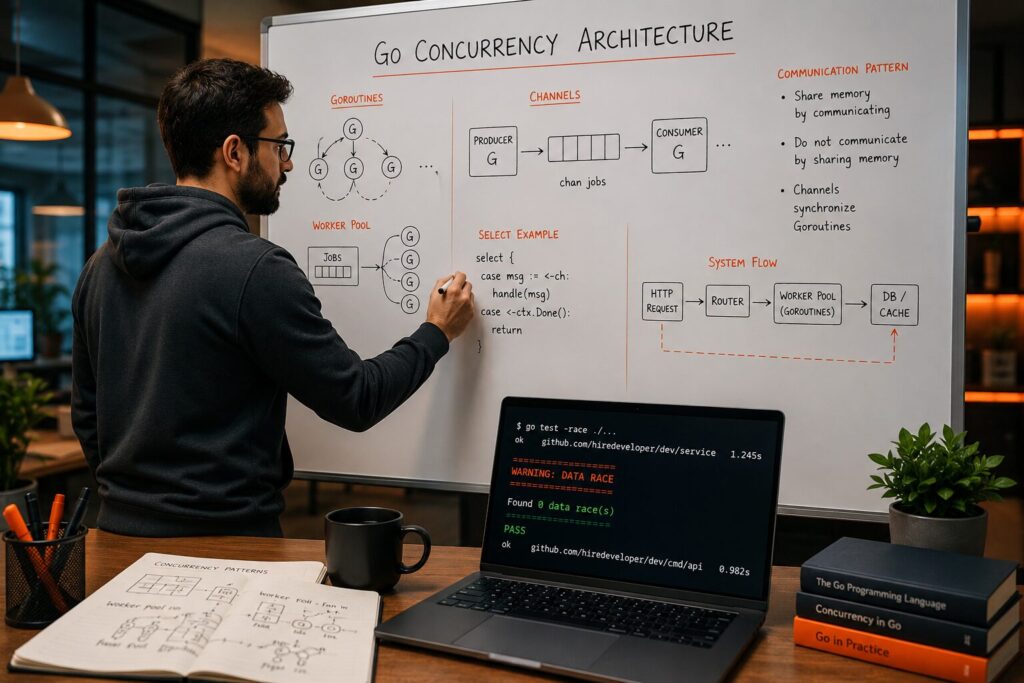 What is concurrent programming in Golang? It is Go’s core architectural feature: the ability to handle thousands of simultaneous operations using goroutines, channels, the select statement, and the context package. These are not advanced features you reach for occasionally. They are the foundation of every production Go service.
The problem is that many developers have read about concurrency without building systems that genuinely depend on it. The result is code that works under light load and fails under real production traffic in ways that are difficult to diagnose.
Our dedicated Golang developers understand concurrency at the operational level:
- Goroutine lifecycle management: Knowing when to spawn goroutines, ensuring they terminate cleanly, and identifying the leak patterns that cause memory growth in long-running services.
- Channel design for real systems: Choosing correctly between buffered and unbuffered channels, knowing when a channel is the right tool versus a mutex, and designing patterns that avoid deadlocks without over-engineering the solution.
- Context propagation across service boundaries: Using Go’s context package correctly across HTTP handlers, database calls, and downstream service calls so that cancellations and timeouts propagate cleanly through the entire call chain.
- Race condition prevention: Running Go’s race detector actively during development, understanding the memory model well enough to reason about data races, and writing concurrent code that is correct by design rather than by luck.
This is the technical depth that makes our engineers more valuable on production systems than engineers who have learned Go from a course.
API Development in Golang: Clean, Fast, and Built for Scale
API development in Golang is one of the highest-value capabilities our engineers bring because APIs are the integration surface for almost everything in modern software. According to OWASP’s Go security guidance, well-structured API design is also one of the most critical security surfaces in backend development.
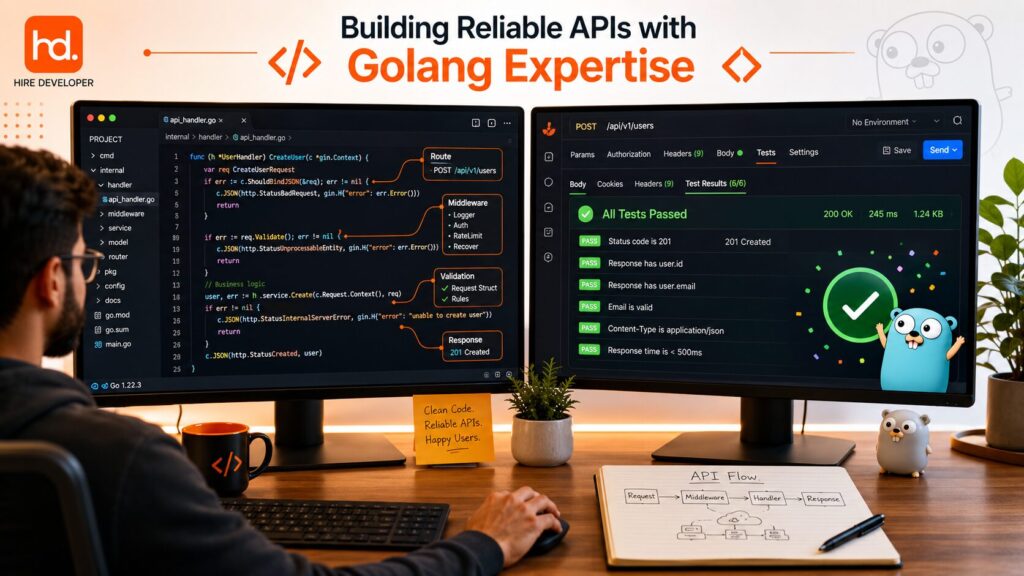
Our engineers build APIs that hold up under real product conditions:
- REST and gRPC API design: Deep understanding of Go’s net/http package with informed framework choices between Gin, Chi, and Echo. For internal service-to-service APIs, our engineers implement gRPC services with well-structured protobuf schemas providing type-safe contracts, efficient binary serialization, and generated client code that stays consistent as the API evolves.
- Middleware architecture: Authentication, rate limiting, request logging, distributed tracing, and error handling implemented as composable middleware chains rather than scattered through handler logic.
- Input validation and error response consistency: Treating validation and consistent error design as first-class concerns from day one, not corrections applied after the first QA pass.
Golang Performance Optimization: How Our Engineers Approach Production Systems
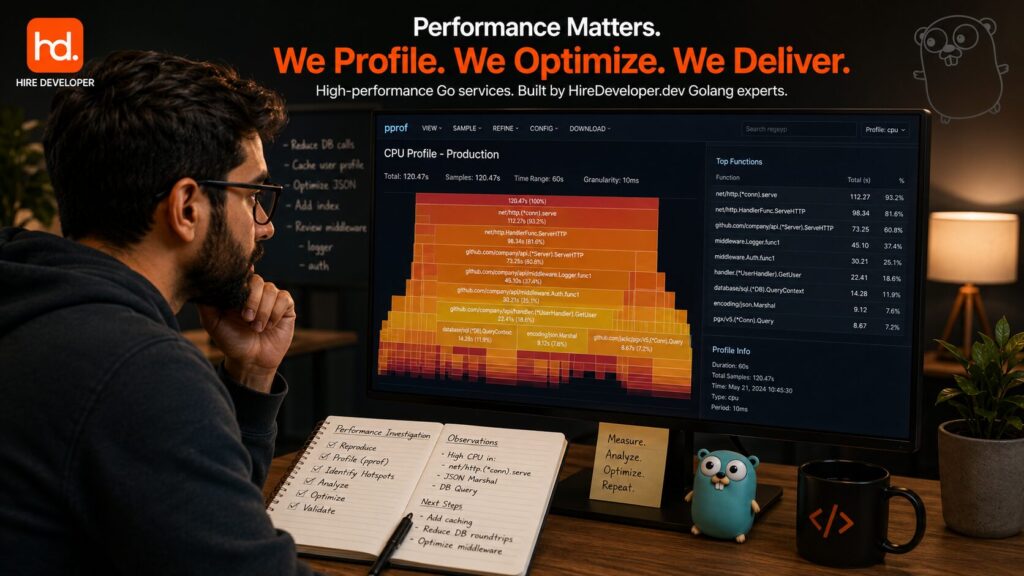 Our golang backend engineers follow a structured process rather than guessing:
- Profile before optimizing: Using Go’s built-in pprof tooling to identify actual bottlenecks in CPU usage, memory allocation, and goroutine activity before writing optimization code. Optimizing without profiling wastes engineering time and sometimes makes performance worse.
- Memory allocation reduction: Understanding escape analysis, minimizing heap allocations in hot code paths, using sync.Pool for frequently allocated objects, and structuring data for cache locality.
- Database interaction efficiency: Proper connection pool sizing, N+1 query identification and elimination, and prepared statement usage. Database interactions are the most consistent source of production performance issues in Go services.
- Benchmarking as a standard practice: Writing Go benchmarks for performance-critical code paths as part of regular development, not in response to a production incident.
This approach means your Go services are built with performance consideration from the start rather than retrofitted under pressure when traffic grows.
Secure Backend Development Practices Every HireDeveloper.dev Engineer Follows
Secure backend development is a baseline at HireDeveloper.dev, not an optional specialization. Every Go engineer we place understands the security implications of their architectural and implementation choices. This aligns with OWASP Go Security guidance that our engineers reference as a standard part of their practice.

- Authentication and authorization: JWT-based authentication, OAuth 2.0 flows, and API key management implemented correctly, with genuine understanding of the attack surfaces each approach introduces.
- SQL injection prevention: Parameterized queries used without exception, never constructing SQL strings from user input, with clear understanding of the security model of each database driver.
- Secrets management: Environment variable management and integration with AWS Secrets Manager or HashiCorp Vault, ensuring credentials never appear in source code, logs, or error messages.
- Supply chain security: Running govulncheck regularly, understanding transitive dependency risks, and treating dependency updates as a standard maintenance practice.
HireDeveloper.dev places Go engineers who treat security as a design input, not a post-launch checklist. Every engineer in our pool has been evaluated on security practices specifically.
Enterprise Golang Solutions: How Our Engineers Think at System Scale
Enterprise Golang solutions require more coding ability. They require system-level judgment: understanding how architectural decisions compound over time and making tradeoffs that balance quality with delivery constraints.

Our experienced Go developers bring this thinking to projects at enterprise scale:
- Service boundary design: Decomposing a domain into services with clean ownership, minimal coupling, and independently evolving API contracts.
- Observability infrastructure: Prometheus metrics instrumentation, distributed tracing via Open Telemetry, structured JSON logging, and health check endpoints that give operations teams genuine system visibility in production.
- Resilience patterns: Circuit breakers, retry logic with exponential backoff and jitter, timeout hierarchies, and bulkhead patterns that keep services partially functional when dependencies fail.
- Event-driven architecture: Go services consuming and producing events via Kafka with correct offset management, consumer group coordination, and dead letter queue handling.
Toolchain and Ecosystem Depth Our Golang Backend Engineers Bring
Technical depth in Go is not just about the language. It is about fluency across the entire ecosystem that production Go development requires.
Our Golang developers arrive with working knowledge of:
- Testing infrastructure: Standard testing package, table-driven test patterns, mock generation with gomock or testify, and integration test structure with Docker Compose.
- Code quality tooling: golangci-lint with a production-appropriate linter configuration, staticcheck for correctness analysis, and go vet as a baseline gate in every CI pipeline.
- Container and deployment tooling: Multi-stage Dockerfile construction for minimal Go images (typically 10 to 30MB), Kubernetes manifest authoring, Helm chart familiarity, and CI/CD pipeline configuration in GitHub Actions or GitLab CI.
- Database tooling: sqlx or database/sql for idiomatic Go database access, golang-migrate for schema migrations, and Redis client libraries for caching patterns.
How We Vet for These Skills Before You Ever Meet an Engineer
Every skill in this article is screened for before any engineer reaches our active placement pool. Our process is structured around one question: can this engineer contribute to a production codebase from the first sprint?
Our assessment includes live code review exercises using real Go production code with intentional issues embedded. We give engineers actual concurrency design problems with no single right answer and evaluate how they reason through tradeoffs. We ask them to explain security decisions in the code they are reviewing. We evaluate how they document architectural choices and how they handle ambiguity in a technical brief.
Only engineers who clear every assessment layer reach client teams. That is why clients working with HireDeveloper.dev consistently report meaningful contributions in the first sprint rather than spending the first month waiting for an engineer to find their footing.
Hiredeveloper.dev: Golang Developers with Real Depth, Ready for Your Project
Hiring Golang developers for a modern software project shapes your backend’s performance, reliability, and maintainability for years. The skills covered in this article, from concurrent programming and API development in Golang to enterprise Golang solutions and secure backend development, are the production baseline for what serious Go development requires.
At HireDeveloper.dev, every engineer in our pool has demonstrated these capabilities against real production criteria. Not a skills test designed to be passed. A technical evaluation designed to reveal actual engineering depth.
Whether you need a single dedicated Golang developer to strengthen an existing backend team or a group of experienced Go developers to build a new service from architecture through deployment, our platform connects you with Go engineers who are ready to contribute from day one.
Built in Indore. Trusted by engineering teams across the US and UK.
Your project deserves engineers who genuinely know Go. Find them at HireDeveloper.dev.