








Why Hiring the Wrong Golang Developer Is So Easy to Do
Here’s a situation that plays out more often than most engineering leaders want to admit.
You post a role for a senior Golang developer. The resume looks right, Go listed front and center, a few years of backend experience, and a GitHub with some projects. The technical call goes fine. They talk confidently about goroutines and microservices. You make the offer.
Three months later you’re doing a code review and finding concurrent functions that would cause a race condition under any real load. The goroutine patterns are copied from tutorials, not designed for production. The API layer has no real error handling strategy. Performance profiling is something they’ve heard of but never actually used.
The cost of that discovery isn’t just the refactor. It’s the three months of product work that’s now sitting on a shaky foundation.
The problem isn’t that the developer lied for. It’s that most technical screens for Golang developers aren’t built to catch the gap between “has used Go” and “writes production-grade Go.” That gap is wide, and it’s not obvious from a resume or casual technical conversation.
This guide is about closing that gap before you make the hire, not after. Whether you’re a CTO, a founder, or an engineering manager trying to hire a Golang developer for a serious backend role, what follows is what actually matters, and how to test for it.
Why Evaluating Go Skills Properly Is Harder Than It Looks
Go has a reputation for being simple. That reputation is earned, the syntax is minimal, the standard library is comprehensive, and there’s far less framework sprawl than you’d find in JavaScript or Python. You can learn enough Go to write working code in a weekend.
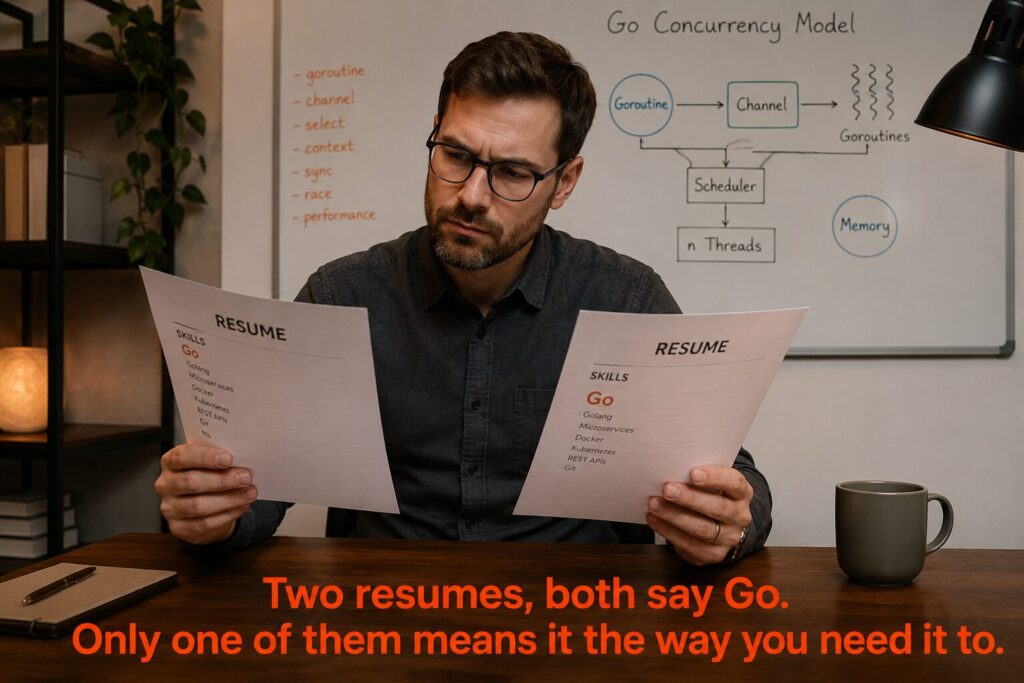
That accessibility is exactly what makes golang development hiring tricky.
Go’s Simplicity Is Deceptive — Surface Knowledge Hides Quickly
A developer who learned Go for a side project can describe goroutines correctly, explain what a channel does, and walk through a basic REST API implementation. In a casual technical screen, that’s often enough to pass. In production, it’s nowhere near enough.
Writing concurrent code that’s correct under real load requires understanding blocking behavior, context propagation, goroutine lifecycle management, and how to detect and fix leaks. None of that comes from documentation reading — it comes from building and debugging systems that actually fail.
The surface/depth gap in Go looks like this:
| Surface Knowledge (Passes most screens) | Production Depth (What you actually need) |
| Knows goroutines exist and how to start them | Can design safe concurrent systems without race conditions |
| Can write a basic REST handler | Understands middleware chains, error propagation, and API versioning strategy |
| Has used channels | Knows when NOT to use channels and why |
| Can write a Dockerfile | Has debugged container memory limits and crash loops in production |
| Knows what prof is | Has actually used it to identify and fix a goroutine leak |
Most Golang Developers Have Used It. Far Fewer Have Scaled It.
Go is popular enough that most backend engineers have touched it. The meaningful question isn’t “have you used Go?” — it’s “have you built something in Go that broke under real traffic, and how did you fix it?”
The go programming language developer you want is someone who’s been in production incidents involving Go, not just someone who’s written Go code. Those are very different experience profiles, and the standard resume doesn’t distinguish between them.
The Core Technical Skills Every Golang Developer Needs in 2026
Let’s get specific. These are the skills that separate a golang engineer you can trust with production systems from one who needs months of supervision to deliver safely.
Concurrency — Goroutines, Channels, and the Sync Package
This is the first and most important area. Go’s concurrency model is its defining feature and its most common failure point when engineers don’t understand it deeply.
A strong go language developer should be able to:
- Explain the difference between buffered and unbuffered channels and give a concrete example of when each is appropriate
- Write a worker pool from scratch, correctly managing goroutine lifecycle and preventing leaks
- Use sync.WaitGroup, sync.Mutex, and sync.RWMutex appropriately — and explain why reaching for a mutex instead of a channel is sometimes the right call
- Detect and reason about a race condition given broken concurrent code
- Use Go’s race detector (go test -race) and explain what it catches and what it doesn’t
If a candidate struggles to reason through a simple goroutine leak scenario in an interview, don’t hire them for anything involving concurrent code. That’s most production Go work.
Backend API Architecture — REST, gRPC, and Middleware Design
Good golang backend development requires more than knowing a framework. It requires understanding what the framework is doing for you and what it isn’t.
Look for:
- Experience designing APIs that remain maintainable as they evolve — versioning strategies, backward compatibility, deprecation handling
- Middleware composition — authentication, logging, rate limiting, tracing — and how these cross-cutting concerns should be structured
- gRPC and Protocol Buffers experience, especially in microservice-to-service communication
- Error handling strategy — not just returning errors, but propagating context, logging at the right layer, and surfacing errors appropriately to clients
An engineer who’s only ever added handlers to an existing router hasn’t done the design work. Ask them to walk you through an API they designed from scratch.
Microservices and Distributed System Patterns
Most modern golang development happens in distributed environments. A golang engineer working on a microservices architecture needs to understand patterns that don’t come from language documentation — they come from operating distributed systems in production.
Key areas to probe:
- Service-to-service communication patterns: synchronous (gRPC/HTTP) vs. asynchronous (Kafka, RabbitMQ)
- Circuit breaker and retry patterns — when they help, when they create cascading failures
- Distributed tracing (OpenTelemetry, Jaeger) — can they implement it, not just describe it
- Graceful shutdown — handling in-flight requests when a service restarts
- Idempotency — designing operations that are safe to retry without side effects
Ask them to describe a distributed systems failure they’ve debugged. The quality of that story tells you more than any textbook question.
Kubernetes, Docker, and Cloud Platform Fluency
Go developers on product teams interact with infrastructure constantly. A strong go programming language developer in 2026 should have more than surface familiarity with containers and orchestration.
Specifically:
- Can write a production-quality Dockerfile for a Go service — not a bloated one, a multi-stage build that produces a minimal final image
- Understands Kubernetes resource limits, liveness/readiness probes, and rolling deployments from having set them up — not just from reading about them
- Has experience with at least one major cloud platform (AWS, GCP, or Azure) for Go service deployment
- Understands how to instrument Go applications for observability: structured logging, metrics (Prometheus), tracing
Database Design and Query Optimization
This one comes up in every role but gets underscreened. Golang developers working on backend systems query databases constantly. Slow queries, N+1 problems, connection pool mismanagement — these are common production issues.
Look for:
- Understanding of connection pool configuration in Go (database/sql, pgxpool) — many developers don’t realize poorly tuned pools cause production instability
- Experience writing efficient SQL — JOINs, indexes, query execution plans
- Knowing when to use NoSQL (Redis, MongoDB) vs. relational databases — and the tradeoffs at scale
- Familiarity with database migrations in production — zero-downtime schema changes, rollback strategies
Beyond Technical Skills — What Separates Good Go Developers From Great Ones
Technical skills get a developer to a passing grade. What makes a golang engineer genuinely valuable on a product team is harder to screen for, but it shows up clearly once you know what to look for.
System Design Thinking at Scale
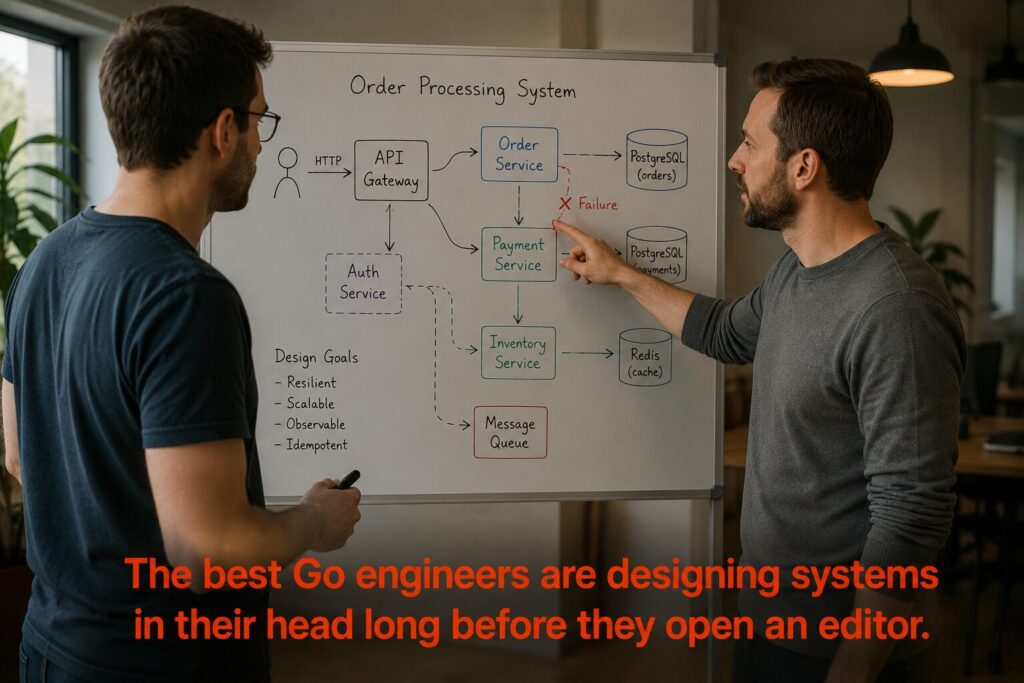
Strong Go developers think about systems before they write code. When given a new requirement, they ask: what happens when this has to handle 10x the current load? What breaks first? What’s the failure mode if a downstream service is unavailable?
In an interview, give them a realistic system design problem, not an abstract algorithm puzzle. “Design a rate limiter for an API serving 100,000 requests per minute” or “how would you architect a notification service that needs to fan out to 50,000 users in under two seconds?” Watch whether they naturally reach for Go’s concurrency tools, think about observability, and reason about failure modes.
Senior engineers from high-scale backgrounds tend to propose similar architectures to the same problems. Pattern convergence is itself a signal.
Code Review Discipline and Clean Code Standards
Go has strong conventions — gofmt, golint, and the idiomatic patterns the community has standardized over fifteen years. A golang developer who ignores these doesn’t just create messy code — they create code that’s harder for the next engineer to reason about.
Ask candidates how they approach code review. What do they look for? What’s a comment they’d always leave vs. one they’d save for a verbal conversation? How do they handle disagreement in a review? The answers reveal whether they think of code quality as a team responsibility or a personal preference.
Debugging and Performance Profiling Ability
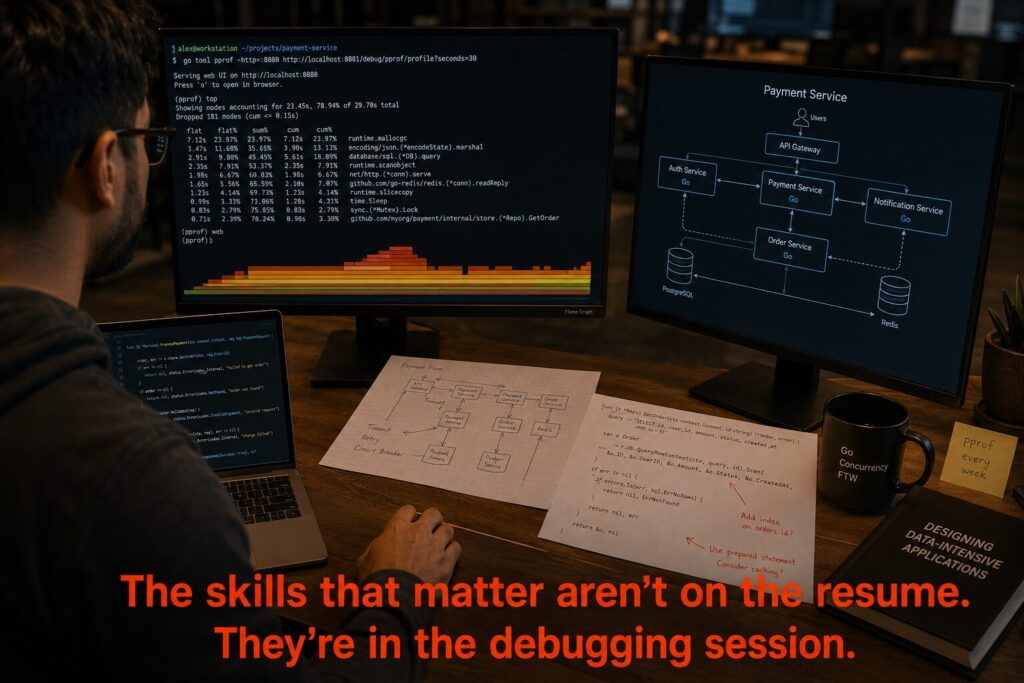
This is the most underrated skill in golang backend development. Any engineer can write code that works in development. The ones you want are the ones who can figure out why it’s failing in production at 3am.
Ask specifically:
- Walk me through how you’d investigate a service with degraded p99 latency that started three days ago
- How do you use pprof and what would you look for in the output?
- Describe a goroutine leak you’ve encountered — how did you find it, how did you fix it?
If they can give specific, detailed answers to these questions, they’ve been in production with Go. If the answers are vague or theoretical, they haven’t.
How to Actually Test Golang Skills Before You Make a Hire
Knowing what skills matter half the problem is. The other half is designing an evaluation process that actually surfaces with them.
What a Strong Technical Interview for a Golang Engineer Looks Like
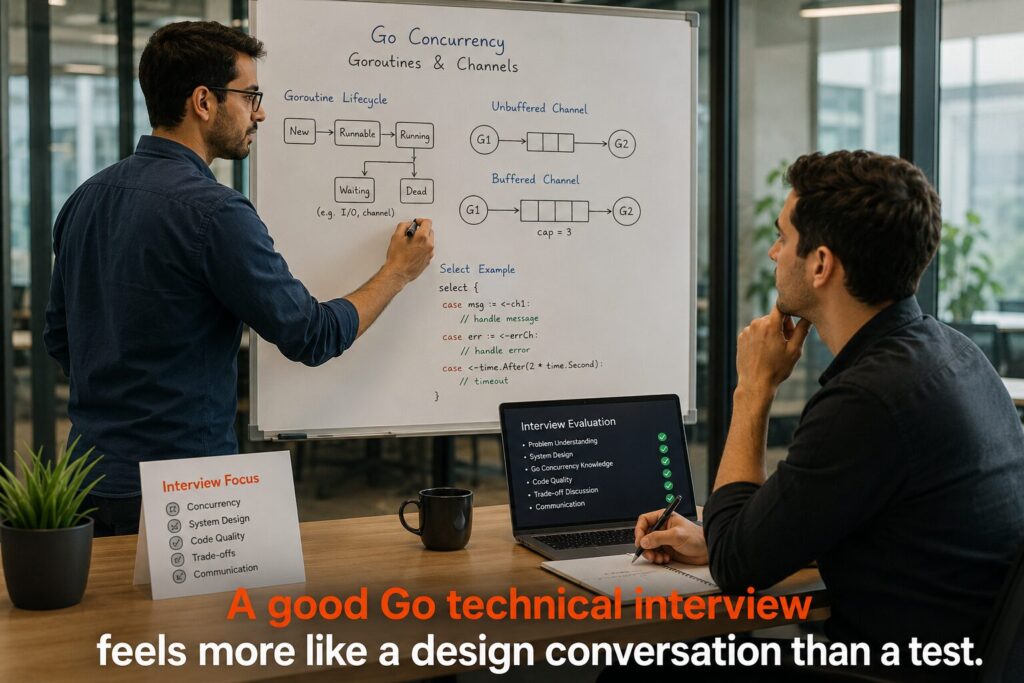
The mistake most teams make is using generic coding assessments — LeetCode-style problems that test algorithmic thinking but have almost nothing to do with production Go work. A senior Golang developer who’s spent five years building distributed systems might struggle with a binary tree problem. That tells you nothing useful.
Build your evaluation around real scenarios:
- Stage 1 — Async coding exercise (take-home): Write a concurrent HTTP client that makes N requests in parallel, with rate limiting, timeout handling, and proper error aggregation. This is small enough to complete in two to three hours but exposes concurrency understanding, error handling discipline, and code organization immediately.
- Stage 2 — Code review exercise: Give them a broken Go service with at least two concurrency bugs and a performance problem. Ask them to find and explain the issues, not fix them, explain them. This separates developers who can read code from those who can only write it.
- Stage 3 — System design interview: Pick a scenario relevant to your actual product. Give them 45 minutes to design it verbally. Strong candidates ask clarifying questions, reason for scale, and reference Go-specific tools naturally without being prompted.
The Coding Exercise That Reveals the Most
If you can only do one thing, give them a concurrent processing problem with intentional edge cases. Something like: process a list of 10,000 URLs concurrently, respect a rate limit of 100 requests per second, handle partial failures gracefully, and return results in the original order.
What you’re looking for isn’t a perfect solution. You’re looking for:
- How they manage goroutine lifecycle
- Whether they handle context cancellation
- How they think about partial failure vs. full failure
- Whether they write code that another engineer could read and maintain
The candidate who writes 150 lines of clean, well-commented, well-structured Go beats the candidate who writes 80 lines that work but nobody else can understand.
System Design Questions That Separate Junior From Senior Golang Developers
Good system design questions for senior Go developer evaluation:
- Design a job queue system that processes tasks with configurable concurrency and retry logic
- How would you build a caching layer for a high-read API service that needs to stay consistent with the database?
- Walk me through how you’d design the data ingestion pipeline for a real-time analytics service processing 50,000 events per minute
Junior developers describe what they’d build. Senior developers describe what could go wrong and how they’d detect and handle it.
Red Flags to Watch for When You Hire Golang Developers
The red flags are usually there in the first code review. The mistake is not looking for them before the hire.
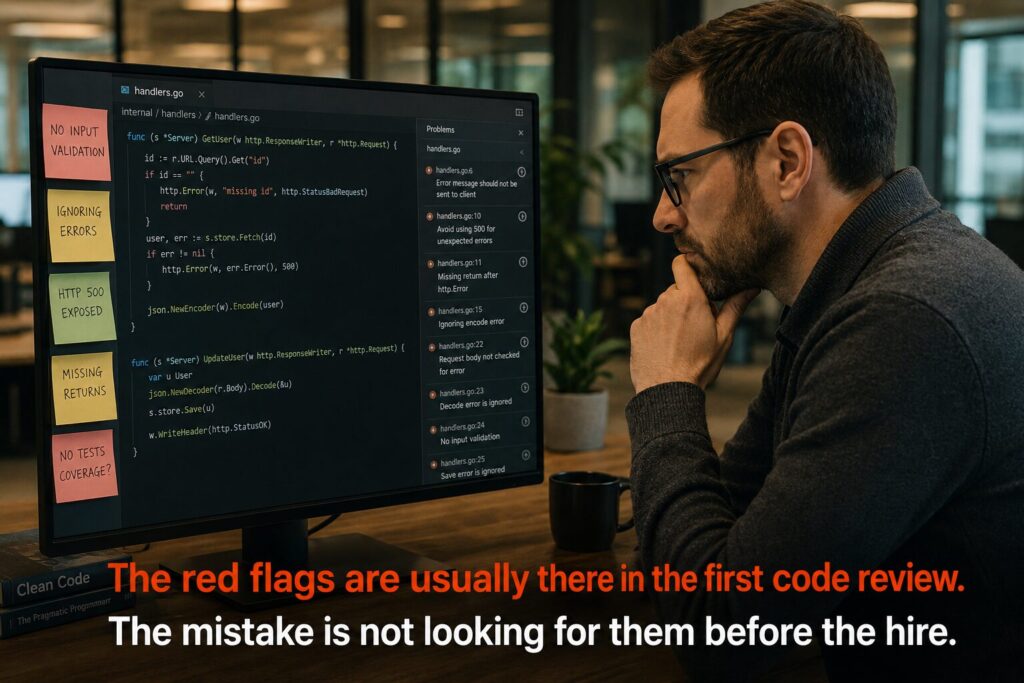
Even with a strong evaluation framework, it’s worth knowing what patterns should make you pause before making an offer.
Watch for these specific signals:
- Copy-paste concurrency — goroutine patterns that clearly came from a tutorial without being adapted to the actual problem. Identical patterns in unrelated parts of the codebase are a tell.
- No error handling strategy — Go is explicit about errors. An engineer who returns errors without context, wraps them inconsistently, or silently ignores them with _ in non-obvious places doesn’t have production Go habits.
- Framework dependency over standard library fluency — developers who can only work inside a specific framework and get uncomfortable when asked about what it’s doing underneath are often Go users, not Go engineers.
- Vague answers to profiling questions — if someone claims performance optimization experience but can’t describe a specific profiling workflow they’ve used, that experience is either very shallow or exaggerated.
- No opinions about code review — golang developers who’ve worked on real teams have opinions about what good Go code looks like. Developers without opinions haven’t reviewed enough code to have formed them.
None of these flags are automatic disqualifiers. But more than one in a senior candidate should give you pause.
How HireDeveloper.dev Helps You Hire Pre-Vetted Golang Developers
Running the evaluation process outlined in this guide — properly, with realistic exercises and real system design conversations, takes meaningful time and requires Go-specific expertise to assess the results. Most companies don’t have both available at once.

That’s the problem HireDeveloper.dev was built to solve.
We’re based in Indore, India, embedded in one of the country’s fastest-growing tech ecosystems and we specialize in placing Go engineers with US and global product companies. Every developer in our network has been through a Go-specific technical evaluation that covers exactly what this guide describes: concurrency depth, API architecture, system design, cloud integration, and debugging experience.
Not a generic coding test. A Go-specific screen designed by engineers who’ve built production Go systems.
What this means practically for companies that want to hire go developers:
- You skip the sourcing and screening — we’ve already done it. Most clients receive qualified candidates within five to seven business days.
- You evaluate against a consistent bar — every developer has cleared the same technical threshold before you meet them.
- You get the full hiring framework — our team can help you design the final interview stage, run reference conversations, and structure the onboarding.
- You’re protected — 60-day replacement guarantee if a placement isn’t working out. The risk sits with us.
Whether you need one senior golang developer to lead a backend project, or a small dedicated team to build and own a Go service from scratch, the evaluation work that makes or breaks the hire is already done.