








Introduction
There’s a paradox at the heart of modern backend engineering. Go (Golang) has become one of the most in-demand languages for building scalable cloud-native systems — and yet, it remains one of the hardest languages to hire locally.
Golang developers aren’t just scarce. They’re expensive, opinionated, and often already locked into high-paying roles at large tech companies. For most SaaS startups and growing enterprises, the local hiring market for Go engineers simply doesn’t work.
That’s exactly why Golang development outsourcing has exploded in 2026.
Companies that once refused to even consider offshore teams are now building entire backend infrastructure with distributed Go developers. And it’s not a compromise. For many of them, it’s actually the better move — faster, more cost-efficient, and surprisingly easier to manage than fighting a broken local hiring market.
This article breaks down why it’s happening, what’s driving it, and how to do it the right way, without the common pitfalls that derail most outsourcing experiments.
What Is Golang Development Outsourcing?
Golang development outsourcing is the practice of hiring external development teams — typically offshore or nearshore — to build, maintain, or scale software systems written in Go.

This isn’t a single engagement model. It can take several shapes depending on what your team needs:
- Engaging a Golang development company to deliver a full product, platform, or service end-to-end
- Hiring individual Golang developers through a vetted platform or specialist agency
- Assembling a dedicated offshore Golang team that operates as a natural extension of your in-house engineering org
- Accessing Golang software development services for specific modules — API layers, microservices, data pipelines, or cloud infrastructure tooling
What separates modern Golang outsourcing from the outsourcing of a decade ago is the quality of available talent, the maturity of remote collaboration tooling, and the widespread adoption of async-first engineering cultures that make offshore teams genuinely effective, not just cheaper.
The conversation has shifted from “can offshore Go teams deliver?” to “why are we not already using them?”
Why Go (Golang) Is the Backend Language - Startups Can't Ignore
Before examining why outsource Golang development has become a standard strategic playbook, it’s worth being precise about why Go specifically has become the backend language of choice for serious engineering teams in 2026.

Performance that scales without drama.
Go was designed at Google for systems that handle enormous, sustained loads. Its concurrency model — built around goroutines and channels — makes it vastly more efficient than Python or Node.js for CPU-intensive or high-throughput workloads. You’re not patching performance problems later. The language architecture handles it natively.
Cloud-native design.
Kubernetes is written in Go. Docker is written in Go. The entire CNCF ecosystem is deeply Go-native. If you’re building AWS, GCP, or Azure with containerized microservices and service meshes, Go fits the stack better than almost any alternative.
Fast compile times, minimal operational overhead.
Go compiles to a single static binary. No runtime dependency nightmares, no JVM tuning, no package manager chaos at deployment. DevOps teams genuinely love this about Go — it simplifies CI/CD pipelines dramatically.
Enterprise-grade adoption.
Uber, Cloudflare, Dropbox, Netflix, and PayPal all run significant Go codebases in production. That enterprise signal has pushed Golang application development from “interesting language choice” to “serious backend standards” across the industry.
The language’s maturity means Golang developers today are experienced engineers who’ve consciously chosen Go for production-grade systems — not hobbyists picking it up on weekends. That’s exactly the profile you want to build your backend infrastructure.
The Real Reasons Offshore Go Teams Are Growing Rapidly in 2026
So why are offshore software development services for Golang growing this fast right now? There isn’t one answer. There are five converging forces.
The Local Golang Talent Market Is Genuinely Broken
In San Francisco, London, Berlin, or Toronto, a senior Go engineer commands $180,000–$230,000+ in total compensation. That’s before equity expectations, healthcare, and a 3–6-month recruiting timeline. For most startups operating on a Series A or B raise, that math simply doesn’t work for building an entire backend engineering team.
Golang outsourcing breaks that cost ceiling without sacrificing quality, provided you know where to look and how to evaluate talent properly.
Remote Engineering Culture Is Now Table Stakes
The pandemic forced a global experiment in distributed software development. The results are now clear: remote teams, when managed well, deliver at parity with co-located ones — sometimes better. Async communication, documentation-first cultures, and timezone overlap strategies are standard knowledge in mature engineering organizations.
That infrastructure made offshore software development not just viable but operationally normal. The stigma is gone. The tooling works. The processes exist.
Offshore Golang Talent Has Matured Significantly
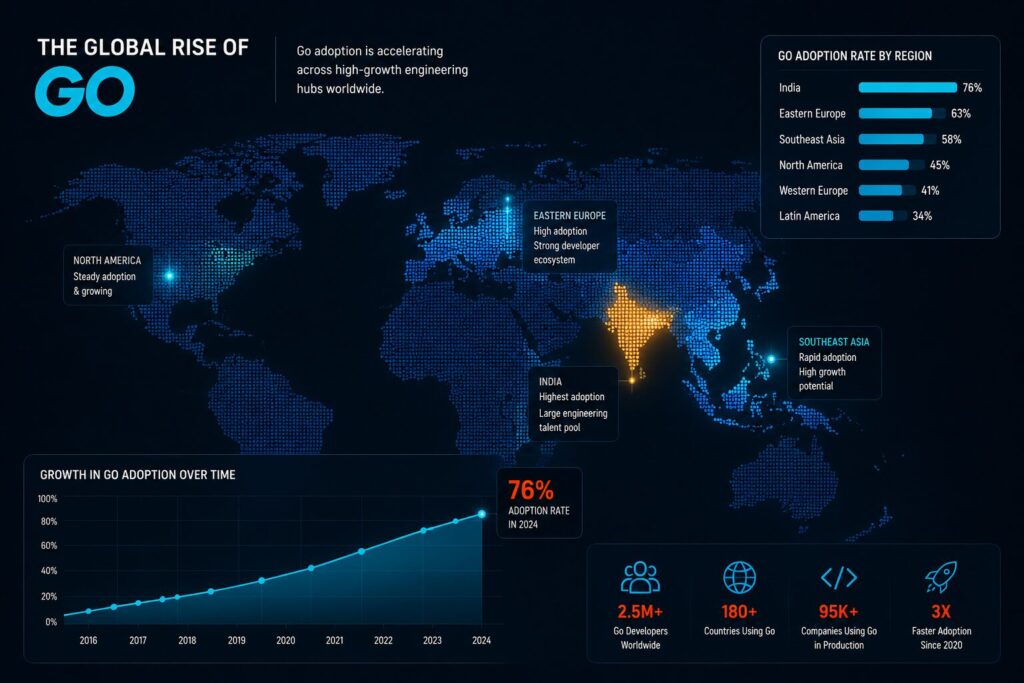
The stereotype that offshore equals low quality was always overgeneralized. In 2026, it’s genuinely obsolete. Engineering talent in India, Poland, Vietnam, and Latin America has been building production-grade Go systems for the better part of a decade. The average Golang developer from a top-tier outsourcing firm in Bangalore or Warsaw often brings more Go-specific production experience than engineers at mid-market US startups.
Cost Arbitrage Is More Valuable in a Capital-Efficient Era
With VC funding tighter than the 2021 era, every engineering dollar needs to justify itself. Golang outsourcing gives companies access to senior-level talent at 40–65% lower cost than US or UK equivalent hires. In an environment where runway extension matters more than headcount optics, that’s a genuine competitive advantage — not a compromise.
Golang Development ServicesAre Now Specialized
Early outsourcing for Go was handled by generalist shops that happened to have a few Go engineers available. Now, dedicated Golang development services providers exist — firms that specialize specifically in Go-based microservices, distributed systems, API platforms, and cloud-native tooling. Specialization drives quality in a way that generalist shops never could.
Golang Outsourcing vs. In-House Hiring: An Honest Comparison
 Let’s be direct about the tradeoffs. Neither model is universally superior — and anyone telling you otherwise is selling something. Here’s an honest, side-by-side view:
| Factor | In-House Golang Team | Offshore Golang Team |
| Average Cost (Senior Engineer) | $160K–$230K/yr (US) | $40K–$80K/yr (India/Eastern EU) |
| Time to Hire | 2–6 months | 2–4 weeks via vetted platform |
| Availability of Go Specialists | Very limited locally | Significantly larger global pool |
| Cultural/Product Alignment | High by default | Requires active, intentional investment |
| IP & Security Control | Straightforward | Manageable with proper contracts |
| Scalability | Slow — dependent on hiring cycles | Fast — team augmentation on demand |
| Best For | Core product ownership, long-term roles | Scaling fast, specialized module builds |
The honest answer for most growth-stage companies: a hybrid model works best. Keep a small in-house core team for product ownership and architectural direction. Hire offshore developers for engineering execution, specialized infrastructure builds, and capacity scaling. Neither side needs to replace the other to be valuable.
What to Look in a Golang Development Company
Not every firm that claims to offer Golang software development services has the engineering depth to deliver on that claim. Here’s how to evaluate them without getting burned.
Technical depth, not portfolio polish.
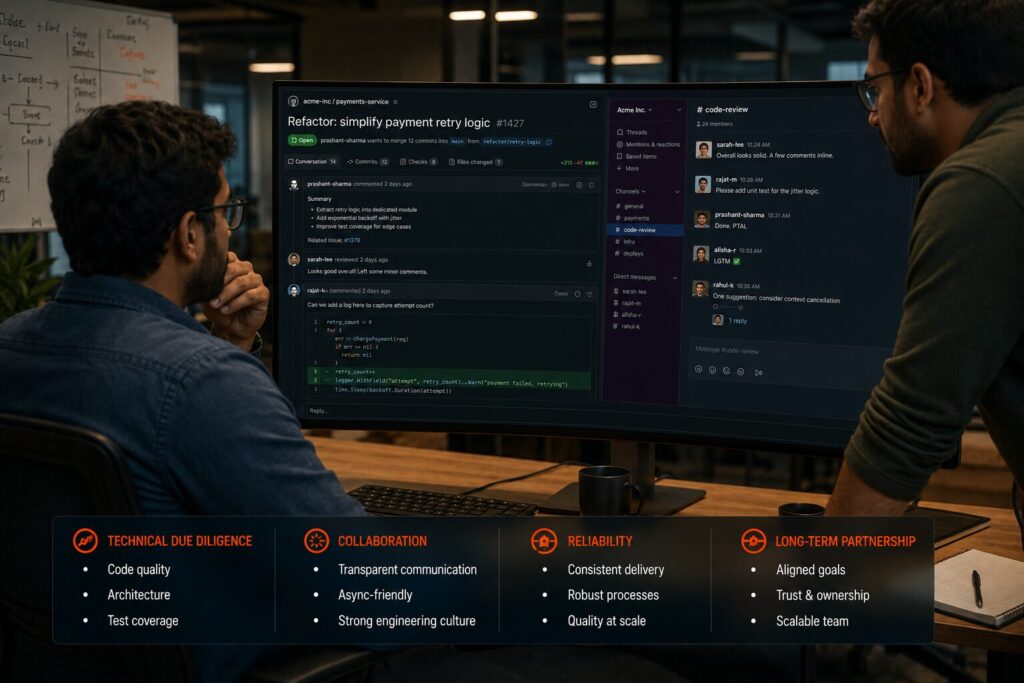
A well-designed website is not a proxy for engineering quality. Ask to see GitHub activity, PR review processes, test coverage standards, and how the team handles technical debt accumulation. The answers reveal more than any case study.
Go-specific experience — not just backend experience.
There’s a significant gap between engineers who’ve used Go for six months on side projects and those who’ve built production-grade distributed systems with it for three years. When you interview, ask specifically about goroutines and channel patterns, gRPC service design, protobuf schema management, go module versioning, error wrapping conventions, and context propagation across service boundaries. These aren’t trick questions. Engineers who’ve shipped real Go systems answer them naturally.
Communication and documentation practices.
One of the most common failure modes in Golang outsourcing isn’t technical — it’s communicative. Ask directly: how do you handle async communication between timezones? Do you write Architecture Decision Records (ADRs)? How is knowledge transferred when a team member rotates off? Mature teams document obsessively. Teams that improvise documentation usually improvise quality too.
Security and IP protection as standard practice.
Any serious offshore software development company in India or elsewhere should have NDAs, IP assignment clauses, and SOC 2 or ISO 27001 alignment ready to produce without hesitation. If a firm fumbles these questions, that’s a red flag worth taking seriously.
References from comparable-scale projects.
Don’t accept “we built an app” as a reference. Ask to speak directly with CTOs or engineering leads who worked with the firm on distributed systems, high-throughput API platforms, or cloud infrastructure builds at a similar scale to yours.
Companies looking to skip the vetting marathon can work with HireDeveloper.dev — a platform that pre-screens Golang engineers against real technical benchmarks, not resume keywords. It’s a faster path to qualified Go talent without the risk of a costly misfire.
How to Successfully Hire Offshore Go Developers
The process of actually hiring and onboarding offshore Go developers is exactly where most companies go wrong — and where good preparation pays dividends.
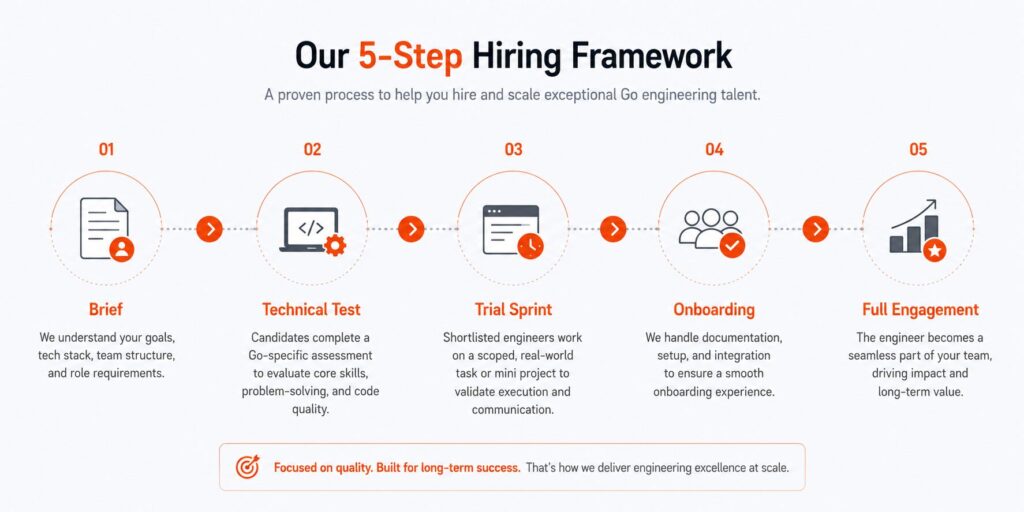
Step 1: Define the engagement model clearly.
Are you hiring a single contributor, a small feature pod, or a full dedicated team? The answer changes your sourcing strategy, pricing expectations, management overhead, and onboarding investment. Be specific before you start outreach.
Step 2: Write a real technical brief.
Don’t post “we need a Golang developer.” Write a two-page brief that covers the system architecture, the specific problems being solved, the scale you’re operating at, the existing tech stack, and the engineering standards you hold. Serious Golang developers for hire responding to serious, detailed briefs. Vague job descriptions attract vague candidates.
Step 3: Run technical assessments that mirror real work.
Design code review exercises and take-home projects that reflect your actual codebase problems. Evaluating Go concurrency patterns, error wrapping conventions, or gRPC service-to-service communication is more revealing than a LeetCode exercise that any language can solve.
Step 4: Start with a paid trial project.
Before committing to a 6-month Golang outsourcing engagement, run a bounded, paid trial — a real project with real timelines and real collaboration expectations. This surfaces communication patterns, quality standards, and cultural fit faster and more accurately than any interview process.
Step 5: Build for async-first from day one.
Establish documentation standards, async check-in rituals, and clear escalation paths before the first sprint begins. Teams that make golang outsourcing development services work treat offshore engineers as first-class team members — not a vendor on the other side of a ticket queue.
Top Use Cases for Golang Outsourcing Development Services
Where does Golang application development outsourcing actually deliver its highest ROI? These are the use cases where offshore Go teams consistently shine:
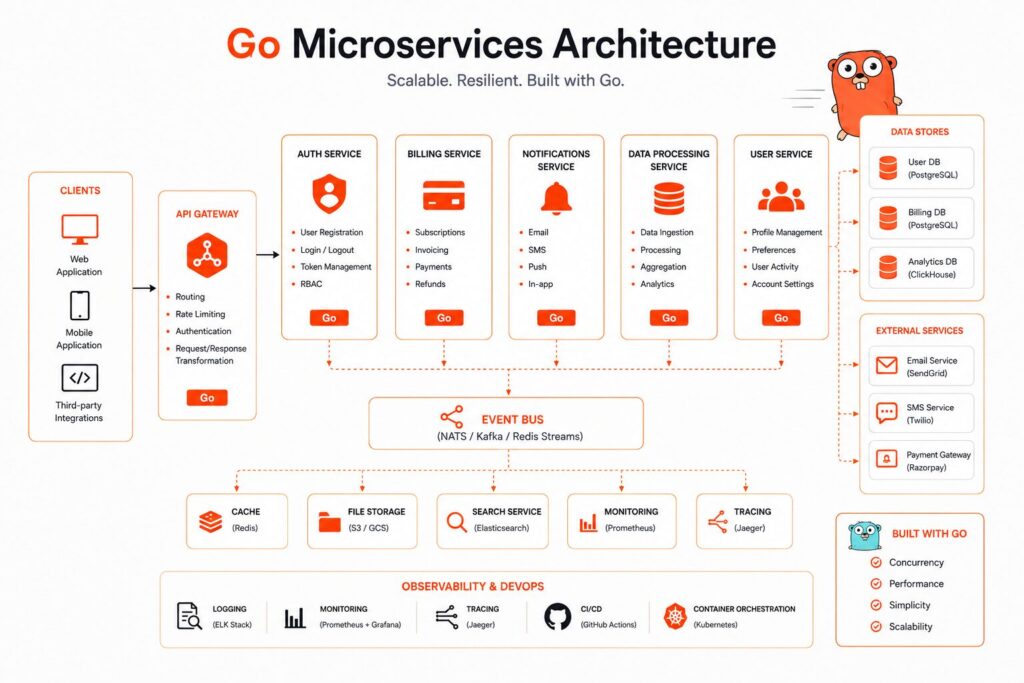
Microservices architecture builds.
Go’s performance profile and fast compilation make it near-ideal for microservices. Outsourcing the build of individual services — auth, billing, notifications, data processing — to a dedicated golang development services team lets you ship faster without overwhelming your in-house engineers with infrastructure work.
API gateway and backend-for-frontend layers.
Go handles high-concurrency API workloads better than most alternatives. Many companies working with golang outsourcing services do so specifically to build and maintain their API platform, where Go’s performance characteristics matter most.
Cloud infrastructure and internal tooling.
CLI tools, Kubernetes operators, terraform providers, and internal platform engineering components are natural fits for Go. Outsource Golang development for these components and your infrastructure team gets high-quality tooling without becoming a full engineering team.
Data pipelines and streaming systems.
High-throughput event processing with Kafka integration, real-time analytics pipelines, and ETL systems built in Go significantly outperform Python equivalents at scale. This is an increasingly common Golang outsourcing engagement pattern for data-heavy SaaS products.
Developer tooling and SDK development.
Companies building developer-facing products APIs, integration platforms, developer SDKs, increasingly choose Go for its performance and clean compilation model. Outsourcing SDK development to specialized Golang developers for hire has become a standard pattern in the developer tools space.
India as a Leading Hub for Offshore Golang Development
When companies evaluate offshore software development services, India consistently leads and for Go specifically, the depth of available talent has grown considerably in recent years.
The reasons are structural. India’s engineering education system produces roughly 1.5 million engineering graduates annually. A growing and significant portion of those graduates are focused on cloud-native development, distributed systems, and DevOps — exactly the technical domain where Go dominates. The language isn’t new to Indian engineers. It’s been in production use at leading Indian product companies and service firms for nearly a decade.

Offshore development services in India have also matured institutionally. The leading firms are no longer small shops hoping to get lucky on a project. They’re organized engineering organizations with dedicated Go practices, formal architecture review processes, security and compliance certifications, and specialized domain knowledge across fintech, healthtech, SaaS infrastructure, and enterprise software.
The time zone of concern often the first objection raised, is less of an obstacle than most US companies expect. With proper async practices, a 5–6 hour overlap between US East Coast morning hours and India late afternoon covers the critical collaboration window for most sprint-based engineering teams. Many teams actually find the schedule reduces context-switching for both sides.
When evaluating an offshore software development company in India, look specifically for published Go engineering content, open-source contributions to the Go ecosystem, and dedicated Go practice leadership not just a roster of engineers who’ve touched it in passing. The difference between a firm with real Go depth and one that just happens to have available Go engineers is significant and worth the diligence.
HireDeveloper.dev connects businesses directly with offshore Golang teams in India — engineers assessed against production-grade Go standards, not just resume claims. Whether you need one backend specialist or a full distributed team, the platform is designed for efficient, reliable Go hiring.
How to Structure and Manage an Offshore Golang Team
Getting the structure right is what separates offshore Golang outsourcing that ships consistently from engagements that drift and disappoint. Here’s what the best run offshore Go teams share.
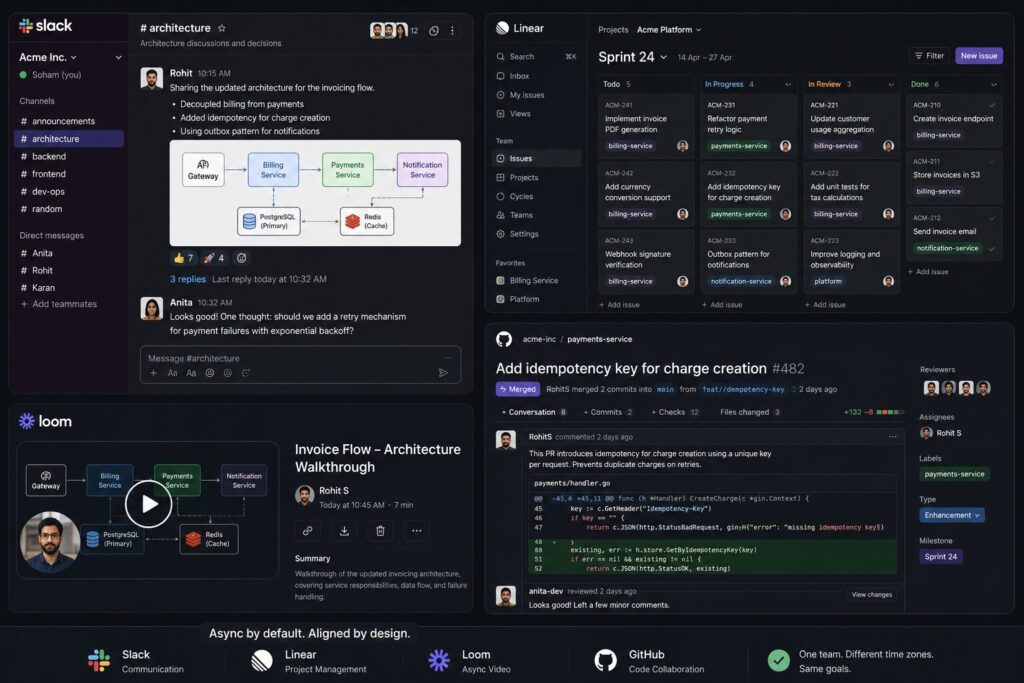
Define clear ownership boundaries early.
Offshore Golang developers need to own specific services, modules, or technical domains — not just execute tasks from a backlog. Ownership creates accountability and encourages the kind of architecture of thinking that produces quality output. Engineers who own something care about it differently than engineers who are processing tickets.
Invest in architecture alignment before writing a line of Go.
Before the first sprint, the offshore team and in-house leads need to align service boundaries, inter-service communication patterns (REST vs. gRPC), error handling conventions, logging and observability standards, and deployment of pipeline expectations. Misalignment at the architecture level causes the majority of expensive rework on Golang outsourcing development services engagements.
Ritualize async-first collaboration.
Weekly architecture reviews via Loom. Detailed PR descriptions that explain why, not just what. ADRs for significant decisions. Daily async check-ins via Slack or Linear comments. Synchronous meetings should be reserved for what genuinely requires real-time discussion — not burned on status updates that a written note handles better.
Instrument the collaboration, not just the code.
Track sprint velocity, PR review turnaround times, build failure rates, and deployment frequency for your offshore team exactly as you would for your in-house team. Data creates the visibility that proximity is used to provide.
Treat timezone distance as an engineering asset.
A properly structured offshore Go team in India extends your engineering coverage window by 10–12 hours. Issues that would wait overnight in a co-located team to get triaged and sometimes resolved during the offshore team’s workday. For on-call rotations and incident response, that coverage is genuinely valuable.
Common Risks in Golang Outsourcing Angular Developers(And How to Avoid Them)
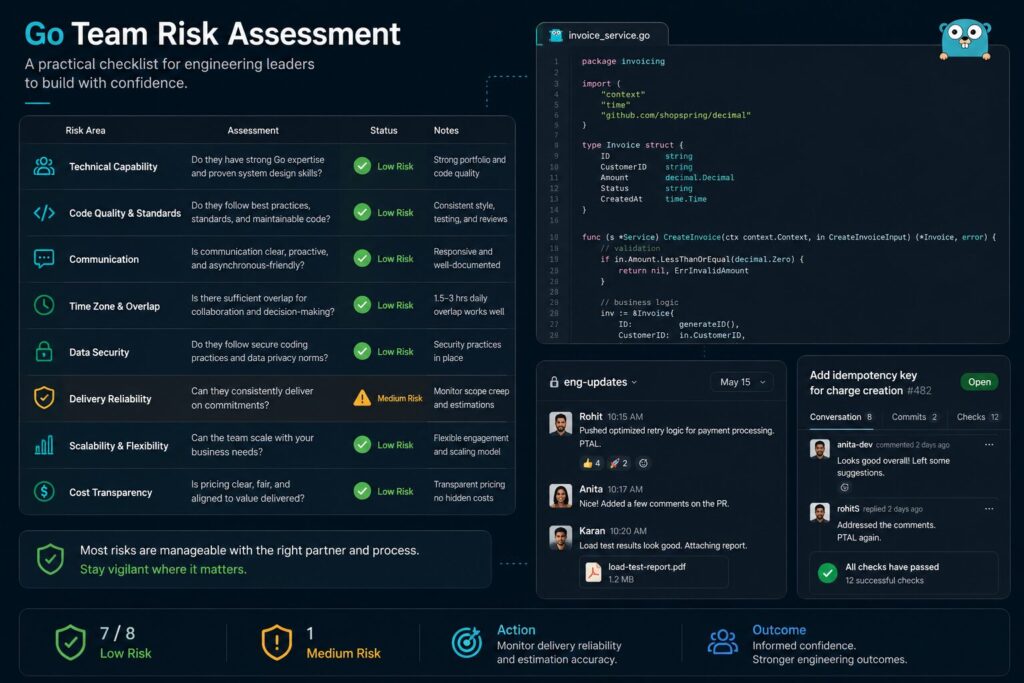 Golang outsourcing done poorly is genuinely painful — delayed projects, rework cycles, and engineering debt that outlasts the vendor relationship. These are the failure modes that actually happen, and how to prevent each one.
Risk: Hiring generalists who overclaim Go experience.
Mitigation: Technical assessments that are Go-specific. Ask candidates to review a piece of idiomatic Go code and explain the design choices — why it’s structured that way, what trade-offs were made, what they’d change and why. Engineers who’ve shipped real Go systems answer these questions fluently.
Risk: Communication breakdown at sprint boundaries.
Mitigation: Written sprint briefs with explicit acceptance criteria defined before work starts. Async video walkthroughs for complex feature handoffs. Never assume shared understanding on Golang outsourcing services engagements — make the spec explicit every time.
Risk: IP exposure and security gaps.
Mitigation: Iron-clad NDAs, IP assignment agreements, access control via VPN and SSO, and code that lives on your repositories — not theirs. Work with offshore software development services providers that have documented, audited security practices.
Risk: Vendor lock-in from poor knowledge transfer.
Mitigation: Never let the offshore team be the sole holders of architectural knowledge. Require comprehensive documentation, maintain ADRs throughout the engagement, and ensure in-house engineers do periodic deep-dives into offshore-owned components.
Risk: Cultural misalignment around code quality.
Mitigation: Define your quality bar in explicit, written standards — linting configurations, test coverage minimums, PR review criteria, deployment checklist. Don’t assume shared norms. The teams that make golang development outsourcing work make standards explicit before the first pull request.
The Cost Reality: What Golang Outsourcing Actually Saves You
Numbers matter. Here’s what Golang outsourcing development services actually look like from a cost perspective in 2026 — with real figures, not ballparks:
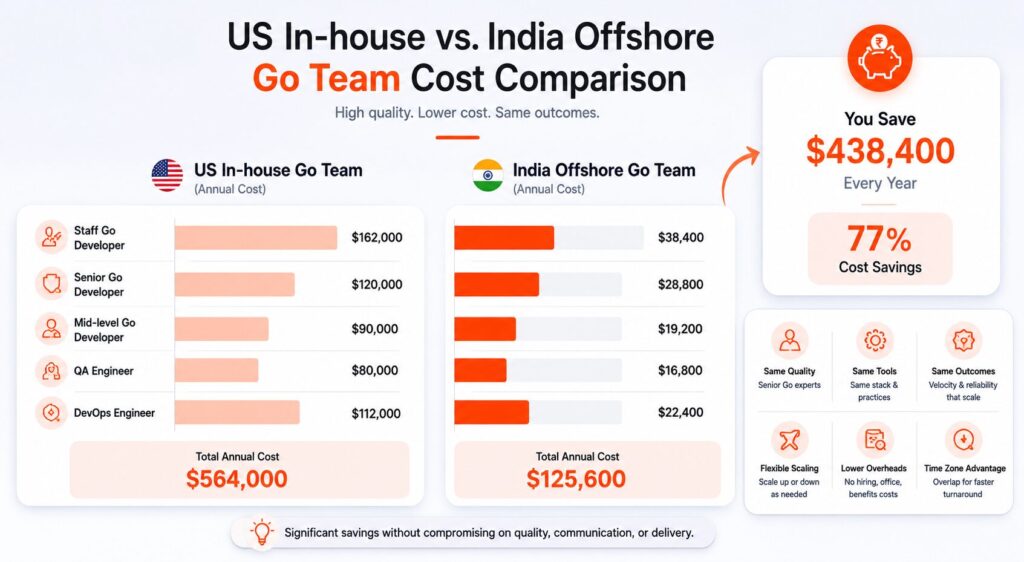
Senior Golang Developer — US Market: $160,000–$230,000/year base salary + equity expectations + benefits + recruiting fees = $200K–$290K total cost to company
Senior Golang Developer — India (via vetted outsourcing partner): $35,000–$65,000/year fully loaded — including management overhead, benefits, tooling, and platform fees
Senior Golang Developer — Eastern Europe (via vetted outsourcing partner): $55,000–$90,000/year
What a 4-person offshore Go team actually costs:
- US in-house equivalent: ~$900K–$1.15M/year
- Offshore equivalent team: ~$180K–$280K/year
- Realistic annual savings: $600K–$870K
That’s not a rounding error. For a Series A company, that’s 12–18 months of additional engineering runway. For an enterprise team, that’s the budget for two additional product lines or a meaningful investment in infrastructure modernization.
The cost differential is a significant reason why hiring offshore developers has become a standard playbook recommendation from CFOs and board advisors at engineering-heavy companies managing burns carefully.
What the raw numbers also don’t capture is opportunity cost. Faster hiring timelines — 2–4 weeks vs. 3–6 months — mean features ship earlier; infrastructure gets built sooner, and hiring bottlenecks stop blocking product decisions. That velocity has real commercial value that doesn’t show up in a cost comparison table.
Get full pricing Estimation breakdown
Ready to build your offshore Golang team without the recruiting overhead and timeline risk? HireDeveloper.dev connects you with pre-vetted Go engineers who’ve shipped production-grade distributed systems — not just impressive resumes. Start building faster without starting from scratch on vetting.
HireDeveloper.dev: The Offshore Golang Team That Actually Ships
Most offshore platforms treat India like a resume warehouse. Western brokers source at arm’s length with zero technical depth. Big agencies sell developers by dozens with no engineering accountability. HireDeveloper.dev is not.
We’re built in Indore, deep inside India’s Tier-2 tech ecosystem, not Bangalore’s overheated talent market. That proximity matters. We screen Go engineers against production standards: concurrency models, distributed systems, production infrastructure, operational realities of running Go at scale. Not recruiter checklists. Not syntax quizzes.
The problem we solve: Great Go developers exist in India. Finding them, vetting them properly, and structuring engagements for long-term success takes more than a LinkedIn search. We built HireDeveloper.dev specifically to fix that gap.
What you get:
- A single senior Go engineer who joins your existing team and contributes from week one
- A dedicated offshore Golang pod to build a new service end-to-end
- A full backend team that owns your cloud infrastructure
All pre-vetted. All ready to ship. All faster than traditional hiring allows.
Why this matters now: The old outsourcing stigma, “you go offshore because you can’t afford local talent” — is dead. In 2026, Golang outsourcing is a strategic leverage play. Talent is real. The collaboration tooling is excellent. The cost arithmetic works even for well-funded teams. The companies winning with offshore Go treat those developers as full team members, invest in alignment upfront, and use trusted intermediaries to shortcut vetting without cutting corners.
HireDeveloper.dev is intermediary. We don’t sell bodies. We place engineers who understand the work, and we stand behind their output.
Built in Indore. Trusted by engineering teams across the US and UK.
→ Start Hiring at HireDeveloper.dev