








Build a High Growth Team: A Framework to Hire Developers Who Deliver
Hiring developers is one of the most consequential decisions any business makes, yet it’s also one of the most consistently mishandled ones. The stakes are real: a great developer hire accelerates your product, reduces technical debt, and compounds your competitive advantage over time. A bad hire does the exact opposite.
This guide exists because most developer hiring advice on the internet is surface level. It tells you where to post jobs, how to structure interviews, and what tech stacks are popular, but it doesn’t tell you why most hires still fail, and what separates the companies that get it right from the ones that cycle through developers endlessly.
By the end of this guide, you’ll have a complete, actionable framework for how to hire developers who don’t just look great on paper, but who actually show up, write quality code, own outcomes, and help your product grow. Whether you’re a first time founder or a scaling tech company, this is the definitive resource you need in 2026.
What This Guide Covers
This is a complete guide to hiring developers from understanding why most hiring fails, to choosing the right model, screening candidates, running trials, and building a team that scales. Use the sections below to jump to what matters most to you right now.
- Why Most Developer Hiring Fails (And Where It Actually Goes Wrong)
- The Hidden Cost of a Bad Developer Hire
- Step 1 – Define Exactly What You Need
- Step 2 – Choose the Right Hiring Model (Freelancer vs Remote vs Agency)
- Step 3 – Local vs Remote: Where Should You Hire?
- Step 4 – Screen Like a Pro: What Actually Works
- Step 5 – The Trial Project (Non-Negotiable)
- Step 6 – Red Flags to Never Ignore
- Hiring by Technology Stack
- Understanding Developer Costs in 2026
- Real World Scenarios and Which Model Wins
- The Smart Hiring Shortcut
Why Most Developer Hiring Fails And Where It Actually Goes Wrong
 Here is a truth that most hiring guides won’t say out loud: developer hiring doesn’t fail at the hiring stage. It fails after hiring.
The pattern repeats across hundreds of businesses every year. You post a job, screen candidates, conduct interviews, review portfolios, and hire the person who looks the most capable. The first few days go well. Communication is responsive. Confidence is high. And then, two to four weeks in, the cracks start to show.
- Deadlines begin to slip – just a little at first, then significantly
- Code quality drops below what was demonstrated in the interview
- Bug counts increase while feature delivery slows
- Communication becomes slower, vaguer, and harder to rely on
- The developer starts missing context about the product they’re building
And you find yourself in the same position you’ve been in before: stuck between the sunk cost of the hire you made and the growing cost of keeping the wrong person on the team.
“Did I just hire the wrong developer again?”- This is not a rare question. It’s the most common one business owners ask themselves within the first 60 days of a developer hire.
Most companies go through two to three failed developer hires before finding someone who actually works. And by the time they do, the product is delayed, the budget is strained, and the team’s confidence in the hiring process is low.
Understanding why this happens is the first step to breaking the cycle. The rest of this guide gives you the framework to fix it. But before we get there, let’s talk about what a bad hire actually costs because most people dramatically underestimate this number. If you want a broader view of your hiring options first, read our guide on freelancers vs dedicated developers vs agencies.
The Hidden Cost of a Bad Developer Hire
The instinct to minimize hiring costs is understandable especially for early-stage businesses. But the math on a bad developer hire tells a very different story than the one your budget spreadsheet suggests.
Most people calculate the cost of a bad hire as: salary paid × months employed. That’s the visible cost. The hidden cost is four to five times larger.
Time Lost: A developer who is underperforming doesn’t just fail to move the product forward they actively slow it down. Other team members spend time explaining, reviewing, correcting, and compensating. When that developer eventually leaves or is replaced, there’s a ramp-up period for the next hire that adds further delay. A two-month bad hire can set your product timeline back by four to six months.
Rework Cost: Code written without proper architecture, test coverage, or long-term thinking creates technical debt that compounds over time. Reworking a feature built incorrectly typically costs 2x to 3x what it would have cost to build it right the first time. This isn’t theoretical it’s one of the most consistent findings across software projects.
Team Frustration: A consistently underperforming developer creates friction across the entire team. Good developers don’t want to work alongside poor ones. The downstream effect on morale, collaboration quality, and retention of your high performers is real and significant.
Opportunity Cost: The time your product spends not shipping is time your competitors are using to capture market share. A six-month delay on a core feature or product launch can mean the difference between entering a market at the right time and entering it too late.
When you add these layers together, the total impact of a single bad developer hire frequently reaches ₹2M to ₹4M for a growing business even before accounting for the cost of the next round of hiring.
This is not just a search for “hire developers.” It is a high-stakes business decision with long term compounding consequences. Treating it like a commodity purchase is the single most common mistake businesses make.
Step 1 - Define Exactly What You Need (Before You Post Anything)
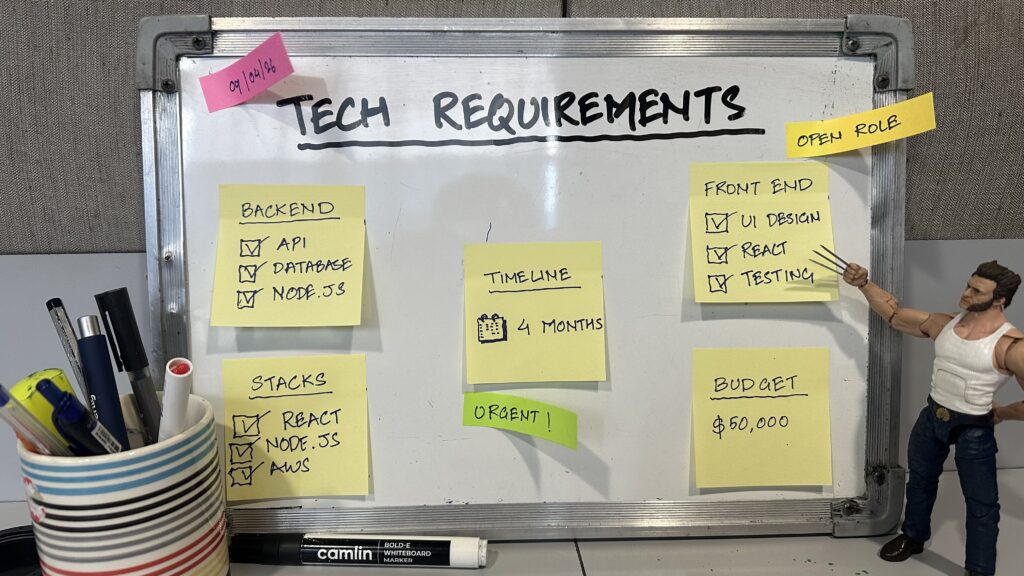 The most common reason developer hiring fails before it even starts is a lack of clarity in the requirement. Most businesses begin the search with something like: “We need a developer.” That’s the equivalent of walking into a hospital and saying: “We need a doctor.” You wouldn’t say that — because there are surgeons, neurologists, cardiologists, and dozens of other specialists, each suited for a completely different problem.
Software development works the same way. The gap between what you need and what a generic “developer” can deliver is enormous. Hiring the wrong type of developer for your specific problem is a failure mode that appears before the first line of code is written.
What ‘Define Your Requirement’ Actually Means
Before you post a job or contact a hiring platform, answer these questions in writing:
- What specific problem is this developer solving?
- What is the expected outcome — not the activity, but the measurable result?
- What tech stack is involved, or what should it be?
- What is the project type: new MVP, scaling existing product, maintenance, migration, or integration?
- What is the timeline and how flexible is it?
- What is the budget range — and what does success look like for that budget?
- What experience level is needed: junior who needs guidance, mid-level who works independently, or senior who leads decisions?
Weak Requirement vs Strong Requirement
Weak: “I want to hire a developer.”
Strong: “I need a backend developer experienced in Node.js and PostgreSQL to build scalable REST APIs for a B2B SaaS product. The system needs to handle 10,000 concurrent users. We have a 3-month timeline and a structured budget. The developer will work alongside our frontend engineer and report to our CTO.”
The second requirement attracts the right candidates, sets a filtering standard immediately, and communicates to experienced developers that you are a serious team worth working with. The first one attracts everyone which is another way of saying it helps you with nothing.
Step 2 - Choose the Right Hiring Model
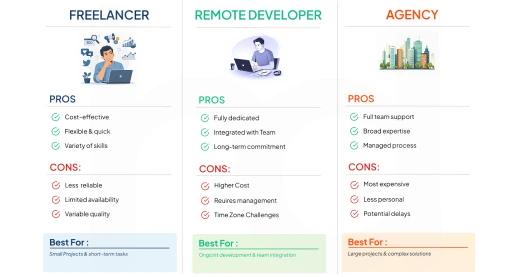 One of the most important and most misunderstood decisions in developer hiring is choosing the right model. This is where many businesses get stuck and where the mismatch between what they need and what they hire creates predictable failure.
There are four primary hiring models available today. Each has a legitimate use case and each is the wrong choice in the wrong context. For a deeper breakdown of this decision, see our full guide: Freelancers vs Dedicated Developers vs Agencies.
Model 1: Freelancers
Freelancers are independent developers who operate across multiple client projects simultaneously. They are the most accessible and lowest-friction option but they come with structural limitations that make them unsuitable for most serious product development work.
- Best for: Small, clearly scoped tasks; one time features; short-term fixes; non-critical work with a defined deliverable.
- Not ideal for: Long-term product development, core architecture, projects requiring continuity of context, or work that depends on ownership mindset.
The fundamental challenge with freelancers is split attention. A freelancer managing four clients gives each roughly 25% of their mental capacity. Your product gets a fraction of what a dedicated developer would deliver and the compounding effect of that fractional attention on quality and speed is significant over time.
Model 2: Agencies
Agencies offer complete project outsourcing you hand them a brief, they build it, you receive a deliverable. For companies that need a fully scoped project built without internal involvement, agencies can work well.
- Best for: Full project outsourcing where you don’t need ongoing control or team integration.
- Downside: High cost, limited day-to-day control, communication layers between you and the actual developer, and reduced alignment with your specific product vision.
Model 3: Dedicated Remote Developers (Most Practical for Growing Businesses)
A dedicated remote developer works exclusively on your project, integrated into your team’s processes, communication, and culture just not in a physical office with you. This model combines the focus of an in-house hire with the flexibility and cost advantages of remote engagement.
- Best for: Startups building MVPs, growing products needing continuous development, businesses that want long-term developer ownership without the overhead of full-time local employment.
For a comprehensive look at this model, read our Ultimate Guide to Hire Remote Developers in 2026.
Model 4: Staff Augmentation
Staff augmentation is ideal when you already have an engineering team and need to scale its capacity quickly without going through a full hiring process. You add vetted developers to your existing team structure on a defined engagement.
- Best for: Teams that need to scale output fast, projects with variable demand, and situations where you need specific skills for a defined period.
Choosing the Right Model: A Simple Framework
| Your Situation | Best Model |
|---|---|
| Building an MVP from scratch | Dedicated Remote Developer end-to-end focus |
| Small, one time feature or bug fix | Freelancer fast, isolated task |
| Full project outsourcing, no internal dev | Agency managed delivery |
| Scaling an existing engineering team | Staff Augmentation flexible capacity |
| Long term continuous product development | Dedicated Remote Developer deep context |
| Core + peripheral tasks running in parallel | Hybrid: Dedicated + Freelancer best of both |
Step 3 - Local vs Remote: Where Should You Hire Developers?
The question of whether to hire locally or hire remotely used to be a philosophical one. In 2026, it’s a practical one and for most businesses, the answer is increasingly clear.
Remote hiring gives you access to a global talent pool that is dramatically larger, more diverse, and in many segments more cost-efficient than your local market. For a strategic breakdown of the top talent markets, see our guide on the best countries to hire developers in 2026.
Why the Best Businesses Are Hiring Remote Developers
- Access to global talent: Your local market limits you to whoever happens to live within commuting distance. Remote hiring removes that constraint entirely.
- Faster time-to-hire: Remote hiring typically compresses the hiring timeline from 8–12 weeks (local) to 1–3 weeks with the right platform.
- Cost efficiency without quality tradeoff: In many global markets, senior developer talent is available at 40–60% of equivalent local rates — with no reduction in technical quality.
- Time zone flexibility: Distributed teams with staggered time zones can effectively extend your product’s development hours beyond a standard 8-hour window.
Why Hire Indian Developers?
India has become the world’s most recognized source of high-quality software development talent. The combination of strong technical education, deep experience with global product development, English-language proficiency, and significant cost advantage makes Indian developers the first choice for companies across North America, Europe, and the Middle East. For a detailed breakdown of the economics and benefits, see our guide on how to hire Indian developers.
- 40–60% cost advantage over equivalent talent in the US, UK, or Australia
- Strong experience with agile development, global product standards, and modern tech stacks
- Large active talent pool across backend, frontend, mobile, AI, and cloud engineering
Remote Developers vs Freelancers: The Key Distinction
It’s important not to conflate remote developers with freelancers. These are not the same thing. A remote developer is a dedicated, long-term professional integrated into your team. A freelancer is an independent contractor managing multiple clients. For a thorough comparison of the two models, read Remote Developers vs Freelancers.
Step 4 - Screen Developers Like a Pro (What Actually Works)
 Most developer screening processes are broken not because the people running them are incompetent, but because they’re using the wrong tools for the wrong job. A developer interview that consists of theory questions and resume review tells you almost nothing about whether someone can solve your actual problem.
What NOT to Do When Screening Developers
- Ask pure theory questions (“What is a closure?” tells you nothing about production code quality)
- Judge primarily on resume credentials and past company names
- Rely on gut feeling from a 30-minute conversation
- Skip technical assessment and move straight to offer
- Use generic LeetCode-style puzzles that don’t reflect your actual tech environment
What Actually Works
1. Real-Problem Technical Test
Give candidates a task that closely mirrors actual work they’d do on your product. This could be:
- Build a small feature similar to something in your codebase
- Fix a bug in a simplified version of your real system
- Optimize a slow database query similar to ones in your product
- Review a piece of code and explain what you’d improve and why
The goal is not to trick them it’s to see how they think, how they communicate during the process, and what quality of work they produce under realistic conditions.
2. System Thinking Assessment
Ask candidates how they would approach scaling your system, handling increased traffic, or designing a new component. The answers reveal whether they think in first principles or just execute tasks.
- “If this API starts handling 100x current traffic, what would you do differently?”
- “How would you structure the database for this feature if we expect rapid growth?”
- “What monitoring and alerting would you set up for this service?”
3. Code Quality Review
Ask candidates to review a piece of code you provide and give feedback. Look for:
- Identification of edge cases and error handling gaps
- Awareness of performance implications
- Suggestions that reflect production-grade standards, not just “it works” thinking
- Communication quality can they explain their reasoning clearly?
Step 5 - The Trial Project (Non-Negotiable)
If there is one step in the developer hiring process that separates businesses that consistently find great talent from those that don’t, it’s this one: the paid trial project.
No matter how strong a candidate looks on paper, no matter how well they performed in your technical screen, no matter how confident you feel after the interviews always run a 1–2 week paid trial project before making a longer commitment.
A trial project reveals things that no other hiring stage can:
Do they communicate clearly and proactively when they encounter a blocker?
Do they meet the deadline they agreed to, or do they need multiple reminders?
Do they take ownership of the outcome, or do they just complete the task as described and stop?
Do they ask smart questions, or do they make assumptions that lead to rework?
Does their real-world code quality match what they showed in the technical screen?
A two-week trial project is your best risk management tool in developer hiring. It is far cheaper to discover a mismatch in week two than in week ten and a good developer will respect and expect this process.
Step 6 - Red Flags You Should Never Ignore
Developer hiring has a set of warning signals that, when spotted, almost always predict a bad outcome. The challenge is that many of these signals are easy to rationalize away in the moment especially if you’re eager to fill a role and the candidate looks otherwise qualified.
Don’t rationalize them. Trust the signal.
- Overpromising timelines: A developer who says everything will be done in half the time you expected is not more capable they’re less realistic. Experienced developers understand complexity and estimate conservatively.
- Vague answers to specific questions: When you ask how they would build a specific feature and receive a general answer about “best practices,” that’s a signal they don’t have depth in the area you need.
- No verifiable past work: If a developer can’t show you something they’ve built whether code on GitHub, a live product, or a case study be cautious. Claims without evidence are just claims.
- Poor communication quality in the hiring process: The quality of communication you experience during hiring is a ceiling, not a floor. If responses are slow, unclear, or inconsistent before they’re hired, expect that to worsen, not improve, once they are.
- Reluctance to do a trial: A developer who pushes back strongly on a paid trial project is either overbooked, lacks confidence in real-world delivery, or both. This is a significant red flag.
- Inconsistency between resume and demonstrated skills: If what they claim to know and what they demonstrate in a technical test don’t align, trust the demonstration every time.
If you observe two or more of these signals in a single candidate, walk away regardless of how strong other factors look. The sunk cost of ending a hiring process is always smaller than the sunk cost of a failed hire.
Hiring Developers by Technology Stack
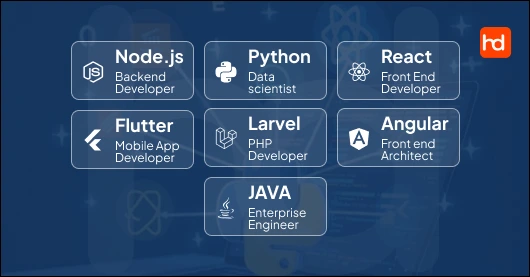 One of the highest-leverage improvements you can make to your hiring process is moving from generic to specific. Instead of searching for “a developer,” search for exactly the type of developer your product needs. This reduces noise, attracts more relevant candidates, and shortens your screening time significantly.
Backend & Core Development
- Node.js Developers — Ideal for real-time applications, REST APIs, microservices architecture
- Python Developers — Strong for data-heavy applications, AI/ML integrations, backend systems
- Java Developers — Enterprise-grade systems, high-throughput backends, Android development
- Laravel Developers — Web applications, CMS platforms, rapid MVP development
Frontend & UI
- React.js Developers — Component-based SPAs, high-interactivity web applications, dashboards
- Angular Developers — Enterprise frontends, complex data-driven applications
Mobile Development
- Flutter Developers — Cross-platform mobile apps (iOS + Android) from a single codebase
Specialized & Emerging
- AI & ChatGPT Integration Developers — LLM-powered features, chatbots, AI automation
- Salesforce Developers — CRM customization, workflow automation, enterprise integrations
- IoT Developers — Connected device systems, embedded software, sensor integration
- Cloud Engineers (AWS, GCP, Azure) — Infrastructure, DevOps, scalable deployment pipelines
Hiring specifically by stack reduces time to hire, improves candidate quality, and ensures the person you bring on has directly relevant experience not just adjacent knowledge.
Understanding Developer Costs in 2026
Developer cost is one of the most discussed and most misunderstood topics in tech hiring. Most businesses either overpay without clear ROI, or hire cheap and pay a larger price in rework, delays, and failed projects.
Here is a grounded view of what developer hiring actually costs in 2026, and how to think about what you’re getting at each level.
| Developer Type | Region | Hourly Rate (USD) | Monthly (Full-Time Est.) |
|---|---|---|---|
| Junior Developer | India / Eastern Europe | $15 – $25 | $2,400 – $4,000 |
| Mid-Level Developer | India / Eastern Europe | $25 – $45 | $4,000 – $7,200 |
| Senior Developer | India / Eastern Europe | $45 – $75 | $7,200 – $12,000 |
| Mid-Level Developer | Latin America | $35 – $55 | $5,600 – $8,800 |
| Senior Developer | US / UK / Australia | $100 – $180 | $16,000 – $28,800 |
| Freelancer (Generic) | Mixed / Variable | $20 – $50 | Unpredictable (per-project) |
Simple Rule: A cheap developer is not a cost-efficient developer. Cost efficiency comes from the ratio of output quality to total spend and that ratio consistently favors the right developer over the cheap one.
When evaluating cost, always factor in: the cost of rework if quality is low, management time if the developer needs constant oversight, time to replace if the hire fails, and opportunity cost if the product is delayed.
Real World Hiring Scenarios: Which Model Wins?
Scenario 1: Startup Building Its First MVP
A SaaS founder needs an MVP built in 12 weeks. Budget is limited but the product architecture needs to be extensible for future scaling. The wrong choice here is a freelancer because the codebase needs to be built for the long term, not just “to work right now.”
The right choice is a dedicated remote developer on a structured trial to full engagement. The slightly higher cost is offset by significantly better architecture, lower rework risk, and a developer who understands your product well enough to support it after launch.
Scenario 2: E-Commerce Business Scaling Features
An established e-commerce business needs continuous feature development across a 12-month roadmap, plus occasional small fixes and design tweaks. A hybrid model works best here: a dedicated remote developer for core product work, with freelancers engaged as needed for one-off peripheral tasks.
Scenario 3: Enterprise Team Scaling Output
A company with an existing engineering team is launching a new product line and needs to increase development velocity by 40–50% for 6 months. Staff augmentation is the right model — adding vetted developers to the existing team structure without disrupting its culture or management layer.
Scenario 4: One-Time Integration or Feature
A business needs a single, well-defined API integration built — no ongoing involvement needed after delivery. A freelancer is appropriate here, provided the deliverable is clearly scoped, quality standards are communicated, and the code is reviewed before acceptance.
The Comparison You Need to See: Hiring Model ROI
| Factor | Freelancer | Dedicated Remote Dev | Agency |
|---|---|---|---|
| Initial Cost | Low | Medium | High |
| Hidden Costs | High | Low | Medium |
| Reliability | Inconsistent | High | Medium |
| Code Quality | Variable | Consistent | Depends on team |
| Scalability | Limited | High | Limited (cost) |
| Ownership Mindset | Low | High | Low |
| Long-Term ROI | Poor to Medium | Strong | Medium |
| Best For | Small tasks | Core product | Full outsourcing |
How to Hire Remote Developers in 3 Days (Yes, Really)
One of the most persistent misconceptions about developer hiring is that it has to take weeks or months. With the right platform and process, it doesn’t. Our guide on how to hire remote software developers in 3 days walks through a compressed, structured hiring process that consistently delivers qualified, ready-to-start developers within 72 hours.
The key is pre-vetting. When you’re working with a platform that has already screened candidates for technical skills, communication quality, and real-world delivery capability, the filtering work that normally takes weeks has already been done. You move directly to role-specific matching and a short trial and you’re working with your new developer before the end of the week.