





Mobile App Development Cost in India 2026: Rates, Timeline & Process




Toptal is very strong at talent access. It is less involved once delivery begins.
Structure helps, but structure alone does not guarantee outcomes.
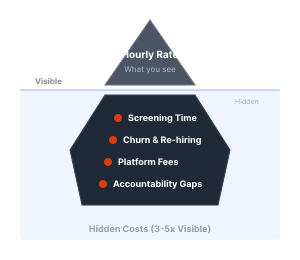
Upwork optimises for choice. Choice comes with overhead.
We are not a marketplace. We are not an algorithm. And we do not stop at matching.
100+ client teams • 150+ engineers • Long-running products

Every engagement has clear delivery ownership from the start. No support maze, no escalation ladder. When something needs attention, it goes directly to the founding team

No marketplace access fees, no intermediaries. Developer cost plus fixed management layer. Transparent rate ranges, clear breakdown before work begins.

Developers aligned to products, not rotated. Average engagement: 16+ months with the same core team. Fewer handovers, steadier delivery.


"We worked with Toptal for around eight months. The engineers were strong, but every few months someone rolled off and we lost context. With HireDeveloper.dev, the same team has stayed with us for over a year, and delivery feels calmer."
— CTO, Series A SaaS company
"Upwork worked when we were early. Once production traffic increased, managing freelancers became a job in itself. We needed stability more than choice."
— Founder, B2B platform
| Toptal | Turing | Upwork | HireDeveloper.dev | |
|---|---|---|---|---|
| Model | Curated platform | Curated platform | Open marketplace | |
| Pricing Clarity | Limited | Moderate | Variable | Transparent |
| Platform Markup | Built-in | Built-in | Built-in | None |
| Accountability | Matching-focused | Shared | Minimal | Founder-involved |
| Continuity | Individual-dependent | Inconsistent | Low | Long-term (avg 16 months) |
| Best For | Specialists | Scale hiring | Short tasks | Serious products |
Most teams do not switch based on promises. They switch after seeing delivery. That is why we start with a short pilot: real work, real timelines, and a clear decision point.
This page is not meant to convince everyone. It is written for teams who have already felt the cost of churn, context loss, and unclear ownership.
Still have questions about Toptal vs Turing vs Upwork vs HireDeveloper? Check out our FAQs to get clear comparisons on talent quality, pricing, vetting processes, engagement models, and which platform might be the best fit for your project needs. If you don’t find what you’re looking for feel free to reach out to us directly we’re happy to help
Turing and Toptal are curated platforms that pair developers with each other. Upwork is a public marketplace for independent contractors. Long-term, committed teams with delivery ownership—not just matching—are offered by HireDeveloper.dev. Context retention, accountability, and continuity are all impacted by the model difference.
HireDeveloper.dev is designed for continuity; on average, employees stay with the same team for more than 16 months. For specialized and short-term requirements, Toptal and Turing are more effective. Upwork works well for task-based work, but because of the frequent turnover of freelancers, it suffers from context loss.
Platform markups and marketplace fees are integrated into Toptal, Turing, and Upwork. HireDeveloper.dev offers clear pricing that includes both development fees and a fixed management layer. No middlemen, no hidden costs, and a detailed breakdown prior to work starting.
With Toptal and Upwork, delivery ownership is entirely yours; they supply access rather than accountability. Turing shares some processes, but not the outcomes. HireDeveloper.dev has founder-level involvement and explicit delivery responsibility from the outset.
Toptal engineers are capable, but they frequently rotate every few months. Teams lose context with each handoff. HireDeveloper.dev retains the same team for 16+ months, resulting in a calmer delivery experience and continual context building rather than reset.
Upwork works well when you need short projects. As production traffic grows, managing freelancers becomes a full time job. Constant screening, re-screening, and turnover cost more than platform costs indicate.
Each freelancer leaves when better opportunities arise. You spend weeks reviewing replacements, re-explaining context, and repairing code from developers who have vanished. Platform fees add up, but context loss costs far more than the evident markup.
Turing matches quickly at scale, but speed favors availability over context richness. Support follows predefined protocols, which can slow down important situations. Delivery ownership remains with you, the platform only grants access, not assurances.
HireDeveloper.dev assigns developers to specific projects for extended periods of time on average, 16 months with the same core team. Toptal and Turing rely on individual availability. Upwork freelancers depart when better opportunities arise. Stability has a direct impact on delivery quality.
Toptal, Turing, and Upwork have built-in costs that increase with each hour. HireDeveloper.dev has no platform markup, just developer costs and a transparent management layer. You pay for delivery rather than access to a marketplace.